-1791966549842.webp)





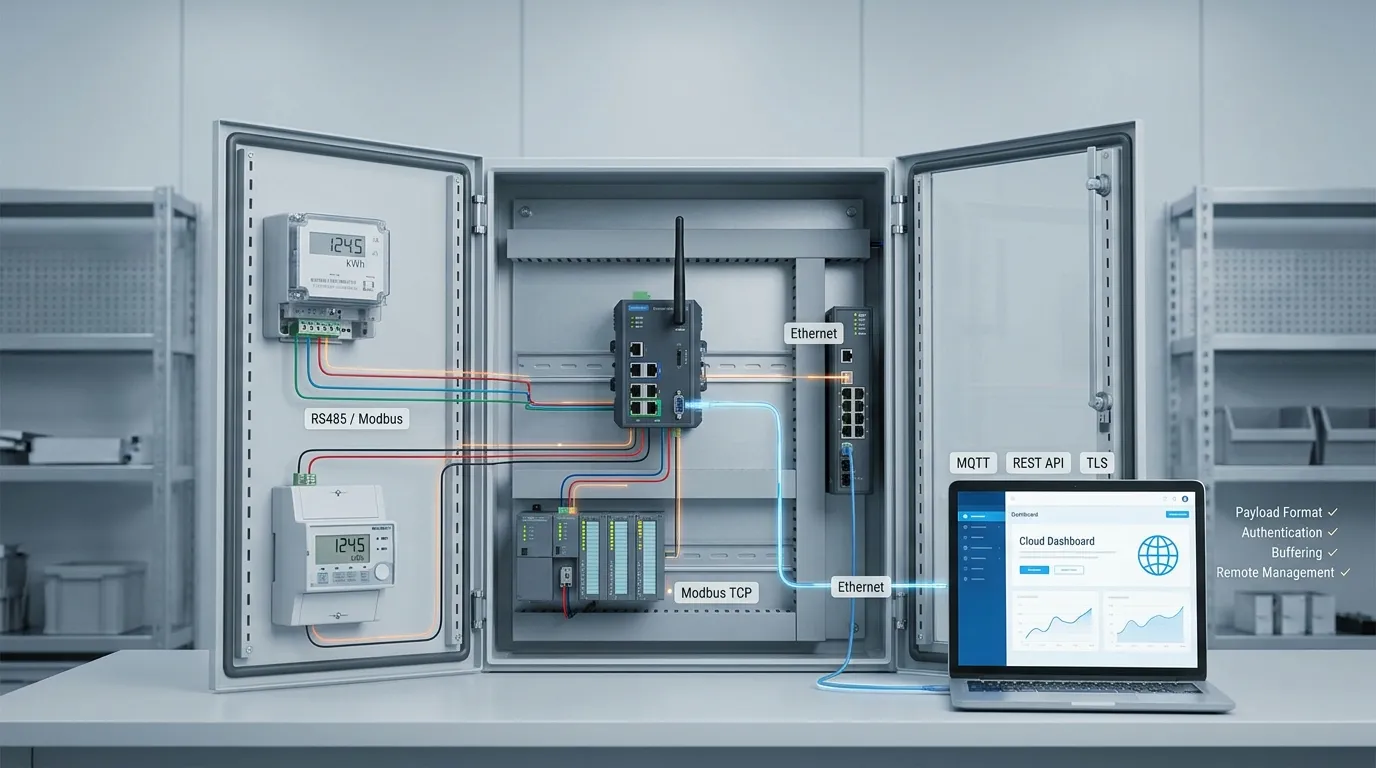

Tespro helps utility teams, industrial IoT integrators, factory automation engineers, smart grid teams, and procurement buyers plan gateway-to-cloud projects. If you need a gateway with MQTT support, REST API access, or cloud integration, the buying decision should start with your field device interface, protocol, payload format, authentication method, buffering needs, network path, and remote management requirements.
This page is a practical checklist for buyers connecting meters, PLCs, sensors, Modbus devices, or industrial equipment to cloud platforms, dashboards, energy management systems, or enterprise software. It is not enough to ask whether a gateway “supports MQTT” or “has an API.” Buyers should confirm how the gateway reads data, transforms it, secures it, stores it during network failure, and sends it to the target platform.
Use this guide before requesting a quotation, datasheet, sample, demo, or integration consultation from Tespro.
When Do You Need an MQTT or REST API Gateway?
An MQTT or REST API gateway is needed when field devices must exchange data with a cloud platform or software system. This often applies to smart metering, AMI/AMR systems, remote monitoring, energy data collection, factory automation, and industrial IoT projects.
The gateway usually sits between field equipment and the platform layer. It may collect data from meters, PLCs, sensors, or controllers through RS485, Ethernet, serial ports, or Modbus. Then it sends structured data to a cloud service through MQTT, REST API, HTTPS, or another integration method.
Buyers should consider this type of gateway when they need to:
- Send meter or equipment data to a dashboard
- Connect Modbus devices to a cloud platform
- Build an energy monitoring or smart grid data workflow
- Share field data with enterprise software
- Support remote diagnostics or device configuration
- Reduce manual data collection from distributed sites
- Keep local SCADA and cloud monitoring connected in one architecture
For real-time or edge processing requirements, buyers can also review Tespro’s guide on edge gateway selection for real-time data.
Does the Project Need MQTT, REST API, or Both?
MQTT and REST API solve different integration problems. A cloud gateway may need one or both, depending on the data flow.
MQTT is usually suitable for continuous telemetry. It works well when devices publish frequent data to a broker. This is useful for meter readings, sensor values, alarms, energy data, and remote monitoring updates.
REST API is often used when a platform or application needs request-response communication. It may be required for configuration, data queries, command delivery, report export, enterprise software integration, or custom platform workflows.
Some projects need both. For example, the gateway may publish live meter data by MQTT while a software platform uses REST API for configuration, device status, or historical data access.
Before choosing a gateway, confirm:
- Will the gateway publish data to an MQTT broker?
- Does the cloud platform require REST API calls?
- Is the API client-side, server-side, or both?
- Is the payload JSON, custom format, or platform-specific?
- Does the project require MQTT topics, QoS, retain settings, or certificates?
- Will local SCADA also need access to the same data?
This decision affects hardware selection, firmware configuration, software integration, and quotation accuracy.
Field-Side Requirements: Devices, Ports, and Protocols
A cloud-ready gateway is only useful if it can read the field device correctly. Buyers should define the device layer before discussing cloud integration.
Common field-side requirements include:
- Meter, PLC, sensor, RTU, controller, or remote I/O type
- RS485, RS232, Ethernet, USB, or other interface
- Modbus RTU, Modbus TCP, DL/T645, serial data, or other protocol
- Register map, data type, scaling rule, and polling interval
- Number of connected devices per gateway
- Cable length, cabinet layout, and grounding conditions
- Whether the gateway must also support local SCADA or HMI access
For Modbus and RS485 projects, the register map is especially important. Without it, the gateway may not know which values to read, how often to poll them, or how to format them for cloud upload.
If your project starts with RS485 or Modbus devices, read Tespro’s related guide on industrial Modbus gateway and RS485 buying requirements.
API-Readiness Checklist for Gateway-to-Cloud Projects
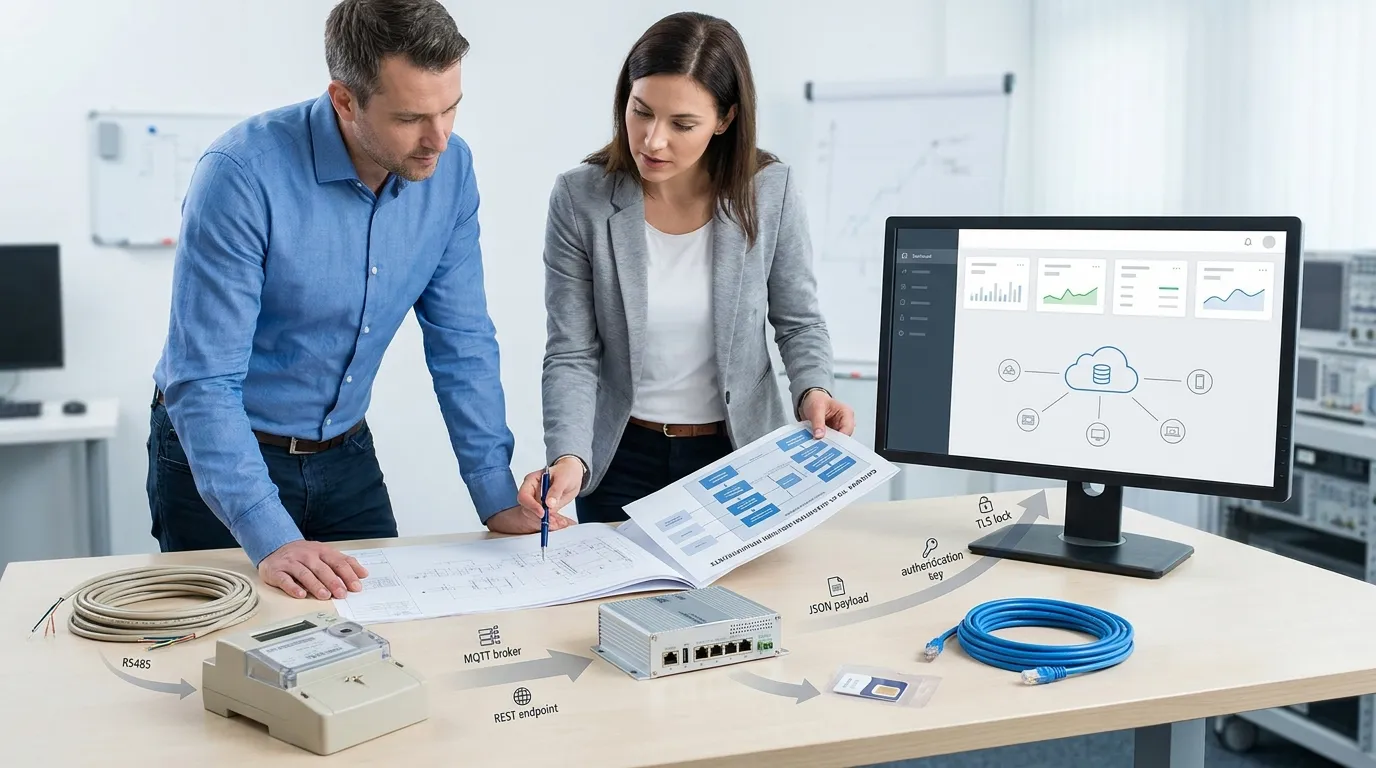
The table below helps buyers prepare technical details before requesting a gateway recommendation or quotation.
| Requirement area | What to confirm | Why it matters | RFQ detail to send Tespro |
|---|---|---|---|
| Field device | Meter, PLC, sensor, controller, or equipment type | Defines interface and protocol needs | Device model, quantity, location |
| Field protocol | Modbus RTU/TCP, serial, Ethernet, or other protocol | Affects data collection method | Protocol, register map, polling interval |
| Interface/ports | RS485, RS232, Ethernet, LAN, cellular, Wi-Fi | Determines gateway hardware configuration | Required ports and connection diagram |
| MQTT setup | Broker address, port, topics, QoS, retain setting | Defines cloud publishing behavior | MQTT broker and topic structure |
| REST API | Endpoint, method, headers, request body | Defines platform communication | API URL, method, authentication details |
| Payload format | JSON, custom format, tag names, units | Affects platform parsing and reporting | Sample payload or expected data format |
| Security | TLS, certificate, token, username/password, VPN | Protects device-to-cloud data | Security and authentication requirements |
| Buffering | Store-and-forward, retry, local logging | Reduces data loss during outages | Offline data behavior and retention needs |
| Network | Ethernet, 4G/LTE, Wi-Fi, APN, static IP, VPN | Affects remote site connectivity | Network type and SIM/APN requirements |
| Management | Remote configuration, diagnostics, updates | Supports maintenance after deployment | Remote access and support expectations |
This checklist also helps separate simple protocol conversion projects from more advanced cloud integration projects.
Cloud, Authentication, and Payload Planning
Cloud integration depends on more than the gateway model. The platform side must be clear before configuration.
For MQTT projects, buyers should prepare the broker address, port, topic naming rule, publish interval, QoS level, authentication method, and TLS requirement. If the platform requires client certificates, token-based login, or a specific payload structure, include those details in the RFQ.
For REST API projects, prepare the endpoint URL, request method, headers, authentication method, JSON body, response behavior, and retry rules. Also confirm whether the gateway will push data to the API or whether another system will request data from the gateway.
Payload planning is often where integration delays happen. The buyer should define:
- Tag names or device IDs
- Timestamp format
- Unit values
- Register scaling
- Alarm or event format
- JSON structure
- Data upload frequency
- Required field names for the cloud platform
If the payload format is not ready, Tespro can still discuss the project. However, the quotation and configuration plan will be more accurate when the buyer provides a sample payload or platform specification.
Security, Buffering, and Remote Management
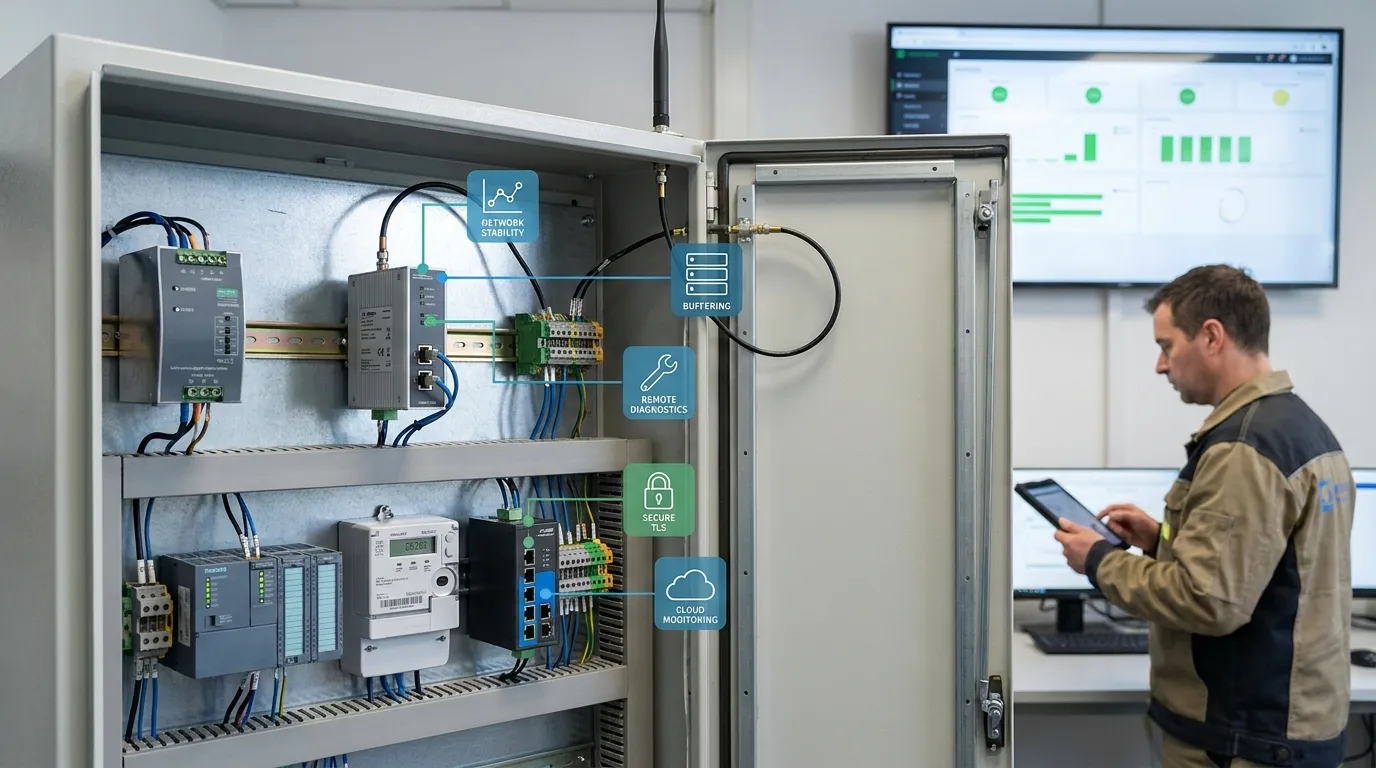
Industrial cloud gateways are often deployed in remote cabinets, substations, factories, utility sites, or unmanned locations. Therefore, security and maintenance features should be part of the buying discussion.
Buyers should confirm whether the project needs:
- TLS or HTTPS communication
- Username/password, token, or certificate authentication
- VPN, APN, or static IP
- Local buffering during network failure
- Retry logic after connection recovery
- Watchdog or automatic reconnect behavior
- Remote configuration
- Firmware update process
- Device logs and diagnostics
- User access control for the platform workflow
Buffering is especially important for energy data, meter reading, and remote monitoring. If a cellular network fails, the gateway should not create avoidable data gaps. The buyer should ask how data is stored, how long it should be retained, and how it is uploaded after reconnection.
Application Fit: Smart Metering, Factory Automation, and Smart Grid
Different projects need different gateway configurations.
In smart metering and AMI/AMR projects, the buyer should focus on meter protocol, read frequency, site count, communication network, data validation, and platform export. For utility protocol planning, see Tespro’s smart grid gateway protocol integration checklist.
In factory automation projects, the gateway may need to connect PLCs, sensors, production equipment, and local control systems to a cloud dashboard or monitoring platform. Buyers should check whether the gateway supports the required field protocol and whether the data flow affects existing SCADA or HMI systems. Related factory integration guidance is available here: factory automation gateway integration checklist.
In remote monitoring projects, network stability, antenna planning, power supply, enclosure, and maintenance access become critical. A technically suitable gateway can still fail in the field if the site network, power, or cabinet design is not planned.
Common Buying Mistakes to Avoid
Many gateway-to-cloud problems come from incomplete requirements, not from the gateway alone.
Avoid these mistakes before ordering:
- Asking for MQTT support without sharing broker details
- Requesting REST API support without an endpoint specification
- Ignoring field protocol and register mapping
- Forgetting TLS, certificates, or authentication requirements
- Assuming all payload formats are supported by default
- Not checking buffering behavior during network outages
- Ignoring SIM, APN, VPN, or static IP needs
- Selecting a gateway without considering cabinet power and installation
- Treating cloud integration as only a hardware purchase
- Not sharing diagrams, software requirements, or platform documents
A good gateway selection process should connect engineering, IT, procurement, and platform teams before final purchase.
What Should You Send Tespro for an RFQ?
To help Tespro recommend a suitable gateway, prepare the following details:
- Product or device type required
- Quantity and deployment scale
- Application: smart metering, factory automation, energy monitoring, smart grid, remote monitoring, or industrial IoT
- Meter, PLC, sensor, or equipment model
- Field protocol and interface requirements
- RS485, RS232, Ethernet, cellular, Wi-Fi, or other port needs
- MQTT broker, topic structure, QoS, and payload format
- REST API endpoint, method, headers, and authentication details
- Cloud platform, dashboard, or software workflow
- SIM, APN, VPN, static IP, or network requirements
- Power supply and installation environment
- Enclosure, DIN rail, antenna, or cabinet constraints
- Security, buffering, and remote management needs
- Datasheet, sample, demo, or OEM/ODM support requirements
- Delivery destination
- Any system diagram, register map, API document, or written specification
The more complete the RFQ, the easier it is to match the gateway, software workflow, and project support.
Why Work With Tespro for Gateway-to-Cloud Projects?
Tespro provides industrial metering, connectivity, and energy data solutions for buyers who need practical device selection and integration support. Our product scope includes optical probes, data transmission units, industrial routers, industrial gateways, meter test equipment, calibrators, and software/platform solutions.
For MQTT, REST API, and cloud gateway projects, Tespro can help buyers discuss the complete data path: field device, interface, protocol, network, security, payload, cloud platform, and remote management. This helps procurement teams avoid vague quotations and helps engineers prepare clearer technical requirements.
Tespro is suitable for buyers who need more than a product name. Our team can review project requirements and support gateway selection for industrial metering, smart grid, remote monitoring, factory automation, and OEM/ODM connectivity projects.
Frequently Asked Questions
Can an industrial gateway support both MQTT and REST API?
Some industrial gateways can support both MQTT and REST API workflows, but support depends on the model, firmware, and configuration. Buyers should confirm whether the gateway works as an MQTT client, REST API client, REST server, or protocol bridge.
When should MQTT be used instead of REST API?
MQTT is usually better for frequent telemetry and publish-subscribe data flow. REST API is useful for request-response communication, software integration, configuration, and enterprise platform workflows. Some projects need both methods.
Can Modbus meter data be converted into cloud payloads?
Yes, this is a common requirement, but the gateway must understand the device protocol and register map. Buyers should provide register addresses, data types, scaling rules, units, polling interval, and the required payload format.
Does a cloud gateway need TLS certificates?
Many cloud platforms require TLS, HTTPS, tokens, usernames, passwords, or client certificates. The exact requirement depends on the MQTT broker, REST API, private cloud, or platform security policy.
What happens if the network connection drops?
Buyers should check whether the gateway supports buffering, retry logic, local logging, and store-and-forward behavior. These features help reduce data loss when cellular, Ethernet, or Wi-Fi connections are unstable.
Can one gateway send data to cloud and local SCADA?
Some gateway architectures can support both local and cloud data paths. Buyers should confirm protocol mode, polling rules, server/client behavior, and whether the existing SCADA system will be affected.
Request a Gateway Recommendation, Datasheet, Sample, Demo, or Quote
Share your gateway-to-cloud project requirements with Tespro for technical review. Send your device type, quantity, application, meter or PLC model, protocol, interface, MQTT broker details, REST API requirements, cloud platform, payload format, security needs, network type, SIM/APN/VPN/static IP requirements, power supply, installation environment, enclosure constraints, remote management needs, delivery destination, and any system diagram or written specification.
Tespro can help you review the project data flow and recommend suitable industrial gateway, connectivity, and platform support options for your quotation, datasheet request, sample request, demo, consultation, or OEM/ODM project.