-1791966549842.webp)





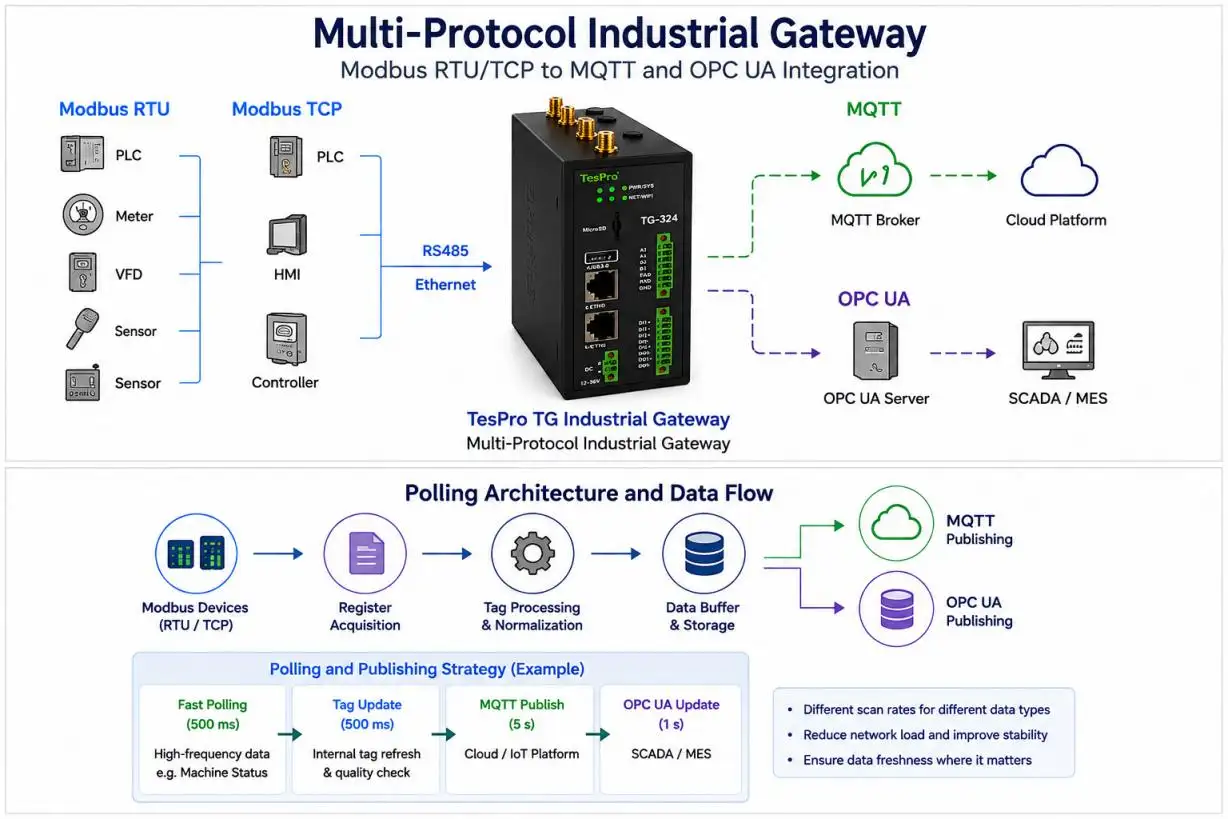

A Multi-Protocol Industrial Gateway is often introduced when legacy Modbus devices must exchange data with MQTT cloud platforms, OPC UA-based SCADA systems, or MES applications. The real engineering challenge, however, is not simply converting protocol packets. It is converting raw field registers into structured, correctly timed and usable industrial data.
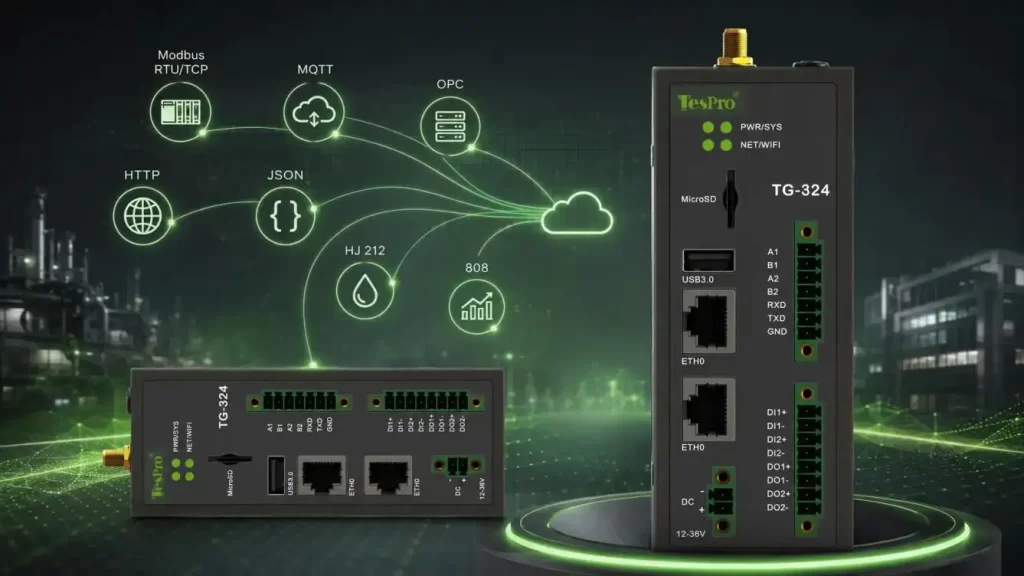
For a typical brownfield project, the data path is:
Modbus RTU/TCP Device → Register Acquisition → Tag Mapping → MQTT / OPC UA → Cloud, SCADA or MES
Tespro approaches this requirement through its TG industrial gateway family and TC-100 protocol converter. The correct platform depends on device quantity, register structure, polling load, northbound protocol and required data-processing functions. Protocol availability, drivers and mapping methods should always be confirmed against the selected model and firmware.
Why Modbus-to-MQTT/OPC UA Integration Is More Than Protocol Conversion
A Modbus meter may return 253 from a holding register, but neither an MQTT platform nor an OPC UA client automatically knows that the value means 25.3°C.
A Multi-Protocol Industrial Gateway must interpret the register before publishing it.
| Data Layer | Example |
| Modbus source | Slave 3, Holding Register 40101 |
| Raw register | 253 |
| Data type | INT16 |
| Scale | ×0.1 |
| Internal tag | Motor01.Temperature |
| Engineering value | 25.3°C |
| MQTT mapping | factory/line1/motor01/status |
| OPC UA mapping | Line1/Motor01/Temperature |
For every point, engineers should define:
•Slave/Unit ID and function code
•Register address and register length
•INT16, UINT32, FLOAT32 or required datatype
•Byte order and word order
•Multiplier, offset and engineering unit
•Read/write permission
•Polling interval, timeout and retry behavior
An address mismatch, incorrect word swap or missing scale factor can create valid communication but completely incorrect process data.
Modbus RTU vs. Modbus TCP: Start With the Field Network
A Multi-Protocol Industrial Gateway may collect both serial and Ethernet Modbus devices, but the two architectures have different performance constraints.
| Factor | Modbus RTU | Modbus TCP |
| Interface | RS485 | Ethernet |
| Device identification | Slave ID | IP + Unit ID |
| Main bottleneck | Baud rate / bus utilization | Connections / network traffic |
| Common equipment | Meters, VFDs, legacy PLCs | Ethernet PLCs, controllers |
| Installation risk | Wiring, termination, grounding | IP, routing, firewall |
With Modbus RTU, baud rate, response time and the number of slaves determine how quickly the complete bus can be scanned. Modbus TCP removes the serial baud-rate limitation but introduces connection count, network latency and device-processing constraints.
For mixed installations, check whether the selected Tespro TG configuration can operate the required RTU and TCP acquisition tasks concurrently rather than assuming all product variants behave identically.
Build an Internal Tag Layer Before Publishing Data
For larger systems, direct Register-to-MQTT mapping becomes difficult to maintain. A better architecture is:
Register → Normalized Tag → Northbound Protocol
The internal tag can contain:
•Tag name
•Engineering value
•Timestamp
•Unit
•Quality/status
•Device identifier
The same Motor01.Temperature tag can then feed an MQTT cloud platform and an OPC UA system without duplicating the Modbus acquisition definition.
This architecture is especially useful when a Multi-Protocol Industrial Gateway connects dozens of devices to multiple upper-level systems.
MQTT vs. OPC UA: Match the Protocol to the Data Consumer
MQTT and OPC UA should not be treated as interchangeable features.
| Dimension | MQTT | OPC UA |
| Architecture | Broker-based Pub/Sub | Client–Server or PubSub |
| Common destination | Cloud / IoT platform | SCADA / MES / OT applications |
| Data structure | Topic + payload | AddressSpace + Nodes |
| Semantics | Defined by payload schema | Structured information model |
| Key settings | Broker, topic, QoS, payload | Endpoint, namespace, nodes, certificates |
MQTT for Cloud Data
A Multi-Protocol Industrial Gateway publishing Modbus data through MQTT may need to format records such as:
device_id + timestamp + tag + value + unit + quality
MQTT does not require JSON, so buyers should verify:
•MQTT protocol version
•Supported QoS levels
•Topic customization
•Payload format
•TLS/authentication
•Reconnect behavior
•Offline buffering
These capabilities should be confirmed by model and firmware.
OPC UA for Industrial Applications
For OPC UA, simply specifying "OPC UA supported" is insufficient.
Confirm whether the gateway operates as:
•OPC UA Server
•OPC UA Client
•Publisher/Subscriber
•Or a defined combination
Also verify node capacity, namespace configuration, update behavior and certificate management.
The TC-100 can be considered for focused protocol-conversion requirements, while a Tespro TG Multi-Protocol Industrial Gateway is more appropriate when the project also requires multi-device collection, data modeling or broader edge-to-platform integration.
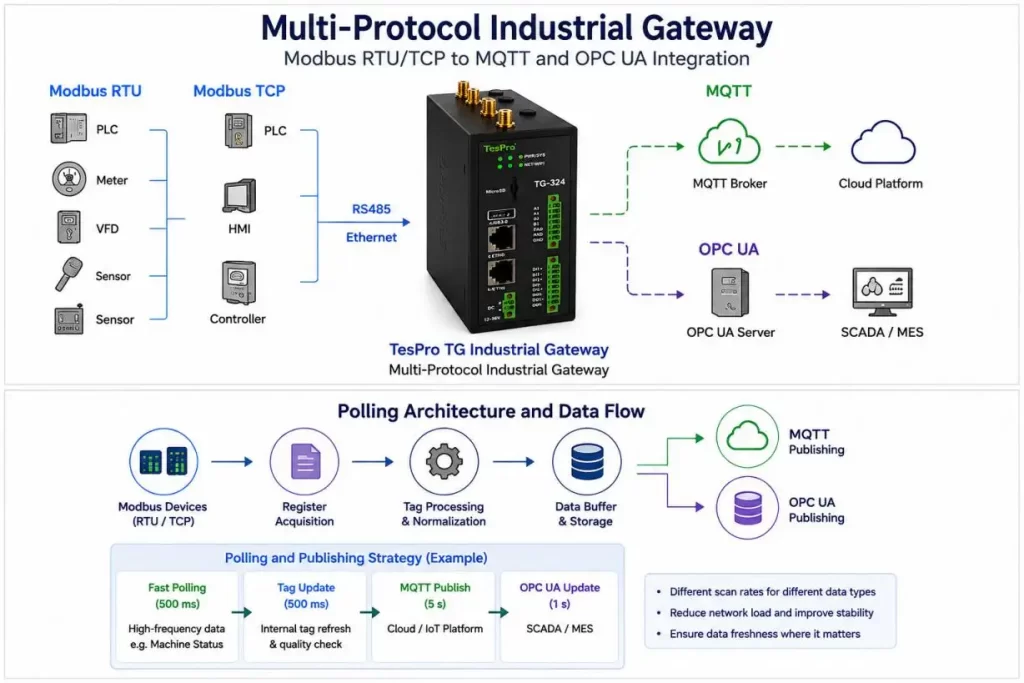
Polling Architecture Determines Real Gateway Capacity
Maximum device count alone says little about performance.
The practical workload is closer to:
Devices × Register Requests × Polling Frequency = Acquisition Load
Consider 50 Modbus slaves with 20 separately requested register blocks. At a one-second scan target, the gateway may need to complete roughly 1,000 transactions per cycle before timeout and retry traffic are considered.
Three design methods help control this load.
1. Group Continuous Registers
Generally, it's more efficient to read registers 40001-40010 together in one block than it is to make individual requests for each address.
2. Separate Polling From Publishing
For example:
•Modbus acquisition: 500 ms
•Internal tag update: 500 ms
•MQTT publishing: 5 s
Cloud transmission does not need to occur after every field poll.
3. Use Multi-Rate Scanning
Fast-changing machine status can be collected more frequently than:
•Temperature
•Energy totals
•Runtime counters
•Maintenance data
This reduces RS485 loading, PLC requests, CPU processing and northbound traffic.
Match Hardware to the Complete Protocol Workload
Before selecting a Multi-Protocol Industrial Gateway, evaluate more than port quantity.
Key sizing inputs include:
•Number of RS485 buses
•Modbus slave count
•Modbus TCP device count
•Total register/tag quantity
•Required polling cycles
•MQTT publishing frequency
•MQTT payload size
•OPC UA role and node count
•Simultaneous MQTT/OPC UA operation
•Offline storage requirements
•Ethernet or cellular uplink
•Environmental and power requirements
Tespro's TG industrial gateway portfolio provides industrial serial and Ethernet connectivity across different configurations. The exact interface combination, cellular capability, protocol drivers and processing functions should be checked against the specific TG model.
Installation Errors Can Look Like Protocol Problems
Before commissioning, verify:
•RS485 A/B polarity
•Termination and grounding
•Duplicate slave IDs
•Baud rate, parity and stop bits
•Register offsets
•Float byte/word order
•Ethernet addressing and routing
•MQTT broker credentials
•OPC UA endpoint and certificates
•Configuration and register-map backups
A technically correct Multi-Protocol Industrial Gateway cannot compensate for an incorrect register table or unstable field bus.
Select the Gateway From the Data Flow Backward
A reliable procurement sequence is:
Device List → Register Map → Polling Cycle → Tag Model → MQTT/OPC UA Architecture → Security → Hardware → Firmware Verification
For projects connecting legacy Modbus equipment with modern cloud, SCADA or MES systems, Tespro can evaluate whether a TG Multi-Protocol Industrial Gateway or TC-100 protocol converter better fits the required architecture. Providing actual device counts, register maps, polling requirements, MQTT payload expectations and OPC UA roles before selection helps avoid both under-sizing and unnecessary gateway complexity.
FAQs
Q1. How should the polling cycle be selected?
The correct polling cycle depends on factors such as the number of devices, register blocks, baud rate, response time, timeout settings, and required data freshness. Rapid polling is not effective on overloaded RS485 networks.
Q2. Can Tespro gateways convert Modbus RTU to MQTT?
Selected Tespro TG industrial gateways can be evaluated for Modbus-to-MQTT integration. MQTT version, TLS/non-TLS mode, topic structure, payload format and authentication must be confirmed by model and firmware.
Q3. Can a Tespro Multi-Protocol Industrial Gateway interface Modbus and OPC UA?
Tespro gateways and conversion products can be used for the Modbus to OPC UA integration. The OPC UA role (Server, Client, Publisher, Subscriber) must be established prior to selection of the Modbus to OPC UA conversion device.
Q4. How does Tespro handle Modbus register mapping?
A standard configuration includes determining Slave ID, function code, register address, datatype, byte order, scaling, polling cycle, and the destination tag. Mapping methods and configuration tools available in Tespro products must be confirmed.
Q5. Can one Tespro gateway combine Modbus RTU and Modbus TCP devices?
Selected Tespro TG gateway configurations provide both serial and Ethernet interfaces, enabling RTU/TCP architectures when the required drivers and performance are supported.