-1791966549842.webp)





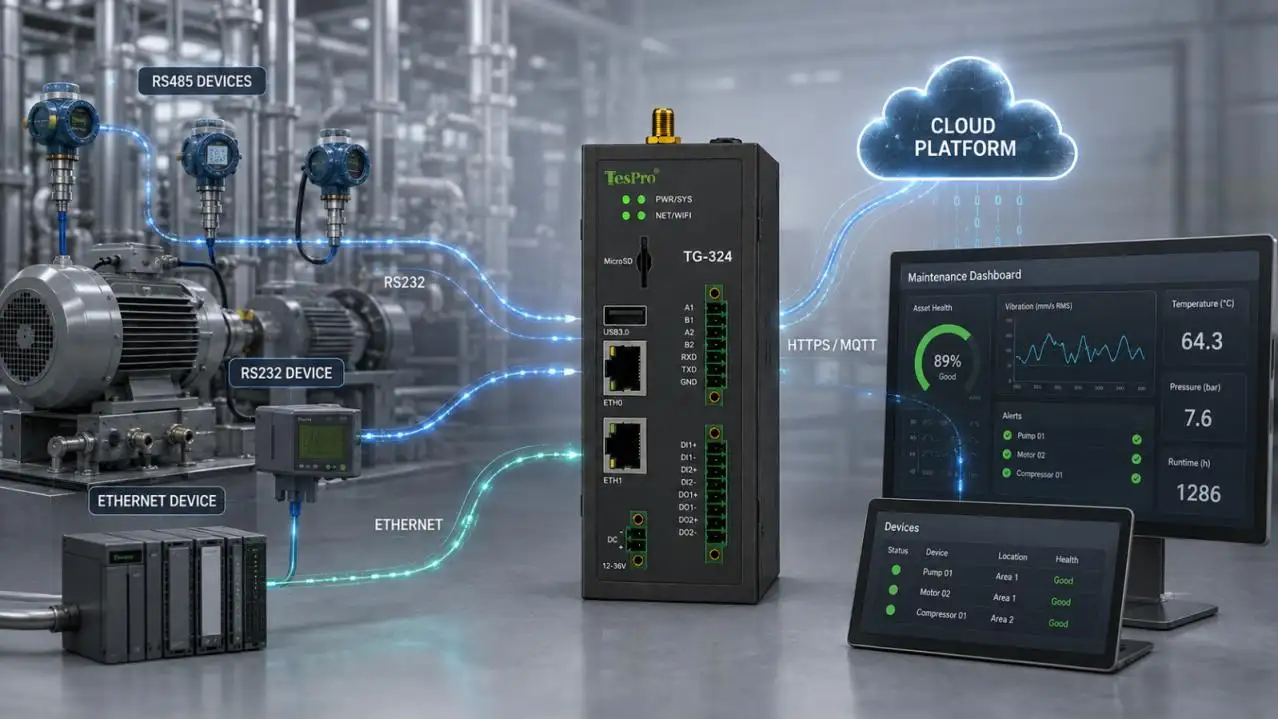

An Industrial Edge Gateway for Condition Monitoring is not a predictive-maintenance algorithm. Its primary role is to build a reliable data path between machines and monitoring platforms: acquiring equipment condition data, normalizing different protocols, filtering unnecessary values, executing threshold rules, buffering data during network interruptions, and forwarding structured information upstream.
For motors, pumps, compressors, production machines, and remote equipment, this data may include vibration indicators, bearing temperature, motor current, pressure, rotational speed, energy consumption, and machine operating state.
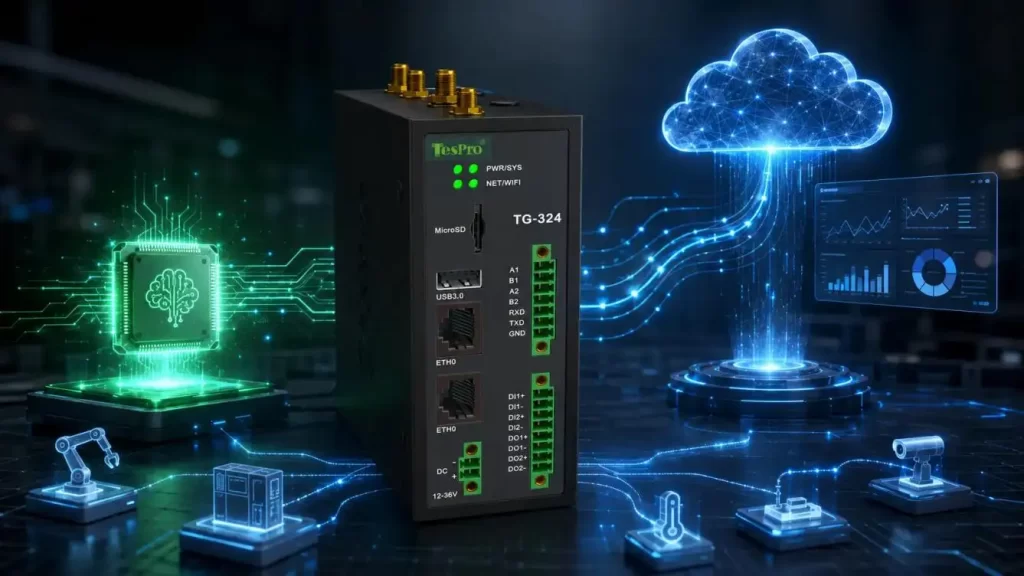
Tespro's TG industrial gateway portfolio is designed around this machine-to-platform data path, combining industrial interfaces, protocol conversion, edge processing, cellular or Ethernet communication, and remote management for industrial data collection applications.
Start With the Condition Data, Not the Gateway Specification
Before selecting an Industrial Edge Gateway for Condition Monitoring, determine where the required measurement already exists.
Typical architectures include:
| Condition Data | Typical Source | Gateway Function |
| Bearing temperature | PLC / sensor | Poll, normalize, upload |
| Vibration RMS | Smart vibration sensor | Collect and trend |
| Motor current | PLC / power meter | Aggregate and report |
| Pressure | Transmitter / PLC | Poll and threshold |
| Machine speed | PLC / sensor | Add operating context |
| Raw vibration waveform | DAQ / vibration analyzer | High-volume data transfer |
This distinction matters because sensor sampling rate and gateway polling rate are not the same parameter.
A smart vibration sensor, for example, may sample internally at high frequency and calculate RMS, peak, or other condition indicators. The Industrial Edge Gateway may only read those values once every second or several seconds through Modbus.
Therefore:
1-second Modbus polling does not mean 1 Hz vibration sampling.
If a project requires raw waveform acquisition, FFT, envelope analysis, or bearing-frequency diagnostics, sampling frequency, analog bandwidth, ADC resolution, anti-aliasing, and local processing capability must be verified separately. A standard industrial gateway should not automatically be treated as a vibration analyzer.
Use Edge Processing to Control Data Volume
Condition monitoring systems can generate large quantities of repetitive data. Uploading every unchanged value increases cellular traffic, broker messages, database writes, and cloud storage without necessarily improving maintenance decisions.
A more efficient Industrial Edge Gateway for Condition Monitoring architecture follows:
Acquire → Parse → Filter → Aggregate → Evaluate → Buffer → Upload
Useful edge operations include:
•Deadband filtering: Essentially ignore changes in values unless these changes exceed some threshold.
•Time-window aggregation: Typically used for computing averages, minimums, or maximums.
•Invalid-value filtering: Employed to alert on either communication errors or invalid sensor values.
•Threshold rules: Essentially used to latch an event when a parameter passes some specified value.
•Local caching: Retain some of the data on the edge when the connection to the WAN is unavailable.
•Event reporting: Used to prioritize alarms.
Tespro's TG gateway products cover industrial data acquisition, edge processing, and communication to northbound platforms.
Build Better Threshold Alarms
A basic rule such as:
Bearing Temperature > 80°C → Alarm
Is often insufficient.
If the value repeatedly moves between 79.8°C and 80.2°C, the system may generate excessive alarm switching.
A more useful edge rule considers:
Threshold + Hysteresis + Persistence Time + Equipment State
For example, an alarm can require the temperature to remain above the threshold for a defined period and only apply while the motor is running.
This is practical condition monitoring logic. It should not be described as automatic failure prediction.
Match Protocols to Both Sides of the Gateway
An Industrial Edge Gateway for Condition Monitoring normally connects two different communication layers.
Southbound Equipment Connectivity
Common requirements include:
•RS485 / Modbus RTU
•Ethernet / Modbus TCP
•RS232 legacy devices
•PLC and industrial meter communication
Tespro TG gateway configurations provide RS232, RS485, and Ethernet interfaces across the portfolio, allowing existing field devices to be connected without redesigning the machine control architecture.
Northbound Platform Connectivity
The gateway may then send normalized data using:
•MQTT
•HTTPS
•Ethernet
•4G/5G cellular communication
MQTT is particularly useful when condition data must be published efficiently to an IoT or cloud platform. Protocol selection, however, should follow the target SCADA, MES, cloud, or maintenance system rather than simply maximizing the number of supported protocols.
Calculate Gateway Load From Polling Requirements
A common procurement mistake is evaluating only the maximum number of devices or tags.
Actual gateway load depends on:
Devices × Tags × Polling Frequency × Protocol Overhead
Consider two systems:
| Project | Data Load |
| 100 tags every 10 s | Moderate |
| 1,000 tags every 100 ms | Very high |
Even when both fall within an advertised tag capacity, CPU load, serial-bus utilization, network traffic, and storage requirements can differ substantially.
For RS485 networks, buyers should also consider:
•Baud rate;
•Number of slave devices;
•Register grouping;
•Response latency;
•Timeout and retry settings;
•Polling schedule.
These factors determine whether the required update interval is realistic.
Size Local Storage for Network Interruptions
For remote equipment, network availability should never be assumed.
An Industrial Edge Gateway for Condition Monitoring should therefore be evaluated for local buffering and recovery behavior.
A practical sizing relationship is:
Required Buffer ≈ Daily Data Volume × Maximum Expected Offline Period
Buyers should verify:
•How long data can be stored;
•Whether timestamps are preserved;
•How data is uploaded after reconnection;
•Whether duplicate records can occur;
•What happens when storage becomes full.
Tespro gateway solutions include data caching and resumed transmission functions for applications where continuous WAN connectivity cannot be guaranteed.
Preserve Context, Not Just Numerical Values
A condition-monitoring platform needs more than a register value such as:
40001 = 4.37
A useful record should contain:
•Asset ID;
•Sensor or tag ID;
•Measurement type;
•Engineering unit;
•Timestamp;
•Operating state;
•Alarm status;
•Data-quality information where available.
This context is essential when comparing equipment trends over weeks or months and provides a stronger data foundation for downstream maintenance analytics.
Verify Industrial Installation Requirements
An Industrial Edge Gateway for Condition Monitoring may operate beside motors, variable-frequency drives, switching equipment, and other electrical noise sources.
The RFQ should therefore evaluate more than protocols:
| Parameter | Why It Matters |
| Operating temperature | Cabinet and outdoor thermal conditions |
| DC input range | Industrial power variation |
| EMC performance | Immunity near motors and drives |
| Watchdog/recovery | Unattended operation |
| Local storage | Network outage protection |
| Cellular/Ethernet | Site communication architecture |
| Remote management | Multi-site maintenance |
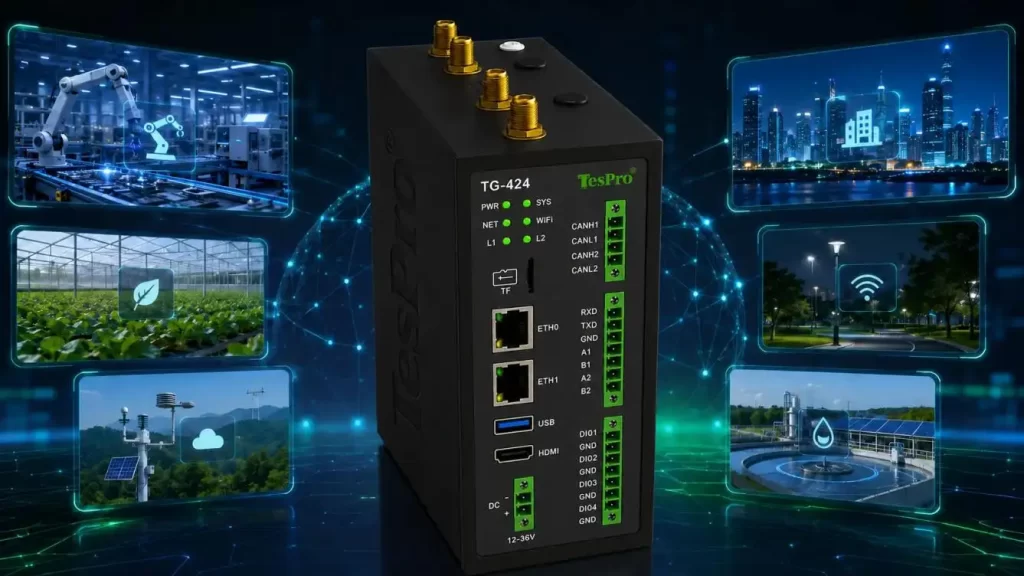
Tespro offers TG gateway configurations with industrial serial and Ethernet interfaces, 4G/5G options depending on model, and wide-temperature versions for industrial deployment. Exact requirements should always be matched against the selected TG model.
Turn the Data Architecture Into the Gateway RFQ
The most reliable selection sequence is:
Machine → Condition Signal → Interface → Protocol → Polling Rate → Edge Rule → Buffer → Network → Platform
An Industrial Edge Gateway for Condition Monitoring should be selected against this complete data path rather than by CPU, protocol count, or an "AI gateway" label alone.
Tespro develops TG industrial gateways for industrial data acquisition, protocol conversion, edge processing, and platform connectivity. For a new condition-monitoring project, provide the equipment list, required tags, polling intervals, communication protocols, alarm logic, offline retention period, and target platform. Tespro can then match the TG gateway configuration to the actual monitoring architecture while leaving advanced fault prediction to the appropriate downstream analytics or diagnostic system.
FAQs
Q1. Are Tespro TG Gateways capable of creating condition-monitoring alarms?
According to the documents, alarm handling and edge-side alarm judgment are listed as Gateway functions. In a condition-monitoring project, threshold logic can be applied to process indications of temperature, pressure, current, and processed vibration. The rule-engine capability must be confirmed for the selected TG model.
Q2. Are Tespro TG Gateways able to capture data from existing PLCs and sensors?
Yes. The documents describe the collection of data using RS485/RS232 and Ethernet interfaces on Tespro's industrial gateways. Modbus is a typical communication interface used for PLCs, meters, sensors, and other industrial devices.
Q3. Does Tespro support Modbus RTU and Modbus TCP?
The documents for Tespro's industrial gateways show support for Modbus RTU/TCP. This integration capability allows the design of a monitoring system where the selected gateway supports the required interfaces and integrates serial Modbus devices and Ethernet equipment.
Q4. Is it possible for a Tespro gateway to convert Modbus equipment data to MQTT?
Yes. Modbus-to-MQTT conversion is specifically mentioned in the documents for Tespro's industrial gateways as an application of industrial gateways. The gateway can poll Modbus data and convert the data to an upstream friendly format and publish it via MQTT.
Q5. What edge processing is Tespro capable of?
Tespro considers gateway edge computing as the processing of data close to field equipment. Typical tasks done at the edge consist of protocol data unit interpretation, anomalous value filtering, data summation, alarm determination, data buffer storage, and simple local decision making on the data prior to it being sent.