-1791966549842.webp)






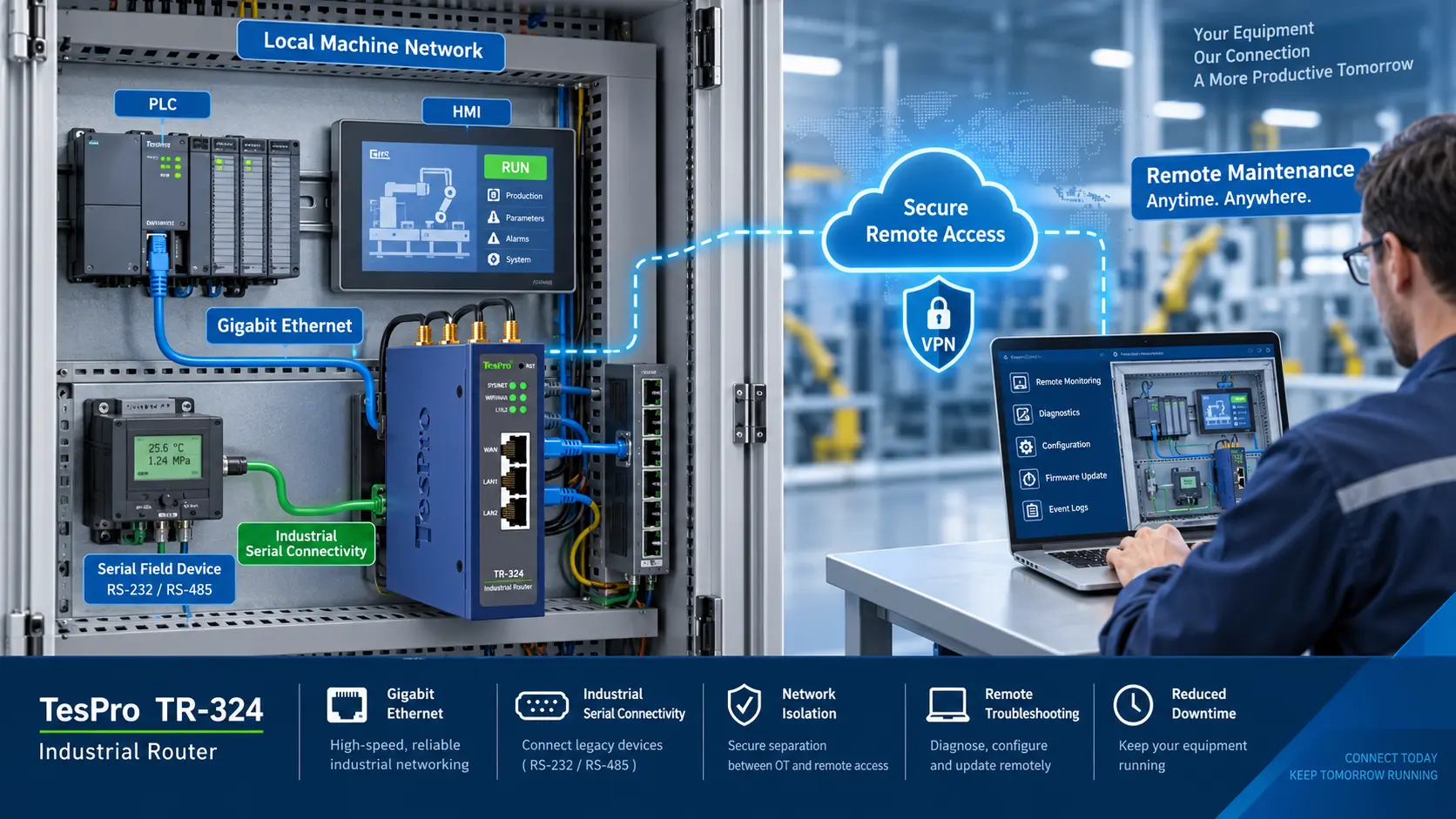
Remote PLC maintenance should not depend on exposing PLC ports directly to the public Internet. The current TR-424 page lists OpenVPN, WireGuard, IPsec and other VPN options together with dual SIM/eSIM switching, link monitoring, watchdog recovery, FOTA and cloud-based bulk updates. This combination addresses both secure access and recovery at unattended sites.
Key Points
- VPN secures the access path; dual SIM provides link redundancy. They solve different problems.
- VPN and engineering-software reconnection must be tested after link switching.
- TesproOS remote logs, configuration and batch upgrades can reduce some on-site maintenance.
Build a controlled remote-access architecture
A common design is for the router to initiate a tunnel to an enterprise VPN endpoint or controlled remote-access service, then restrict reachability with firewall rules, VLANs, certificates and individual accounts. The TR-424 page also lists 802.1X, RADIUS, TACACS+, certificate management and attack-protection functions.
Dual SIM does not mean zero interruption
Dual SIM can improve availability when a carrier or SIM fails, but cellular registration, IP changes and VPN reconstruction still take time. Test failover duration, tunnel recovery, PLC engineering-software reconnection and application timeouts.
Remote O&M turns maintenance into a repeatable process
TR-424 supports Web UI, CLI, SSH, JSON-RPC, TesproOS, FOTA, logs and bulk firmware/configuration updates. For larger fleets, standardized configuration and diagnostics can matter more to lifetime cost than peak throughput.
Recommended data path: engineer to VPN, then to the field device
A safer maintenance path is typically engineering workstation → enterprise VPN or controlled remote-access service → TR-424 → specific PLC/HMI subnet, rather than exposing PLC services directly to the public Internet. Limit reachability to only the required subnets, ports and accounts. For multiple customers or projects, separate certificates, credentials or device groups to reduce lateral-access risk.
Link redundancy and cybersecurity solve two different problems
A dual-SIM test should measure carrier loss, SIM switching, cellular re-registration and IP change. A VPN test should measure tunnel rebuild, session recovery, certificate validity and central-end availability. Testing them separately reveals whether the slowest recovery step is cellular, tunnel reconstruction or the PLC engineering tool itself.
Applications and Technical Boundaries
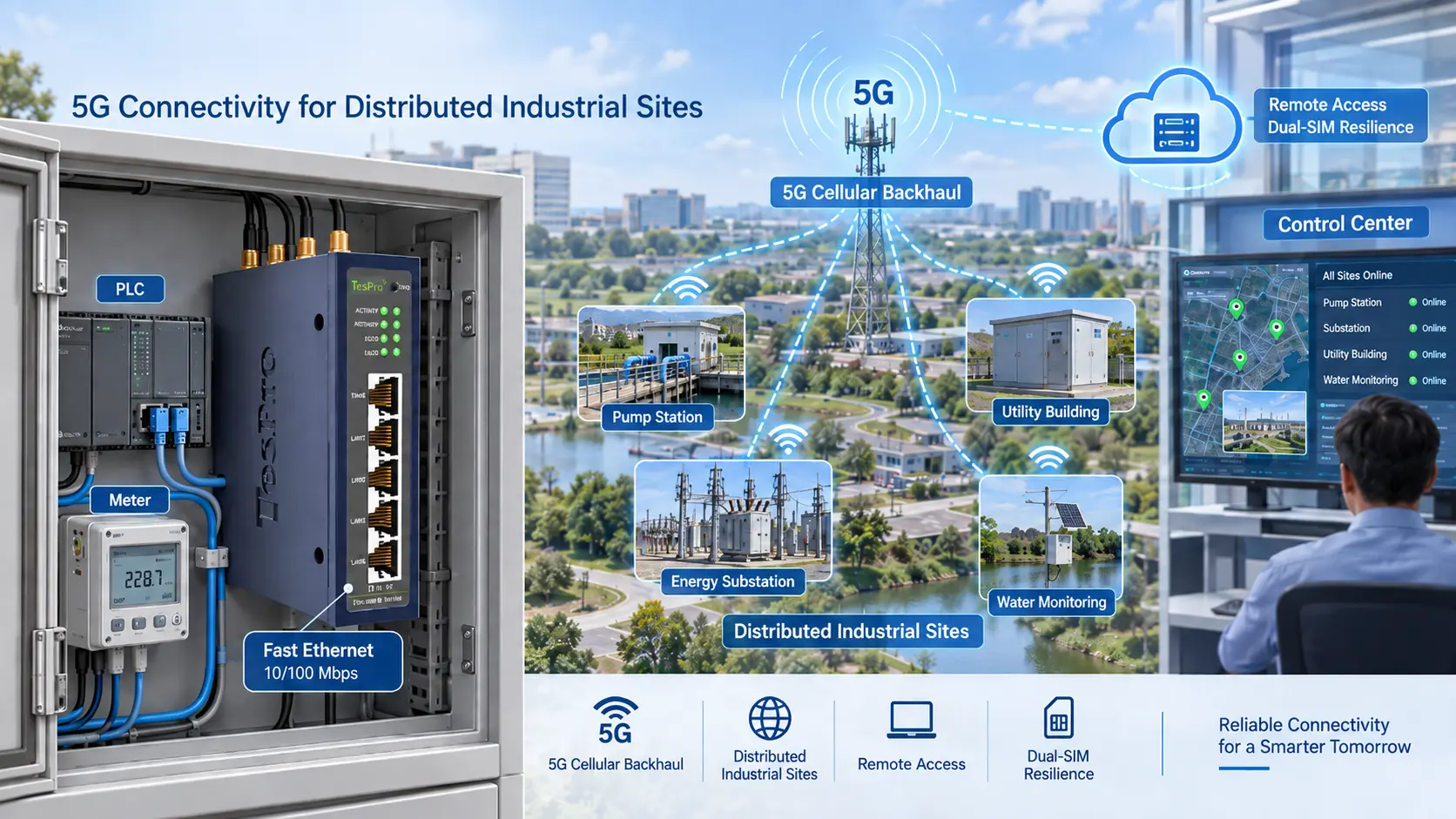
Good fit for a TR-424 remote-maintenance architecture: Unattended PLC/HMI sites, remote after-sales support for equipment builders, distributed pump/energy sites and projects that need dual SIM plus centralized O&M.
Scenarios that need an additional security layer: Critical infrastructure, multiple external maintenance parties or strict compliance should combine router VPN functions with enterprise identity, jump hosts, audit and least-privilege policy rather than relying on the router alone.
TR-424 brings remote access and remote operations into the same security framework
TR-424 places VPN, dual SIM, link monitoring and TesproOS remote operations in the same device layer. Its value is not exposing a PLC directly to the public Internet; it is creating a controlled remote-access boundary that can also recover and be diagnosed when the cellular path changes.
Frequently Asked Questions
Q: Which VPN technologies are listed for TR-424?
A: The current page lists OpenVPN, WireGuard, IPsec, PPTP, L2TP, GRE, DMVPN and other tunneling functions. Confirm the exact firmware and enterprise-security requirement for the project.
Q: Will the VPN automatically recover after dual-SIM switching?
A: The router provides link monitoring and switching, but recovery time depends on the network, VPN type and server design. It should be validated on the target carrier.
Q: Can TesproOS eliminate all field maintenance?
A: No. Remote configuration, logs and upgrades can reduce site visits, but power, antennas, cabling, hardware faults and safe field procedures still require a maintenance process.
Q: Can I use simple port forwarding to reach a PLC remotely?
A: Some networks technically allow it, but exposing PLC services directly to the public Internet is generally a poor security design. Prefer a controlled VPN or remote-access platform and restrict source, destination and credentials.