-1791966549842.webp)





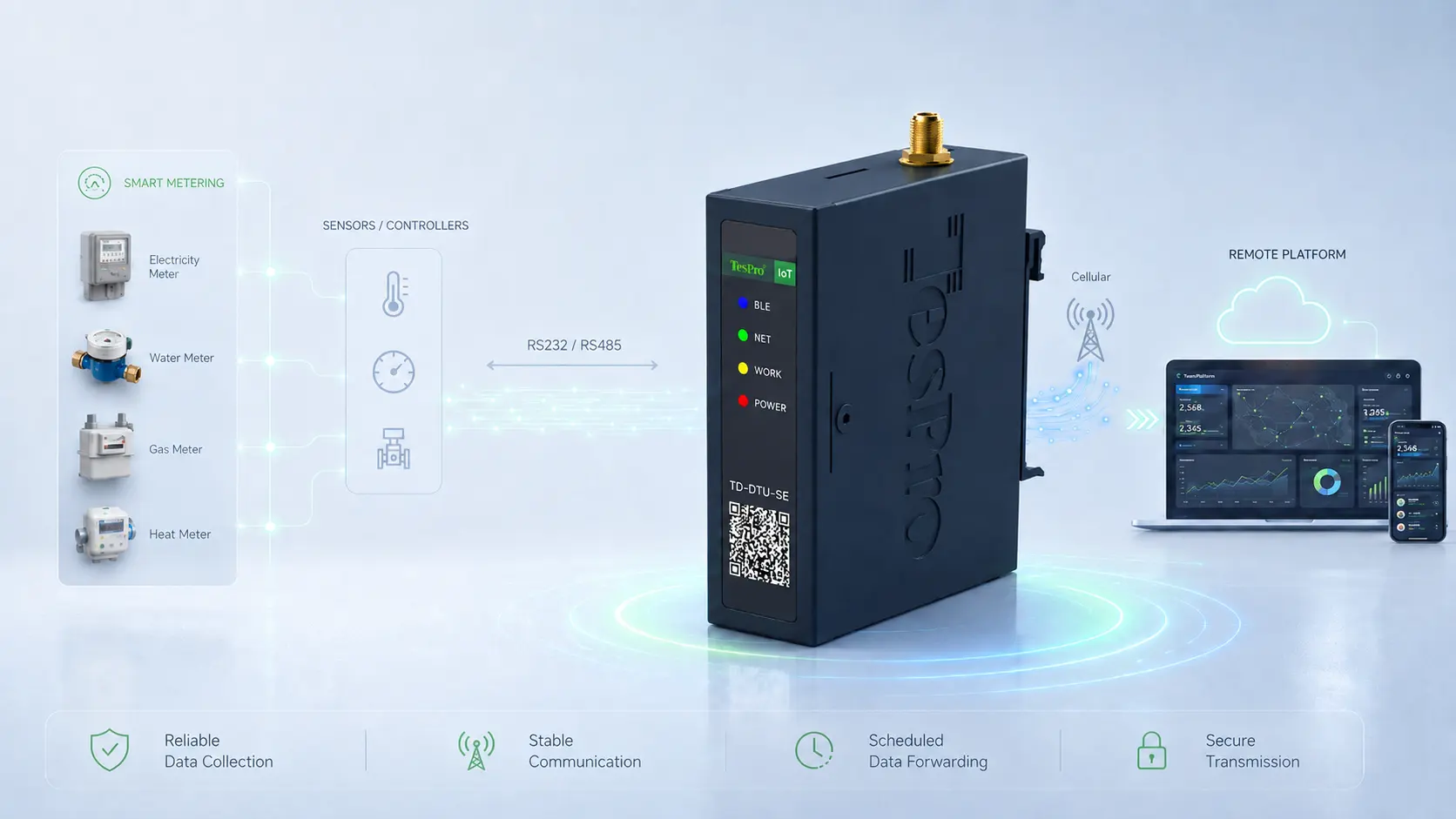

A DTU is best when the main task is carrying serial data reliably to a remote system. An industrial gateway is better when data must be parsed, converted or processed locally. Tespro positions TD-DTU devices for automatic meter-reading transmission, while TG gateways add multi-protocol integration and edge processing.
Key Points
- If the server already parses the meter protocol, a DTU is simpler.
- Multiple protocols, serial networks, local buffering and tag mapping favor a TG gateway.
- Do not confuse “transport over MQTT” with “parse Modbus and map it into MQTT data.”
DTUs fit transparent or lightweight transport
TD-DTU devices center on RS232/RS485, cellular networking, TCP/UDP/MQTT and heartbeat/reconnection. Existing meters or controllers can reach a remote server without changing their application protocol.
Gateways fit data-layer work
TG-100/325/424 can poll devices, parse tags, convert protocols and run local logic. At multi-meter or multi-protocol sites, a gateway can reduce server-side integration complexity.
Compare total system cost, not only device price
A DTU is simpler, but if the server needs extensive custom parsing, the site contains several protocols or point maps change frequently, a gateway can reduce backend development and maintenance.
Ask “who parses the data?” to separate DTU from gateway quickly
If the remote server already has mature meter-protocol parsing, the field device only needs to transport serial frames reliably and a DTU is simpler. If the field should turn registers/objects into structured points before publishing MQTT/OPC UA/HTTP, a gateway is the more natural tool. This question is often more useful than comparing CPU or price.
Then evaluate site complexity and offline requirements
One RS485 bus, few devices and low traffic usually favor a DTU. Multiple buses/protocols, high point count, local buffering/rules or richer exception handling favor a gateway. If there is no external power, TD-DTU-PLUS battery operation becomes a separate selection factor.
Applications and Technical Boundaries
Choose a DTU first: The server parses data, the site is mainly RS232/RS485, traffic is modest and the goal is quick connectivity for an existing device.
Choose a TG gateway first: The field must parse multiple protocols, normalize points, buffer/replay, run rules or feed several upper-level systems.
Tespro uses TD-DTU and TG to separate transport from data-layer processing
Tespro TD-DTU and TG products represent two distinct technical ideas. A TD-DTU focuses on reliably carrying serial data to a remote server, while a TG gateway additionally parses protocols, models points, buffers data and runs rules. Separating transport from data-layer processing makes remote-metering architectures easier to understand and maintain.
Frequently Asked Questions
Q: Can a Tespro DTU use MQTT?
A: Tespro’s DTU category and PRO/PLUS information list MQTT transport capability.
Q: Can a DTU perform full Modbus-to-MQTT conversion?
A: Do not assume so. MQTT transport is different from parsing Modbus registers and mapping them into topics/payloads; complex conversion is better suited to a TG gateway.
Q: Can one DTU connect multiple meters?
A: It can be evaluated over an RS485 bus, but capacity depends on bus design, addresses, baud rate, response time and collection interval.
Q: If a DTU supports MQTT, why is it not the same as a gateway?
A: MQTT Client can carry data, while parsing Modbus registers into MQTT topics/JSON and managing a point map is a higher-level data-gateway function. These are different responsibilities.