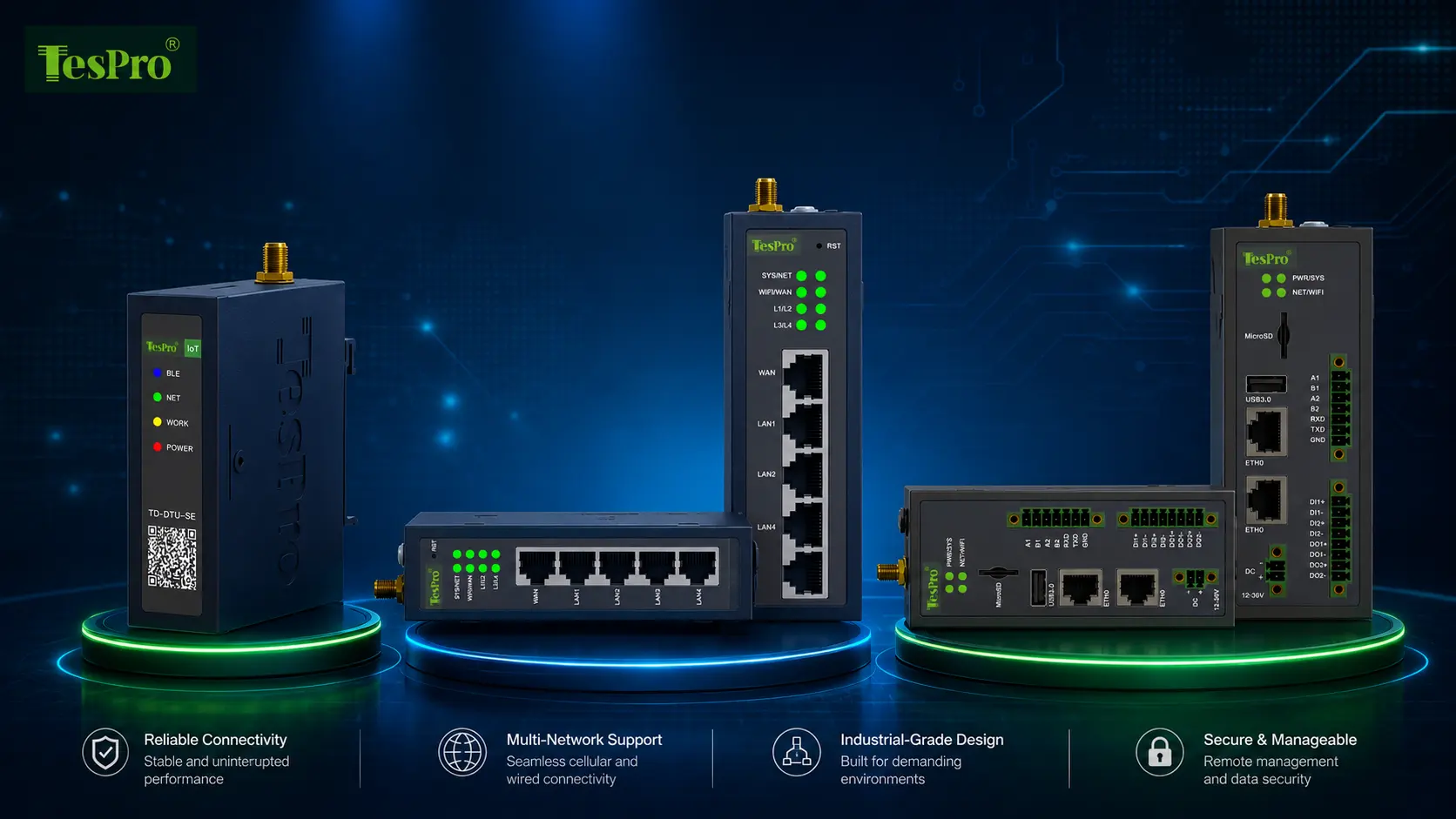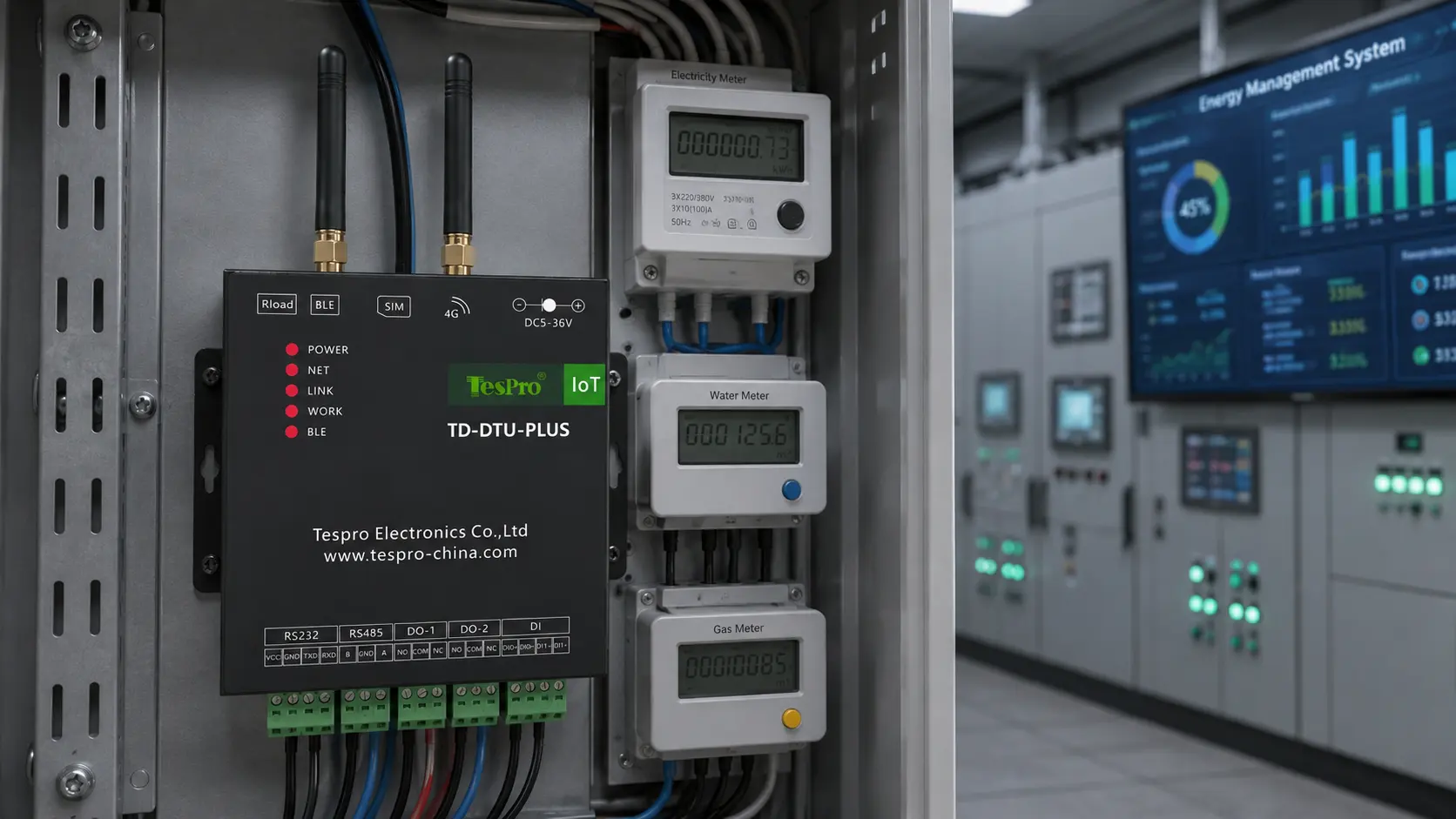


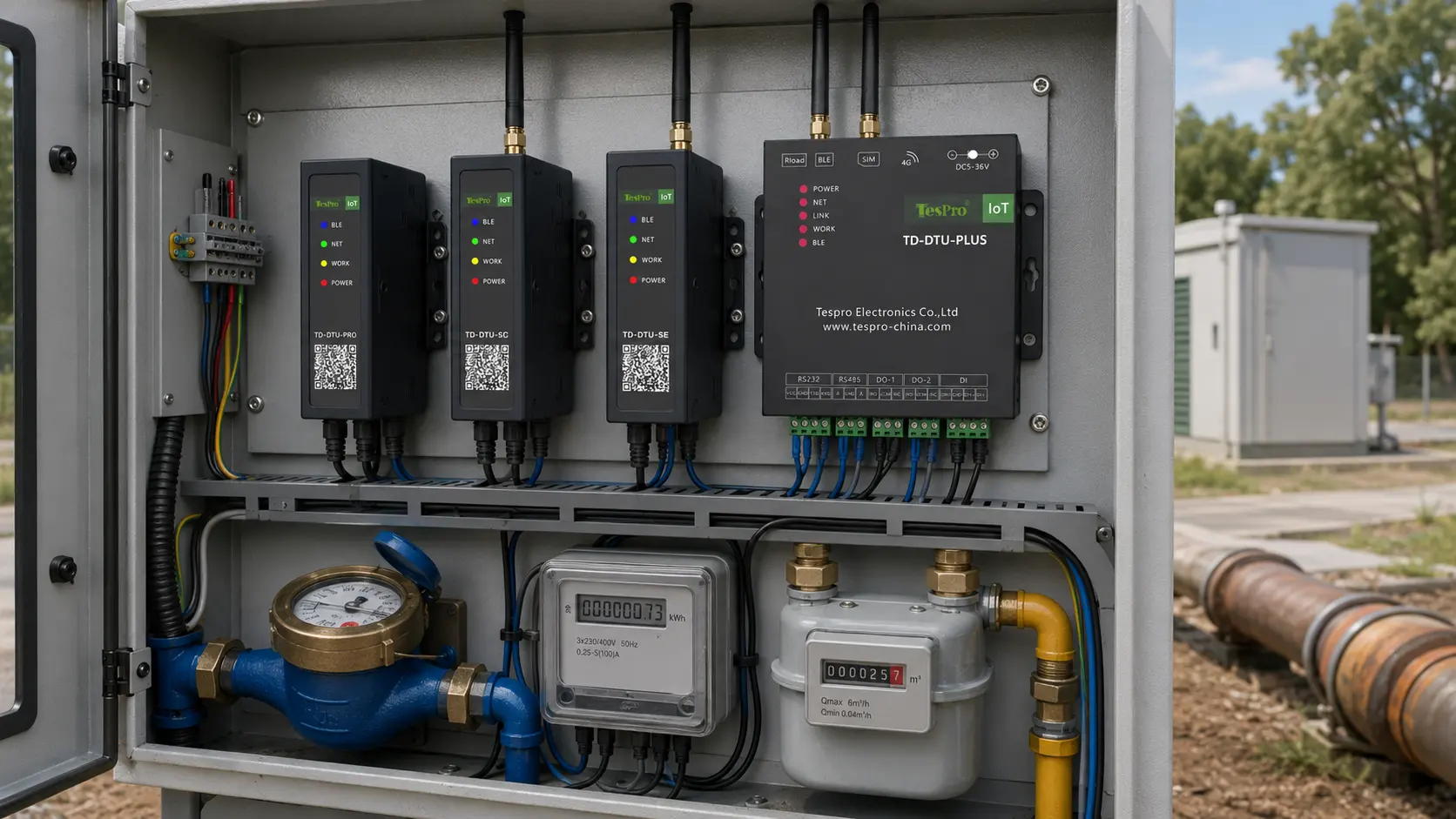

TD-DTU-PRO targets remote metering and telemetry that need reliable serial-to-cellular transport. Tespro’s official technical material lists 9–36 VDC, simultaneous 1×RS232 + 1×RS485, 300–115200 bps, TCP Client, UDP Client, MQTT Client and SSL encryption, with broad cellular-band coverage.
Key Points
- RS232 and RS485 can operate simultaneously, useful when both serial types are present.
- MQTT/TCP/UDP are transport mechanisms and should not automatically be treated as a full protocol gateway.
- Confirm bands, APN, serial settings and server mode before deployment.
Dual serial interfaces improve compatibility
Some sites contain both legacy RS232 controllers and RS485 meters. TD-DTU-PRO can operate both interface types simultaneously, reducing the need for extra converters.
Client-initiated connections fit carrier-NAT environments
TCP Client, UDP Client and MQTT Client modes initiate communication from the field device, so many projects do not require a fixed public IP at the site. VPN or private APN requirements depend on whether inbound access is needed.
SSL supports encrypted transport workflows
Official technical material lists SSL encryption support. The project should still confirm server certificates, TLS requirements, key management and compliance needs.
TD-DTU-PRO fits a powered, dual-serial, client-initiated architecture
With 9–36 VDC field power, simultaneous RS232 and RS485, and TCP/UDP/MQTT Client modes, it suits telemetry nodes in equipment rooms, substations and instrument cabinets with stable power. If independent battery operation is required, evaluate PLUS; if complex protocol mapping and edge logic are required, evaluate a TG gateway.
Client-initiated sessions simplify many cellular deployments
Carrier networks often use NAT, so field devices do not have a directly reachable public address. When the DTU initiates a connection to a fixed server or MQTT broker, the backend can exchange data through that session. If the head-end must initiate arbitrary access to the serial device at any time, evaluate VPN, private APN or a platform reverse channel.
Applications and Technical Boundaries
Where TD-DTU-PRO fits: Remote metering/telemetry with 9–36 VDC, simultaneous RS232 and RS485, server-side business parsing and TCP/UDP/MQTT client connections.
When PRO is not the first choice: No external power → evaluate PLUS. Complex multi-protocol parsing, point maps or edge logic → evaluate TG.
TD-DTU-PRO is strongest as a stable serial-to-cellular path
TD-DTU-PRO is strongest because it stays simple and focused. Dual serial interfaces, client-initiated cellular sessions and TCP/UDP/MQTT transport fit telemetry and meter-reading systems where the server already understands the application protocol. By not trying to become a full gateway, it can remain easier to operate in clearly bounded architectures.
Frequently Asked Questions
Q: How many serial interfaces does TD-DTU-PRO have?
A: Official technical material lists 1×RS232 and 1×RS485 and states that they can operate simultaneously.
Q: Does TD-DTU-PRO support MQTT?
A: Yes. MQTT Client is listed together with TCP Client and UDP Client modes.
Q: What is the operating temperature of TD-DTU-PRO?
A: The current official Wiki datasheet lists -20°C to +60°C. Some main-site copy differs, so production orders should reconfirm against the latest approved datasheet.
Q: Is GNSS standard on TD-DTU-PRO?
A: The official technical data lists GPS/GLONASS/BDS/Galileo/QZSS as optional, so confirm the exact configuration.