-1791966549842.webp)





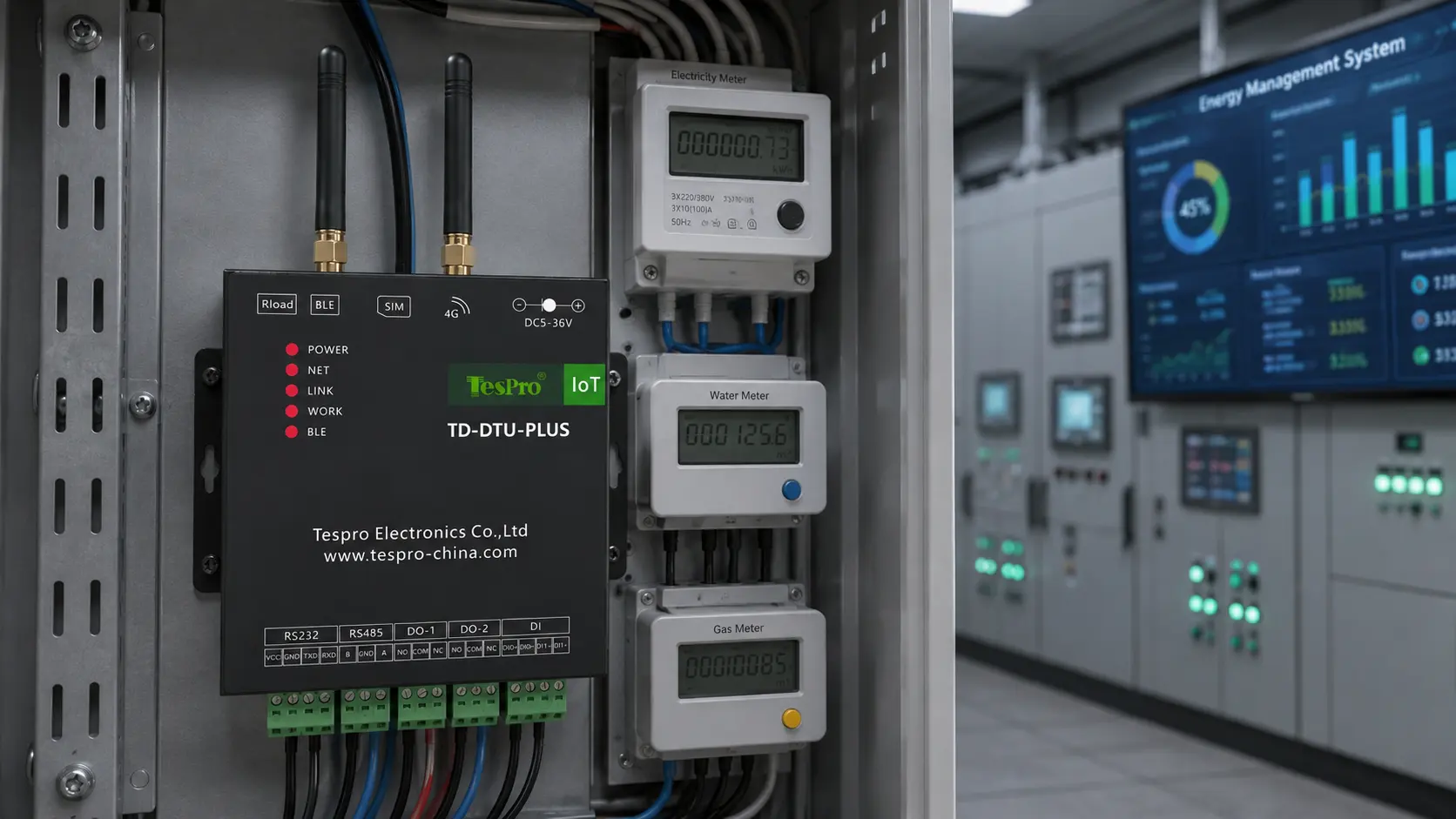

At temporary collection points, unpowered meter boxes or remote sites, power can be a bigger problem than communication. Tespro’s TD-DTU-PLUS page lists a 27,000 mAh battery, 4G/Bluetooth, 300–115200 bps and TCP/UDP/MQTT, positioning it for remote metering and IoT collection without reliable external power.
Key Points
- The 27,000 mAh battery is a core differentiator of TD-DTU-PLUS.
- Real runtime depends on collection interval, signal quality, online time and temperature.
- Battery projects need sleep/reporting strategy plus charging or replacement workflow.
Battery capacity alone cannot predict runtime
Weak cellular signal increases transmit power; frequent reconnection, short reporting intervals and continuous Bluetooth also reduce runtime. Validate at the actual site instead of converting 27,000 mAh into a fixed number of days.
Best for periodic acquisition and short online windows
A battery-powered DTU is well suited to scheduled wake-read-upload-sleep workflows. If the application needs 24/7 online operation or frequent bidirectional control, reconsider the power architecture.
Meter protocol still requires validation
TD-DTU-PLUS states IEC/ANSI meter-protocol compatibility and multiple interfaces, but a specific meter still depends on physical interface, protocol version, permissions and software configuration.
Build battery life from energy per wake-up cycle, not from 27,000 mAh alone
Runtime depends on standby current, whether the DTU powers another device, meter-read duration, cellular registration time, data volume, signal quality, Bluetooth use and temperature. A better method is to measure one complete wake → acquire → connect → upload → sleep cycle, multiply by cycles per day, then add margin for low temperature and battery aging.
A battery DTU is strongest for intermittent duty, not continuous high traffic
Hourly or daily reads can take advantage of periodic wake and sleep. If the application demands 24/7 online presence, second-level two-way control, long Bluetooth sessions or repeated weak-signal reconnects, battery life drops sharply and a fixed power architecture may be more appropriate.
Applications and Technical Boundaries
Where TD-DTU-PLUS fits: Sites without stable external power, periodic collection/reporting, remote meter boxes or temporary monitoring points where a longer maintenance interval is important.
When not to rely on battery alone: Always-online operation, high-frequency control, sustained high data or extremely weak signal should first be solved with better power and network design rather than only more battery capacity.
TD-DTU-PLUS brings unpowered remote sites into a connected metering architecture
TD-DTU-PLUS brings cellular collection to meter boxes and temporary sites without reliable external power. It is best suited to scheduled wake-up, short communication windows and low-duty-cycle acquisition rather than continuous high traffic. In that architecture, battery capacity, wake strategy and reporting interval are all part of the same design problem.
Frequently Asked Questions
Q: Does TD-DTU-PLUS require external power?
A: Its current positioning supports deployment without external power through a 27,000 mAh battery; related product information also lists a 9–36 V input.
Q: Which backend protocols are listed?
A: The current product page lists TCP, UDP and MQTT.
Q: How many days will 27,000 mAh last?
A: There is no universal number. Runtime depends on reporting interval, signal quality, data volume, temperature and operating mode and should be tested.
Q: Can TD-DTU-PLUS also use external power?
A: Official technical information lists both 9–36 VDC and a 27,000 mAh battery. Confirm the exact charging/power strategy in the current datasheet and user instructions.