-1791966549842.webp)





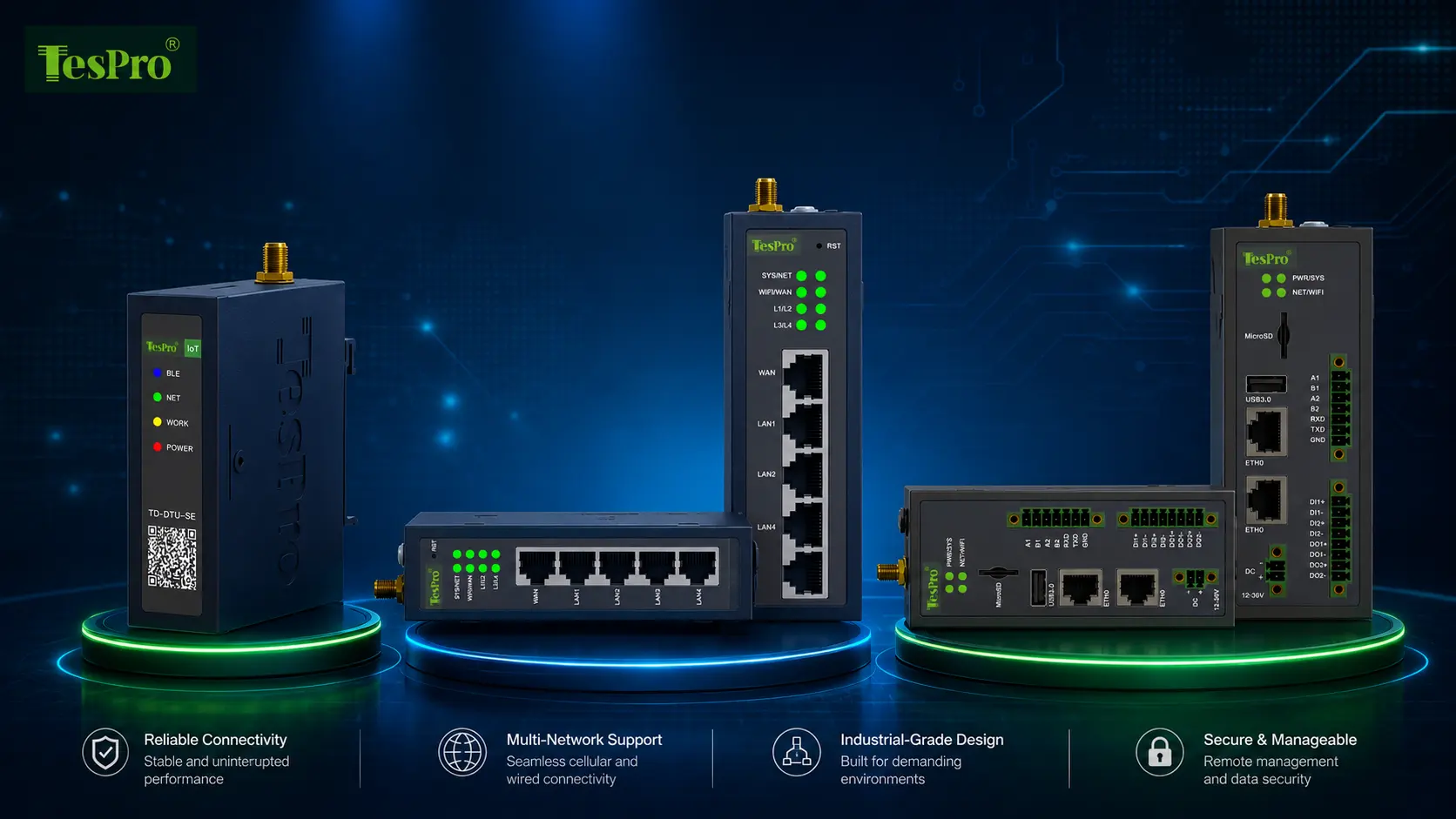

A common selection mistake is choosing the product category first and forcing the application into it. Start with the job: use a TR industrial router for 4G/5G connectivity, VPN and link redundancy; a TG gateway for multi-protocol acquisition, tag mapping, local processing or AI; and a TD-DTU when the primary task is reliable RS232/RS485 transport to a remote server.
Key Points
- TR addresses the network layer, TG the data/edge layer, and TD-DTU the serial-transport layer.
- Higher-end products can overlap in features, but the primary responsibility should remain clear.
- Draw both network topology and data flow before selecting a model.
Scenario 1: Remote PLC maintenance
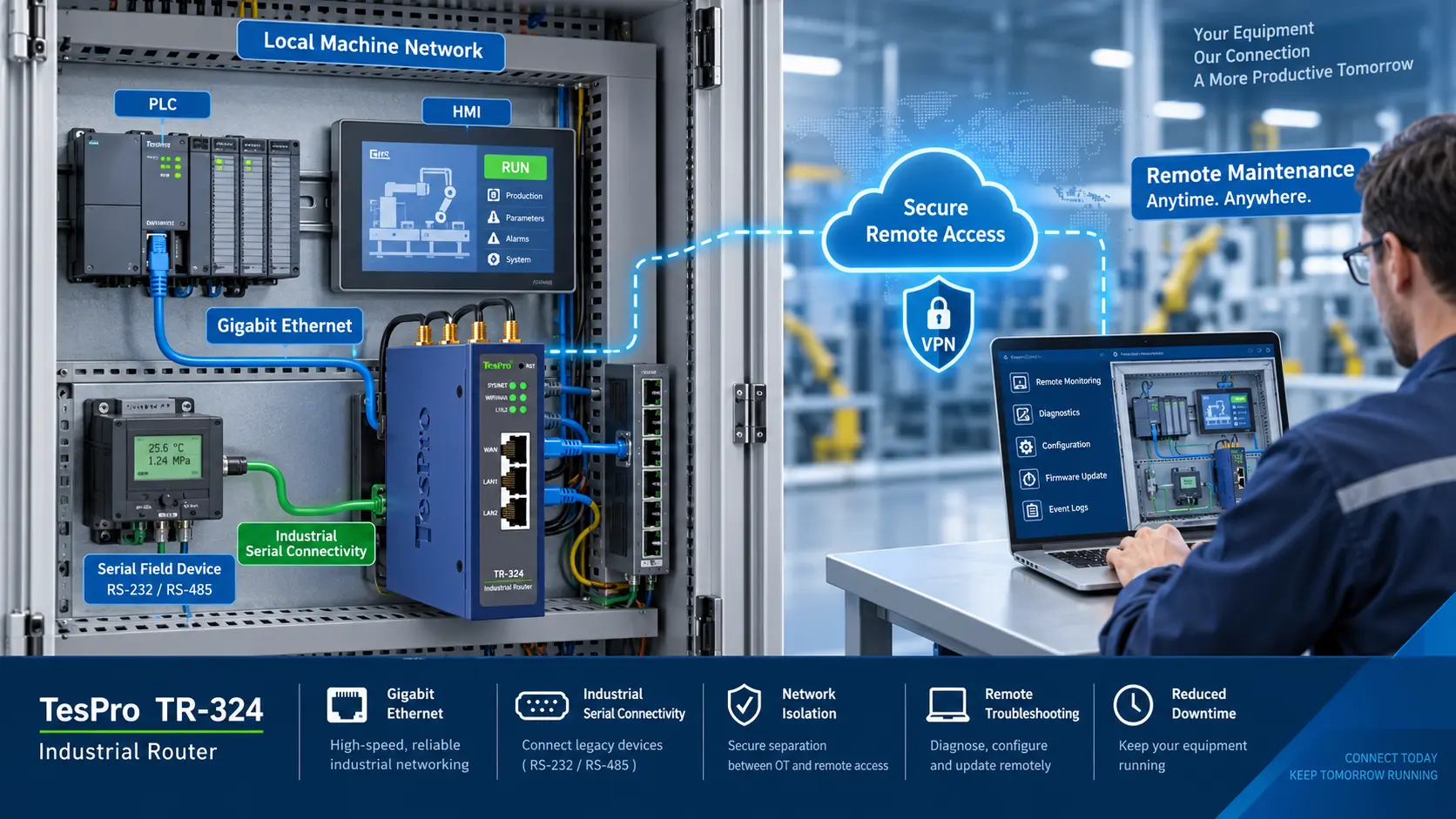
When VPN, dual SIM, cellular backhaul and remote logs are the main requirements, TR is the direct fit. TR-424 adds Wi-Fi 6, Gigabit Ethernet, serial interfaces and TesproOS.
Scenario 2: Multi-device protocol aggregation
When Modbus, DLMS, BACnet, OPC UA, S7 or other protocols must be integrated, or local filtering, buffering, rules and AI are required, TG-100/325/424 cover use cases from protocol gateway to high-performance AI edge node.
Scenario 3: Simple serial remote metering
If the server already parses the meter protocol and the field only needs RS485/RS232 over 4G/TCP/UDP/MQTT, TD-DTU-PRO/PLUS can be simpler. PLUS adds a 27,000 mAh battery for sites without stable external power.
Break the project into network, data and control layers
Network layer: who needs 4G/5G, VPN, dual SIM and Ethernet? Data layer: who parses Modbus/DLMS/BACnet/OPC UA, maps points, buffers and publishes? Control layer: which deterministic logic must remain in PLC/DCS? Once these layers are separated, TR, TG and TD-DTU roles become clearer and the project avoids turning one device into a single point for every responsibility.
Complex sites can layer TR + TG + DTU
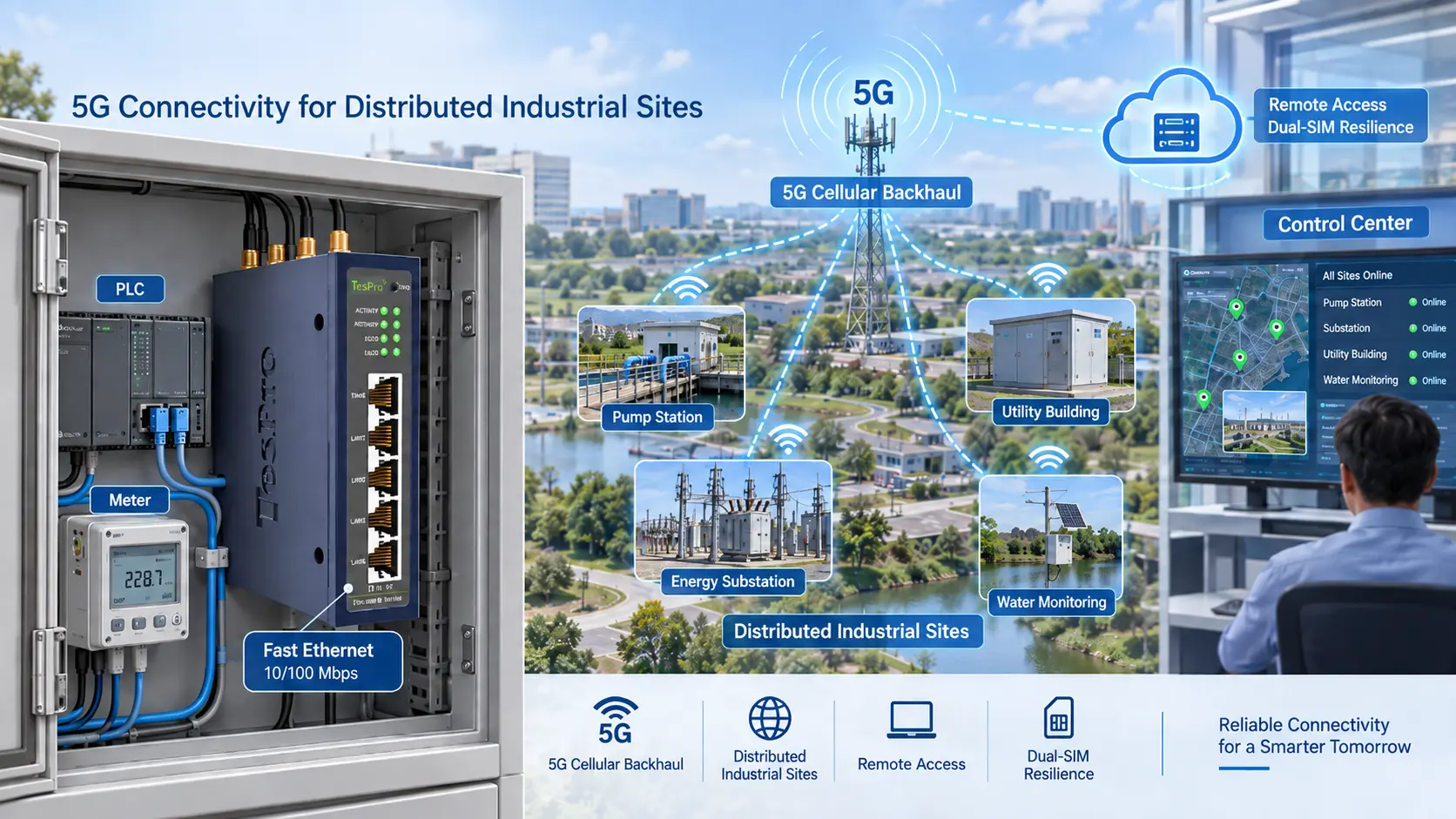
In a remote energy site, a TR router can own dual-SIM/VPN network security, a TG gateway can handle multi-protocol acquisition, normalization and edge buffering, and selected distributed serial assets can enter through TD-DTU. Whether all three are justified depends on site scale, security segmentation and maintenance organization; simpler sites should still minimize unnecessary layers.
Applications and Technical Boundaries
A clearer architecture separates network connectivity, data processing and serial transport first, then assigns TR, TG and TD-DTU to the layer each handles best. This reduces overlap and keeps maintenance boundaries understandable.
A common architecture mistake is asking one device to own networking, security, protocol parsing, buffering, control and business logic at the same time. The more tightly those responsibilities are coupled, the harder upgrades and fault isolation become.
Tespro maps TR, TG and TD-DTU to network, data and serial-transport responsibilities
Tespro maps TR, TG and TD-DTU to three different responsibilities: network connectivity, data processing and serial transport. A mature IIoT architecture does not ask one device to do everything. It gives each layer the job it handles best, reducing over-design while making future expansion, maintenance and fault isolation clearer.
Frequently Asked Questions
Q: Why not use one high-end gateway for every project?
A: More features do not always reduce total cost. A right-sized device can be simpler to deploy, validate and maintain.
Q: Can TR and TG be used together?
A: Yes. TR can handle secure networking and cellular redundancy while TG handles field protocols and edge data, creating a clearer layered architecture.
Q: Is choosing the most feature-rich TG-424 always the safest option?
A: No. A simpler TR or TD-DTU can be easier to validate and maintain and may have a lower total cost for a simple site. More unused functions do not automatically create more reliability.