-1791966549842.webp)







Industrial Router with Cellular Connectivity is a fast way for field devices to reach the cloud securely and reliably. At Tespro, we build it for people who run utilities, plants, campuses, and city infrastructure. You need uptime you can trust, installation that fits tight panels, and power draw that respects your budget. This is your 101 guide, written for first-time adopters and busy engineers alike.
What Is an Industrial Router With Cellular Connectivity?
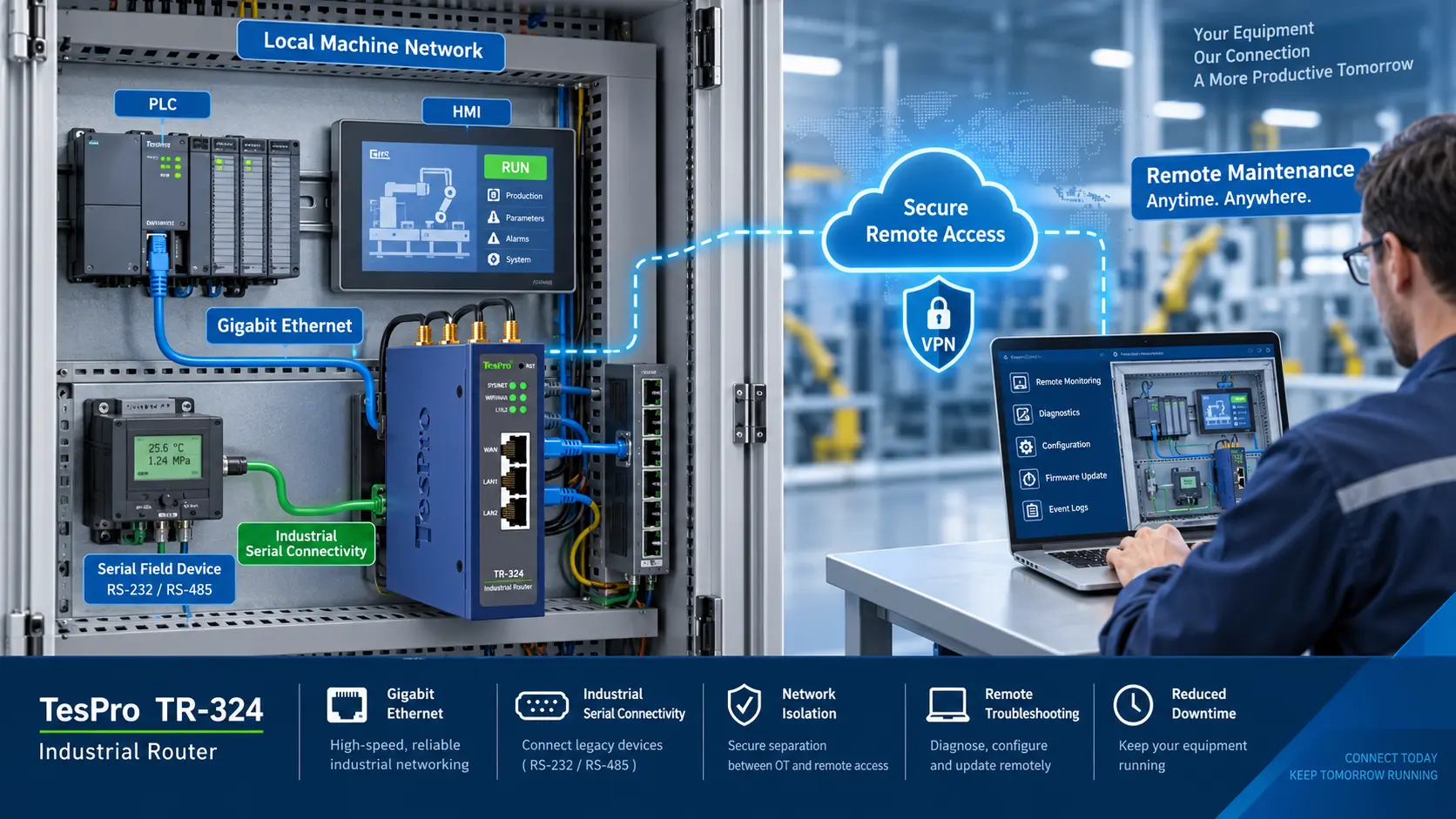
An Industrial Router with Cellular Connectivity connects machines, sensors, and controllers to cloud platforms using cellular networks. It also bridges local networks over Ethernet or WiFi. In simple terms, it is your secure highway from edge to cloud.
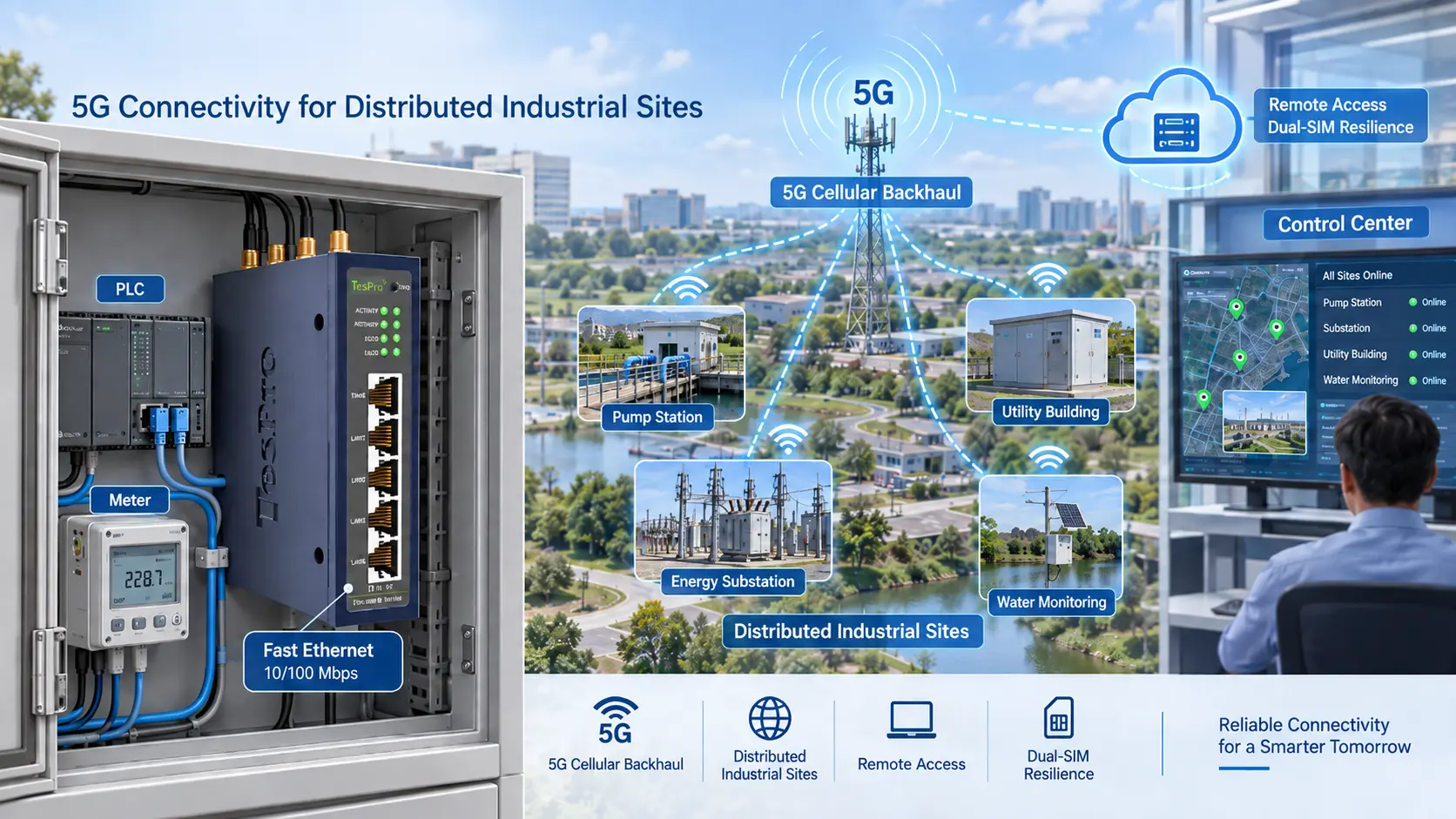
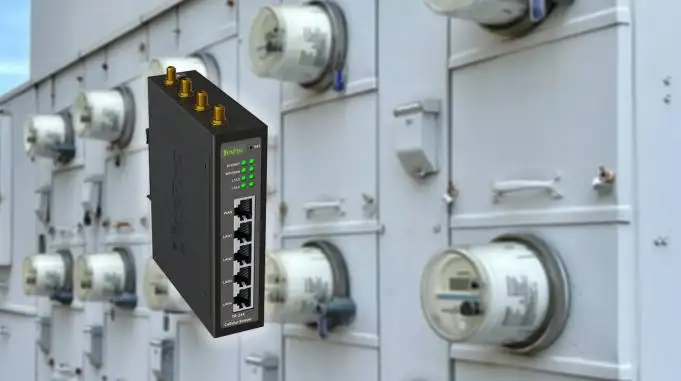
Tespro routers support GPRS, 4G, 5G, and NB-IoT. This range lets you choose the right cost and speed for each site. NB-IoT is ideal for low-bandwidth telemetry. 4G and 5G handle high-volume data and fast response. For many deployments, a mix is best. Our devices also integrate with AMI/AMR systems, so utilities can collect meter data in near real time and reduce manual work.
Why Secure Cloud Matters?
When you push operations data to the cloud, you gain visibility and speed. Decisions move from guesswork to facts. A secure link also protects revenue and safety. Tespro's Industrial Router with Cellular Connectivity creates a private bridge between edge devices and your cloud, whether you operate on public LTE networks or on VPDN private networks that isolate traffic by APN. The result is continuous, authenticated communication that reduces manual visits and keeps your SCADA, AMI/AMR, and analytics in sync.
From Edge to Cloud
Our approach is simple: collect data on site, aggregate it over Ethernet or Wi-Fi, then send it over the cellular path that fits your coverage and cost plan. The router manages sessions, monitors link health, and restores service automatically after interruptions. You get a steady flow of telemetry without babysitting links.
Multi-Network Flexibility for Real Deployments
No two sites are the same. Some cabinets sit in basements. Some assets move. Some regions only offer legacy coverage. Tespro supports GPRS, 4G, 5G, and NB-IoT to match your environment. You can start with today's coverage and migrate later without replacing edge hardware. This is a practical way to reduce risk.
On the LAN side, the router brings field devices online fast. Up to five auto-adaptive 100 Mbps Ethernet ports simplify wiring in existing panels. WiFi 802.11n (up to 300 Mbps) lets you connect handheld tools or nearby sensors without pulling cable. It works as a local bridge and as a backup path when you need it.
What does this mean in practice? A water utility can backhaul meter data from dense urban areas on 4G or 5G. A rural site can use NB-IoT for small, periodic payloads at low cost. A retrofit in an older plant can rely on GPRS where nothing else exists. The Industrial Router with Cellular Connectivity meets the network where it is and keeps data moving.
Redundancy That Keeps You Online
Downtime is expensive. Tespro builds redundancy into the core of our Industrial Router with Cellular Connectivity so the link stays up when conditions change.
✓ Dual SIM standby: Two cellular profiles ready to go. If one carrier fails, the router switches without user action.
✓ Triple backup switching (wired/WiFi/4G): Three independent paths with automatic failover. You can prioritize low cost first, then fail over to best effort.
✓ Smart link monitoring: Health checks trigger recovery and restore the preferred path when it returns.
✓ Local resilience: Devices continue to talk over LAN/Wi-Fi during backhaul outages, so processes are not disrupted.
These safeguards protect AMI/AMR rollouts that must report on schedule. They also support mobile or temporary sites where signal quality is uneven. The goal is simple: your data gets home.
Power, Form Factor, and Installation
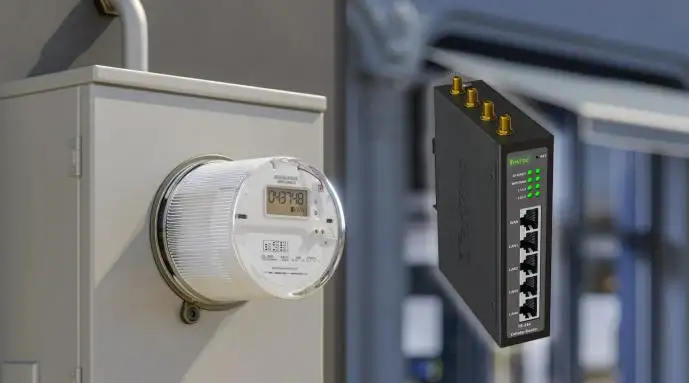
Industrial cabinets are crowded, and power rails are not always clean. We design for that. The router accepts a wide DC input from 5 to 30 V, with dual-path power via DC jack and terminal block for redundancy. Typical current draw stays under 400 mA, which helps when you power from batteries, solar, or constrained auxiliaries.
The enclosure is compact at 93 × 118 × 24 mm (without antennas), and it mounts on a DIN rail in seconds. Small size means it fits behind doors and in slim enclosures. DIN mounting means maintenance is quick and predictable. For field technicians, this is the difference between an easy install and a truck roll that drags on.
Built for the Field
Real sites face heat, cold, dust, and vibration. Tespro's Industrial Router with Cellular Connectivity operates from −20°C to 75°C, with storage from −40°C to 80°C, and tolerates 5% to 95% non-condensing humidity. That range covers curbside cabinets in summer, plant rooms in winter, and many outdoor enclosures.
We also consider electrical noise and fluctuating voltage. The wide-voltage, dual-path input keeps the device stable during spikes and sags. Combined with solid RF design, this stability preserves link quality over time. You deploy once and focus on operations, not on replacing failed gear.
Applications and ROI
When connectivity is steady and secure, outcomes improve fast. Here is where customers see value first.
✓ AMI/AMR and utilities: Real-time meter reads and alarms reduce manual collections and speed outage response. Continuous reporting improves billing accuracy and load planning.
✓ Smart city: Streetlights, environmental sensors, and parking systems share one Industrial Router with Cellular Connectivity as an edge hub. Data flows to the cloud for analytics and control.
✓ Campuses and industrial internet: Robots, PLCs, and energy meters connect over Ethernet or Wi-Fi, then backhaul over 4G/5G. Teams gain dashboards that reflect the last minute, not yesterday.
✓ Mobile and temporary sites: Construction, events, and pop-up facilities come online in hours. Dual SIM and triple path failover keep services running until fixed links arrive.
The financial case is straightforward. Fewer site visits and faster decisions cut operating costs. Wide network support avoids forklift upgrades. Low power draw extends backup runtimes. In many projects, the payback comes from reduced truck rolls alone, before you count the value of better data.
How Tespro Helps You Start
Choosing the right Industrial Router with Cellular Connectivity is only part of the journey. We map APN/VPDN topology, engineer failover resilience, and pre-stage standards-based configs for repeatable installs. Having guided large utility and city programs, we minimize risk and speed your path to scale.
Call to Action
Ready to connect your field assets to the cloud with confidence? Contact Tespro to speak with an engineer, request a demo kit, or schedule a proof-of-concept at one of your sites. We will help you configure the right cellular plan, power options, and redundancy strategy - so your data arrives securely, every time.