


A building management system exposes chiller temperatures as BACnet objects, but the plant PLC expects Modbus holding registers. The devices share an Ethernet network, yet the PLC cannot interpret the BACnet object identifiers, properties, or data types.
An Ethernet connection alone cannot resolve that mismatch. The integration requires protocol interpretation, address mapping, data conversion, and controlled handling of communication failures.
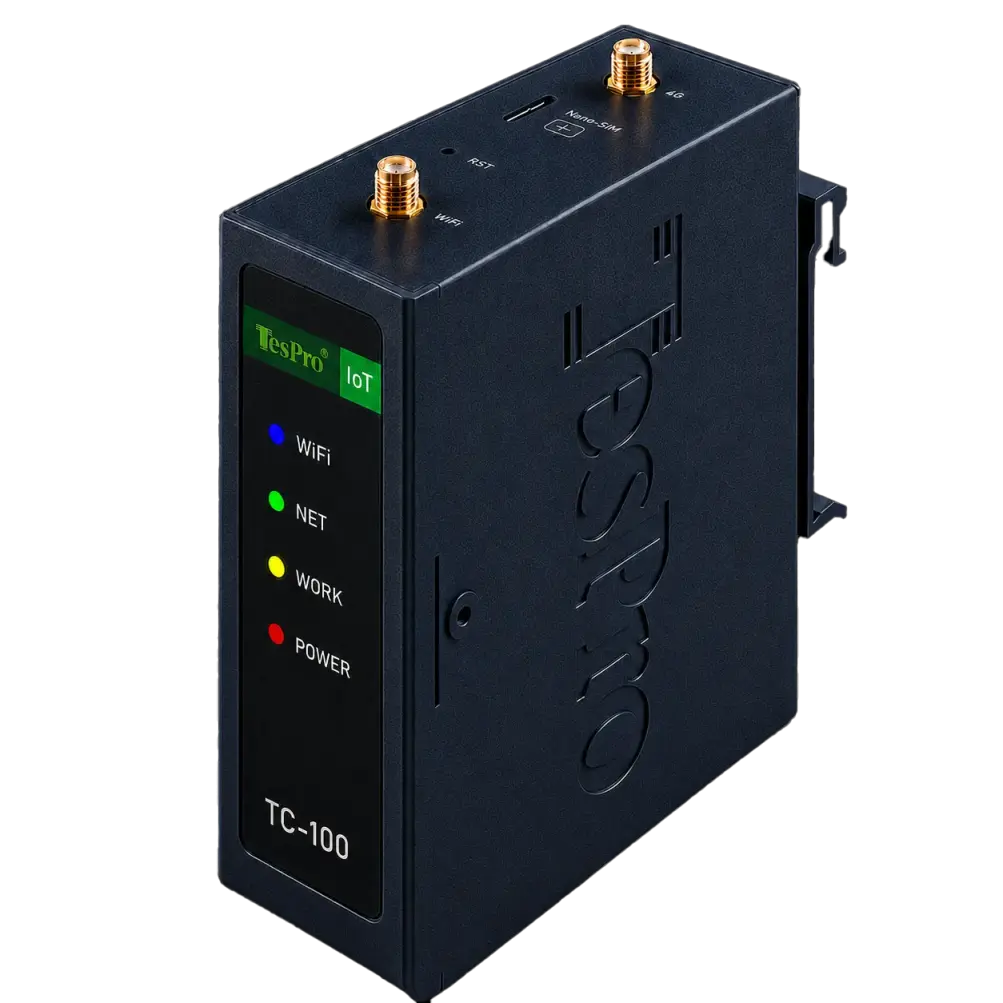
At Tespro, we evaluate an Industrial Protocol Converter for BACnet Modbus and OPC UA against the actual communication roles and point list. Our TC-100 supports these protocol families, but selecting the correct conversion direction and data representation remains a project-level engineering decision.
1. Confirm Protocol Direction Before Selecting Hardware
BACnet, Modbus, and OPC UA organize and exchange information differently. Even when two devices support the same transport network, their application-layer data may be incompatible.
| Protocol | Data Structure | Primary Integration Constraint |
| BACnet/IP | Objects and properties | Object identifiers, Present_Value, status, and command priorities |
| BACnet MS/TP | BACnet objects over RS485 | Serial token-passing topology and timing |
| Modbus RTU/TCP | Coils and 16-bit registers | Address offsets, register grouping, and data interpretation |
| OPC UA | Typed nodes and attributes | Namespace identifiers, access rights, timestamps, and data quality |
The first decision is not which protocols appear in the converter's specification. It is which device initiates communication and which device supplies the requested data.
For example, if a PLC operates as a Modbus TCP client, the converter must expose the required values through an appropriate Modbus server interface.
Tespro's TC-100 offers BACnet-to-Modbus and OPC UA-to-Modbus as typical conversion configurations. Direct BACnet-to-OPC UA translation, reverse-direction control, and simultaneous multi-protocol operation should be confirmed against the intended firmware.
Protocol availability does not establish unrestricted conversion between every protocol pair.
2. Data Mapping Determines Whether Readings Remain Accurate
A protocol converter can maintain an active connection while delivering incorrect process values.
Consider a Modbus temperature register containing a signed 16-bit measurement. If the destination interprets the register as unsigned, a negative reading becomes a large positive number. No communication alarm necessarily occurs because the register transaction itself succeeds.
Similar errors appear when floating-point values are assembled from registers in the wrong word order.
Tespro TC-100 supports INT/UINT formats, 32-bit floating-point values, and configurable byte-order arrangements, including ABCD, DCBA, CDAB, and BADC.
What Must Be Defined in the Mapping Table?
For each point converted, the configuration has to define:
• Source reference: BACnet object/property, Modbus register or OPC UA NodeId.
• Destination reference: Target register or object, node.
• Numerical interpretation: Signedness, data width, floating-point representation and format, and byte order.
• Engineering conversion: Scaling factors, units, and allowable range.
• Update behavior: Polling interval, timeout, and stale data indication.
• Access control: Is the point read-only or is it controlled by external commands?
Both BACnet and OPC UA, carry other information that is not directly represented by Modbus registers.
A BACnet Analog Input can expose reliability information. An OPC UA DataValue may contain a StatusCode and source timestamp. Mapping only the numerical value discards that context.
For applications where data validity affects alarms or supervisory decisions, separate registers or explicitly defined status indicators may be necessary. Their implementation must be verified rather than assumed.
3. Check Physical Interfaces and Polling Capacity
Protocol support cannot compensate for insufficient bus interfaces.
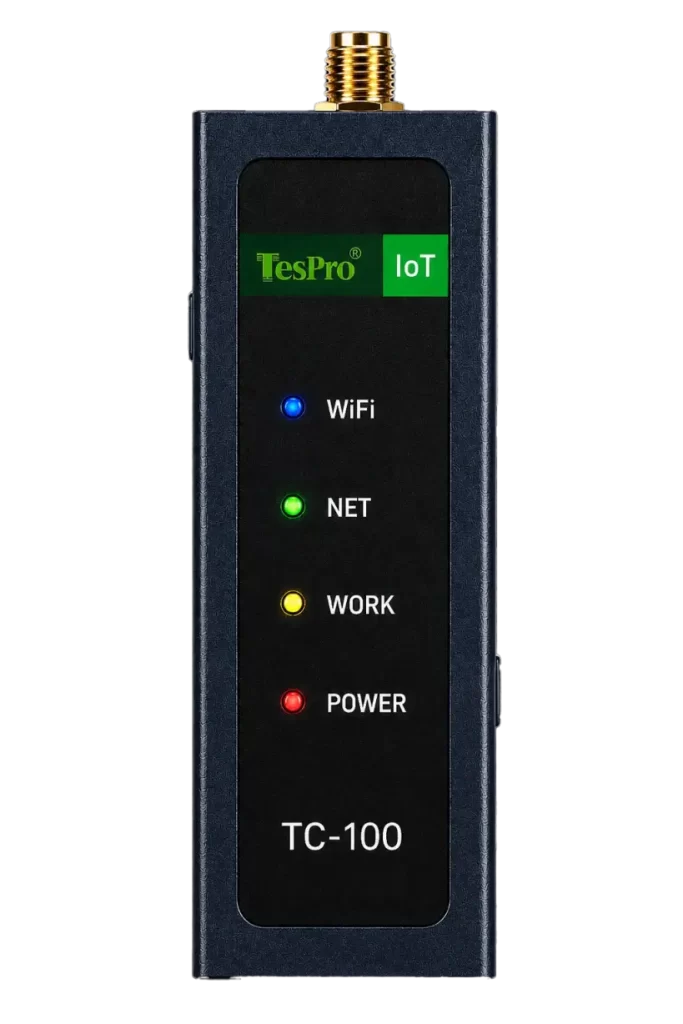
The standard TC-100 configuration provides one RS485 serial port, with RS232 or CAN available as alternative customized interfaces. It also provides one WAN and one LAN Ethernet connection, each rated at 10/100 Mbps.
This architecture can accommodate common serial-to-Ethernet integration arrangements. However, one RS485 interface cannot independently serve two physically separate serial networks.
If a project contains both a BACnet MS/TP trunk and a separate Modbus RTU bus, the system architecture requires reconsideration.
Serial Polling Creates a Performance Bottleneck
On Modbus RTU networks, each transaction consumes bus time through request transmission, slave processing, response transmission, and required inter-frame delays.
Communication errors and retries increase with increasing device count. This results in an ever longing polling cycle. Additionally, Token Passing has a latent overhead associated with it which is present with BACnet MS/TP. OPC UA Subscriptions and Modbus Polling implement entirely different methods for achieving data transfers.
Prior to deciding upon a gateway configuration, determine:
• Total number of devices and points mapped
• Expected baud rates and expected response times
• Critical measurement refresh intervals
• Timeout and retry policies for communication failures.
Not all 100Mbps Ethernet interfaces are the same and not all 100Mbps Ethernet interfaces can poll hundreds of points at Ethernet speeds.
Maximum practical point counts, concurrent connections and polling latency should be determined for the project.
4. Evaluate Communication Failures and Control Semantics
A converter serving monitoring applications has different responsibilities from one forwarding control commands.
For monitoring, a common failure is stale data: the upstream system continues displaying the last valid reading after the source device stops responding.
For control, the consequences may be more serious.
BACnet commandable objects use priority-based control and relinquishment behavior. A conventional Modbus register write has no equivalent priority structure. Translating commands without defined rules can produce conflicting setpoints or unexpected equipment behavior.
Consider the following as individual validation activities:
• Monitoring points: Disconnect the source device and check timeout detection, invalid value handling, and recovery after reconnection.
• Writable points: Check command permissions, acceptable value ranges, feedback behavior and equipment side interlocks. BACnet priority translations (if any) should be defined.
• OPC UA connections: Check client/server role, security, certificate and session handling.
The TC-100 is based on TesproOS and includes management functions (e.g. configuration, diagnostics, logging, software updates) via VPN.
These functions assist in the administration of the gateway. They are not a substitute for application-level authorization, or for the segmentation and verification of individual protocol mappings.
5. What Should Procurement Verify Before Deployment?
The hardware specs of the TC-100 published by the supplier state 12 - 36 VDC, an operating temperature range of -40°C to +75°C, and an IP protection rating of IP30.
IP30 does not protect against water. Condensation and wash-down, as well as outdoor and weather exposed, installations require a protective cover.
For acceptance testing, it is better to use a representative configuration than to demo with a few simple registers.
The test will cover the following:
- Protocol Roles: Verify required conversion direction and supported variants of the protocol.
- Data Integrity: Evaluate signed values, floating point numbers, scaling, and the order of the registers.
- Communication Loading: Measure the latency of updating the device with the planned number of points.
- Failure Recovery: Simulate loss of communication of the serial port, Ethernet and device power.
- Control Safety: Verify constraints on commands, and the behavior of the system on return to normal operation.
- Configuration Control: Capture settings of the firmware, mapping files and parameter backups.
For OEM and large scale deployments, the selection of the interface, the extent of customization, the technical details and the acceptance criteria should be agreed to prior to placing the order.
Tespro's TC-100 Industrial Protocol Converter provides a configurable basis for integration of BACnet, Modbus, and OPC UA. Share your protocol topology and point list to our technical team to evaluate the required testing.
FAQs
Q1: What industrial protocols does the Tespro TC-100 support?
Tespro TC-100 supports Modbus RTU/TCP, BACnet/IP, BACnet MS/TP, and OPC UA. Specific conversion directions depend on firmware and project configuration.
Q2: Can Tespro TC-100 convert BACnet data to Modbus?
Yes. Tespro identifies BACnet-to-Modbus as a typical conversion application. Object mapping, register allocation, scaling, and communication roles require configuration.
Q3: Does Tespro TC-100 support OPC UA to Modbus conversion?
Yes. OPC UA-to-Modbus is a documented application. Node mapping, data types, access permissions, and update intervals must be verified for the target system.
Q4: Can TC-100 convert BACnet directly to OPC UA?
TC-100 supports both protocol families, but direct BACnet-to-OPC UA conversion should be confirmed with Tespro for the required firmware, communication roles, and mapping functions.
Q5: What communication interfaces are available on Tespro TC-100?
TC-100 provides one 10/100 Mbps WAN port, one 10/100 Mbps LAN port, and Wi-Fi 4. One RS485 port is standard; RS232 or CAN configurations are customizable.