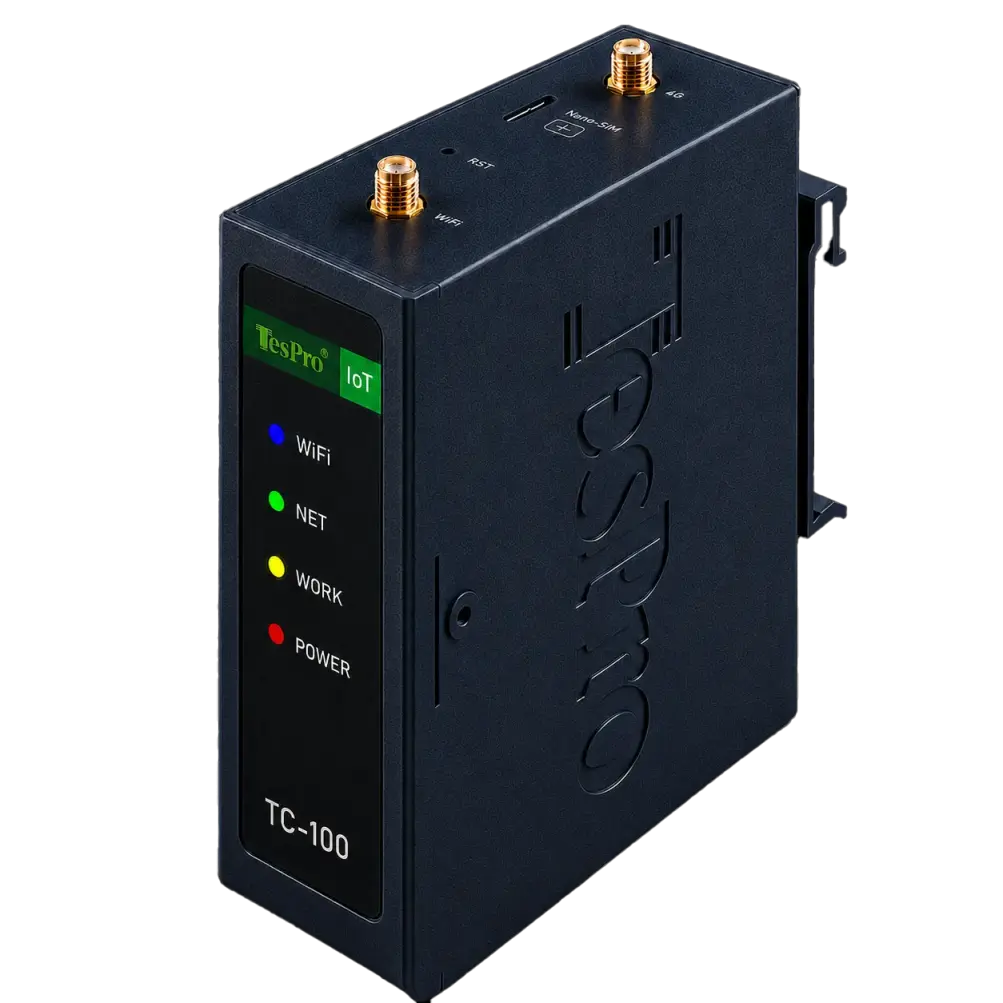


A utility operator upgrading a remote metering system may discover that the lowest-cost cellular DTU cannot meet its remote polling and maintenance requirements. In this setup, meters or dedicated data collection software handle meter reading, while the DTU provides RS485 connectivity and cellular data transmission. Although scheduled meter readings are successfully transmitted to the server, remote polling commands may experience delays, repeated connection attempts can increase power consumption, and firmware updates may exceed the available maintenance window. Any additional protocol handling or automated data acquisition capabilities depend on the specific TD-DTU model and should be verified before deployment..
These problems often originate in the choice between LTE Cat 1 and NB-IoT.
Both technologies support cellular machine-to-machine communication. However, they differ in how they manage data volume, network access and power. Analyzing DTU options for Wireless Data Transmission requires examining the entire data acquisition cycle, not just the number of bytes sent to the server.
In the case of Tespro's industrial metering, the main issue is whether the DTU works as an intermittently connected endpoint or as a communication bridge between field instruments and a remote management system.
1. How Do 4G Cat 1 and NB-IoT Differ Technically?
An LTE carrier uses peak rates of 10 Mbps downlink and 5 Mbps uplink for LTE Cat 1. The coverage of a network can be improved by using other techniques and Narrowband Signaling over a 180 kHz carrier with NB-IoT.
NB-IoT is designed for small and infrequent data transfers, and to operate for long periods of time on a single charge.
| Engineering Factor | LTE Cat 1 | NB-IoT |
| Radio bandwidth | Standard LTE carrier | 180 kHz |
| Peak throughput | 10 Mbps DL / 5 Mbps UL | Much lower; varies between NB1 and NB2 |
| Response latency | Generally lower | Can increase substantially with coverage repetitions |
| Power management | Depends on modem implementation | PSM and eDRX are central design features |
| Mobility | Conventional LTE handover | No conventional connected-mode handover |
| Difficult RF conditions | Depends on signal quality and antenna configuration | Coverage enhancement through repeated transmissions |
| Typical workload | Multi-meter collection and bidirectional communication | Periodic reporting from stationary endpoints |
The actual difference in theoretical throughput rarely affects end-to-end latency. Other factors, such as connection establishment, contention and delay through network relay, and acknowledgment by the server, can take longer than data transfer itself.
This is where Cat 1 becomes relevant for repeated exchanges or large transfers. It is also important for communication sessions where responsiveness must be maintained.
2. When is LTE Cat 1 a Better Choice for Industrial DTUs?
RS485 Polling & Remote Commands
Let's consider an industrial DTU connected to multiple electricity meters over an RS485 bus. In a typical Modbus RTU polling setup, the Modbus master (such as a data collection application or a DTU with built-in Modbus master functionality) sends a request to a specific meter using its slave address. The addressed meter validates the request, including its CRC, and returns a response containing the requested data. The master then checks the CRC of the received response before proceeding with the next polling request. This request-response process takes place sequentially, with only the addressed meter responding to each request.
A slow or unresponsive meter can cause a polling cycle to stall.
The modem can't do anything about delays on the RS485 bus. Once it has the data, however, it must transfer it all, and other data requests, in a timely manner.
LTE Cat 1 is well suited for installations that require:
Timely data collection and reporting: Reliable cellular data transmission when project testing confirms the required polling and reporting intervals. Actual performance depends on factors such as RS485 baud rate, device response times, the number of registers being read, and communication timeouts or retries.
•Bi-directional communication: Remote changes to meter/controller parameters; diagnostic queries; and meter readings upon request.
•Real time event reporting: Immediate notification of power outages, abnormal consumption and alarms.
•Remote configuration and firmware updates: Transfer of configuration files and firmware packages via "always on" communication.
NB-IoT can also support scheduled meter collection if the payload is small and the collection interval is long. Continuous availability of downlink communication is what places strain on the NB-IoT network.
When using NB-IoT, a device can be programmed to go into a low-power state. However, a sleeping endpoint cannot respond to every server command, and this should be accounted for when designing the application.
3. Does NB-IoT Always Consume Less Power?
Not always.
NB-IoT can provide support for Power Saving Mode (PSM), whereby the device stays registered but enters a low-power state. eDRX reduces the interval at which the endpoint checks for paging.
Both mechanisms can extend operating life in battery-powered systems, but they also restrict when a device can receive commands.
Energy consumption depends on the complete reporting cycle:
Average current = Total charge consumed per cycle / Cycle duration
Engineers should include four operating states:
•Meter or sensor acquisition
•Network registration and data transmission
•Retransmission and recovery after failed communication
•Idle or deep-sleep periods
Under weak coverage, NB-IoT may repeat transmissions to improve decoding reliability. Those repetitions consume energy and increase communication time.
A device reporting once daily may benefit considerably from long sleep intervals. A DTU exchanging data every few minutes may spend much more time in active radio states, reducing that advantage.
Cat 1 can also support power-saving features in certain module and network configurations. Their availability should be verified rather than inferred from the LTE category.
For either technology, battery-life calculations should use measured current profiles, realistic signal conditions, and battery derating—not modem sleep-current figures alone.
4. Why Do Coverage and Protocol Choice Affect Reliability?
The coverage enhancements in NB-IoT make communicating from basements or underground meter chambers easier.
Once registered on the network, that doesn't mean the device can reliably communicate with the application server.
In the absence of proper application server communication, a device may end up making multiple, redundant attempts to send small data packets to the application server. This makes large file downloads and other interactive diagnostics unrealistic.
The application protocol can also play a role.
MQTT typically runs over TCP and can be secured with TLS. When TLS is enabled, session setup and authentication can add overhead, especially if the device reconnects for every report.
Another transmission scheme with less control and management may provide better energy efficiency for small data packets.
•What other factors should be considered before modem selection?
•Does the local operator support the intended LTE category and bands?
•Will MQTT, UDP, or TCP communication meet the requirements of the application in terms of the time aspect?
•Will the planned location of the device ensure sufficient signal quality for communication?
•Can the device handle sessions being interrupted? What happens if acknowledgments are not received? Are retransmissions done properly?
LTE Cat 1 and NB-IoT are not the same, just because they both use cellular networks. A modem that supports LTE doesn't mean it supports NB-IoT, and the coverage of a given operator varies by region.
5. How Does Tespro Support 4G Industrial Data Collection?
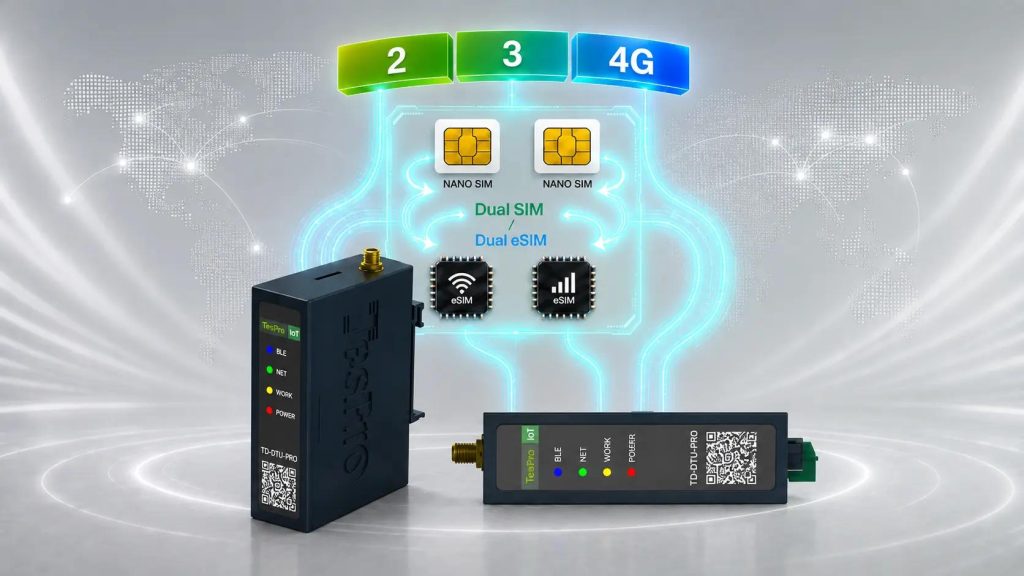
Tespro's TD-DTU-SE and TD-DTU-PRO product specifications offer the devices support LTE Cat 1, 4, and 6.
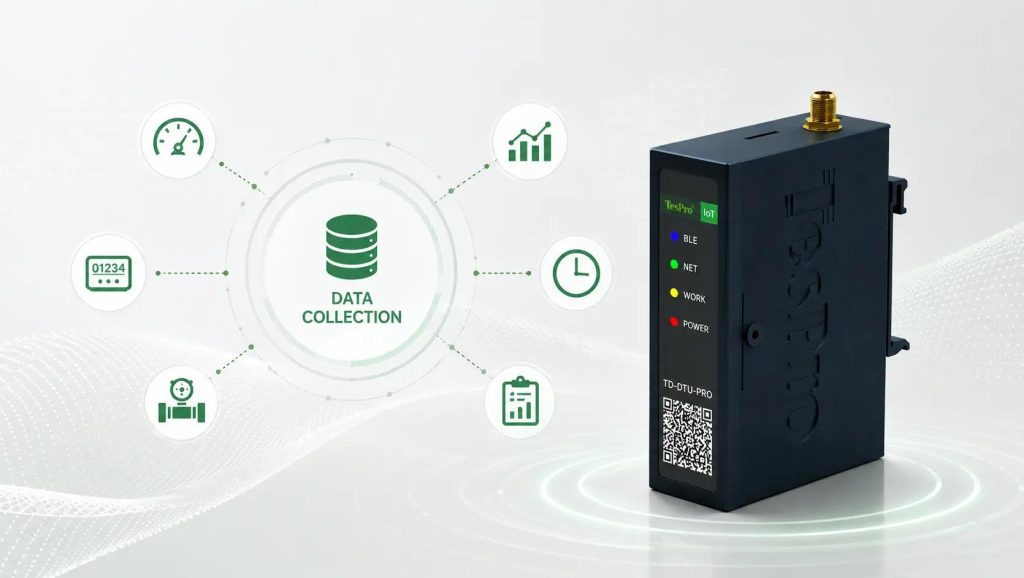
Tespro has documented features for industrial communication including:
•RS232 and RS485 interfaces for connection of instruments and field devices.
•Modbus and DLMS protocols for metering and utilities applications.
•TCP/UDP and MQTT protocols for data communication.
•Dual SIM and eSIM for flexible and redundant data communication.
•Multiple data collection modes.
The TD-DTU-PRO has Wi-Fi 4 for local connection and commissioning.
The features allow engineers to integrate metering infrastructure and field devices using cellular connectivity.
Prior to buying the hardware, one should verify the modem category, LTE bands, SIM configuration, and the functions of the protocol.
6. What Should Be Tested Before Large-Scale Deployment?
A successful bench connection does not demonstrate field reliability. Acceptance testing should reproduce the application's communication schedule, weak-signal conditions, and recovery scenarios.
| Verification Test | What to Measure | Failure Risk |
| Multi-meter polling | Complete acquisition-cycle time | Serial timeout or delayed reporting |
| Weak-signal transmission | Delivery time and retry frequency | Excessive delay or energy consumption |
| Network interruption | Reconnection and data recovery | Missing or duplicated records |
| Remote commands | End-to-end response time | Unacceptable downlink delay |
| Power cycling | Startup current and registration behavior | Supply instability or failed recovery |
| Firmware transfer | Completion time and interruption handling | Incomplete or failed updates |
The acceptance criteria should come from the actual operating requirements. A daily consumption report may tolerate delayed delivery; a remotely controlled industrial process may not.
For most multi-device DTU applications requiring frequent polling and bidirectional access, LTE Cat 1 is the more practical starting point. NB-IoT deserves consideration when endpoints are stationary, reporting is infrequent, and minimizing energy consumption outweighs response-time requirements.
TESPRO provides industrial cellular DTU configurations for serial data acquisition and remote metering. Check out our Data Transfer Unit products or contact our team for further assistance regarding your meter interface, network, and reporting schedule for configuration.
FAQs
Q1. Does Tespro offer a 4G Cat 1 DTU for wireless data transmission?
Yes. Tespro's TD-DTU-SE and TD-DTU-PRO offer LTE Cat 1 among their available cellular configurations for industrial data transmission.
Q2. Can Tespro DTUs transmit meter data through MQTT?
Yes. Tespro's DTU specifications include MQTT, TCP, and UDP communication for transferring collected data to remote servers.
Q3. Which is better for smart metering, LTE Cat 1 or NB-IoT?
LTE Cat 1 is generally better for frequent polling and remote commands. NB-IoT suits low-volume, intermittent reporting from stationary meters.
Q4. Can Tespro DTUs connect to RS485 electricity meters?
Yes. The TD-DTU-SE and TD-DTU-PRO provide RS485 and RS232 interfaces for connecting compatible electricity meters and industrial devices.
Q5. What industrial protocols do Tespro DTUs support?
Tespro offers the Modbus RTU, Modbus TCP, DLMS, IEC 1107, and other metering protocols. Exact functionality depends on the selected model.