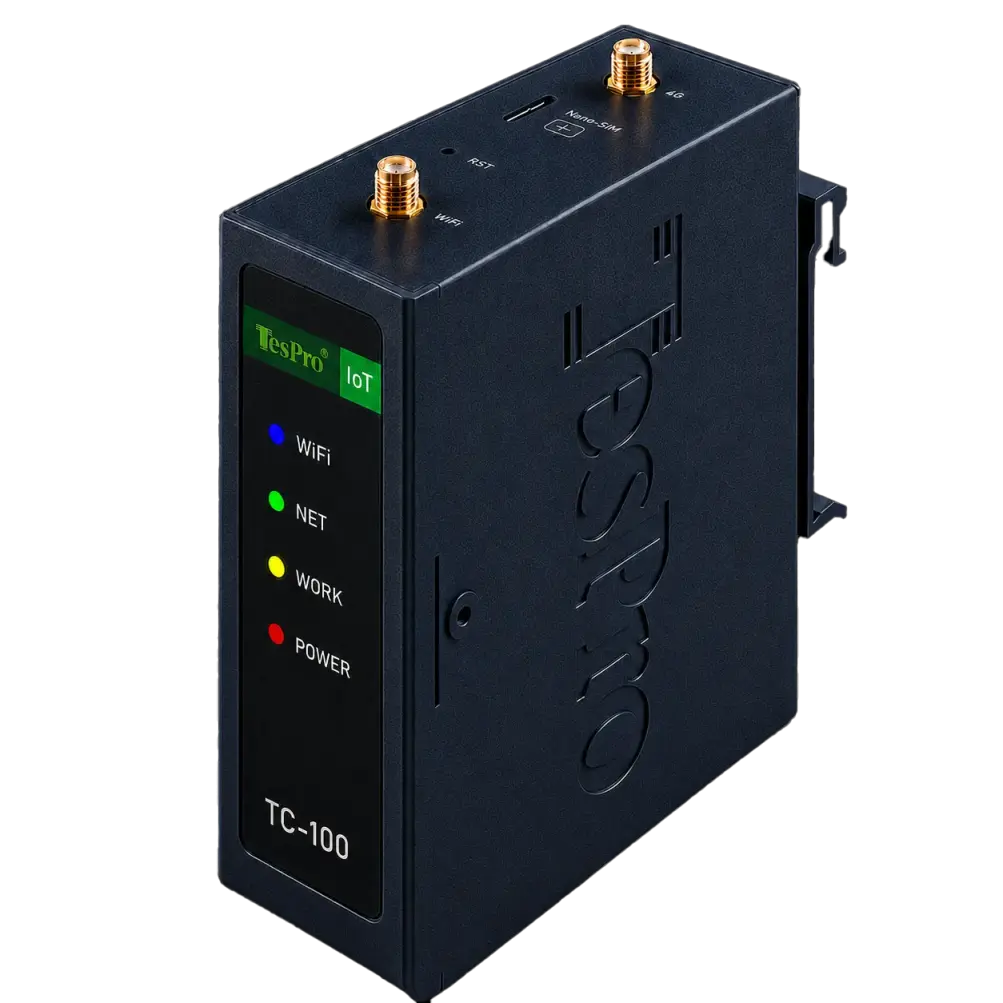


A cellular gateway at a remote pumping station reports a healthy 5G signal, yet the SCADA server has stopped receiving pressure readings. The modem remains registered with the operator, so the backup SIM never activates. Replacing the SIM card or increasing antenna gain will not resolve the actual problem: the gateway has lost upstream connectivity without detecting a cellular disconnection.
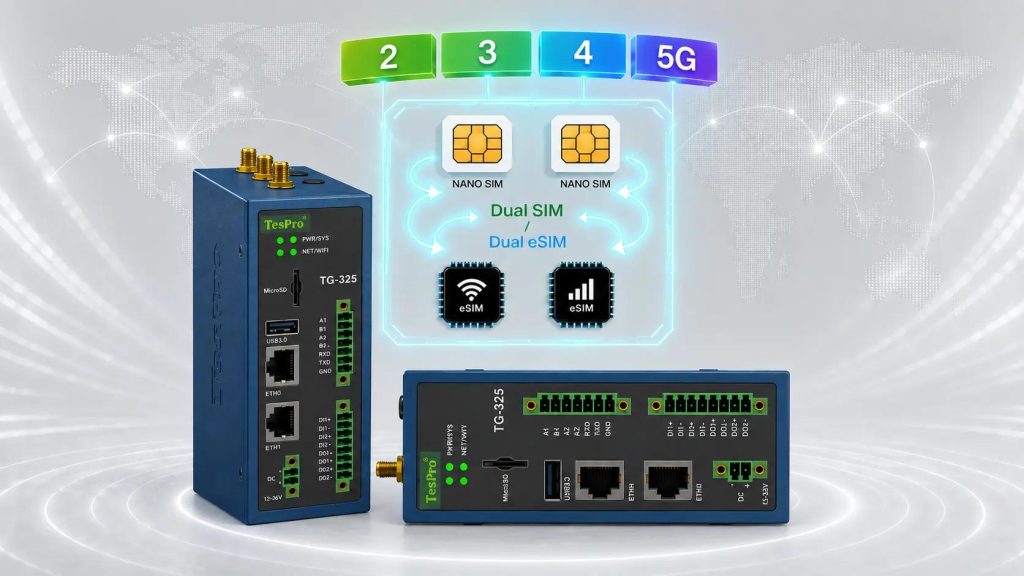
For engineers specifying a 5G Industrial Gateway with Dual SIM, the crucial question is not if two SIM cards fit inside the device. The important question is how the gateway identifies a failed communication path, switches networks, and restores industrial data transfer.
1. Does Dual SIM Provide Continuous Connectivity?
Having Dual SIMs and having Dual Cellular Connectivity are two different pieces of hardware.
Many architectures of single modems with Dual SIM cards allow for single active cellular data connections. Switching cellular operators requires modem reconfiguration, network registration, APN session establishment, and other latency-introducing processes that contribute to communication interruptions.
Separate active cellular connections can be supported with a dual modem architecture. Adding an extra modem however, adds hardware and power consumption costs, and adds thermal and antenna considerations.
When you define redundancy requirements, consider:
• Dual SIM: 2 active connections not guaranteed.
• Dual modem: Supports two active connections, depending on configuration.
• Automatic failover: Detects a failed uplink, and recovers through an available alternate connection.
• Application level continuity: Is dependent on other factors such as, IP addressing, transport session, VPN recovery and application retry.
A gateway may complete cellular switching successfully while the supervisory application remains disconnected.
For telemetry systems, a recoverable interruption may be acceptable. Closed-loop machine control requiring deterministic communication generally needs a different architecture rather than relying on cellular SIM switching.
2. How Should a 5G Industrial Gateway Detect Network Failure?
Radio Registration Is Not Proof of Data Connectivity
A modem can display acceptable RSRP and SINR values while a carrier's upstream routing or packet-data service is unavailable.
Reliable failure detection therefore needs to distinguish several conditions:
• Radio or registration failure: The modem loses access to its serving network.
• APN connection failure: Network registration succeeds, but the cellular data session cannot be established.
• Upstream routing failure: The data session remains active, but a required remote endpoint becomes unreachable.
• Persistent packet loss: The link operates intermittently, disrupting application exchanges.
Heartbeat-based link detection addresses some of these conditions. The destination matters: successful ICMP responses from an operator gateway do not prove that a private SCADA endpoint is reachable.
Preventing Unnecessary SIM Switching
Aggressive failure detection creates another risk. A transient packet-loss event may trigger failover even though the primary network would recover immediately.
Where supported, switching policies should include consecutive failure thresholds, detection intervals, and recovery hold-down periods.
Automatic failback deserves separate configuration. Returning to the preferred SIM too early can create repeated disconnections when coverage is unstable.
Buyers should verify which detection targets, thresholds, and failback policies are configurable in the actual firmware.
3. Which Hardware and Network Parameters Affect Failover?
Two SIM cards are useful only when the alternative network provides a genuinely usable path.
| Parameter | Technical consideration | Required verification |
| Cellular architecture | Single-modem switching introduces reconnection time | Modem count and active/standby behavior |
| 5G NR bands | Operators may use different frequencies and SA/NSA configurations | Regional band and carrier compatibility |
| LTE fallback | 5G coverage may be intermittent or unavailable | Supported LTE bands and fallback behavior |
| APN configuration | Operators may require different APNs and authentication | Per-SIM profile configuration |
| Network addressing | Backup sessions may receive different IP addresses | VPN, NAT, and remote access recovery |
| Antenna installation | Metal cabinets and cable losses affect reception | On-site RSRP, RSRQ, SINR, and throughput |
Using two subscriptions from the same operator does not protect against a shared core-network outage.
Even separate operators may share towers or backhaul infrastructure. For remote energy, utility, and manufacturing installations, carrier diversity should be evaluated through actual coverage and routing tests.
4. MQTT, Modbus TCP, VPN Sessions – What is this?
Reconnecting to the cellular network and recovering applications happen independently of each other.
Upon a SIM card swap, the gateway may acquire a new IP address. Existing TCP sessions will terminate. VPNs may need to reestablish security associations.
The consequences depend on the industrial protocol.
MQTT Telemetry
MQTT clients must detect transport loss and reconnect to the broker. QoS settings, persistent-session configuration, and application buffering determine how messages are handled during an outage.
QoS 1 supports at-least-once delivery under the appropriate session conditions, but duplicate messages remain possible. It does not guarantee recovery of measurements that were never stored.
Modbus TCP and SCADA
An interrupted Modbus TCP transaction usually requires a new request upon recovery of the connection. Polling timeouts, retry intervals and handling of stale data should be configured based on the process.
VPN-based remote maintenance may involve tunnel negotiations, route updates and state updates of firewall.
Carrier-grade NAT may prevent unsolicited inbound access after switching operators. An outbound VPN tunnel to a reachable server may be more practical than assuming a publicly accessible cellular address.
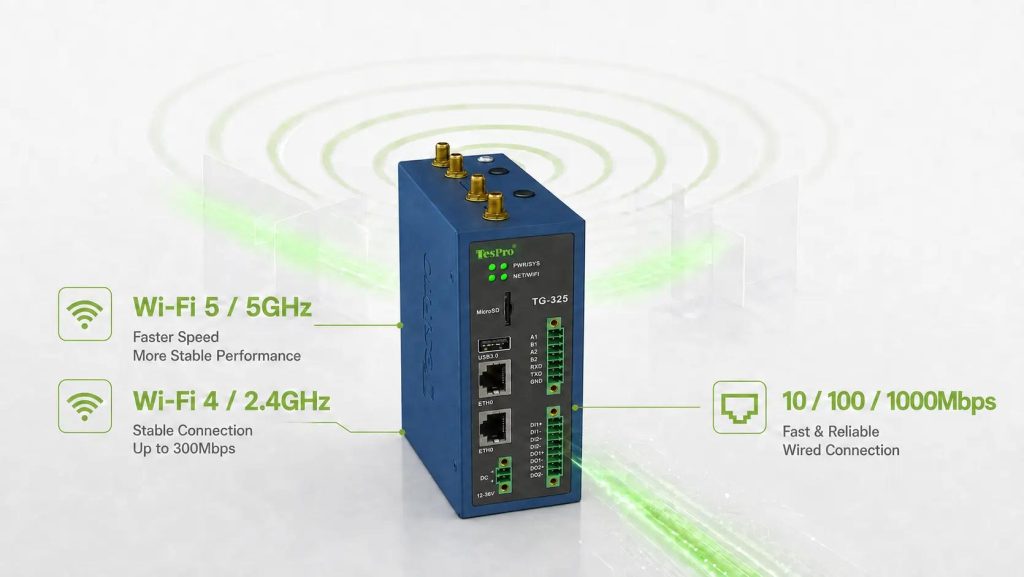
5. Verified Features and Configuration Limits of Tespro TG-325
The Tespro TG-325 is a cellular- and locally-connecting industrial gateway.
TG-325 specs include:
• Support for 2G/3G/4G/5G (including 5G NR)
• Dual/SIM/eSIM
• Link switching and link detection
• Two Gigabit Ethernet ports, one RS-232 port, two RS-485 ports
• TesproOS, VPN functionalities, system logging and remote configuration
The aforementioned features of the TG-325 make it ideally suited for industrial data acquisition and remote monitoring projects requiring other cellular connectivity.
The published feature list does not guarantee a SIM-switching time, continuous session preservation, or support for all possible failover policies.
Prior to purchase, customers should validate the delivered modem variant, the frequency bands supported, the functionalities of the firmware and the supported VPN protocols.
6. How Can Engineers Test Automatic Failover?
A meaningful acceptance test should reproduce failures other than removing the antenna.
We recommend testing your configuration with both operator subscriptions.
• Take a baseline of the application traffic. Record cellular registration, IP address and VPN state. Monitor application transactions.
• Simulate an upstream black hole. Block upstream traffic to the target server. Verify if the gateway detects the upstream failure.
• Take a cellular disconnection. Disable the primary connection and capture registration and state change on the backup SIM.
• Analyze Modbus application behaviors. Look for gaps in Modbus polling. Verify the status of the VPN and MQTT. Search for duplicate records or missing records Monitor application behavior from beginning to end.
• Restore the primary network. Check failback occurs as per the defined policy.
Measure the time taken to detect a failure and the time taken for cellular reconnection and end-to-end application restoration and note the minimum and maximum values.
Repeat the test with a realistic traffic load, weak signal conditions and with Application behavior in focus. A single successful switch does not prove recovery consistency.
For projects integrating 5G connectivity, Integration of industrial communication protocols, and Dual-SIM redundancy, Contact the Tespro Team and send your carrier bands, Network topology and failover acceptance criteria for a configuration review.
FAQs
Q1. Does Tespro offer a 5G Industrial Gateway with dual SIM support?
Yes. Tespro's TG-325 supports 5G connectivity and dual SIM/eSIM configurations for cellular link switching and backup.
Q2. Does the Tespro TG-325 support automatic network failover?
The TG-325 supports dual-SIM link switching, heartbeat-based link detection, and automatic reconnection. Exact failover triggers and policies should be confirmed for the selected firmware.
Q3. Can the Tespro TG-325 use physical SIM cards and eSIMs?
Yes. The options include dual physical SIM, dual eSIM, and one physical SIM combined with one eSIM.
Q4. Does dual SIM switching guarantee zero network downtime?
No. SIM switching may interrupt cellular sessions, VPN tunnels, and application connections. Recovery time must be measured during deployment testing.
Q5. Which cellular networks does the Tespro TG-325 support?
The TG-325 product family offers 2G/3G/4G/5G connectivity, including 5G NR eMBB and RedCap options. Actual support depends on the selected modem and regional configuration.