-1791966549842.webp)





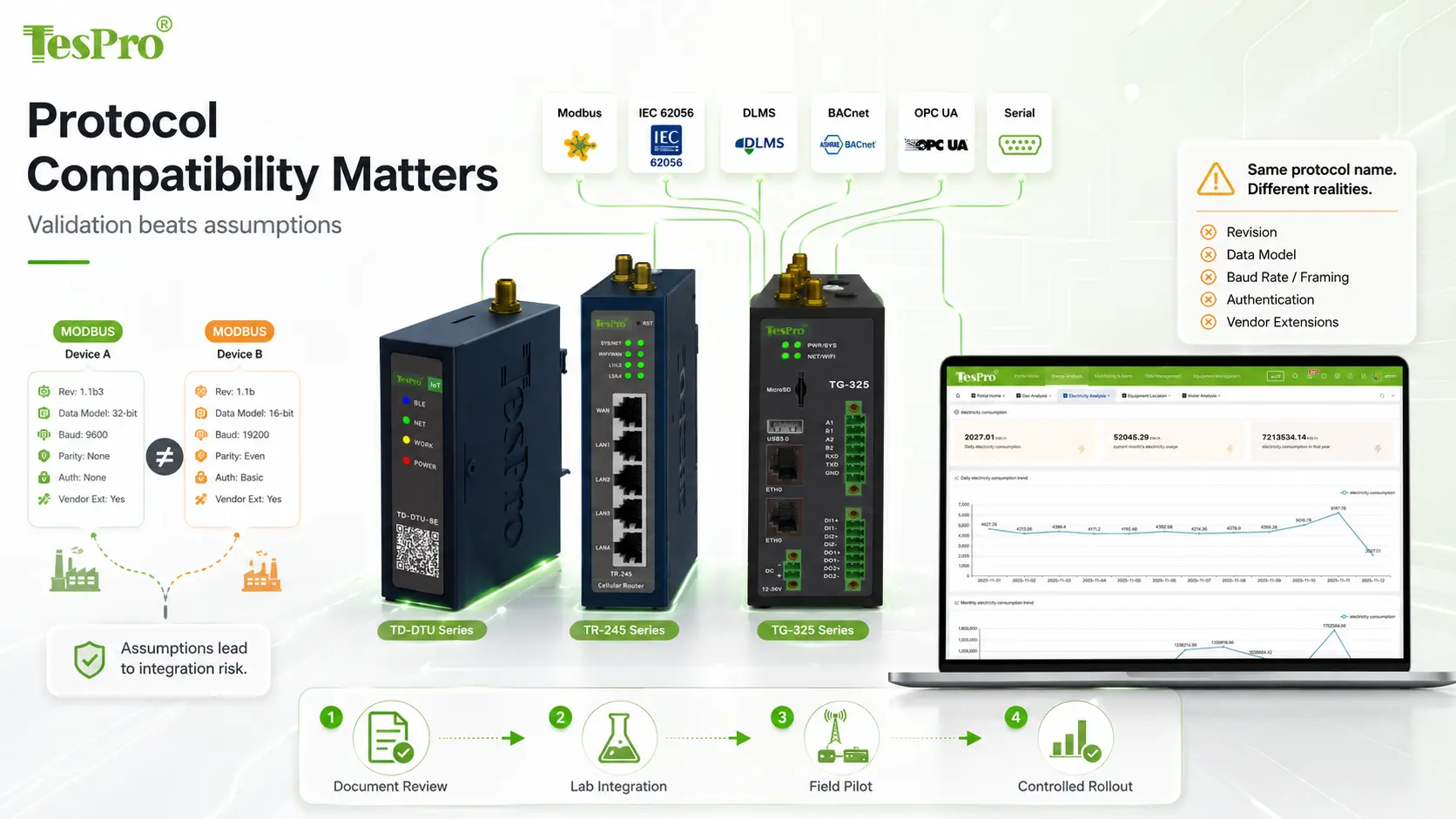

A shared protocol name is not proof of compatibility. Modbus, IEC 62056, DLMS, BACnet, OPC UA and even basic serial passthrough can vary by revision, data model, baud rate, authentication and vendor extensions. Tespro projects are better validated through document review, laboratory integration, field pilot and controlled rollout.
Compatibility has at least four layers
The physical layer covers interfaces, electrical levels and optical geometry. The communication layer covers baud, addressing and sessions. The protocol layer covers objects, registers and function codes. The business layer includes software, permissions, timestamps and exception handling.
Test cases must represent the real workflow
Reading one register or seeing a COM port is not project success. Validate normal reads, write permissions, reconnect, abnormal messages, buffering, restart behavior and platform consistency. Optical-probe tests also need attachment, ambient light, driver and application checks.
Turn results into reusable evidence
Record device model, firmware, configuration, test date, result and limitation. Tespro and the customer should agree on acceptance criteria and repeat critical tests when a model or firmware revision changes.
Project evaluation checklist
✓ Device model, firmware and protocol revision
✓ Complete register, object or point map
✓ Serial, network, authentication and access
✓ Normal and abnormal test cases
✓ Acceptance record and retest triggers
Frequently asked questions
Q: Why can two devices that support Modbus still be incompatible?
A: They may differ in master or slave role, RTU or TCP mode, function codes, address offsets, data types, byte order, scaling and exception handling.
Q: How long should a Tespro sample test run?
A: There is no universal duration. Simple interfaces can be checked quickly, while network stability, buffering, dual SIM, VPN or multi-protocol concurrency should be tested across longer normal and abnormal conditions.
Q: Can compatibility testing be completed only in a laboratory?
A: Laboratory testing is useful for protocol and function issues, but coverage, cabinet temperature, grounding, interference and field workflow still require target-site validation.
Q: Does one successful test guarantee permanent compatibility?
A: No. Firmware, platform versions, carrier networks and production revisions can change. Keep version records and define retest triggers.
Next step: When a target device or application is available, provide manuals, maps, packet samples, hardware and expected steps to build a Tespro compatibility-validation checklist.
Pre-publication check: Confirm all brand, product, customization, validation and case statements against current datasheets, product status and project records.