-1791966549842.webp)






The real campus problem is connectivity, not meter count
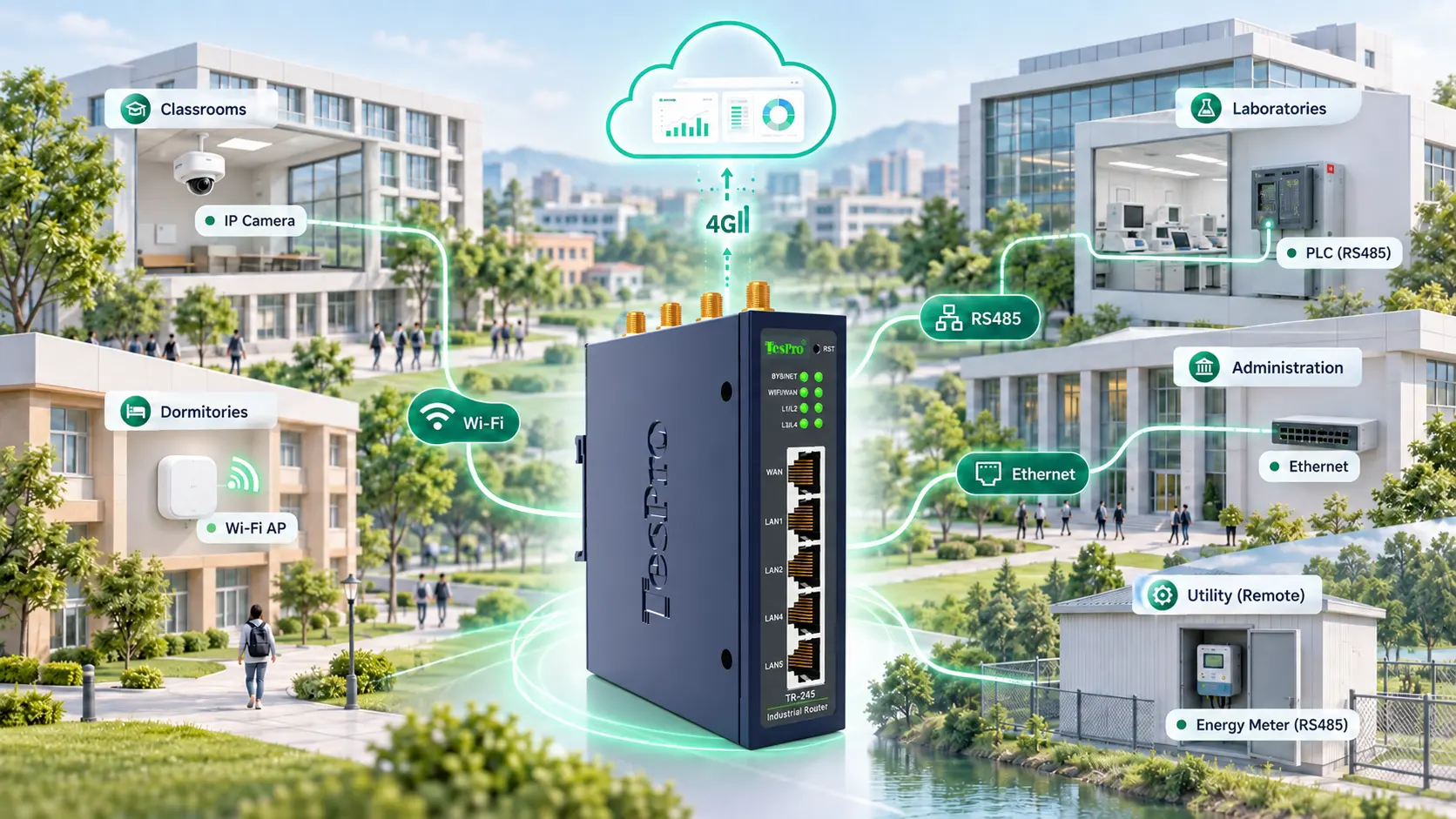
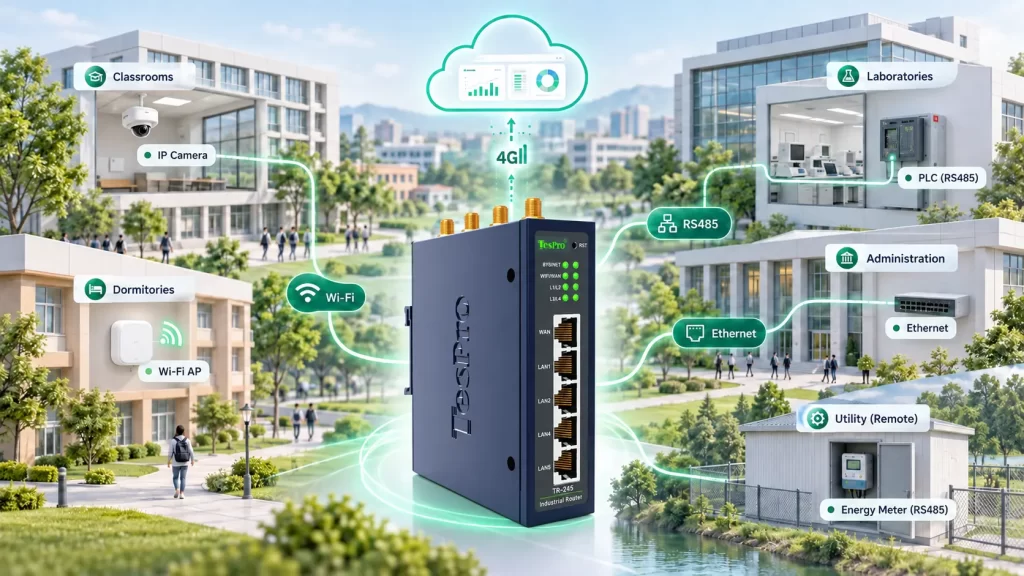
Universities contain classrooms, dormitories, laboratories, administration buildings and remote utility points. Some assets are modern IP devices, others remain on RS485, and some facilities cannot reach the campus wired network. A platform alone cannot solve this last-mile connectivity gap.
Why TR-245 fits mixed campus networks
Tespro positions TR-245 as a 5G industrial cellular router with multiple LAN ports and serial connectivity. In a campus energy network, that combination can provide cellular backhaul, local Ethernet access and field-device integration in one node.
Case: distributed campus energy acquisition
Tespro publishes a university case in which classrooms, dormitories, laboratories and administration buildings used a mixture of smart meters, power sensors and legacy monitoring equipment. Remote lighting stations and auxiliary facilities were difficult to reach with the wired campus network. TR-245 was used to bring those distributed points into a centralized monitoring architecture.
The key value is network unification, not replacing every device
Real campus retrofits rarely start from a clean slate. An industrial router allows existing meters and controllers to remain in service while the communication layer is modernized. A gateway can then be added where protocol normalization or edge processing is required.
Frequently Asked Questions
Q: Does every campus project need 5G?
A: No. 5G is justified by traffic, coverage, operator availability and application type. Low-bandwidth metering may work well over 4G.
Q: Why are multiple LAN ports useful?
A: They allow several local Ethernet devices to share one field node and can reduce extra switching and wiring.
Q: Can legacy RS485 meters remain in service?
A: Yes when interfaces and protocols are compatible. More complex translation should be handled by a gateway or platform.