

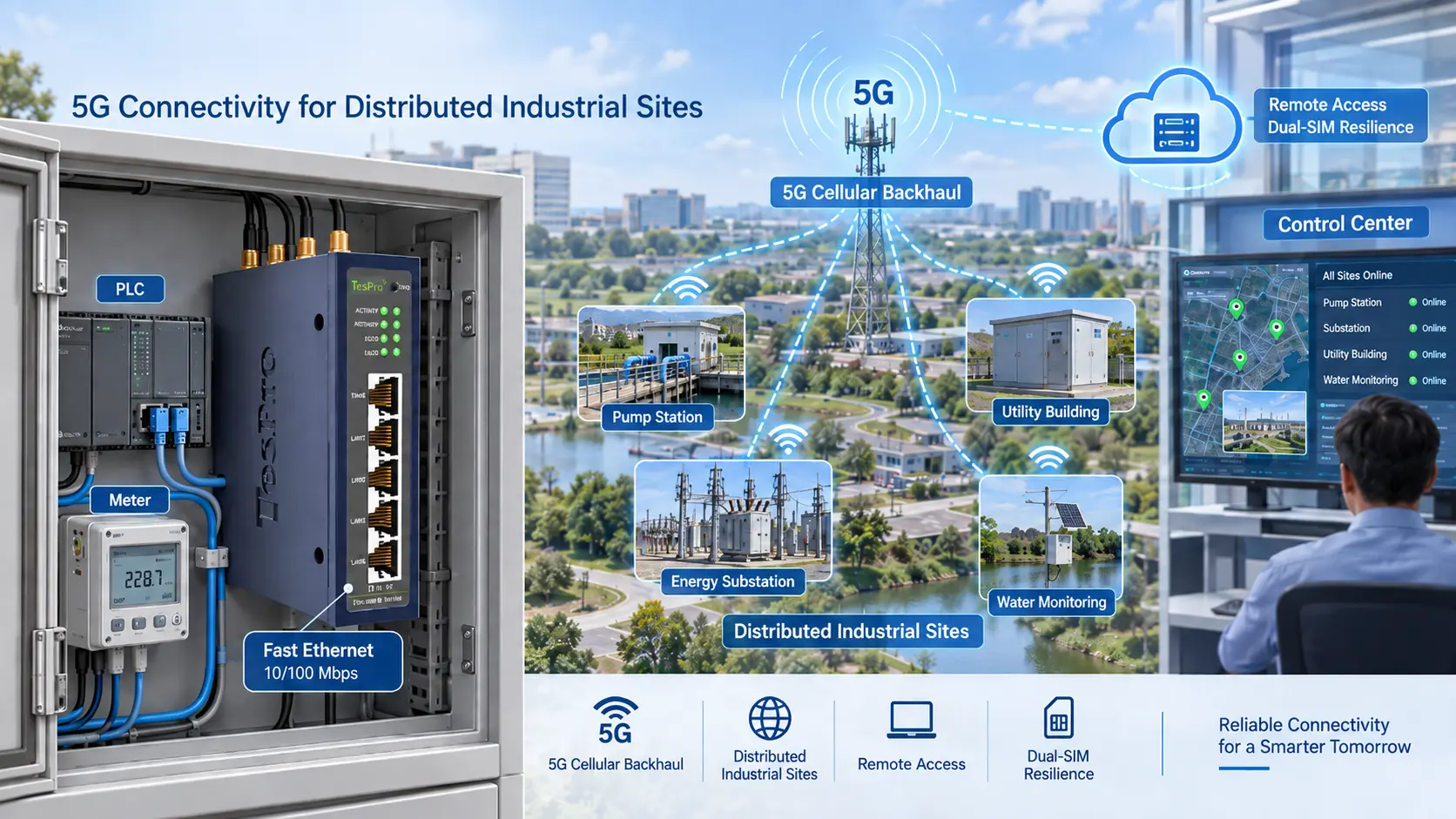

Distributed sites create a different networking problem
Industrial networks are no longer limited to one factory floor. Universities, transport systems, energy facilities and municipal infrastructure often contain remote cabinets or auxiliary buildings that cannot easily be connected to the main wired network. These sites need a reliable way to connect local devices while keeping deployment and maintenance manageable.
TR-245 as a cellular access point for field equipment
Tespro TR-245 supports 2G/3G/4G/5G cellular access and provides multiple 10/100 Mbps Ethernet ports together with RS485 and RS232 connectivity. This makes it useful for field sites that mix IP devices with legacy industrial equipment. The router can provide cellular backhaul while the local equipment continues communicating through familiar Ethernet or serial interfaces.
Where 5G helps without overstating local bandwidth
TR-245 combines a 5G-capable cellular WAN with 10/100 Mbps Ethernet on the local side. This makes it useful for distributed sites that need 5G coverage, responsive remote access, cellular migration or dual-SIM resilience while the connected local devices do not require Gigabit Ethernet. If the project needs high-throughput local networking as well as 5G, a Gigabit model is the more appropriate choice.
Example application
A distributed campus may have energy meters and control equipment in several buildings beyond the reach of the central IT network. TR-245 can provide cellular connectivity at each remote point, connect local devices over Ethernet or serial interfaces, and forward selected data to the central energy platform. Dual-SIM capability can be used to improve resilience where cellular coverage varies by operator.
Practical selection logic
TR-245 is most relevant when the user needs 5G cellular access, multiple Fast Ethernet connections and serial device connectivity but does not require Gigabit local networking or a full edge-computing gateway. It is a router-first solution: its role is to create a stable, manageable communication path between local industrial equipment and a remote system.
FAQ
Does a project always need 5G to use TR-245?
No. The model supports multiple cellular generations, so deployment can follow the network available in the target region.
What kinds of devices can connect locally?
Typical devices include PLCs, meters, controllers and other equipment using Ethernet, RS485 or RS232 communication.
Can TR-245 still be used where only 4G coverage is available?
Yes. Because it supports multiple cellular generations, the router can operate according to the network available at the deployment location.
Does TR-245 support legacy serial equipment?
Yes. RS485 and RS232 connectivity allow existing meters, PLCs and controllers to be integrated alongside Ethernet devices.
When is TR-245 a better choice than a full edge gateway?
Choose it when the main requirement is 5G-capable routing, remote access and device connectivity rather than local protocol processing, data transformation or edge computing.