-1791966549842.webp)






A Rugged Industrial Cellular Router installed in an outdoor cabinet operates under conditions that are far more demanding than a laboratory test bench. Solar loading, enclosure heat buildup, unstable DC power, metal shielding, antenna feeder loss, induced surges and condensation can all interrupt cellular connectivity even when the router itself remains within its published specifications.
For this reason, Tespro treats the selection of a Rugged Industrial Cellular Router as a system-engineering task rather than a single-parameter comparison. The TR industrial router, cabinet, power architecture, antenna system, carrier network and remote-maintenance strategy must be evaluated together.
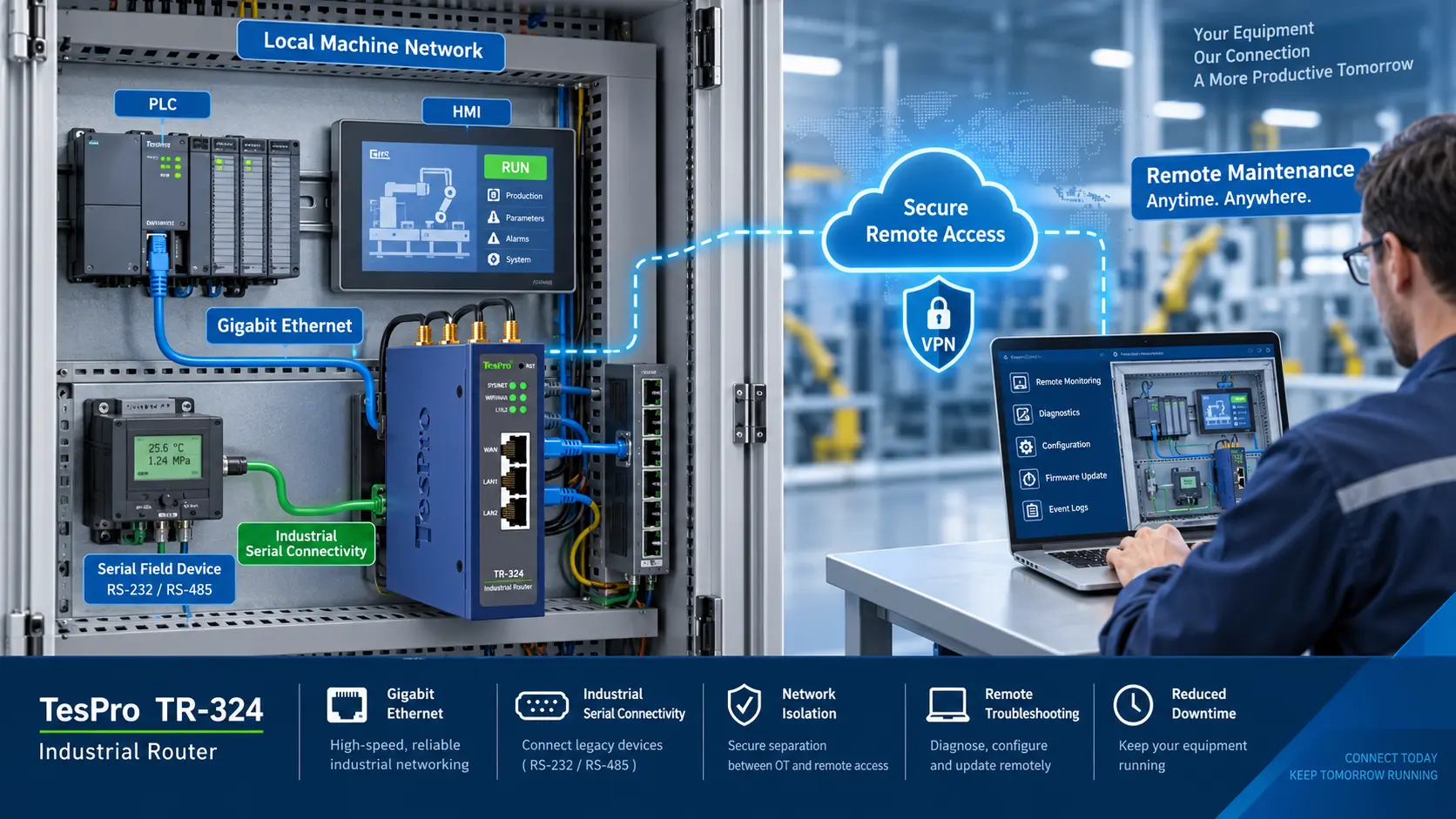
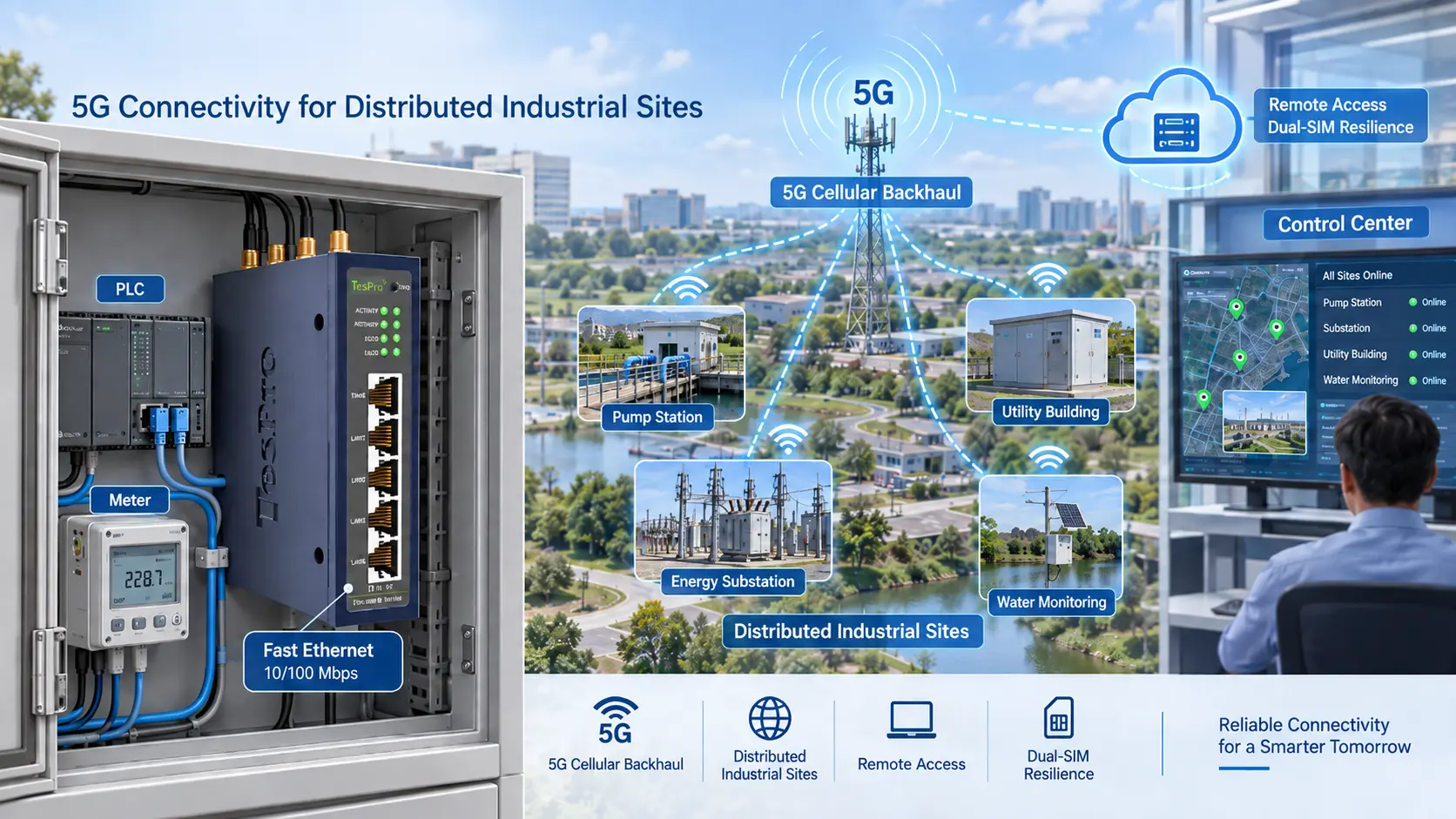
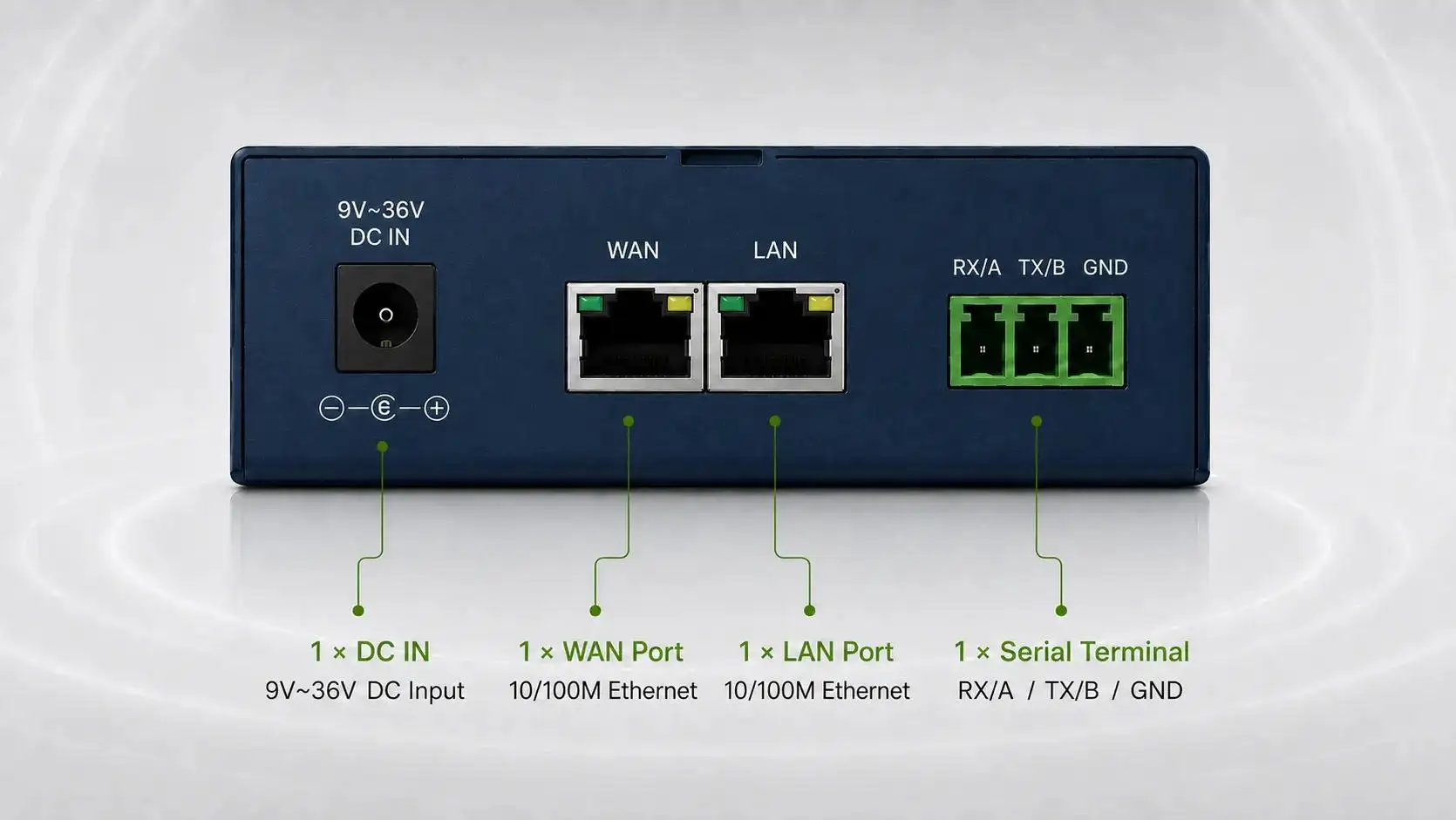
Tespro's TR industrial router portfolio covers cellular generations from 2G to 5G, with Ethernet, Wi-Fi, dual-SIM/failover, VPN and remote-management options across different configurations. The correct configuration should be selected against the actual installation environment rather than by maximum specifications alone.
Why Outdoor Ambient Temperature Is Not the Router Temperature
A common design error is to compare local weather data directly with the operating-temperature rating of a Rugged Industrial Cellular Router.
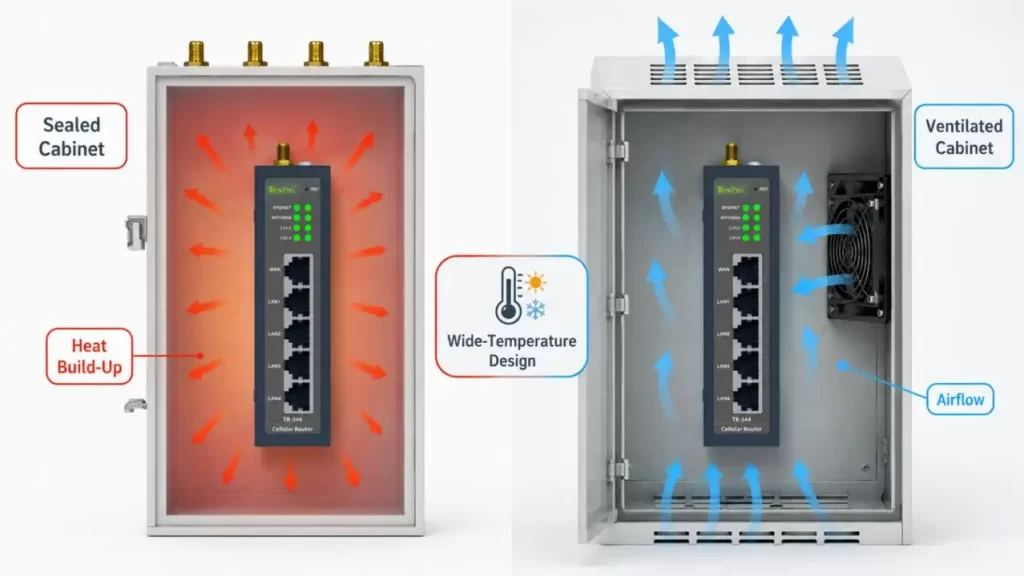
Inside a solar-exposed cabinet, actual temperature depends on several heat inputs:
•Outdoor ambient temperature;
•Solar radiation on the enclosure;
•Cabinet material, color and surface treatment;
•Heat generated by PLCs, PSUs and Ethernet switches;
•Router power dissipation;
•Equipment spacing and airflow;
•Ventilation, fan or cooling capacity.
The relationship is better understood as:
Ambient Temperature + Solar Load + Internal Heat − Heat Dissipation = Cabinet Thermal Condition
Tespro specifies operating temperatures down to -40°C and up to 75°C on multiple TR industrial router models. This range is useful for equipment selection, but it does not mean the router should be exposed directly to rain, sunlight, snow or uncontrolled outdoor conditions. A suitable protective enclosure and proper thermal design remain necessary.
Sealed Cabinet or Ventilated Cabinet?
| Cabinet Strategy | Main Advantage | Main Engineering Risk |
| Sealed enclosure | Better dust/water exclusion | Heat accumulation |
| Passive ventilation | Low power consumption | Limited cooling capacity |
| Filtered fan | Improved heat removal | Filter maintenance |
| Active cooling | Controlled temperature | Higher cost and power demand |
| Cabinet heater | Low-temperature/condensation control | Additional heat load |
The Rugged Industrial Cellular Router should therefore be selected after the cabinet thermal strategy is defined.
Wide DC Input Is Only One Part of Power Reliability
Outdoor industrial cabinets commonly use 12 VDC or 24 VDC supplies, but the nominal voltage is not the voltage the router necessarily sees at its terminals.
Field conditions may include:
•Long-cable voltage drop;
•Battery discharge;
•Short-duration brownouts;
•Motor and contactor switching;
•Unstable solar power;
•PSU startup transients;
•Lightning-induced surges.
A wide input range helps a Rugged Industrial Cellular Router tolerate normal supply variation. It does not automatically solve transient events or poor power quality.
| Power Solution | Function | Key Limitation |
| Direct DC feed | Simple power delivery | Minimal conditioning |
| DC/DC converter | Regulation or isolation | Adds thermal load |
| UPS/battery backup | Bridges short outages | Requires battery maintenance |
| External SPD | Diverts transient energy | Depends on correct grounding |
For IEC 61000-4-5 surge immunity, procurement teams should ask which ports were tested, at what test level and under what coupling conditions, rather than accepting "surge protected" as a complete specification.
Antenna Design Can Determine Cellular Reliability
A high-performance Rugged Industrial Cellular Router cannot compensate for poor antenna installation.
Metal cabinets can shield cellular RF signals, making external antennas preferable in many deployments. However, an external antenna introduces feeder loss, weather sealing and lightning-protection requirements.
Cabinet Antenna vs. External Antenna
| Inside Cabinet | External Antenna |
| Simple installation | Better placement flexibility |
| No exposed cable entry | Requires sealed feedthrough |
| May suffer metal shielding | Introduces coaxial loss |
| Lower external exposure | Requires surge-path assessment |
Antenna selection should consider the entire RF path:
Antenna Gain − Cable Loss − Connector Loss − Installation Loss = Effective RF Benefit
For LTE and 5G systems, MIMO performance also depends on antenna separation, orientation and local multipath conditions. A nominally higher-gain antenna is not automatically the better choice.
Tespro's 4G and 5G TR industrial router configurations should therefore be matched with the antenna arrangement, local cellular bands and operator coverage during cabinet design—not after commissioning problems appear.
Device Surge Immunity Does Not Replace Site Lightning Protection
An outdoor Rugged Industrial Cellular Router may be exposed to transient energy through several conductive paths:
•DC power wiring;
•Ethernet cables;
•External antenna feeders;
•Grounding conductors;
•Connections between separate cabinets.
Device-level surge immunity and site-level lightning protection serve different purposes.
A complete installation may require:
•Coordinated SPDs;
•Short bonding paths;
•Suitable earth connection;
•Protected cable entry points;
•Antenna-line surge protection;
•Separation of power and signal wiring.
IEC 61000-4-5 testing demonstrates immunity under defined surge conditions. It should not be interpreted as proof that equipment can withstand a direct lightning strike.
IP Rating Does Not Prevent Internal Condensation
Another frequent mistake is assuming that a sealed outdoor cabinet remains dry internally.
Ingress protection and condensation are different engineering problems.
Condensation occurs when:
Surface Temperature < Dew Point
Typical risk periods include:
•Rapid evening cooling;
•Cold equipment followed by warm humid air;
•Daily heating/cooling cycles;
•Moisture trapped during cabinet servicing.
IEC 60068-2-30 addresses cyclic damp-heat conditions associated with high humidity and temperature cycling. Depending on the site, mitigation may require:
•Pressure-equalization vents;
•Controlled ventilation;
•Enclosure heaters;
•Drainage strategy;
•Humidity monitoring;
•Appropriate component spacing.
A Rugged Industrial Cellular Router still requires a cabinet environment that keeps moisture within acceptable limits.
Select 4G, 5G and Dual SIM by Recovery Requirement
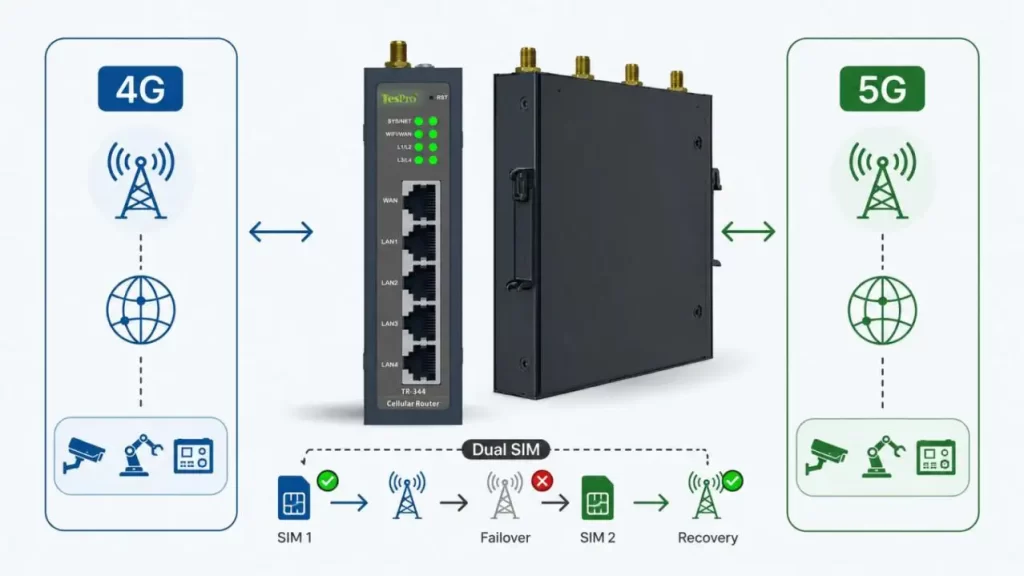
5G should not be specified simply because it offers higher peak bandwidth.
PLC telemetry, meters and pump stations may operate effectively over 4G, while applications such as multiple video streams or high-volume edge data may justify 5G.
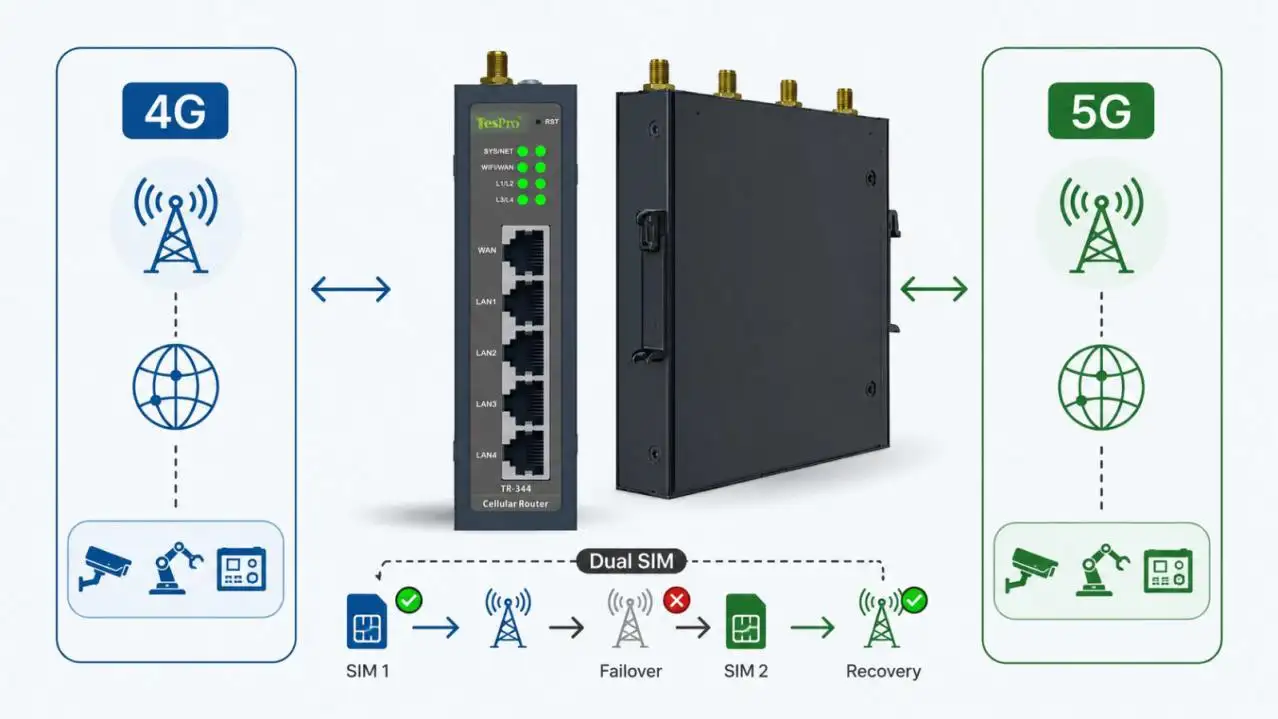
Dual SIM should also be evaluated by recovery time, not only by SIM count.
A real failover sequence may involve:
Link Failure → Health Check → SIM Switch → Network Registration → IP Assignment → VPN Recovery → Application Reconnection
Therefore, dual SIM improves network redundancy but does not guarantee zero interruption.
Tespro TR industrial routers provide different 4G/5G, dual-SIM, failover and VPN options, allowing the communication architecture to be selected around bandwidth, carrier diversity and acceptable recovery time.
Remote Operations Checklist for Outdoor Sites
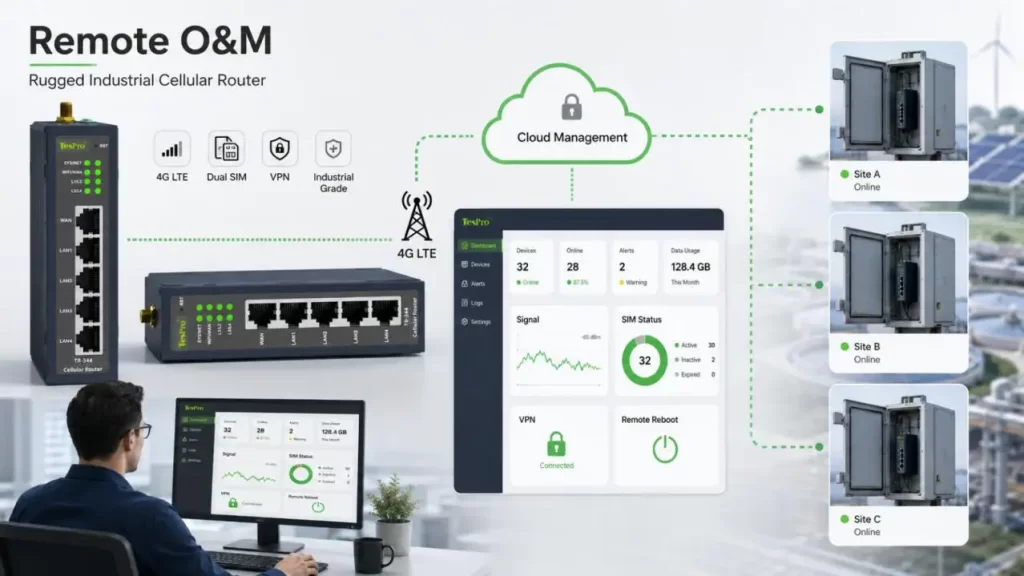
For unmanned cabinets, remote diagnostics can reduce unnecessary field visits.
A remotely managed Rugged Industrial Cellular Router should ideally provide visibility into:
•RSSI, RSRP, RSRQ and SINR;
•Cellular registration and operator status;
•SIM and failover state;
•WAN address and VPN status;
•Watchdog and reboot history;
•Connectivity health checks;
•Data consumption;
•Alarm/event logs;
•Firmware version;
•Configuration backup and restore.
Remote restart, SIM switching and watchdog functions can recover many software or network faults, but they cannot repair a failed PSU, damaged antenna, loose connector or water-contaminated cable.
Tespro incorporates remote-management capabilities into its TR industrial router direction, helping integrators manage distributed outdoor installations more efficiently.
Final Rugged Industrial Cellular Router Selection Checklist
Before approving a Rugged Industrial Cellular Router, verify:
•Actual cabinet temperature, not only outdoor weather;
•Suitable protective enclosure and installation conditions;
•DC voltage quality and surge exposure;
•Antenna position, feeder loss and MIMO layout;
•Grounding and SPD architecture;
•Condensation risk;
•4G/5G bandwidth requirements;
•Dual-SIM recovery behavior;
•Remote diagnostic and recovery functions;
•Applicable test reports and market compliance.
The best Rugged Industrial Cellular Router is therefore not simply the model with the widest temperature range or fastest modem. It is the configuration that fits the complete cabinet environment.
Tespro can support TR industrial router selection for outdoor cabinets, utilities, remote monitoring and harsh-environment projects, including configuration and OEM/ODM requirements, helping project teams align connectivity hardware with real installation conditions before deployment at scale.
FAQs
Q1. What Industrial Cellular Router options does Tespro provide?
Tespro's industrial TR routers provide multiple options and configurations for 4G and 5G industrial networking, remote monitoring, and deployment for distributed installations along with their models for bandwidth and interfaces. It also offers options based on carrier coverage and environmental needs.
Q2. Are Tespro Rugged Industrial Cellular Routers suitable for direct installation outdoors?
Tespro Rugged Industrial Cellular Routers should not be assumed to be a weatherproof product for unrestricted direct exposure outdoors. Protective cabinets or enclosures designed to meet the relevant dust, water, sun, heat, and condensation requirements should be used for all outdoor installations.
Q3. What are the considerations for evaluating the wide-temperature range of Tespro TR routers?
When evaluating the wide-temperature range of Tespro TR routers, the range of the operating temperature of the routers should be evaluated, along with the inner temperature of the installation cabinet, solar heating, ventilation, and heat of other nearby devices.
Q4. Does a wide DC input range remove the need for additional protection?
No. A wide DC input range improves power flexibility, but external protection may still be required for brownouts, voltage drop, switching pulses and lightning exposure.
Q5. Do Tespro TR industrial routers support dual-SIM failover?
Yes, Tespro provides dual-SIM failover functional TR industrial routers. Customers should verify switching logic and ensure the entire process from network registration, and IP and VPN restoration, to application reconnection is tested.