-1791966549842.webp)





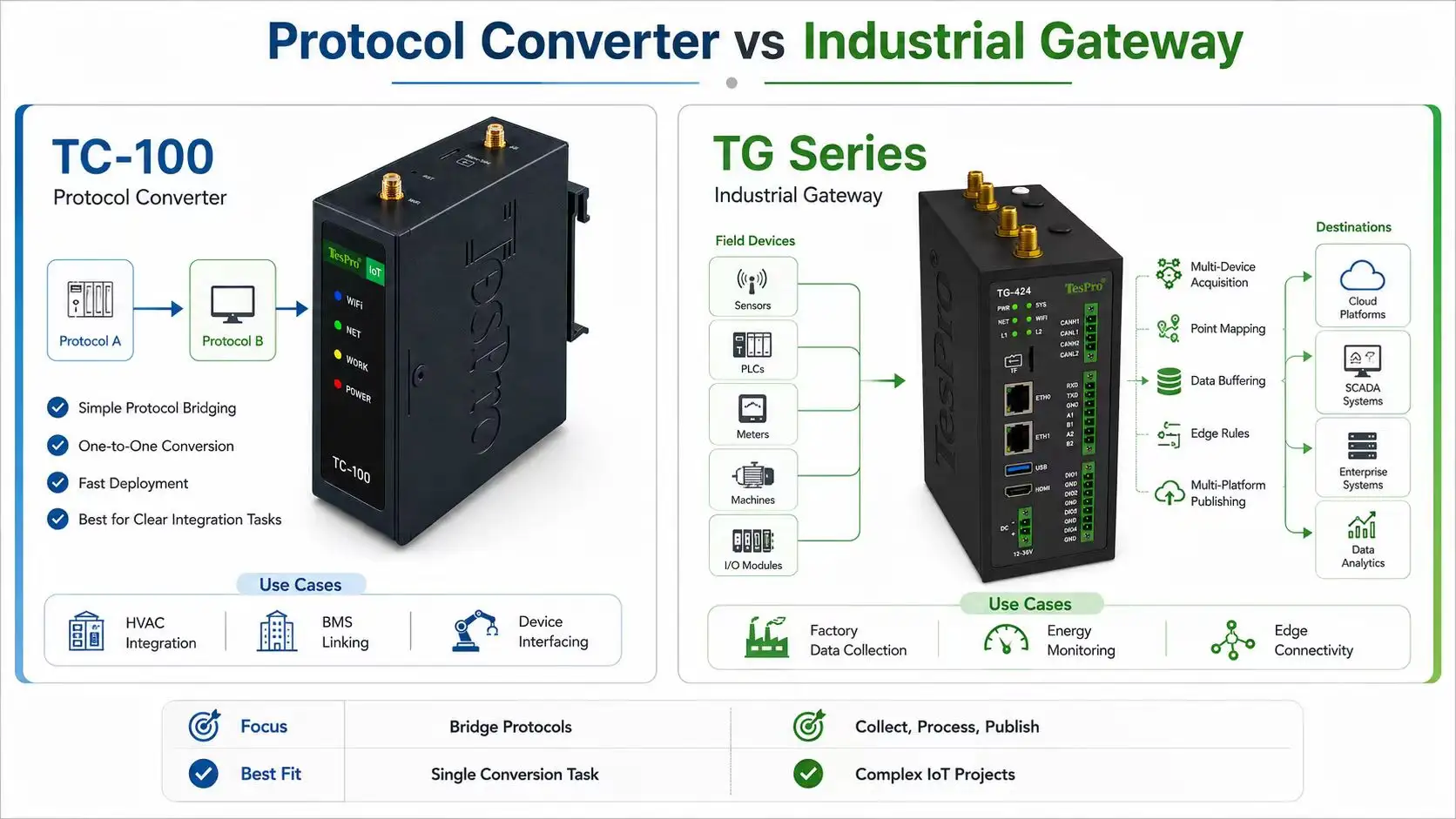

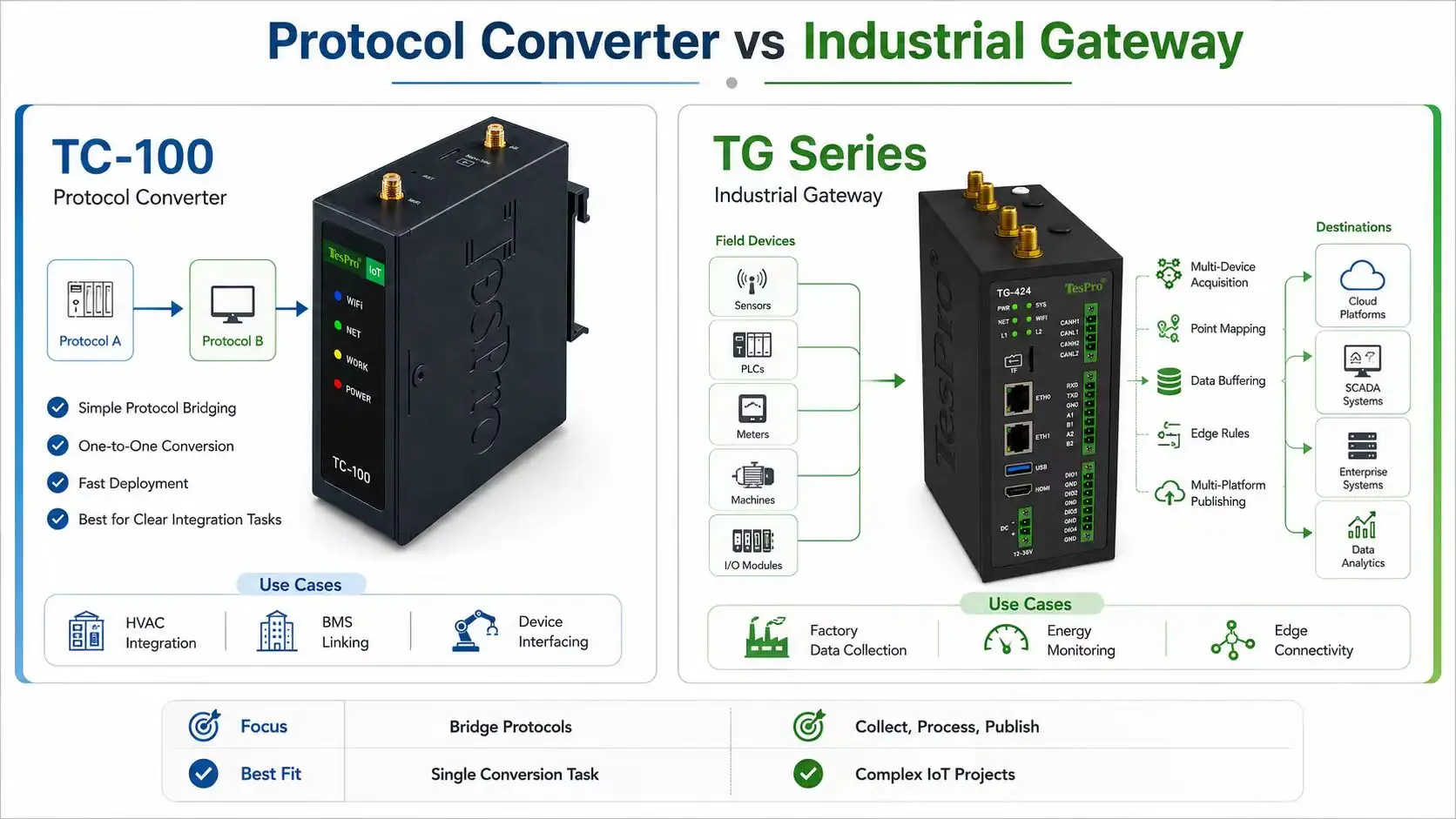
A protocol converter maps a defined source protocol to a defined target protocol and fits focused interoperability. An industrial gateway may also acquire multiple devices, normalize tags, buffer records, run rules or applications and connect multiple platforms. Select by project complexity rather than assuming more functions are always better.
Key Takeaways
• Use a converter for focused, limited protocol bridging.
• Use a gateway for multiple devices, platforms and edge logic.
• A more complex device is not automatically more reliable; workload fit matters.
Compare functional boundaries
A converter focuses on protocol A to protocol B. A gateway extends into acquisition, storage, applications and operations. A small mapping project may not need the complexity of a full gateway.
Compare expansion and maintenance
A gateway better supports future devices, rules and platforms but requires resource, software and version management. A converter remains more focused.
Compare total integration cost
Beyond unit price, include development, testing, configuration, training, updates and long-term maintenance.
How Tespro Fits
Tespro TC-100 can be evaluated for conversion among confirmed BACnet, Modbus and OPC UA combinations. Tespro TG Series gateways fit multi-protocol acquisition, tag mapping, buffering and edge applications. Select by points, interfaces, platforms and future expansion.
Compatibility and Selection Checklist
✓ Number of source and target protocols
✓ Device, interface and point scale
✓ Need for buffering, rules or scripts
✓ Number of platforms and data model
✓ Future expansion and development
✓ Budget, testing and maintenance resources
Frequently Asked Questions
Q: Is a protocol converter a type of gateway?
A: In a broad sense yes, but product selection should distinguish the actual functional boundary.
Q: Does BACnet-to-Modbus always require a TG gateway?
A: No. TC-100 may be evaluated first when points and functions are clearly defined.
Q: Is a gateway always more reliable because it has more features?
A: No. Reliability depends on hardware, software, load, configuration and environment.