-1791966549842.webp)







Power Calibrator accuracy is the backbone of reliable billing, safe power delivery, and honest energy use. At Tespro, we build three-phase instruments that make meter verification simple in the field, even for beginners. This guide explains why verification matters, how a three-phase Power Calibrator is used on-site, and how Tespro turns lab-grade capability into a compact tool you can carry to the meter base.
Three-Phase Meter Accuracy: Why It Matters
Three-phase watt-hour meters sit at the heart of commercial and industrial revenue. Small errors compound over time. A 0.5% drift on a large account can translate into significant annual losses or customer disputes. Beyond revenue, accuracy protects power quality programs and helps spot abnormal conditions. With growing concern about line losses and theft, utilities and facility managers need a practical way to validate meters in real operating conditions.
A modern Power Calibrator helps you do this on-site, without complex test benches. It checks accuracy at common grid frequencies (45 - 65 Hz), verifies pulse behavior, and highlights phase or wiring problems. When you can test at the point of service, you gain clarity and speed.
How a Three-Phase Power Calibrator Works On-Site
A three-phase Power Calibrator simulates or measures real loads across all three phases and compares the meter's registered energy to a known reference over a timed interval. In the field, that process must be fast, traceable, and safe. Tespro designed our handheld unit to support this workflow from setup to printed report.
Preparation
✓ Confirm the supply: 50 Hz or 60 Hz within 45 - 65 Hz
✓ Identify the test points and meter pulse output (if present)
✓ Ensure safe voltage access up to 480 V rating
✓ Plan at least two load points, including a low-current check
Verification Flow
✓ Connect phase inputs and reference leads according to the wiring guide
✓ Apply or measure voltages and currents; the wide 500:1 current range and 10,000:1 display resolution help you see tiny deviations as well as high-load behavior
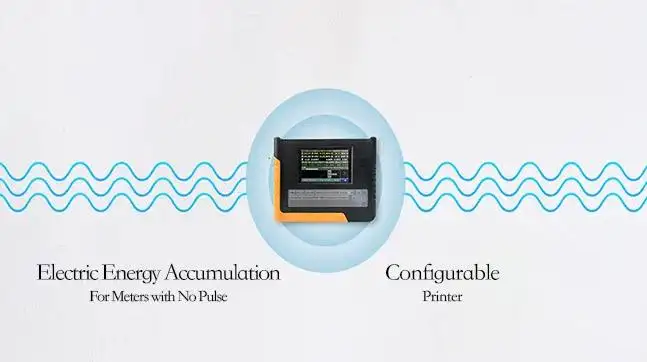
✓ Sense the meter's energy pulses; if the meter has no pulse port, use the built-in energy accumulation function to complete the test
✓ Record the error at each point and print a clear report on-site for audit trail
Why the details matter: low-current performance often reveals hidden issues in real facilities, especially at night or during standby periods. That is why Tespro supports a minimum start-up current of 1 mA and a starting voltage sensitivity down to 0.5 V. You can verify that meters behave properly even when loads are barely above idle.
What Sets Tespro's Power Calibrator Apart
Tespro builds for the realities of on-site work. Every specification translates into a practical advantage:
✓ Compact and handheld: Move from panel to panel without a cart or bench setup. Field teams complete more verifications in a shift.
✓ Wide measurement span: A 500:1 current range supports everything from milliamp checks to higher currents without swapping hardware, and the 10,000:1 display resolution helps you pinpoint small errors.
✓ Grid-ready inputs: Operate across 45 - 65 Hz at up to 480 V, so you can test typical three-phase systems confidently.
✓ Low-load insight: With 1 mA start-up and 0.5 V sensitivity, confirm that meters register correctly during off-peak hours and low-power modes.
✓ Pulse detection and beyond: Read pulses for classical error tests, or accumulate energy even when the meter lacks a pulse output. No more blocked tests due to missing terminals.
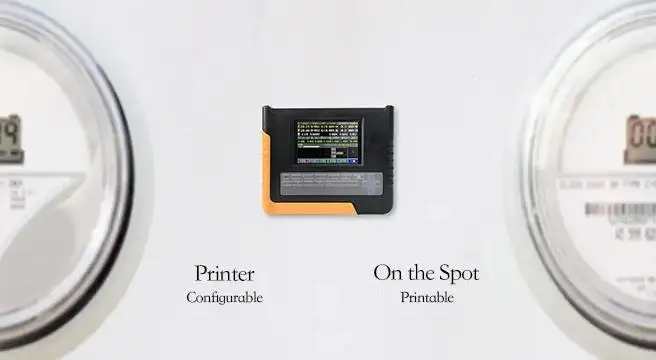
✓ Print on demand: Connect to a portable printer, configure, and produce a black-and-white report on-site. Close the job with documented results that your customer and auditor can both trust.
The result is a faster, clearer verification process that keeps your crews moving and your data defensible.
A Practical Guide to Verifying Watt-Hour Meters
Think in terms of three checkpoints: wiring, load points, and documentation.
- Wiring and phase check
Start with a visual inspection and a quick phase sequence confirmation. Mis-wires and CT polarity errors often account for the biggest accuracy problems. A Power Calibrator will reveal unusual phase angles or implausible energy flow.
- Load point testing
Run at least two points:
- A low point near the meter's start threshold. Tespro's sensitivity down to 1 mA and 0.5 V lets you confirm the meter begins registering when it should.
- A nominal point that represents typical operation. With 480 V capability and a broad current span, you can mirror real service conditions.
If time allows, add a higher point to observe linearity. Capture the percent error at each point and compare it to the meter's accuracy class target (for many revenue meters, Class 0.5 or better is common).
- Documentation
Finish by printing a test report. Include site, date, load points, pulse counts or accumulated energy, and calculated error. On-the-spot evidence reduces callbacks and gives your customer immediate clarity.
Detecting Leaks, Theft, and Abnormal Conditions
Anomalies often show up first as inconsistent energy behavior:
- A meter that under-registers only at very low current may indicate a sticky start.
- A sudden phase imbalance or negative power flow could mean backfeeding or tampering.
- Unexpected base load with no equipment scheduled points to leakage or wiring bypass.
With real-time pulse sensing and wide dynamic range, a Tespro Power Calibrator helps you spot these symptoms on the same visit you verify accuracy. You leave with a diagnosis, not just a number.
Service, Customization, and Support From Tespro
Every field team operates differently. Tespro supports customization to fit your workflow, including cable lengths, color options, and logo branding, as well as OEM/ODM services. You get competitive pricing, a 12-month warranty, continuous product upgrades, and permanent technical support with a 24-hour response commitment. That means faster deployment today and a roadmap for tomorrow.
Call to Action
Ready to verify three-phase meters with confidence? Contact Tespro to book a live demo, request a sample report, or get a quote for your team. Bring a Power Calibrator to your next site and prove accuracy on the spot - clearly, quickly, and credibly.