-1791966549842.webp)





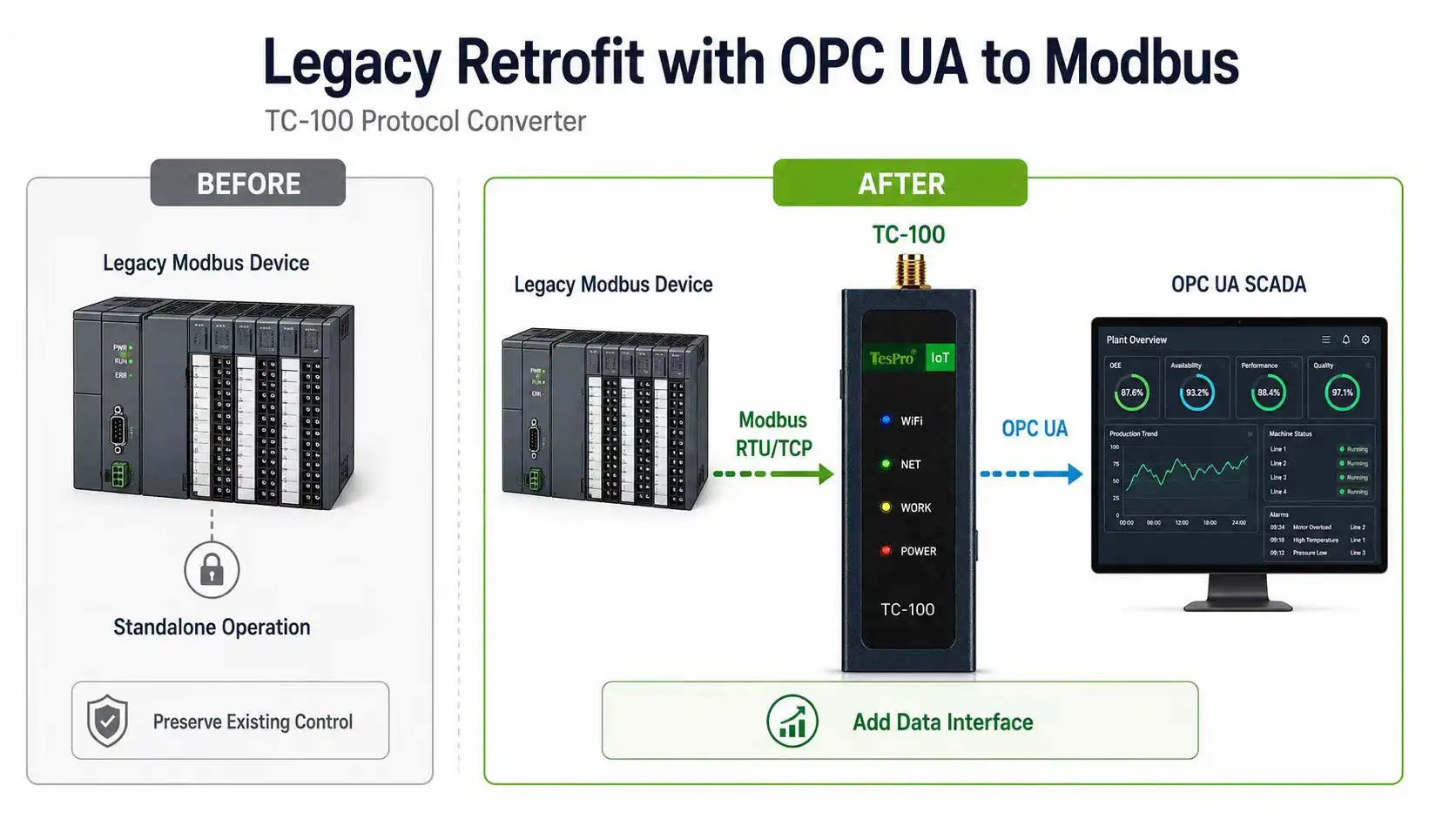

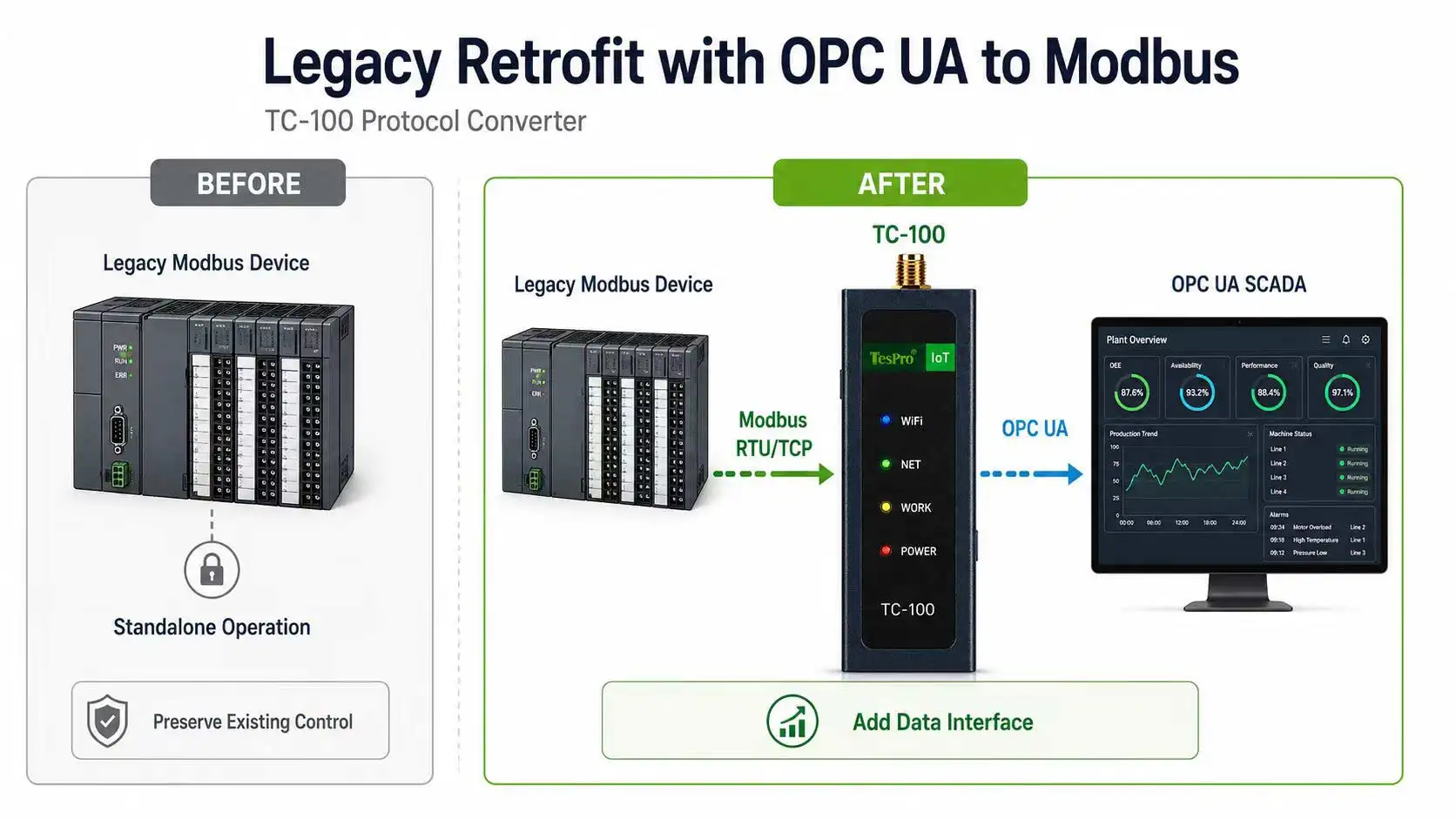
Legacy modernization can expose Modbus data to an OPC UA system through a converter or gateway without replacing the controller. The core principle is to preserve existing real-time control and safety logic while adding mapping, timestamps, quality and access control at the data-access layer.
Key Takeaways
• Protect existing control before adding data connectivity.
• Missing legacy documentation is a major risk.
• Start read-only and open writes gradually after validation.
Establish the current-state baseline
Record PLC or device model, firmware, serial settings, registers, scan cycle, existing HMI and exception states. Without a baseline, retrofit impact is difficult to measure.
Begin with read-only data
Map status and metering points into OPC UA, validate types, units, timestamps and quality, then evaluate writes.
Plan downtime, rollback and maintenance
The retrofit should include bypass, backup, rollback and a maintenance window while preserving independent operation of the original system.
How Tespro Fits
Tespro TC-100 fits focused Modbus and OPC UA bridging projects, while the TG Series is more suitable for multiple devices, buffering, rules and multiple upper-level systems. Select by legacy documentation, point count, writes and expansion needs.
Compatibility and Selection Checklist
✓ Legacy model, firmware and control boundary
✓ Modbus registers, types and scan cycle
✓ OPC UA nodes, certificates and clients
✓ Read-only and write scope
✓ Downtime, bypass, backup and rollback
✓ Long-term maintenance and documentation
Frequently Asked Questions
Q: Does modernization always require a new PLC?
A: No. Protocol conversion can add data access while preserving existing control.
Q: What if the register map is missing?
A: Vendor documents, existing HMI and packet analysis may help, but risk and testing increase.
Q: Can writes be enabled immediately?
A: It is not recommended. Validate read-only first, then evaluate writes and failure states one by one.