-1791966549842.webp)






Advanced metering infrastructure is not a continuous high-bandwidth application. It typically carries small, periodic meter readings, scheduled commands, event alarms and occasional bursts after an outage. The engineering challenge is therefore not peak speed alone, but maintaining a secure and observable data path across thousands of distributed sites.
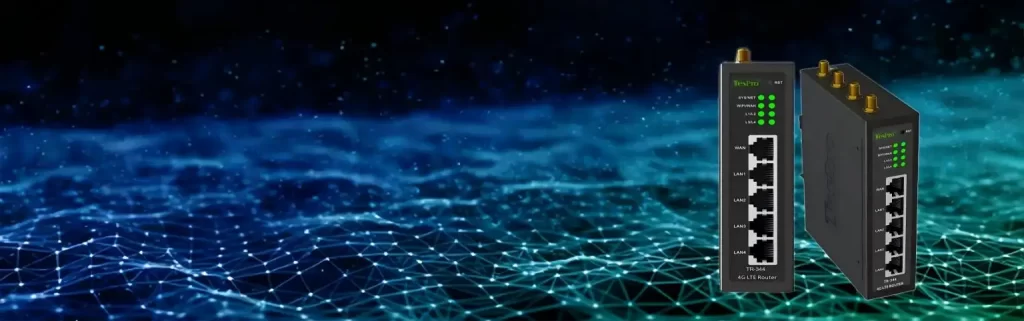
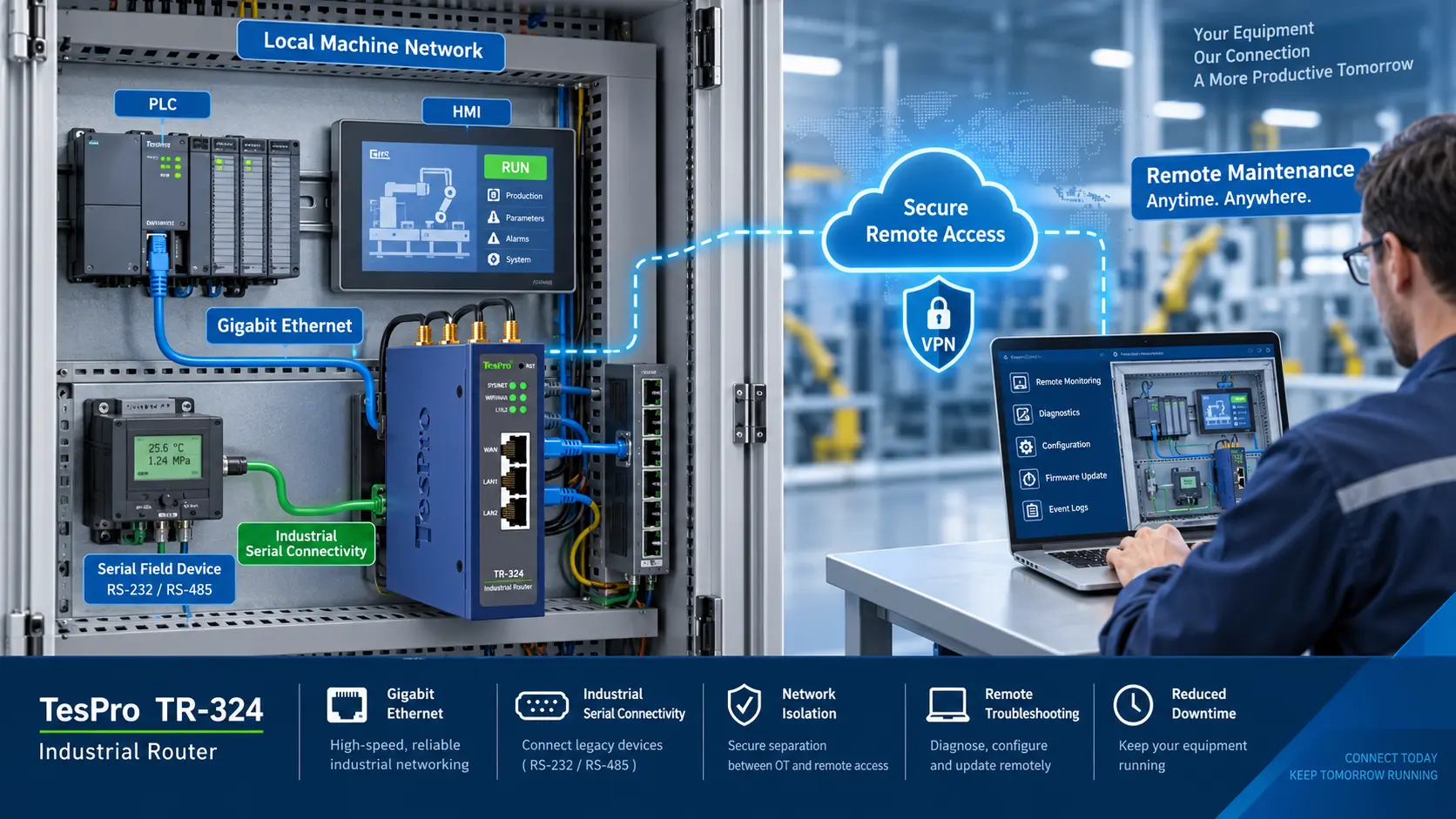
An Industrial Router With TesproOS Remote Management connects field equipment to utility platforms while giving engineers centralized control over network settings, security policies, software versions and device status.
The Industrial Router's Position in an AMI Network
A common AMI data path is:
Smart meters → Data concentrator or gateway → Industrial router → Cellular/Ethernet WAN → HES, MDMS or utility cloud
These components should not be treated as interchangeable.
| Component | Primary Responsibility |
| Smart meter | Records consumption, status and meter events |
| Data concentrator | Aggregates data from multiple meters |
| Industrial gateway | Parses protocols and performs edge processing |
| Industrial router | Provides WAN routing, VPN, firewall and failover |
| HES/MDMS | Collects, validates, stores and analyzes meter data |
An Industrial Router With TesproOS Remote Management primarily protects and maintains the WAN communication layer. If a project also requires meter-protocol conversion, data normalization or offline record storage, those functions must be confirmed in the concentrator, gateway or selected router configuration.
Why TesproOS Remote Management Matters
Managing five routers individually may be practical. Managing hundreds across substations, transformer cabinets, campuses and commercial facilities is not. Configuration drift can develop in APN settings, VPN parameters, firewall rules and firmware versions, even when all sites originally used the same template.
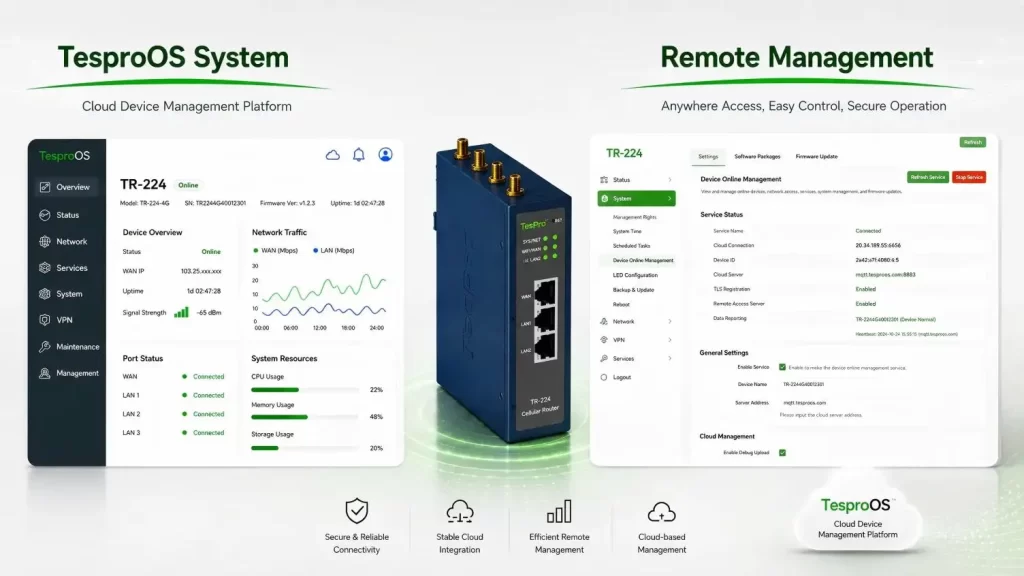
TesproOS provides a common software foundation for compatible Tespro devices, supporting functions such as:
• Remote status and alarm monitoring
• FOTA/SOTA software upgrades
• Batch configuration
• VPN and firewall management
• Device grouping and asset management
• Remote log review and troubleshooting
For an AMI operator, this creates a more structured maintenance workflow. Engineers can determine whether a failure is associated with cellular registration, signal quality, SIM status, the VPN tunnel, Ethernet connectivity or the downstream field device before dispatching personnel.
Remote management still cannot resolve damaged antennas, unstable power supplies, loose terminals or failed hardware. It reduces avoidable site visits; it does not remove the need for field maintenance.
Technical Criteria for AMI Router Selection
Selecting an Industrial Router With TesproOS Remote Management requires assessment of the complete communication path.
| Decision Area | Engineering Questions |
| Cellular coverage | Are the required regional bands and operators supported? |
| Signal performance | Can engineers monitor RSRP, RSRQ, SINR and registration status? |
| Redundancy | Does failover respond to lost data reachability, not only SIM disconnection? |
| Security | Are VPN, firewall, whitelisting and administrator controls available? |
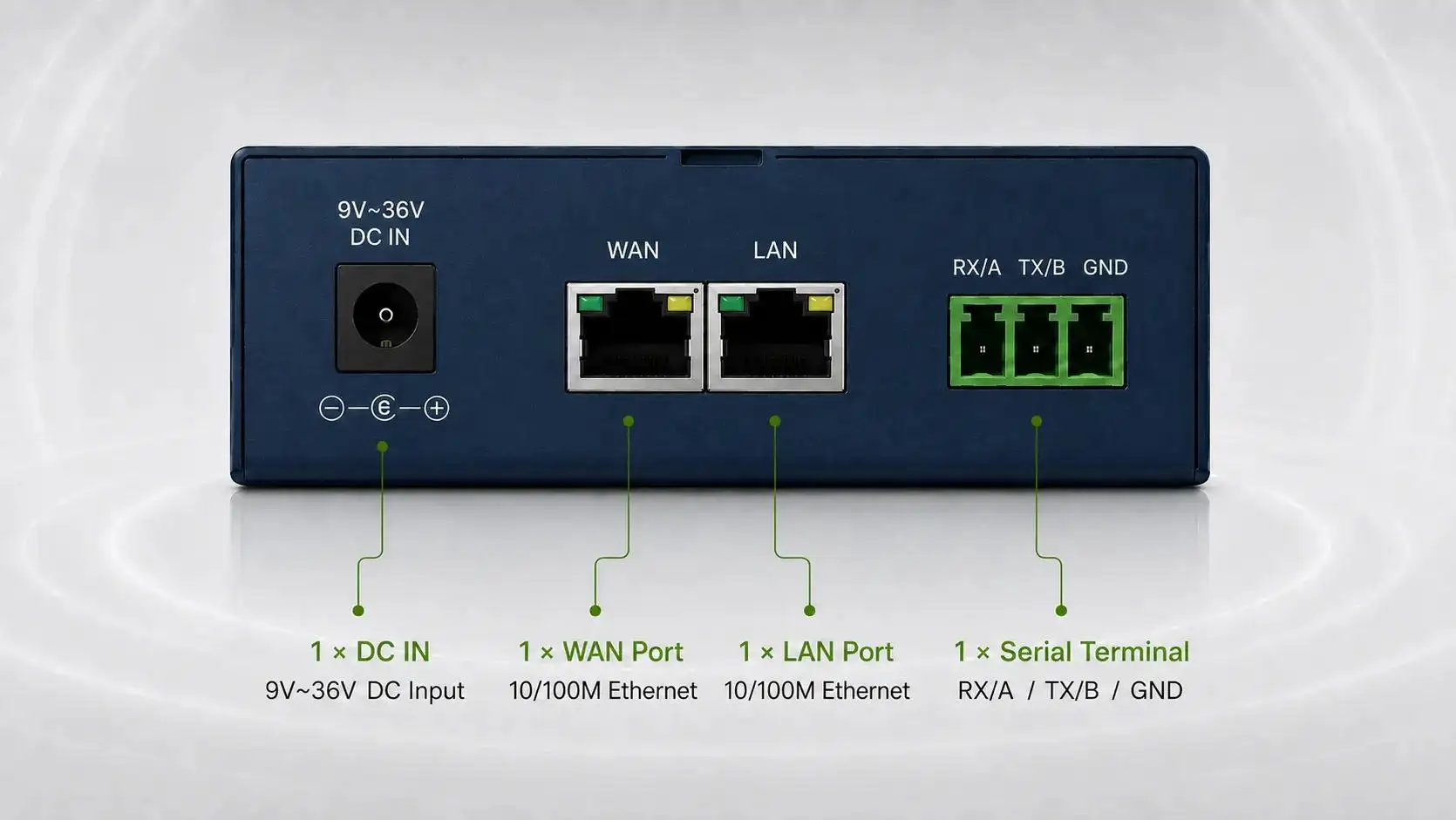
| Interfaces | Are the required WAN, LAN, serial or DIO interfaces provided? |
| Protocol role | Is transparent IP routing sufficient, or is protocol conversion required? |
| Performance | Are 100 Mbps ports adequate, or is Gigabit Ethernet justified? |
| Environment | Do power input, temperature, EMC and installation specifications match the cabinet? |
| Integration | Can the router connect to the existing HES, MDMS, SCADA or cloud platform? |
| Lifecycle | Can configurations, logs, permissions and software versions be managed at scale? |
Exact functionality should always be checked against the selected hardware, firmware and regional configuration.
4G and 5G Are Different Design Choices
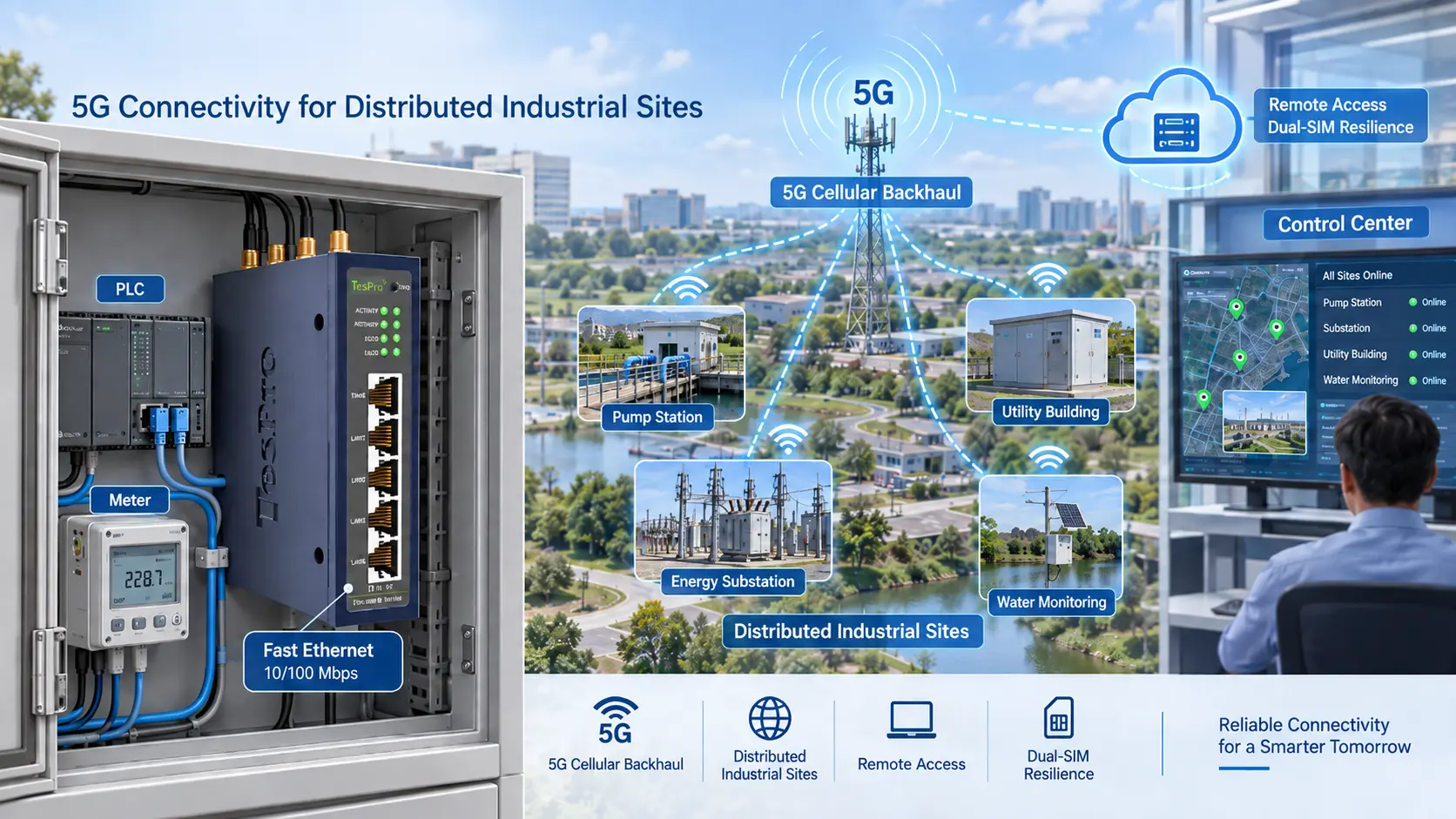
For routine meter reads, alarms and remote configuration, a stable 4G connection is often sufficient. AMI traffic is usually more sensitive to availability, reconnection time and packet delivery than to maximum throughput.
A 5G configuration becomes more relevant when a site:
• Aggregates a large number of downstream devices
• Shares the WAN link with feeder automation or condition monitoring
• Requires more frequent telemetry
• Runs edge applications with larger datasets
• Must support future high-bandwidth services
When specifying an Industrial Router With TesproOS Remote Management, utilities should compare real operator coverage, antenna conditions, data plans and network longevity rather than selecting 5G solely for its theoretical speed.
Security Requires More Than a VPN Checkbox
Remote management introduces a control path into field infrastructure, so it must be designed deliberately. A practical AMI security architecture may include:
• Private APN or controlled carrier connectivity
• IPsec or OpenVPN tunnels
• Default-deny firewall policies
• IP whitelisting and restricted management ports
• Separation of metering, maintenance and corporate networks
• Role-based administrator permissions
• Credential and certificate rotation
• Logged configuration and software changes
TesproOS supports encrypted VPN connections, firewall rules and IP access controls on compatible devices. These capabilities strengthen the communication layer, but an Industrial Router With TesproOS Remote Management cannot independently establish complete smart-grid compliance. Security also depends on platform authentication, key management, utility procedures and network segmentation.
Redundancy Must Be Tested End to End
A router can remain powered and registered while application data is no longer reaching the HES. Availability monitoring should therefore verify the complete path, not only device uptime.
Before rollout, test:
• Weak-signal and network-loss recovery
• Primary-to-secondary SIM switching
• WAN and VPN tunnel reconnection
• Power interruption and automatic restart
• Configuration restoration
• Interrupted or unsuccessful software updates
• Communication recovery with the HES or MDMS
Dual SIM also requires genuine operator diversity. Two SIM cards using the same underlying network may not provide meaningful redundancy. Offline meter-data buffering should be confirmed separately because storage may reside in the meter, concentrator or gateway rather than the router.
From Pilot Deployment to Fleet Operation
At Tespro, we recommend validating an Industrial Router With TesproOS Remote Management in representative field conditions before large-scale deployment:
- Survey operators, signal strength and antenna locations.
- Map meters, concentrators, gateways and platform endpoints.
- Define APN, VPN, firewall and access-control policies.
- Create a controlled baseline configuration.
- Pilot the system at several different site types.
- Test failover, reboot and remote-upgrade behavior.
- Expand in batches while monitoring exceptions.
This approach exposes coverage, integration and recovery issues before they affect a large router fleet.
Tespro Engineering for AMI Connectivity
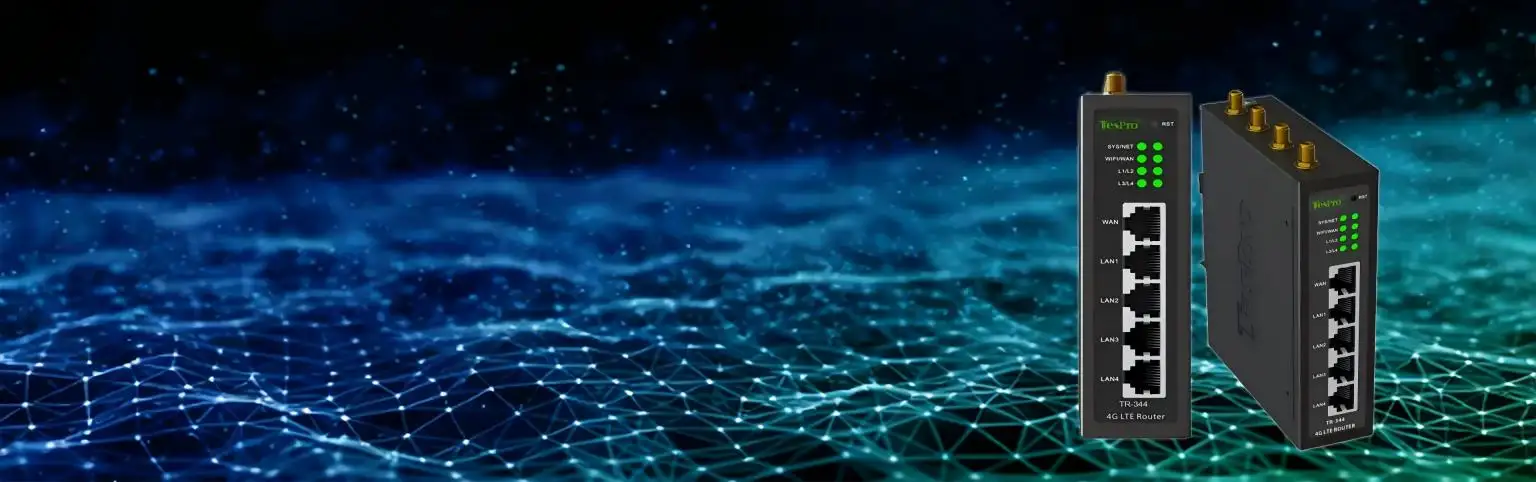
Tespro industrial cellular routers support cellular options from 2G through 5G, together with Ethernet, Wi-Fi, dual-SIM redundancy, VPN and cloud-based management. Different models provide varying port counts, 100 Mbps or Gigabit Ethernet, and Wi-Fi configurations, allowing the hardware to be matched to the actual AMI architecture.
TesproOS adds graphical configuration, remote operation, system monitoring and software lifecycle tools for compatible TR routers and TG gateways. Our hardware and software teams can also support OEM/ODM requirements involving interfaces, network configuration and platform integration.
A well-designed Industrial Router With TesproOS Remote Management should make an AMI network easier to observe, secure and maintain—not merely connect it to a cellular tower. Utilities and system integrators can review the Tespro industrial router range or share their field-device, operator and platform requirements with our engineering team.
FAQs
Q1. What Does a Tespro Industrial Router Do in an AMI Network?
A Tespro industrial router establishes the WAN connection between field equipment and the HES, MDMS, SCADA or utility cloud. It can provide cellular connectivity, VPN protection, firewall control and network redundancy.
Q2. Which Tespro Routers Support TesproOS Remote Management?
TesproOS is available for selected Tespro TR Series industrial routers and TG Series gateways. Supported functions vary by hardware and firmware, so customers should confirm compatibility for the selected model.
Q3. Does Tespro Offer Both 4G and 5G Industrial Routers?
Yes. Tespro offers industrial router configurations supporting network generations from 2G through 5G. Available cellular bands and operator compatibility depend on the model and target deployment region.
Q4. Does a Tespro Industrial Router Support Dual-SIM Failover?
Selected Tespro routers support dual SIM and automatic connection failover. Project engineers should verify failover triggers, operator diversity, reconnection time and preferred-SIM recovery during commissioning.
Q5. What Can Engineers Manage Remotely Through TesproOS?
Depending on the device configuration, TesproOS can support remote status monitoring, graphical configuration, alarms, log review, VPN settings, batch configuration, asset management and FOTA/SOTA upgrades.