-1791966549842.webp)





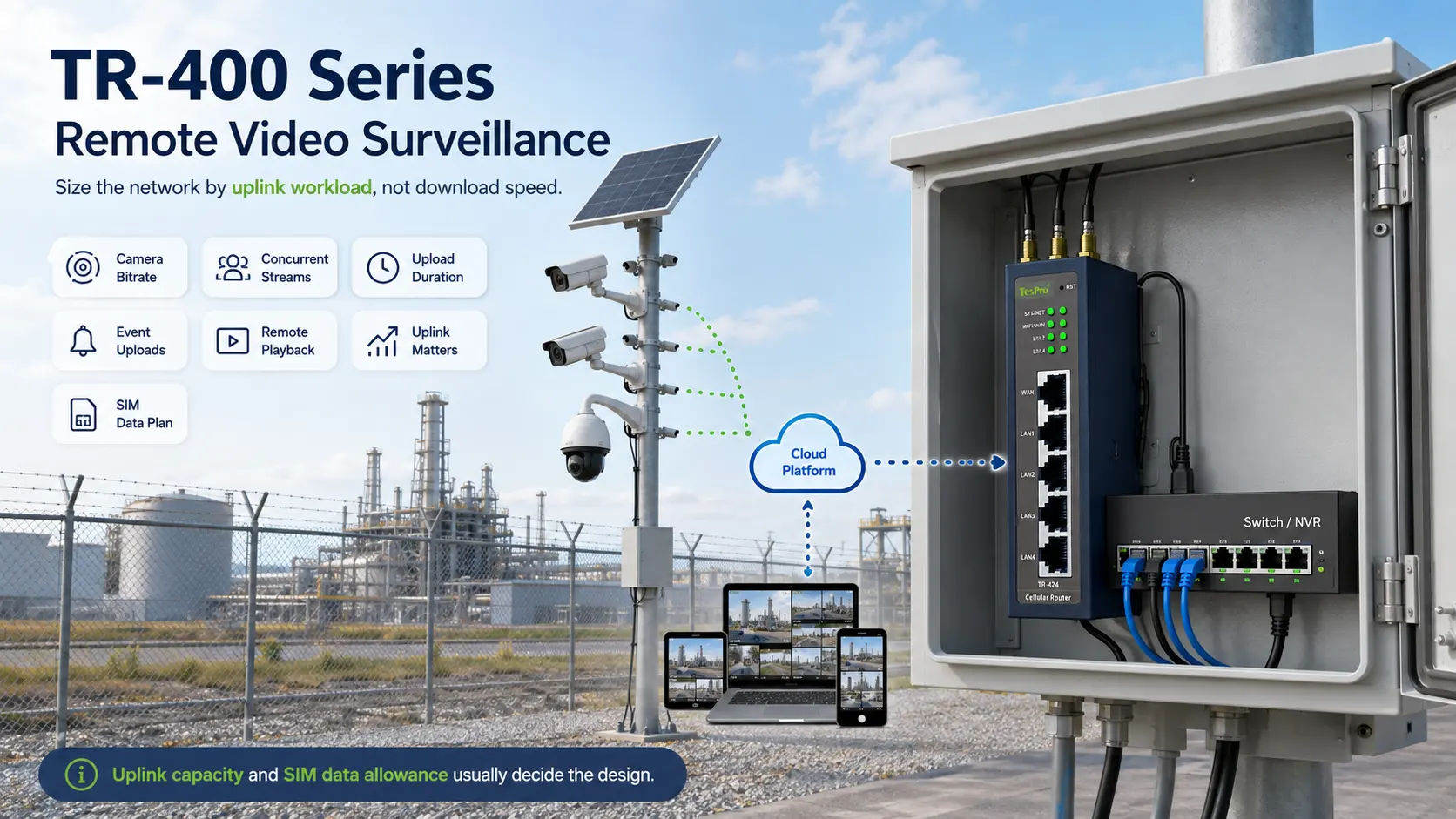

Video backhaul must be sized from camera bitrate, concurrent streams, upload duration, event policy and remote playback—not the router's advertised download speed. Uplink and SIM data are usually decisive.
Key Takeaways
- Bitrate × concurrency × time drives base traffic
- H.265, frame rate and resolution affect bitrate
- Local recording and event upload can reduce continuous traffic
Technical Principle and Project Value
Video backhaul must be sized from camera bitrate, concurrent streams, upload duration, event policy and remote playback—not the router's advertised download speed. Uplink and SIM data are usually decisive. In a real project, bitrate × concurrency × time drives base traffic and h.265, frame rate and resolution affect bitrate must be considered in the same architecture. Begin with the workload, field devices and operating model rather than one marketing specification.
Parameters to Confirm During Implementation
A practical sequence is to confirm camera count and per-stream bitrate, then verify continuous/event upload and local nvr, and finally test local recording and event upload can reduce continuous traffic with the real equipment. Record pass criteria so the design can be repeated across sites.
Why Real-Workload Testing Is Necessary
Actual carrier uplink changes with signal and congestion; one speed test does not represent long-term capacity. Public content and project documents should therefore state model, firmware, regional network, options and environmental conditions and avoid unverifiable claims such as 'works for every project' or 'absolute reliability'.
How Tespro Fits
Tespro TR-424/TR-444 can be evaluated for moderate 4G video workloads; TR-425/TR-445 fit projects needing 5G and higher concurrency. Select port count by camera/switch topology.
Decision and Verification Table
| Decision factor | What to verify |
| Bitrate × concurrency × time drives base traffic | Confirm against camera count and document pass/fail criteria in the pilot or site test. |
| H.265, frame rate and resolution affect bitrate | Confirm against per-stream bitrate and document pass/fail criteria in the pilot or site test. |
| Local recording and event upload can reduce continuous traffic | Confirm against continuous/event upload and document pass/fail criteria in the pilot or site test. |
Compatibility and Selection Checklist
- ✓ Camera count
- ✓ Per-stream bitrate
- ✓ Continuous/event upload
- ✓ Local NVR
- ✓ Average/peak uplink
- ✓ SIM plan
Frequently Asked Questions
Q: Do four cameras always require 5G?
A: No. It depends on per-camera bitrate, concurrent viewing, site 4G uplink and local recording.
Q: How can monthly data be estimated?
A: Multiply average actual upload bitrate by active upload time, then add playback, snapshots and protocol overhead.
Q: Can a multi-port router replace a PoE switch?
A: No. Published Ethernet ports should not be assumed to provide PoE.
Next Step
Provide camera count, per-stream bitrate, continuous/event upload, expected quantity and project schedule so Tespro can evaluate the model, sample test and deployment path.