-1791966549842.webp)






Direct Answer
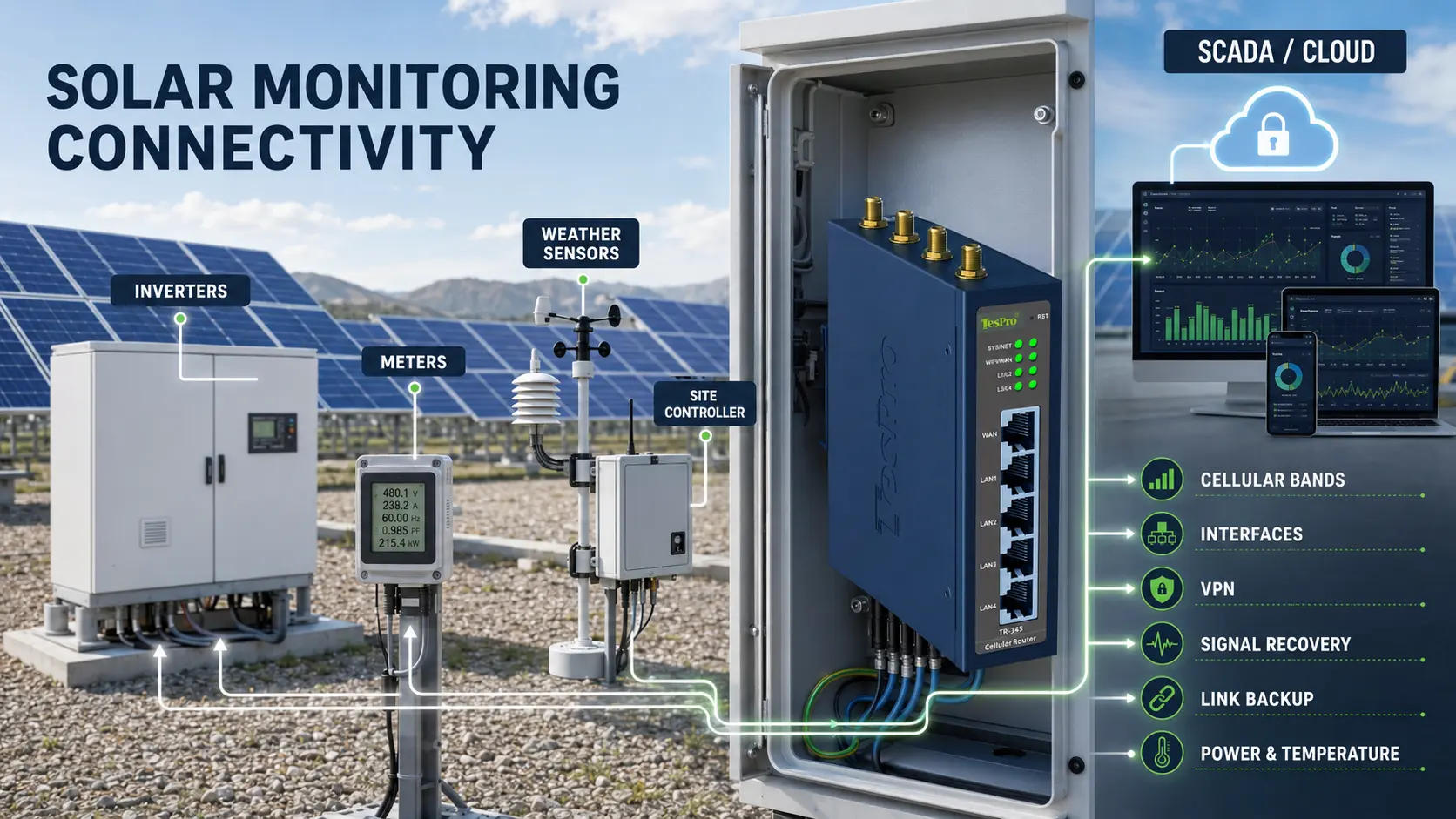
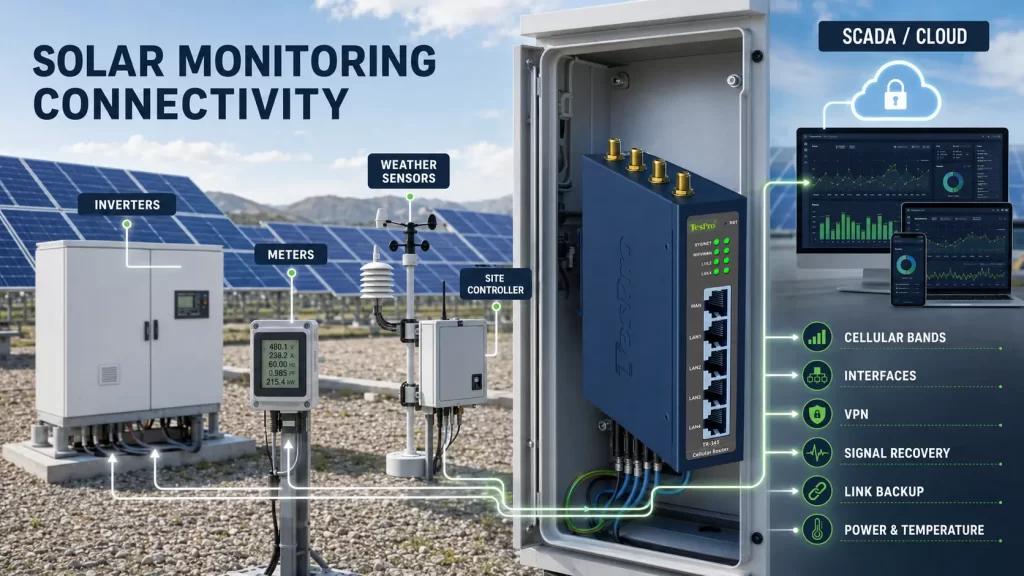
An industrial router for solar monitoring connects inverters, meters, weather sensors and site controllers to a SCADA or cloud platform. Selection should cover local cellular bands, interfaces, VPN topology, weak-signal recovery, link redundancy, cabinet temperature and power rather than focusing only on 4G or 5G.
Key Takeaways
• Solar telemetry is usually modest; coverage and automatic recovery often matter more than peak speed.
• The router provides backhaul, while inverter protocol parsing is normally handled by a collector or gateway.
• A pilot should test redial, VPN recovery, buffered retransmission and hot-cabinet operation.
Connectivity challenges at solar sites
Solar plants may be located on rooftops, in rural areas or in high-heat environments with uneven coverage, unstable power and limited on-site support. The router must recover after long outages and expose useful status and logs for remote maintenance.
Recommended data path
A common design connects inverters, meters and weather stations to a data collector or gateway, then uses an industrial router for cellular backhaul, enterprise VPN and SCADA access. Add a TG Series gateway when protocol parsing, tag mapping or local buffering is required.
Questions to answer before selection
Confirm site count, device interfaces, reporting interval, maintenance method, carrier coverage, antenna location, acceptable outage time and environmental limits. 5G is usually justified only when the site also carries sustained video or other high-bandwidth traffic.
How Tespro Fits
Tespro TR Series industrial routers can be evaluated for solar-site backhaul, VPN-based maintenance and link redundancy, with TR-100 as a representative option for standard telemetry projects. Confirm bands, dual-SIM behavior, ports and environmental ratings from the current datasheet. Pair with a Tespro TG Series gateway when protocol parsing or local buffering is required.
Compatibility and Selection Checklist
✓ Country, carrier and required bands
✓ Inverter, meter and weather-station interfaces and protocols
✓ VPN topology, remote users and access permissions
✓ Primary/backup links, antenna and weak-signal testing
✓ Cabinet temperature, power, surge and mounting
✓ Site count, data usage and expected quantity
Frequently Asked Questions
Q: Does every solar plant need a 5G industrial router?
A: No. 4G is usually sufficient for inverter, meter and alarm data. Evaluate 5G when the same site carries multiple video streams, images or large files.
Q: Can an industrial router read every inverter directly?
A: Not necessarily. A router provides IP connectivity; inverter protocols are normally parsed by a collector, PLC or industrial gateway.
Q: Can the site be maintained without a fixed public IP?
A: Often yes. The router can initiate a connection to an enterprise VPN or remote-management platform and operate behind carrier NAT.