-1791966549842.webp)





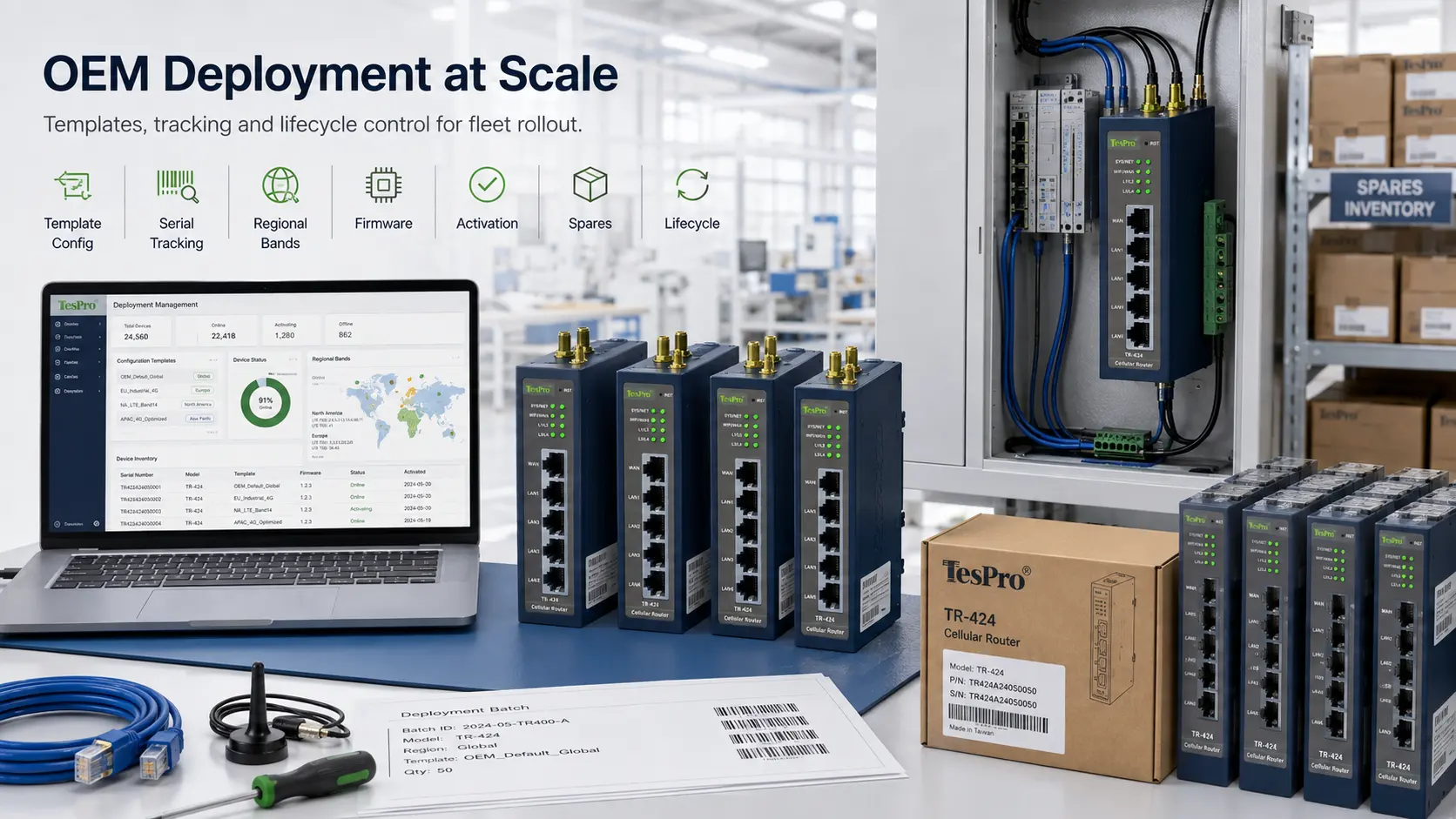

Fleet-scale OEM deployment depends less on one router's specifications and more on configuration templates, serial-number tracking, regional bands, firmware versions, activation, spares and lifecycle process.
Key Takeaways
- Build a country/carrier configuration matrix
- Separate factory defaults from customer-site settings
- Changes should be traceable and reversible
Why This Topic Has Commercial Value
Fleet-scale OEM deployment depends less on one router's specifications and more on configuration templates, serial-number tracking, regional bands, firmware versions, activation, spares and lifecycle process. In a real project, build a country/carrier configuration matrix and separate factory defaults from customer-site settings must be considered in the same architecture. Begin with the workload, field devices and operating model rather than one marketing specification.
Reduce Risk with Verifiable Information
A practical sequence is to confirm country list and expected quantity, then verify branding and packaging and default configuration template, and finally test changes should be traceable and reversible with the real equipment. Record pass criteria so the design can be repeated across sites.
Tespro Cooperation Boundaries and Next Step
Shipping one configuration before confirming bands, certifications and SIM policy can cause registration or compliance problems. Public content and project documents should therefore state model, firmware, regional network, options and environmental conditions and avoid unverifiable claims such as 'works for every project' or 'absolute reliability'.
How Tespro Fits
Tespro can evaluate OEM/private-label, preconfiguration and volume needs around the TR-400 Series. Customization scope, MOQ, lead time and software functions require project review.
Decision and Verification Table
| Decision factor | What to verify |
| Build a country/carrier configuration matrix | Confirm against country list and document pass/fail criteria in the pilot or site test. |
| Separate factory defaults from customer-site settings | Confirm against expected quantity and document pass/fail criteria in the pilot or site test. |
| Changes should be traceable and reversible | Confirm against branding and packaging and document pass/fail criteria in the pilot or site test. |
Compatibility and Selection Checklist
- ✓ Country list
- ✓ Expected quantity
- ✓ Branding and packaging
- ✓ Default configuration template
- ✓ Firmware strategy
- ✓ Support and spares
Frequently Asked Questions
Q: Can configurations be preloaded for a volume project?
A: It can usually be evaluated after receiving the standard template, regional information and security requirements.
Q: Can one cellular variant be used in every country?
A: Not always. Bands and certifications may differ, so create a regional model matrix.
Q: Does private labeling only change the logo?
A: It may include labels, packaging, interface or documentation, but scope and MOQ require confirmation.