-1791966549842.webp)






In the era of Industry 4.0 and smart manufacturing, machines, PLCs, sensors, and actuators must communicate seamlessly. However, they often speak different languages—MODBUS and PROFINET are two of the most popular industrial protocols. So how can a single Industrial Router DIN Rail understand both and bridge them to the cloud or a control center? This article takes a science-driven, step-by-step approach to explain the translation mechanism, while highlighting how the Tespro TR-225 5G Industrial Cellular Router embodies these capabilities with its rugged design and protocol intelligence.
Why Do Industrial Protocols Need a "Translator"?
Protocol diversity in one factory: A single production line may contain MODBUS RTU sensors (serial), MODBUS TCP drives (Ethernet), and PROFINET controllers (real-time Ethernet).
• No native mutual understanding: MODBUS uses a simple request-response model; PROFINET relies on time-critical cyclic data exchange. Without a gateway, they cannot interpret each other's frames.
• The router as a bridge: An Industrial Router DIN Rail with built-in protocol conversion sits between field devices and the IP network, transforming industrial traffic into standard TCP/IP or MQTT for cloud platforms.
1. How Does an Industrial Router "Hear" MODBUS?
MODBUS is the most widely used serial communication protocol in industrial automation. It exists in two main variants: MODBUS RTU (RS232/RS485) and MODBUS TCP (Ethernet).
MODBUS RTU Over Serial – The Traditional Voice
• Physical layer via RS485/RS232: The router's serial ports (e.g., TR-225 offers 1×RS485 + 1×RS232) directly connect to legacy MODBUS RTU devices.
• Frame interpretation: The router listens for binary frames (address, function code, data, CRC). It extracts register values (temperature, pressure, speed) without disturbing the original device.
• Local edge processing: Instead of forwarding every raw byte, the router can pre-process data—scaling, averaging, or alarm triggering—before sending to the cloud.
MODBUS TCP – The Ethernet Evolution
• Encapsulated in TCP/IP: MODBUS TCP wraps the same data model into a TCP packet (port 502). A 5G/LTE router like the TR-225 can route these packets natively.
• Gateway mode – RTU to TCP: The router reads MODBUS RTU from a sensor, repackages it as MODBUS TCP, and forwards it over cellular to a SCADA server.
• Multiple master support: An industrial router can act as a "virtual master" polling several slave devices, then serve aggregated data to a cloud platform via MQTT or REST API.
TR-225's MODBUS Strengths at a Glance
• Rich serial interfaces: One RS485 and one RS232 enable simultaneous connection to legacy meters and modern drives.
• Built-in electric meter protocols: DL/T 645-2007, IEC 62056-21, IEC 61850, and DLMS – ideal for energy monitoring alongside MODBUS.
• OPC UA support: Converts MODBUS data to OPC UA, the vendor-neutral standard for Industry 4.0 interoperability.
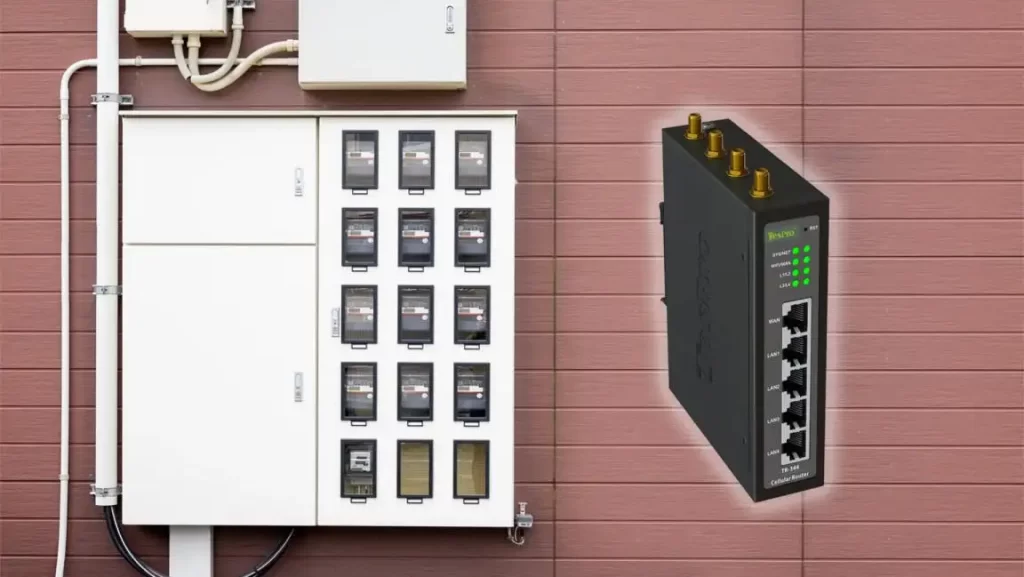
2. How Does It "Understand" PROFINET?
PROFINET is the real-time Ethernet protocol from PROFIBUS & PROFINET International (PI). It is deterministic, cyclic, and often used for motion control. An Industrial Router DIN Rail does not normally replace a PROFINET controller, but it can:
Transparent Layer-2/Layer-3 Forwarding
• No protocol modification needed: If the router supports IEEE 802.1Q VLAN and QoS (Quality of Service), it can prioritize PROFINET real-time (RT) frames over best-effort IP traffic.
• DSCP mapping: The router maps PROFINET's priority codes (e.g., EtherType 0x8892) to IP DSCP tags, ensuring low latency even on cellular backhauls.
Protocol Gateway – PROFINET to OPC UA
• Indirect understanding: A powerful industrial router (like the TR-225) can run an OPC UA server that collects data from a PROFINET network via a separate coupler, then presents it to the cloud.
• Edge-based data filtering: Instead of forwarding all PROFINET cyclic data (which can be huge), the router extracts only key process values (motor current, speed setpoint) and sends them via 5G.
Practical Limitation and Best Practice
• Not a PROFINET controller: The router cannot replace a Siemens S7 or a Beckhoff PLC. But it can piggyback on existing PROFINET switches, reading diagnostic information or acting as a data logger.
• Future-proof with TSN: Time-Sensitive Networking (TSN) will merge IT and OT. Routers like the TR-225, with powerful MTK chipsets, are ready for firmware updates that support TSN profiles.
3. Why the Tespro TR-225 Excels as a Protocol-Aware Industrial Router
The TR-225 5G Industrial Cellular Router is not just a pipe; it is a smart edge gateway. Its design directly addresses the challenges of speaking multiple industrial languages.
Industrial-grade hardware built for harsh environments
• Temperature: Built to operate MODBUS polling and PROFINET forwarding in extreme environments (Deserts and Freezers) with temperature ranges of -40°C to 75°C.
• Voltage: 12–36V with dual power paths and redundancy via a DC jack and terminal block power keeps the router functional through power fluctuations.
• DIN rail mounting: Ultra-compact (93×118×24mm without antenna) snaps onto standard 35mm rails, saving space inside crowded cabinets.
Comprehensive Network Redundancy
• Triple backup switching: Wired (WAN/LAN) ↔ WiFi (802.11n up to 300Mbps) ↔ 4G/5G. If one link fails, the other takes over without losing the MODBUS TCP connection.
• Dual SIM dual standby: For remote oil wells or unmanned substations, two SIMs from different carriers provide cellular failover, so PROFINET diagnostics never stop.
Built-In Industrial Protocol Stack
• Native MODBUS RTU/TCP, BACnet, M-bus, OPC UA: No need for external protocol converters. The router reads DL/T 645 power meters and sends data over 5G to a central historian.
• 300Mbps (2.4GHz) or 1200Mbps (5GHz) WiFi: High-speed local access for engineers to configure PROFINET parameters via a web browser.
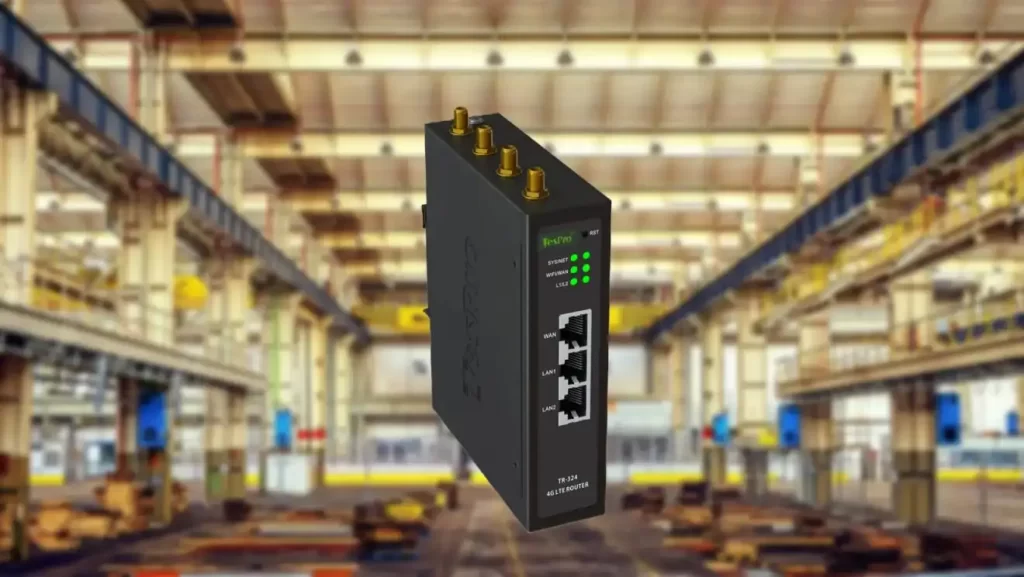
Real-World Scenario: Mixing MODBUS and PROFINET on One Router
Imagine a smart pumping station:
• MODBUS RTU flow meters and pressure transmitters (RS485) → TR-225 polls every 2 seconds → converts to MODBUS TCP → sends via 5G to cloud SCADA.
• PROFINET variable frequency drives (VFDs) are connected to a local PLC. The TR-225 mirrors the PLC's diagnostic data (OPC UA) over the same 5G link.
• Result: One Industrial Router DIN Rail handles both legacy serial MODBUS and modern PROFINET traffic, reducing hardware cost and complexity.
Conclusion: The Router as a Multilingual Edge Node
An Industrial Router DIN Rail like the Tespro TR-225 does more than just route IP packets. It listens on RS485/RS232, decodes MODBUS RTU frames, forwards MODBUS TCP, prioritizes PROFINET real-time streams, and uplinks everything via 5G/LTE. By integrating industrial protocol awareness, wide temperature tolerance, and dual-power redundancy, such a router becomes the central nervous system of any IIoT deployment.
Whether you are retrofitting a legacy MODBUS network or building a future-proof PROFINET cell, the TR-225's ability to "speak" both languages—along with BACnet, M-bus, and OPC UA—makes it a true polyglot on the DIN rail.
FAQs
Q1: Does the TR-225 support both MODBUS RTU and MODBUS TCP?
A: Yes, it supports MODBUS RTU over RS485/RS232 and MODBUS TCP over Ethernet, with built-in gateway mode between them.
Q2: Can a DIN Rail Industrial Router replace a PROFINET controller?
A: No, a PLC cannot be replaced, but it can send PROFINET frames and pull diagnostics in OPC UA.
Q3: What is the operating temperature of the TR-225?
A: The operating temperature of the TR-225 is between -40° C and +75° C.
Q4: Is dual SIM redundancy in the TR-225?
A: Yes, Dual SIM Redundancy is in the TR-225. Carrier Switch Dual SIM Redundancy allows the TR-225 to move to a different Cellular Carrier and maintain Carrier Redundancy if the original Cellular Carrier fails.
Q5: What other industrial protocols does the TR-225 support, besides MODBUS?
A: The TR-225 also supports BACnet, M-bus, DL/T 645, IEC 61850, DLMS and OPC UA.