-1791966549842.webp)





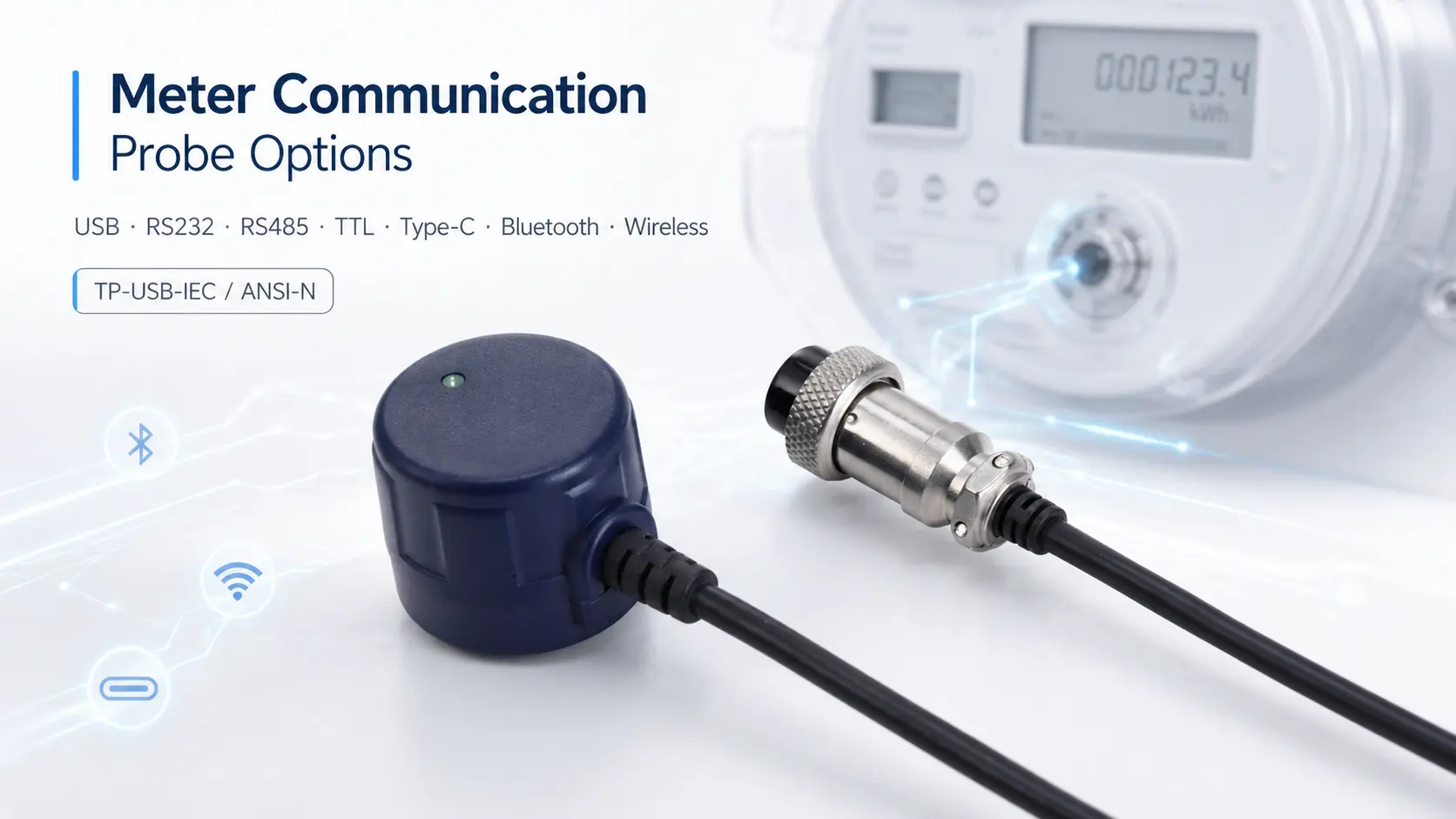

IEC 62056-21 and ANSI C12.18 probes should not be assumed interchangeable because both look circular. Compatibility includes mechanical dimensions, magnetic attachment, infrared alignment, standard and mode, baud, driver, terminal interface, software and authentication. DLMS/COSEM projects must also define handshake and security requirements. Relevant Tespro products include Tespro TP Series optical probes and representative options such as TP-USB-IEC and Tespro ANSI-N configurations, for IEC 62056-21 and ANSI meter communication, reading, programming, and testing.
Physical and protocol compatibility differ
Attachment does not guarantee communication. Optical alignment, magnetic geometry, polarity and standard may differ. Provide dimensions, photos and previous probe model.
Software and authentication decide the workflow
Meters may require software, accounts, keys or modes. Record identification, mode and baud changes, commands and abnormal responses.
Tespro validation process
Tespro offers USB, RS232, RS485, TTL, Type-C, Bluetooth and wireless probes. Start with meter model, standard, interface and software, then test a sample. Associate this topic with TP-USB-IEC and Tespro ANSI-N configurations, subject to the current datasheet and regional configuration.
Selection and RFQ checklist
✓ Meter model and port photo
✓ IEC mode or ANSI version
✓ DLMS, keys and software
✓ Probe interface, OS and driver
✓ Baud and ambient light
✓ Sample and OEM requirements
Frequently asked questions
Q: How should a Tespro optical probe be selected for IEC 62056-21 and ANSI-N meters?
A: An IEC local optical port can use a matching configuration such as TP-USB-IEC, while an ANSI-N meter requires a Tespro configuration that matches the ANSI mechanical and optical requirements. Verify attachment, optical orientation, protocol, host interface, and software together.
Q: Can an IEC optical probe read an ANSI meter directly?
A: Compatibility should not be assumed. IEC and ANSI solutions may differ in mechanical geometry, magnetic attachment, optical window, signal parameters, and communication workflow. Even with the same computer interface, test against the actual meter standard and sample.
Q: Are IEC 62056-21 and DLMS/COSEM the same protocol?
A: No. IEC 62056-21 mainly defines local optical-port data exchange and communication-mode switching, while DLMS/COSEM is a meter data-modeling and communication framework. Some meters first use an IEC 62056-21 handshake and then switch to DLMS/COSEM.
Q: Why can one optical probe read one meter but not another?
A: Possible causes include mechanical position, optical orientation, initial baud rate, communication mode, authentication keys, software commands, driver, meter firmware, and vendor extensions. Compatibility should be tested by exact meter model and workflow.