-1791966549842.webp)





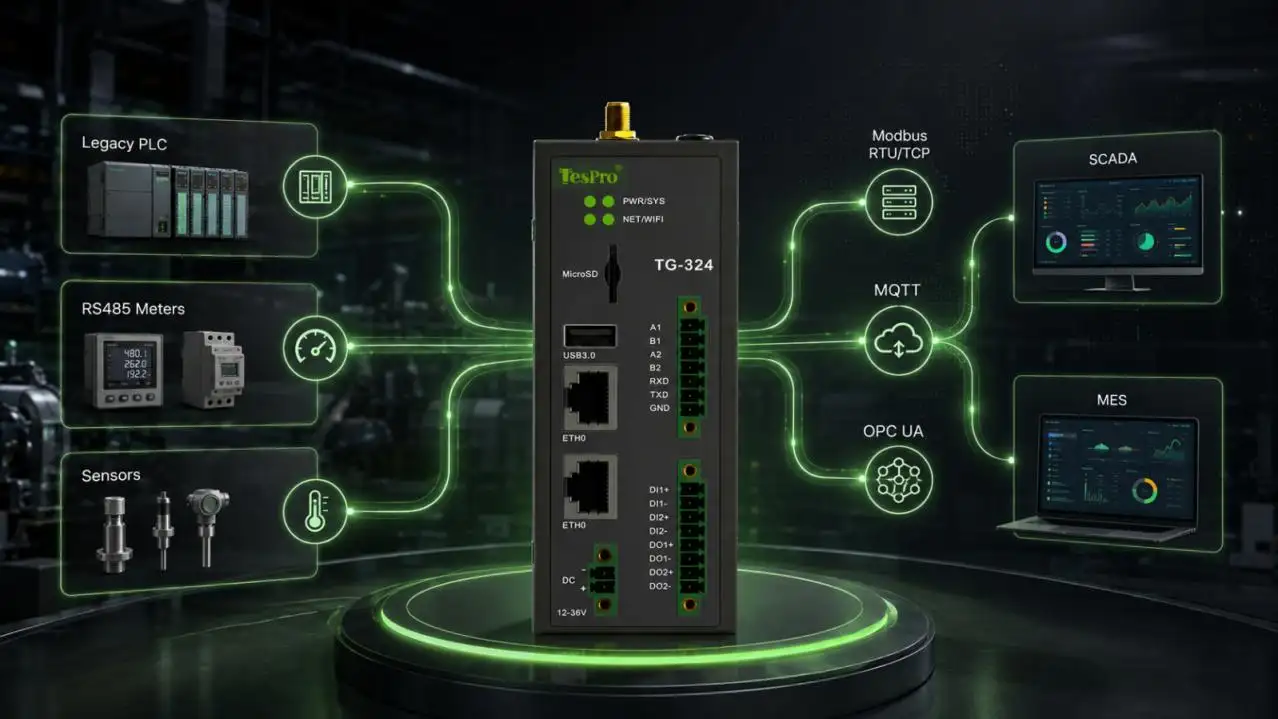

Numerous factories utilize PLCs, sensors, meters, and controllers installed before the advent of MQTT, OPC UA, or cloud technologies. Despite their ability to control the production process, their data tends to get stuck in RS232, RS485, Modbus, and other proprietary layers. An IoT Gateway for Smart Factory initiative can implement a managed integration layer, while still attempting to not replace every legacy PLC.
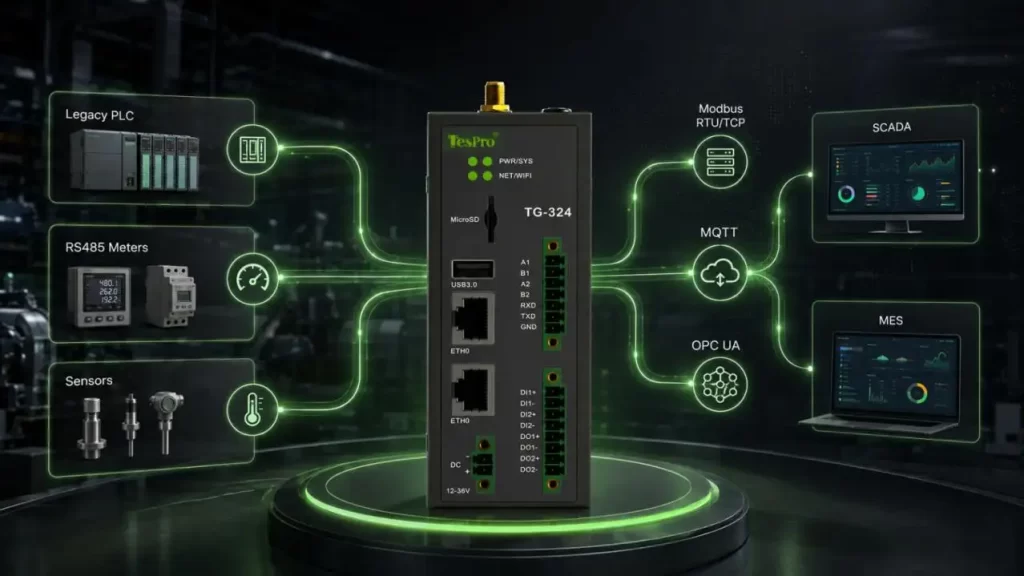
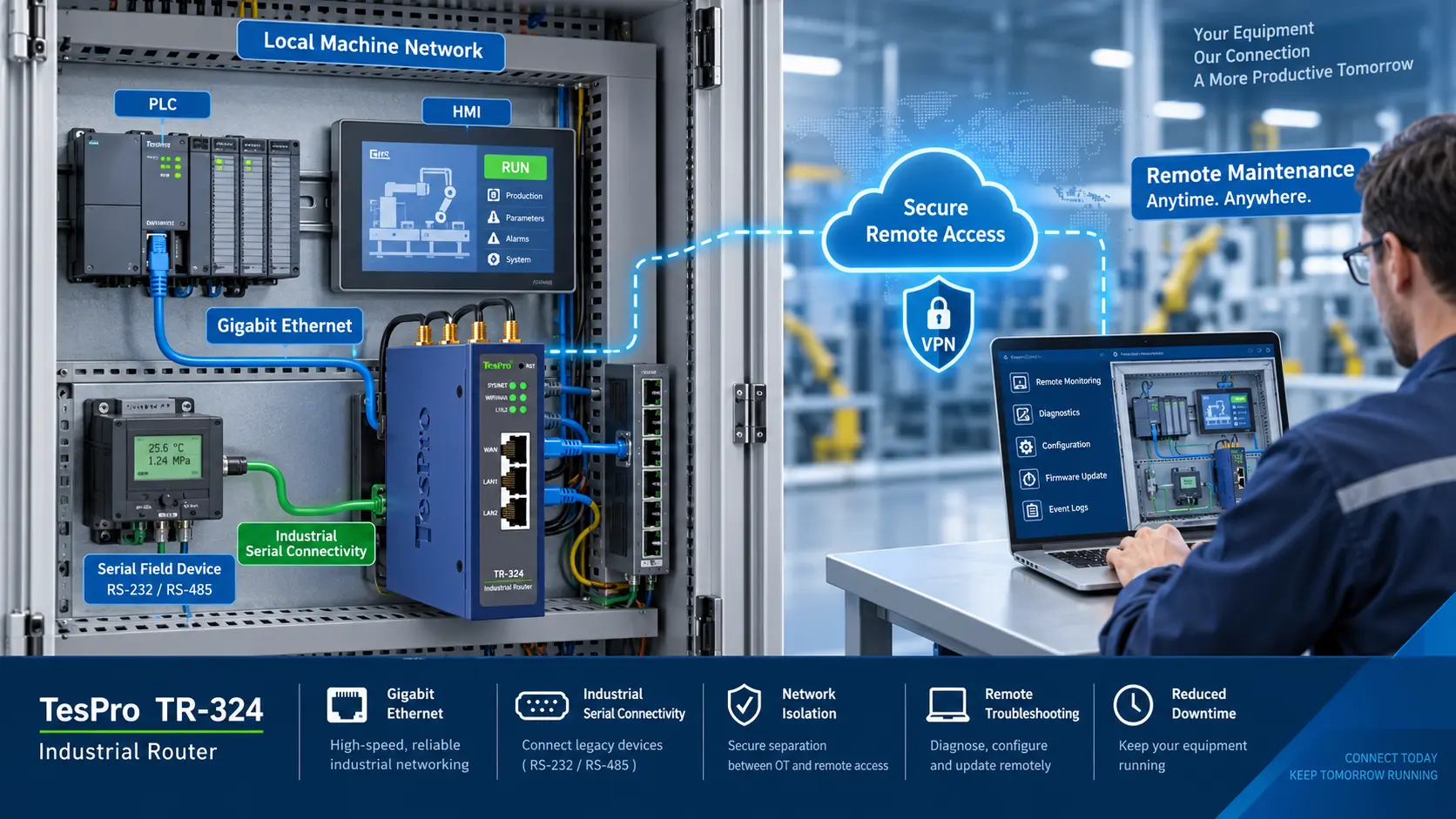
At Tespro, we position the TG industrial gateway around this task: acquire field data, convert supported protocols, map raw values into usable tags, and forward selected information to SCADA, MES, or cloud systems. Across Tespro's TG portfolio, configurations include industrial Ethernet, RS232/RS485, cellular connectivity, and model-dependent support for Modbus, MQTT, HTTPS, and OPC UA.
Why Legacy PLC Data Becomes an Integration Bottleneck
A legacy PLC can still execute machine logic correctly while being difficult to connect to higher-level systems. The real gap is between control-oriented data and information-oriented platforms.
A brownfield line may contain an Ethernet PLC, RS485 meters, serial controllers, and older sensors. Before selecting an Industrial IoT Gateway for Smart Factory, engineers should confirm:
•Physical interface compatibility
•Required southbound protocol
•Address, data type, byte order, and scaling
•Northbound format required by SCADA, MES, or cloud
"Supports Modbus" does not mean automatic compatibility with every PLC. The project still needs the correct register map, communication role, and data interpretation. The Modbus specification defines protocol transactions and function codes, but device-level implementation still has to be engineered correctly.
How the Gateway Turns PLC Registers into Usable Data
The practical data path is:
Interface → Protocol Acquisition → Address Reading → Data Interpretation → Tag Mapping → Edge Processing → Northbound Delivery
Data Mapping Matters as Much as Protocol Conversion
A gateway may read:
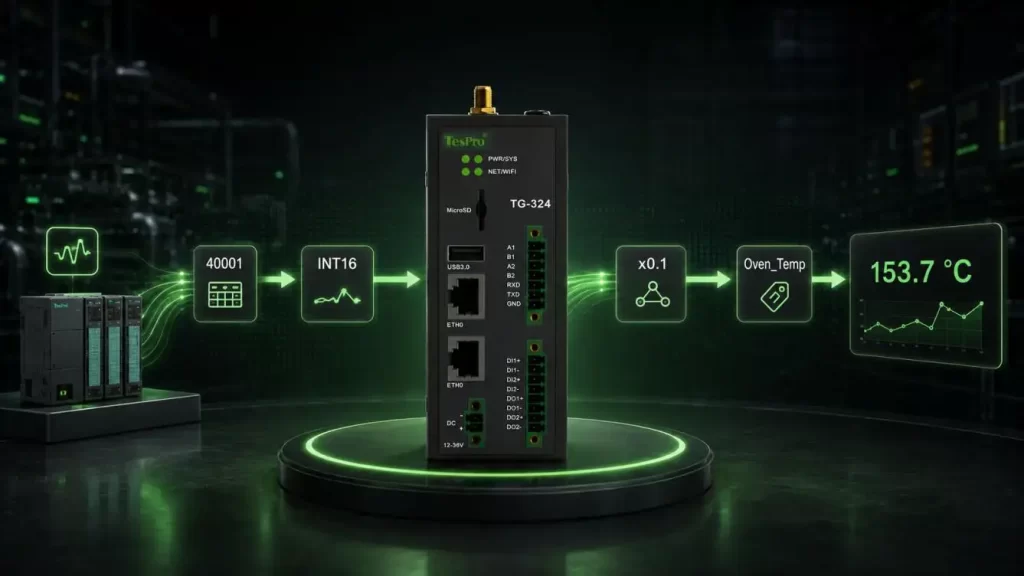
40001 = 1537
But the platform needs context:
40001 → INT16 → ×0.1 → Oven_Temperature → 153.7 °C
Mapping may include register location, BOOL/INT/FLOAT type, byte or word order, scale, unit, timestamp, and tag name.
Therefore:
Protocol Conversion ≠ Data Integration
A usable Industrial IoT Gateway for Smart Factory must help bridge the gap between raw machine values and structured data that an upper-level system can consume.
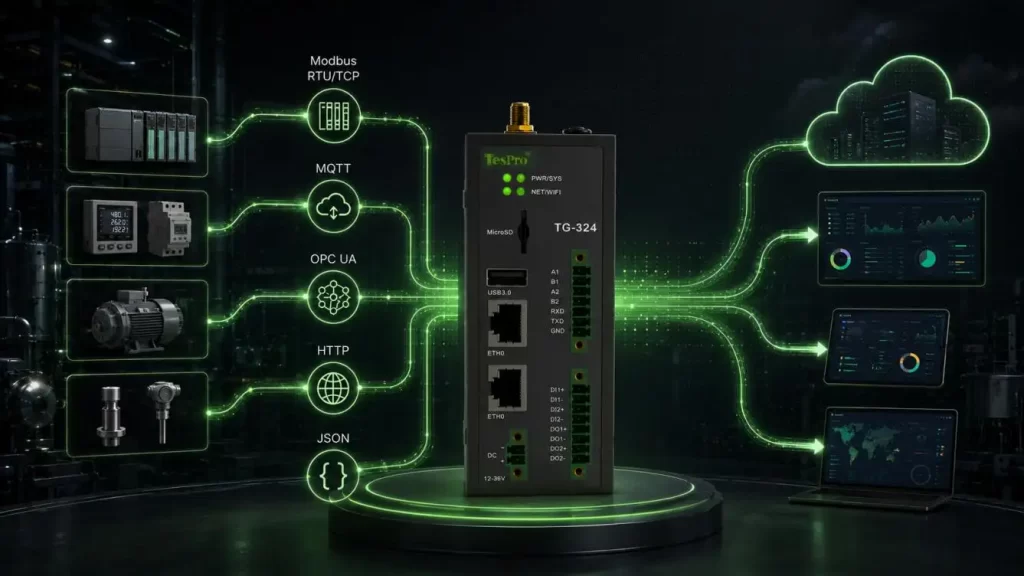
MQTT, OPC UA, and HTTPS Are Not Interchangeable
MQTT is designed for lightweight publish/subscribe messaging, while OPC UA includes industrial information modeling and data access concepts. OPC Foundation documentation specifically treats information modeling as a way to turn raw data into structured information.
HTTPS or APIs may instead fit applications where the target platform expects web-based ingestion.
Tespro TG configurations can combine RS485/RS232 and Ethernet with northbound communication options. Specific TG models list Modbus RTU/TCP, MQTT, OPC UA, HTTP/HTTPS, and cellular connectivity, so protocol support should always be confirmed at the model level before engineering starts.
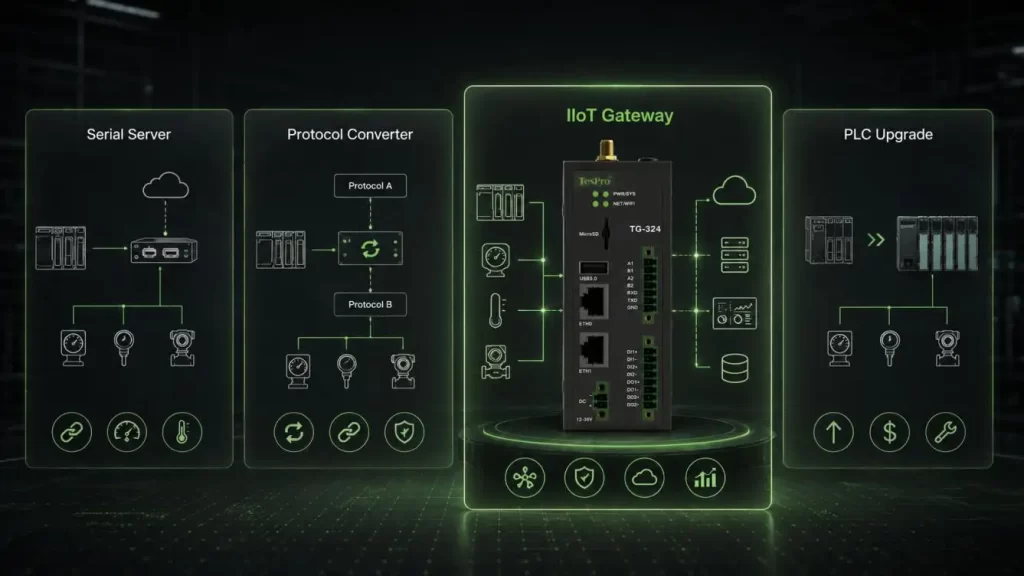
Compare the Integration Architecture
Choosing an Industrial IoT Gateway for Smart Factory should start with architecture comparison, not a feature list.
| Approach | Best Fit | Main Limitation |
| Serial Device Server | Extending serial data over Ethernet | Limited data normalization |
| Protocol Converter | Converting one protocol to another | Limited edge/platform logic |
| Industrial IoT Gateway | Multi-device acquisition, mapping, processing, and uplink | Requires engineering configuration |
| PLC Replacement | Obsolete or unreliable controller | More migration work and downtime |
A gateway is most suitable when the PLC remains serviceable but its communication layer no longer matches the factory data architecture.
Direct PLC-to-platform connections may suit small systems. For larger brownfield sites, gateway aggregation can reduce interface fragmentation and standardize the northbound connection while leaving deterministic machine control inside the PLC.
Match the Gateway to Devices, Data Load, and Platform
Create an integration matrix before choosing hardware.
| Item | Define Before Purchase |
| Field Device | PLC model, meter, sensor, controller |
| Interface | RS232, RS485, Ethernet |
| Protocol | Modbus or verified vendor protocol |
| Load | Device count, tag count, polling interval |
| Mapping | Type, byte order, scale, unit, tag |
| Northbound | MQTT, OPC UA, HTTPS/API |
| Destination | SCADA, MES, broker, database, cloud |
Device count, tag count, and polling interval must be evaluated together. Two thousand tags collected every second create a different processing and communication load from the same number collected every minute.
For RS485 networks, baud rate, request/response timing, and slave count also influence the achievable scan cycle.
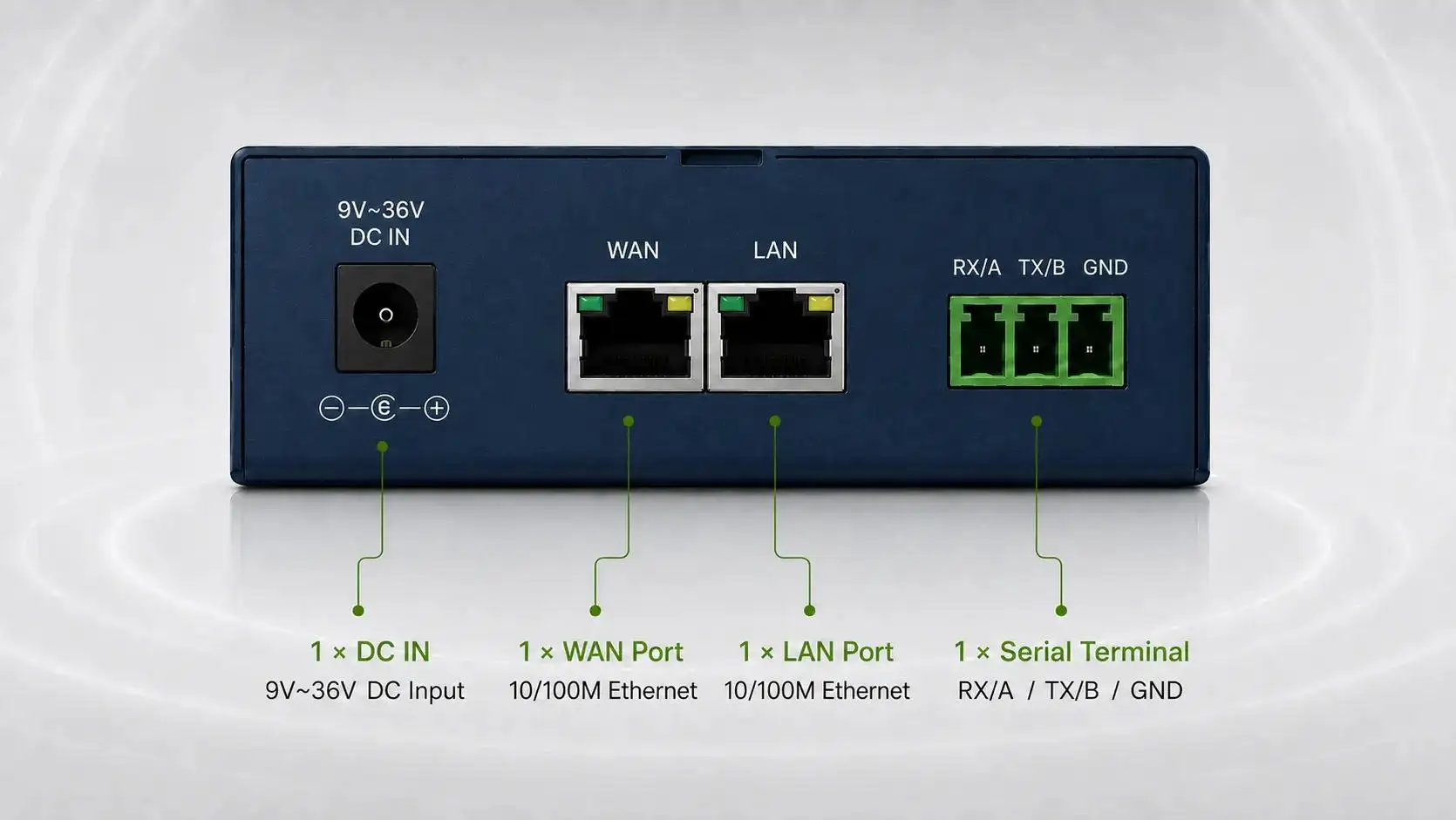
Tespro's TG range includes configurations with dual Ethernet, multiple RS485 ports, RS232, 4G/5G options, and local storage interfaces. For example, the TG-324 provides two Gigabit Ethernet ports, two RS485 interfaces, one RS232 interface, and Micro SD support.
We therefore recommend sizing an Industrial IoT Gateway for Smart Factory from the actual device inventory and data-rate requirement rather than one headline specification.
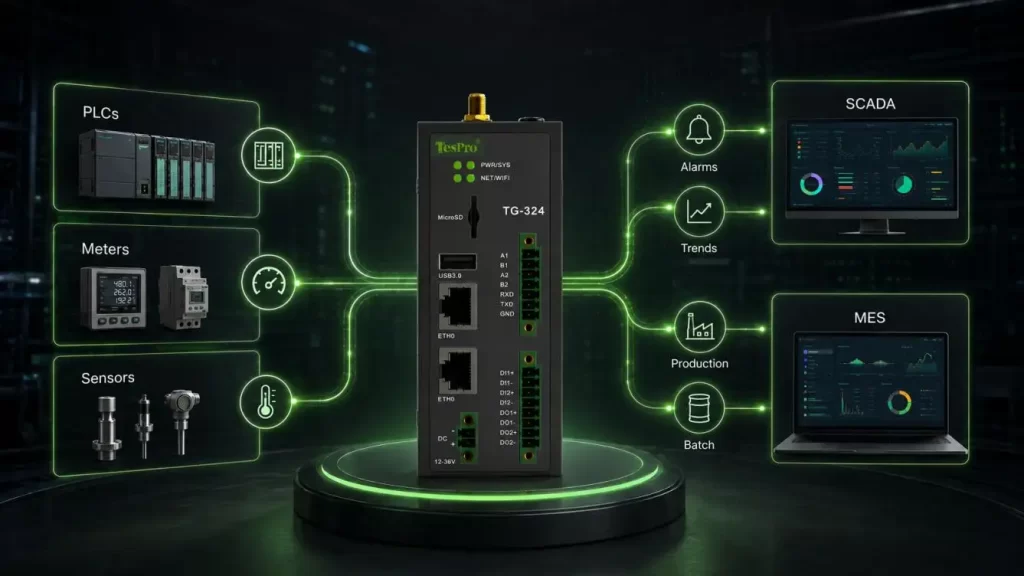
Where the Gateway Fits Between SCADA and MES
An Industrial IoT Gateway for Smart Factory does not automatically turn PLC registers into a complete MES model.
PLC → Gateway → SCADA
commonly carries:
•Equipment states
•Alarms
•Process values
•Trends
•Supervisory information
By comparison:
PLC → Gateway / Integration Layer → MES
usually requires additional production context:
•Work order
•Batch
•Cycle count
•Machine state
•Downtime reason
•Quality result
ISA-95/IEC 62264 addresses enterprise-control system integration and defines relationships between manufacturing control and higher-level operations. This is why machine-level data acquisition should not be confused with complete MES integration.
The gateway can acquire, normalize, and deliver machine data; the MES still applies production context and business logic.
Commission and Maintain Legacy PLC Integration
For brownfield projects, implement read-only acquisition when possible. Verify serial parameters, device addresses, Ethernet configuration, and key tags against the PLC EDS within brownfield projects.
Commissioning entails:
•Validation of raw, converted, and engineering values.
•Removal of PLC with subsequent detection of communication fault.
•Cutting off WAN or broker access and evaluating if the communication is restored.
•Assess buffering for the store-and-forward option.
•Validation of time stamps and logs with time sync.
•Gateway reset with confirmation of configuration.
•Final configuration stored.
The Tespro TG products along with the models offer local processing and user-defined field polling and platform publishing with configurable reporting methods, to help fulfill specific project needs.
Verify Standards and Cybersecurity Claims
Before deployment, buyers should verify the evidence behind EMC, electrical safety, environmental, and cybersecurity claims rather than relying on broad marketing labels.
IEC 62443, for example, is a standards series rather than one generic certification. IEC 62443-4-2 specifically addresses technical security requirements for industrial automation and control system components.
Likewise, "OPC UA support" should be checked for the required:
•Client/server role
•Data Access behavior
•Security configuration
•Certificate handling
•Required information model
Protocol support alone is not proof that every PLC, SCADA, or MES combination will work without engineering configuration.
Make the Purchasing Decision from the Integration Matrix
Before ordering an Industrial IoT Gateway for Smart Factory, provide the supplier with the PLC model and firmware, protocol, register/tag list, device count, polling interval, SCADA/MES target, northbound protocol, network architecture, and operating environment.
At Tespro, our TG industrial gateway direction focuses on field connectivity, protocol conversion, edge data handling, and reliable uplink communication—not on claiming that one gateway automatically makes a factory smart.
For a legacy-equipment integration project, share the real PLC, sensor, meter, protocol, and data matrix with Tespro first. This allows the required TG configuration, interface capacity, protocol support, and platform connection to be evaluated before deployment.
Explore Tespro TG Industrial Gateways
FAQs
Q1. Can Tespro Industrial IoT Gateway connect to legacy PLCs?
Tespro TG industrial gateways connect to devices through interfaces like RS232, RS485, and Ethernet. Whether a gateway can connect to a specific legacy PLC should be confirmed by checking the legacy PLC's protocol, firmware, communication role, and required data addresses.
Q2. Can Tespro TG gateways gather data from PLCs and industrial meters?
It is possible for Tespro TG gateways to gather data from PLCs and industrial meters depending on the TG model and the configuration of the project. The requirements of the project should be assessed to determine the number of devices to be connected, the protocols to be used, and the polling frequency.
Q3. Does Tespro support Modbus RTU and Modbus TCP?
Support for Modbus RTU and Modbus TCP is available on a model-dependent basis on Tespro TG industrial gateways. It is recommended that users check the specific requirements and device constraints including master/client roles, required functions, register maps, baud rates, and so on.
Q4. Can Tespro Industrial IoT Gateway convert PLC data to MQTT?
Tespro TG industrial gateways, in certain configurations, have the capability to collect field data and publish it to an MQTT broker. PLC data is generally in a raw format and must be mapped to the IoT platform in the form of tags, data types, and with the structure of topics, before it can be used.
Q5. Can Tespro TG Gateways integrate legacy equipment to OPC UA?
Certain Tespro TG Gateways can be used to implement OPC UA connectivity. The specific requirements of the project should be checked to determine client/server roles, tag structure, security settings, certificates, and SCADA requirements.