-1791966549842.webp)





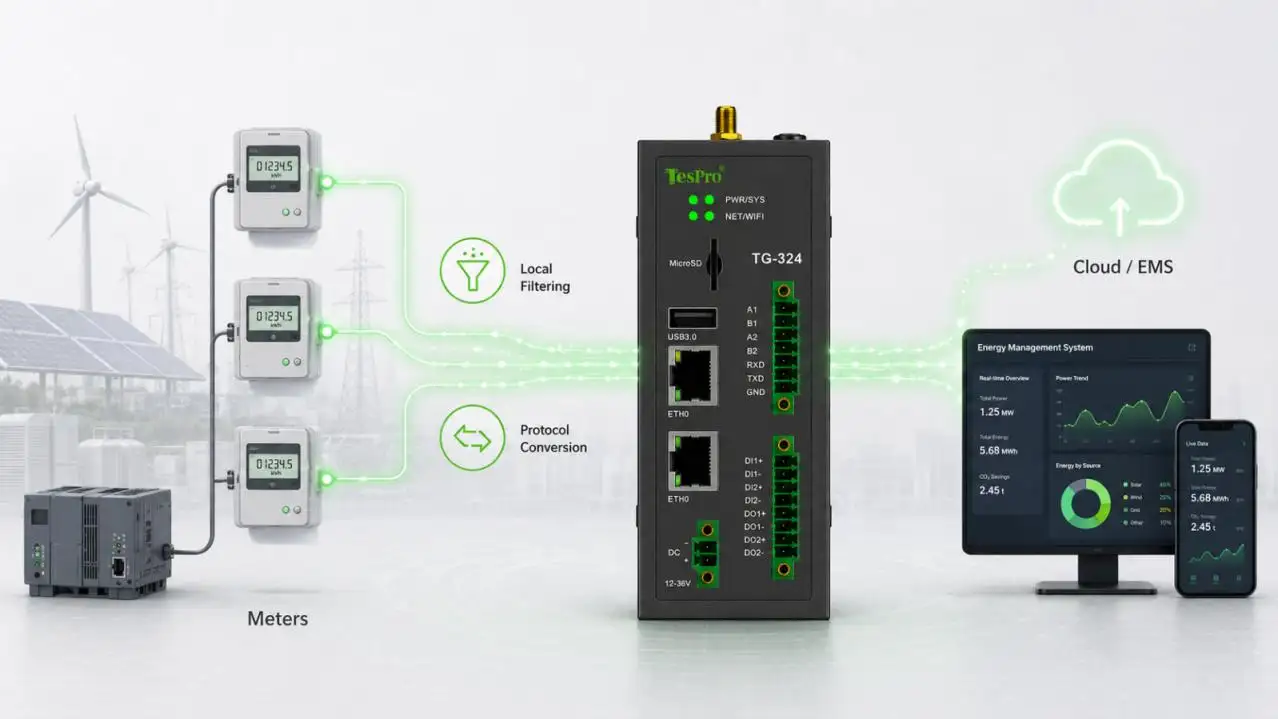

Energy monitoring systems often collect far more data than an EMS or cloud platform needs continuously. Hundreds of meters may report voltage, current, power, power factor, frequency, demand, and accumulated energy every few seconds.
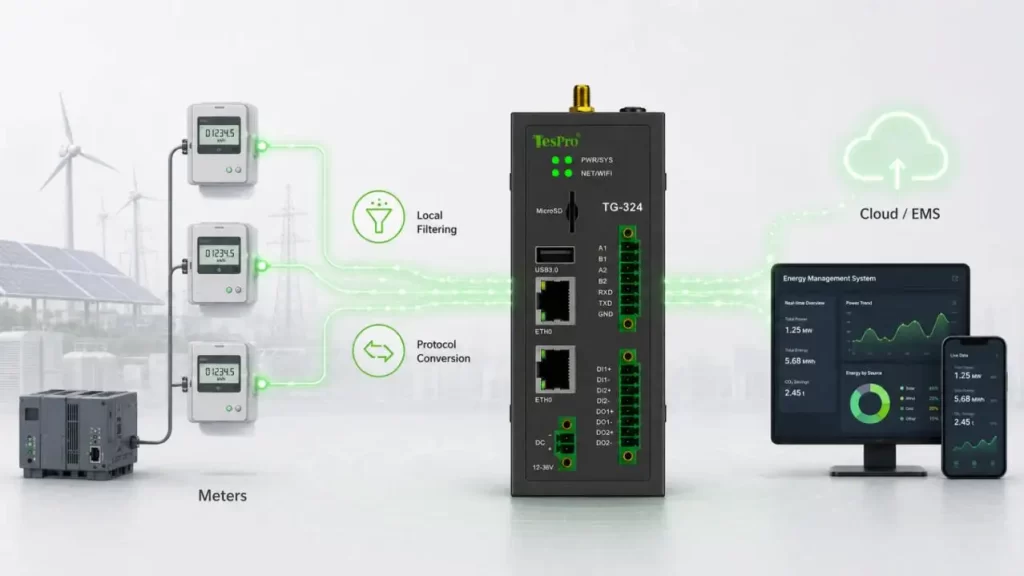
An Industrial Edge Computing Gateway processes part of this workload near the field devices. Instead of forwarding every raw reading, it can collect, normalize, filter, aggregate, store, and transmit selected data. The objective is not simply lower bandwidth—it is to reduce repetitive data while preserving demand peaks, alarms, abnormal events, and historical continuity.
Why Process Energy Data at the Edge?
Consider 100 meters with 30 data points each. At a one-second polling interval, the system produces 3,000 samples per second, before timestamps, packet headers, retries, or JSON formatting.
An Industrial Edge Computing Gateway introduces a controlled processing chain:
Acquire → Timestamp → Normalize → Filter → Aggregate → Buffer → Publish
This allows fast field acquisition without requiring every sample to reach the cloud.
Typical strategies include:
• Voltage/current: deadband or change-of-value filtering
• Energy totals: interval reporting
• Demand: average plus minimum/maximum retention
• Alarm conditions: immediate event-driven reporting
• Routine status: timed aggregation
The important distinction is that reducing transmission frequency does not have to mean reducing field sampling frequency.
Select Filtering Rules by Energy Data Type
| Method | Suitable Data | Main Limitation |
| Fixed interval | Energy totals, trends | May miss short events |
| Averaging | Stable load data | Can hide peaks |
| Deadband | Voltage, current | Incorrect thresholds remove useful changes |
| Change-of-value | Dynamic parameters | Traffic increases during rapid variation |
| Min/Max | Demand and load | Does not preserve every sample |
| Event trigger | Alarms, limits | Depends on correct thresholds |
A practical Industrial Edge Computing Gateway normally combines several methods. A five-minute power average, for example, may be useful for reporting, while maximum demand and overcurrent events should be retained separately.
The engineering target is therefore information-preserving data reduction, not the highest possible compression ratio.
Size the Gateway From Workload, Not CPU Labels
Gateway capacity depends on more than processor type or RAM.
A useful sizing relationship is:
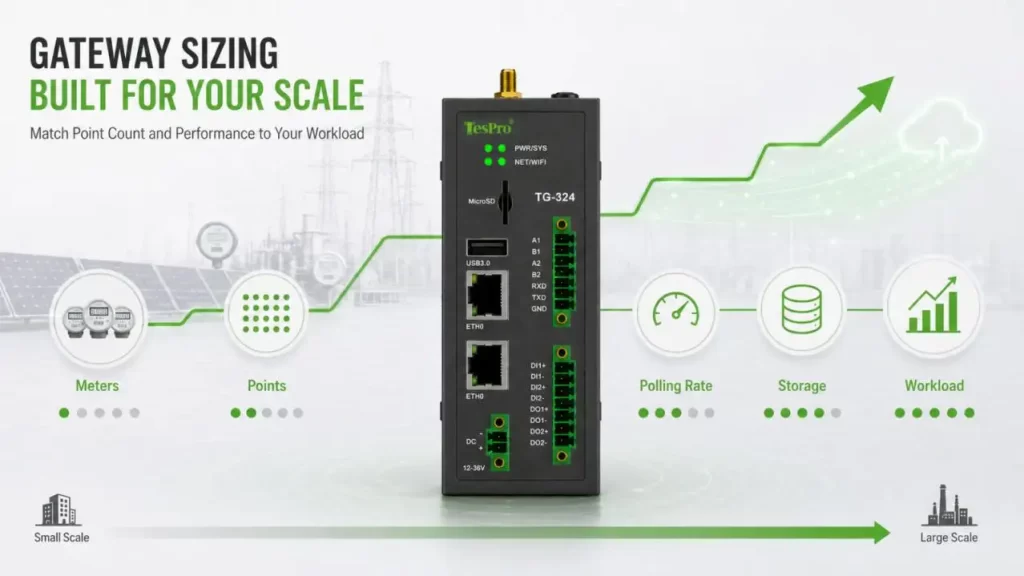
Point Count × Polling Rate × Protocol Sessions × Filtering Rules × Storage Writes × Encryption
Buyers should therefore evaluate:
• Number of field devices and data points
• Minimum required polling interval
• Concurrent serial/Ethernet connections
• Protocol conversion workload
• Local database writes
• MQTT/HTTPS publishing frequency
• VPN or TLS processing
• Offline retention period
Tespro's product range illustrates why a workload-based selection approach matters. For relatively straightforward industrial communication tasks, we offer the TG-100 with 1 WAN + 1 LAN and configurable RS485, RS232, or CAN field interfaces. For projects requiring more device connections and higher processing capacity, the TG-324 and TG-325 provide dual RS485, RS232, GPIO, and more capable network architectures for more complex edge applications.
At Tespro, we therefore recommend selecting the Industrial Edge Computing Gateway according to actual device connectivity, protocol, data volume, and processing requirements rather than assuming every TG platform provides the same edge-computing capacity.
Match Gateway Capabilities to Real Project Value
For energy monitoring projects, the value of an Industrial Edge Computing Gateway is not defined by how many interfaces or protocols appear on a datasheet. The more important question is whether the gateway can connect existing meters, deliver data to the required EMS or cloud platform, and remain reliable under real site conditions.
Reduce Integration Work Across Legacy and New Systems
A gateway that supports both field-side and platform-side communication can reduce the need for additional protocol converters or separate communication hardware.
| Project Requirement | Tespro Capability | User Value |
| Existing serial meters | RS232, RS485, Modbus RTU | Reuse installed meters and reduce replacement cost |
| Ethernet devices | Modbus TCP, Ethernet | Easier integration with newer equipment |
| Meter-specific communication | DLMS, IEC 62056-21 on applicable models | Better compatibility with energy metering systems |
| EMS/cloud connection | MQTT, OPC UA, HTTP/HTTPS, TCP/UDP | Connect field data to different upstream platforms |
| Remote sites | Cellular connectivity on selected models | Reduce dependence on fixed wired networks |
TG-324 and TG-325 extend this flexibility with dual RS485, RS232, GPIO, multiple protocol support, and OpenWrt/LEDE-based application environments. C/C++, Lua, Go, and Python development support on these models can help system integrators implement project-specific data handling where required.
These capabilities are model-specific and should not be assumed across every TG gateway.
Improve Reliability in Industrial Installation
Continuous energy monitoring often takes place inside control cabinets or unattended sites where temperature, electrical disturbance, and maintenance access are critical.
Across applicable TG models, design features include:
• 12–36 VDC power input
• Operating temperatures up to -40°C to +75°C
• Serial and Ethernet connectivity for mixed equipment
• Cellular communication for distributed sites
• Reverse-polarity, overvoltage, overcurrent, surge, or lightning protection on specified models
• Fanless aluminum-alloy thermal design on TG-324 and TG-325
For users, these features can translate into fewer communication interruptions, lower maintenance frequency, and more stable long-term operation.
Avoid Paying for Unnecessary Functions
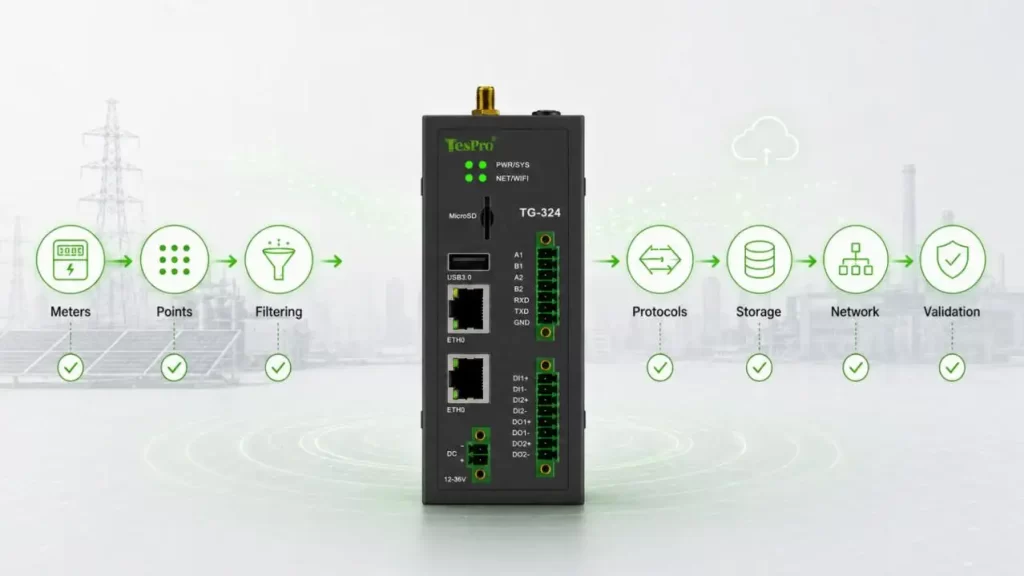
We separate gateway capabilities into different levels so customers can match functionality to actual project requirements.
| Capability Level | Typical Use |
| Standard | Ethernet, serial interfaces, core protocols |
| Optional | GNSS, wireless, selected interface options |
| Project Configuration | Polling intervals, protocol mapping, reporting logic |
| Advanced Model-Specific | Local applications, higher computing capacity, AI functions |
For example, NPU-based AI capability belongs to higher-performance TG-424/TG-400-class platforms.
Protect Data During Network Interruptions
A suitable Industrial Edge Computing Gateway should also support reliable operation when the WAN is unavailable.
Important project requirements include:
• Timestamped local buffering
• Store-and-forward transmission
• Automatic reconnection
• Historical data replay
• Alarm prioritization
• Watchdog recovery
• Configuration backup and remote diagnostics
Storage should be sized from retained data rate × expected offline duration, not storage capacity alone.
At Tespro, our hardware and software teams can also support OEM/ODM adaptation for protocol mapping, interfaces, firmware, and project-specific configurations. This helps customers select an Industrial Edge Computing Gateway around actual meters, point count, protocols, network conditions, and deployment environment rather than simply choosing the model with the longest feature list.
FAQs
Q1. What are the functions of an Industrial Edge Computing Gateway?
Industrial edge gateways have the ability to integrate field devices with an energy management system (EMS), supervisory control and data acquisition (SCADA), Internet of Things (IoT), and cloud computing platforms as well as perform data acquisition, protocol conversion, and edge computing for project-specific requirements.
Q2. Are Tespro gateways able to connect to current energy meters?
Yes, if the corresponding TG model and configuration are used. Interfaces may be available for RS232, RS485, Ethernet, and other field connections to permit the integration of current energy meters and other industrial devices.
Q3. Is Modbus communication supported by Tespro?
Some Tespro gateways provide support for either Modbus RTU or Modbus TCP.
Q4. Are Tespro Industrial Edge Computing Gateways able to push data to an EMS or cloud computing platform?
Yes, depending on the specific gateway and project requirements, northbound communication may utilize protocols such as MQTT, OPC UA, HTTP/HTTPS, TCP/UDP, or other custom integration.
Q5. Are Tespro gateways capable of performing local filtering of energy data?
Local data handling may be defined by the chosen hardware and software environment. Typical project requirements may involve interval reporting, protocol mapping, data consolidation, and/or event-driven data transmission.