-1791966549842.webp)





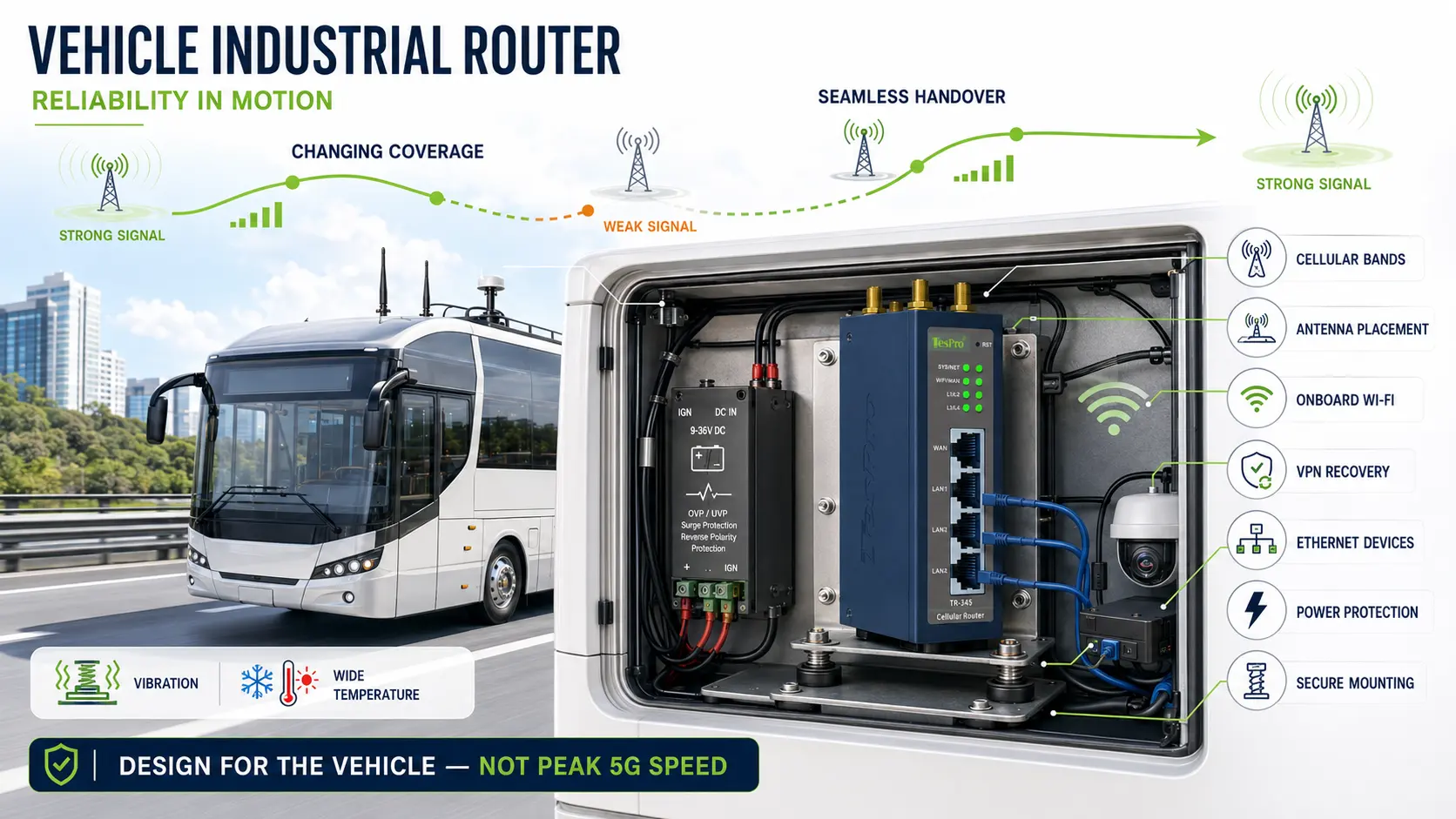

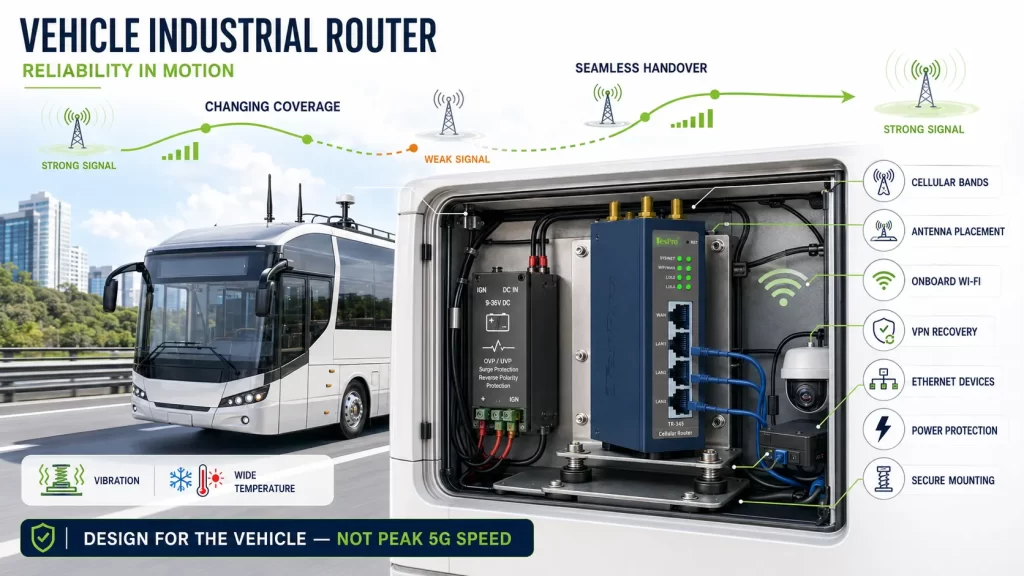
A vehicle industrial router must handle changing coverage, frequent handovers, ignition-related power variation, vibration and temperature shifts. Selection should validate cellular bands, antenna placement, onboard Wi-Fi, VPN recovery, Ethernet devices, power protection and mounting together instead of comparing only peak 5G speed.
Key Takeaways
• Coverage continuity and recovery time are the key mobile metrics.
• Antenna location and vehicle-body shielding can matter more than advertised radio performance.
• Ignition and load changes create power transients that require full-vehicle testing.
Test the network on the real route
Good signal at a parking location does not prove mobile stability. Log carrier, band, signal, handover, outage and reconnection time on the actual route, and verify that tunnels and application sessions recover.
Do not ignore onboard power and mounting
Vehicle power can experience cranking drops, load changes and electromagnetic noise. Mount the device securely, maintain a thermal path and use suitable fusing, grounding and protection.
Separate backhaul from onboard access
Cameras, telematics, passenger Wi-Fi and controllers have different bandwidth and security needs. Network segmentation, access control and traffic priority prevent one service from disrupting another.
How Tespro Fits
Tespro TR Series routers can be evaluated for cellular backhaul and VPN access in vehicles, AGVs, machinery and mobile equipment. Exact 5G, Wi-Fi, dual-SIM, port, power and environmental capabilities depend on model and regional configuration and should be tested with the actual route and power system.
Compatibility and Selection Checklist
✓ Country, route and carrier coverage
✓ 4G/5G bands and fallback policy
✓ Cellular, Wi-Fi and GNSS antenna positions
✓ Vehicle power range and cranking transients
✓ Vibration, temperature, mounting and cooling
✓ Cameras, terminals, controllers and VPN traffic
Frequently Asked Questions
Q: Does every vehicle project require dual SIM?
A: No, but two different carriers can reduce the risk created by regional coverage differences.
Q: Will VPN sessions break while the vehicle moves?
A: They can. Network handover or a new IP address may interrupt the tunnel, so test automatic VPN and application reconnection.
Q: Can the router be installed inside a metal enclosure?
A: The device may be mounted inside, but cellular and Wi-Fi antennas usually need suitable external placement to avoid shielding.