

Selecting an Industrial Edge Computing Gateway begins with the workload, not the processor specification. Engineers must first quantify device count, polling frequency, data volume, local processing, offline retention, field interfaces and security requirements. Otherwise, the gateway may be unable to maintain deterministic data collection—or may be oversized for a simple protocol-conversion task.
At Tespro, we evaluate gateway hardware against the complete OT-to-cloud data path: field device → edge processing → secure uplink → cloud or SCADA platform.
Industrial Router, Protocol Gateway or Edge Gateway
These devices serve different functions and should not be evaluated by the same criteria.
| Device | Primary Role | Local Processing | Typical Use |
| Industrial router | Cellular, Ethernet and VPN routing | Limited | Remote network access |
| Protocol gateway | Interface and protocol conversion | Basic | Modbus-to-MQTT conversion |
| Industrial Edge Computing Gateway | Acquisition, conversion, buffering and local applications | Medium to high | Multi-device IIoT integration |
An Industrial Edge Computing Gateway becomes necessary when the project requires data normalization, local rules, store-and-forward, scripting or multiple simultaneous industrial protocols.
Start With the Processing Workload
Before comparing CPUs, document:
• Number and type of PLCs, meters and sensors
• Registers or tags collected from each device
• Polling and reporting intervals
• Maximum acceptable latency
• Local calculations, alarms or scripts
• VPN, firewall and encryption workloads
• Maximum cellular or WAN outage duration
• Expected expansion over the product lifecycle
| Workload | Main Tasks | Hardware Priority |
| Basic acquisition | Polling and transparent transmission | Stable, low-power CPU |
| Protocol integration | Conversion, filtering and MQTT publishing | CPU concurrency and RAM |
| Local applications | Scripts, database and multiple services | More RAM and durable storage |
| Advanced analytics | High-rate processing or complex software | Higher sustained compute capacity |
CPU Selection: Sustained Performance Matters
CPU clock rate is an inadequate way to assess the performance of an Industrial Edge Computing Gateway. A Gateway can poll serial devices, perform on-the-fly conversion of register values, encrypt traffic over a VPN, and publish messages over MQTT all simultaneously.
Analyze:
• Architecture and software support: Determine support for the OS, protocol stack, drivers and development tools.
• Core and thread count: Tasks performed simultaneously require dedicated resources.
• Encryption performance: TLS and VPN traffic can stress a CPU greatly.
• Thermal stability: A fanless gateway must be able to perform at its rated temperature without throttling.
Processing headroom: Test the limits of what the system can handle by simulating the largest and most stressful combination of traffic the system is expected to handle. A real world design should account for headroom for diagnostic and self-healing functions as well as future upgrades.
Tespro uses different hardware levels rather than treating a higher clock rate as universally better. Lightweight acquisition and protocol conversion do not require the same platform as memory-intensive local applications.
RAM and Storage Must Be Calculated Separately
RAM supports active protocol drivers, message queues, scripts and management services. Flash or eMMC stores firmware, logs, applications and offline data.
Peak memory tests should be conducted with device polling, VPNs on, MQTT reconnects, and message queues. Average RAM usage can mask peak usage that can lead to process termination or loss of data.
Offline storage can be estimated as:
Storage=Tags×Samples/s×Bytes/sample×Offline seconds×Overhead
For 500 tags sampled once per second at 16 bytes per record, 24-hour storage is approximately 0.9 GB using a 1.3 overhead factor. Compression may reduce this figure, while timestamps, indexes and repeated retries can increase it.
For an Industrial Edge Computing Gateway, also check:
• Storage write endurance
• Log rotation and retention policies
• File-system recovery after power loss
• MicroSD, USB or eMMC expansion
• Behavior when the data partition becomes full
Interfaces Are More Than Port Counts
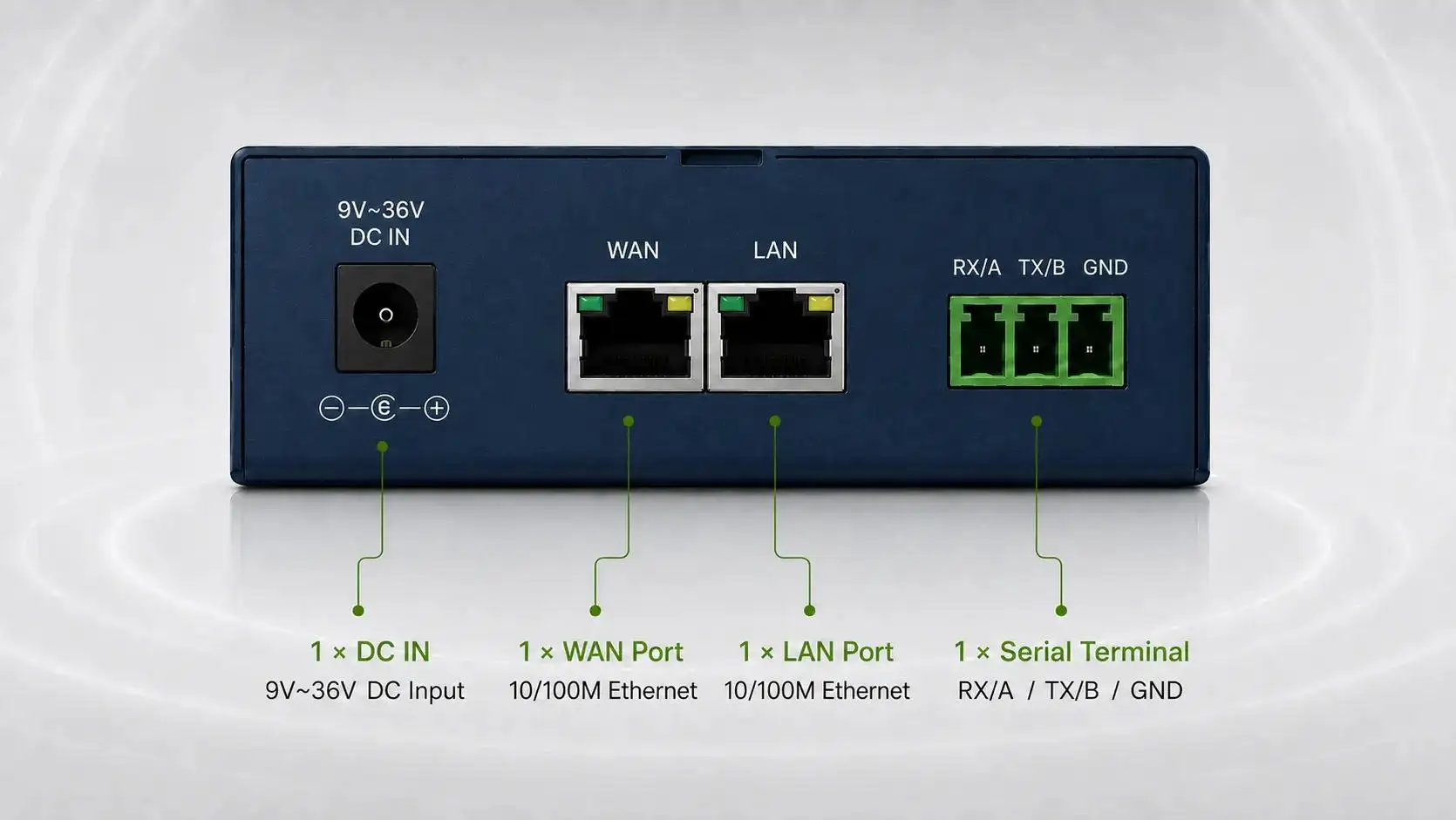
The selected Industrial Edge Computing Gateway must match both the physical connector and the electrical characteristics of the field network.
Serial and I/O Checks
• RS232, RS485 or CAN compatibility
• Required number of independent serial buses
• Baud rate, parity and flow control
• RS485 termination, biasing and node topology
• Galvanic isolation and surge resistance
• DI/DO, analog input and GPIO requirements
For example, selected Tespro gateways provide 3 kV isolated serial interfaces, helping separate field-side electrical disturbances from gateway electronics.
Network Checks
Ethernet speed must reflect actual traffic rather than marketing preference. A 100 Mbps port can be sufficient for meter telemetry, while Gigabit Ethernet is more appropriate for multiple high-rate sources or heavy local-to-cloud transfers. Cellular selection should also consider regional bands, 4G/5G availability, antenna placement and link redundancy.
Match Southbound and Northbound Protocols
Protocol support must be verified by direction and function.
| Layer | Examples | Engineering Checks |
| Southbound | Modbus RTU/TCP, BACnet, OPC UA, DLMS | Device role, register map, scan rate |
| Data handling | Lua scripts, conversion and filtering | Data types, scaling, byte order |
| Northbound | MQTT, HTTPS, OPC UA | QoS, topic structure, payload and TLS |
| Management | Web UI, SSH, SNMP, cloud platform | Permissions, logs, OTA and backup |
"Modbus supported" is not a complete specification. Confirm client/server roles, INT/FLOAT formats, byte order such as ABCD or DCBA, timeout handling and maximum polling frequency. For MQTT, verify QoS, persistent sessions, broker authentication and reconnect behavior.
Comparing Tespro Industrial Gateway Configurations
Tespro's range illustrates how connectivity and computing requirements affect configuration.
| Model | CPU / Memory | Key Connectivity | Best-Fit Direction |
| TG-100 | 880 MHz dual-core, 128 MB RAM | 100 Mbps, 4G, selectable RS232/RS485 | Compact acquisition |
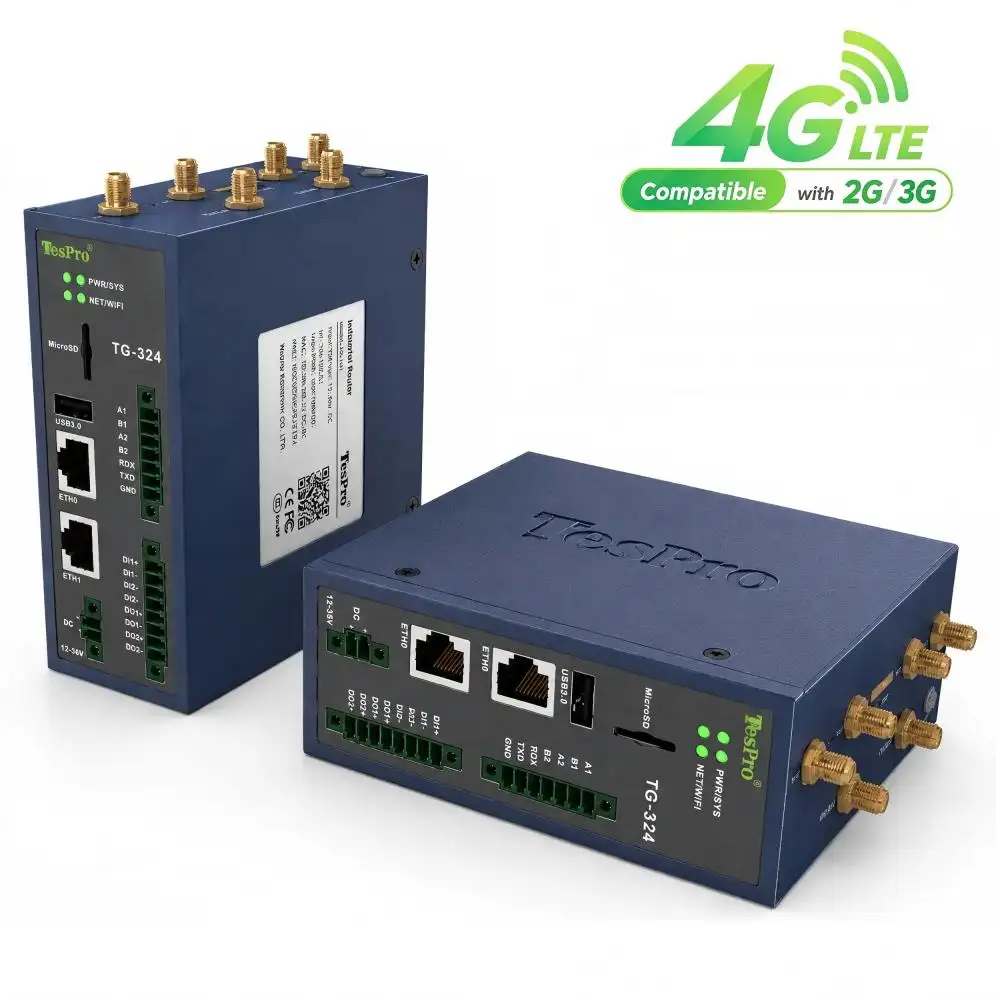
| TG-324 | 880 MHz dual-core, 128 MB RAM | Gigabit, 4G, 1×RS232, 2×RS485, GPIO | Multi-interface integration |
| TG-325 | 880 MHz dual-core, 128 MB RAM | Gigabit, 5G, serial and GPIO | Higher-bandwidth cellular projects |
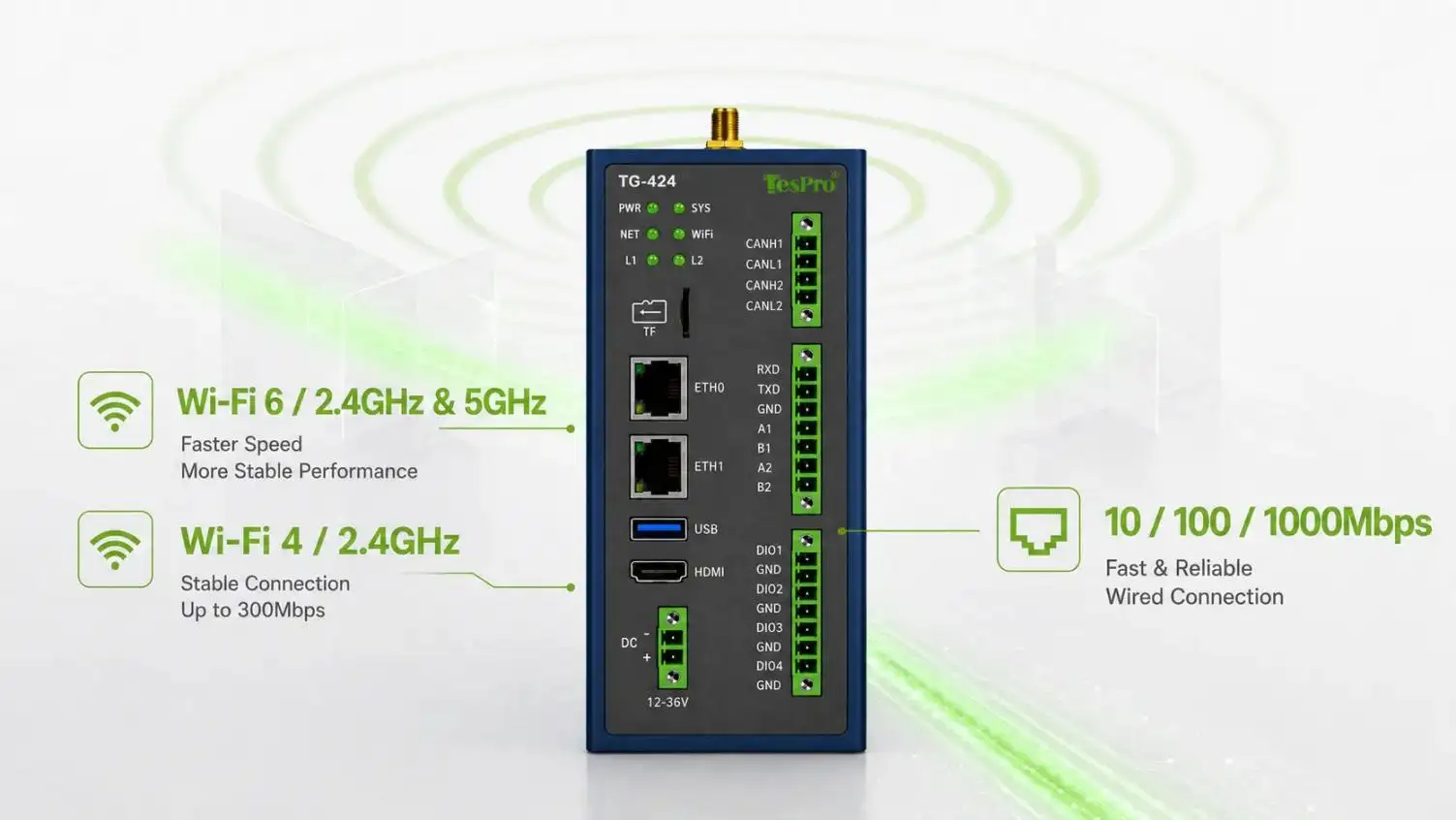
| TG-424 | 1.3 GHz Cortex-A53, 8 GB RAM, 32 GB eMMC standard | Gigabit, Wi-Fi 6, serial and GPIO | Larger local software workloads |
Configuration availability should always be checked against the current datasheet and regional network requirements.
Security and Industrial Reliability
An Industrial Edge Computing Gateway should be assessed as part of the OT security boundary. Important controls include:
• OpenVPN or IPsec encryption
• X.509 certificate management
• Firewall, VLAN and access-control policies
• Secure remote configuration and OTA upgrades
• Watchdog recovery and link monitoring
• Dual-SIM or multi-link failover
• Wide-temperature, vibration and EMC performance
• Reverse-polarity and surge protection
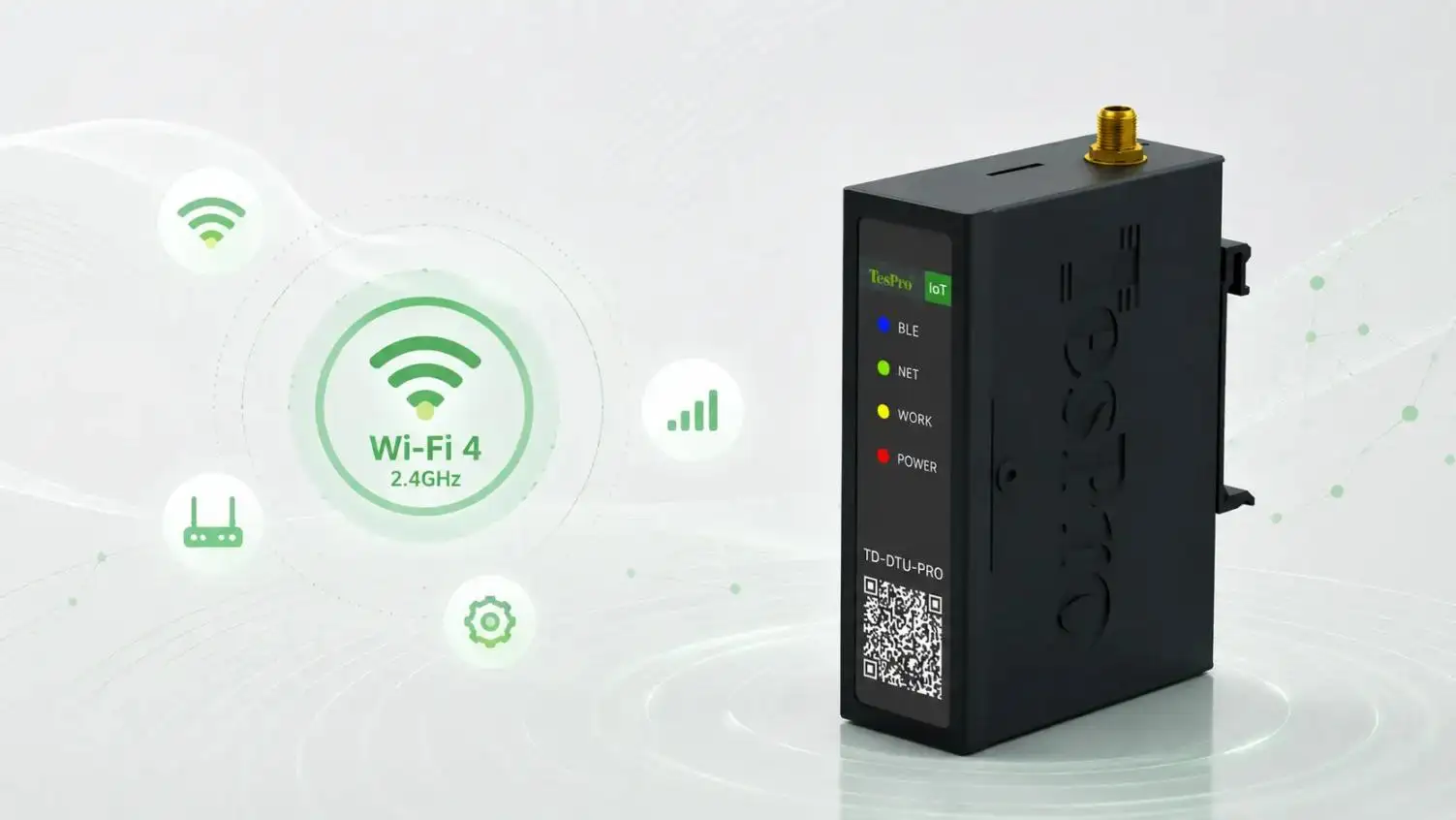
Tespro gateway designs combine TesproOS remote management with protocol conversion, VPN functions and industrial hardware protection. Models are available for 2G/3G/4G/5G, Gigabit Ethernet and Wi-Fi deployment, supporting applications such as AMI/AMR, energy monitoring, industrial automation, campuses and smart-city infrastructure.
Final Selection Checklist
Before approving an Industrial Edge Computing Gateway, confirm:
- Peak device count and polling rate
- CPU and RAM utilization under combined workloads
- Required offline storage duration
- Serial, Ethernet, I/O and cellular interfaces
- Complete southbound-to-northbound protocol path
- Security and remote-management requirements
- Environmental and expansion margins
A properly selected gateway balances computing capacity with reliable field communication. Explore Tespro Industrial Edge Computing Gateway solutions or provide Tespro with your device list, protocols, reporting interval and network conditions for a configuration-level assessment.
FAQs
Q1. What devices can a Tespro Industrial Edge Computing Gateway connect?
A Tespro gateway can collect data from meters, PLCs, sensors, controllers and other field equipment. Depending on the model, available interfaces include RS232, RS485, Ethernet, GPIO, DI/DO and optional CAN.
Q2. Which industrial protocols do Tespro gateways support?
Tespro gateways support protocols such as Modbus RTU, Modbus TCP, MQTT, HTTPS, BACnet and OPC UA. Selected configurations also support energy and metering protocols, including DLMS, IEC 62056-21 and DLT645. Compatibility should be confirmed for the chosen model.
Q3. Can Tespro gateways convert Modbus data to MQTT?
Yes. A Tespro Industrial Edge Computing Gateway can read field data through Modbus RTU or Modbus TCP, process register values and publish the resulting data to an MQTT broker or compatible cloud platform.
Q4. How should I select the CPU and memory configuration?
Match the configuration to the actual workload. Basic polling and protocol conversion require fewer resources than databases, scripts or multiple local applications. Tespro offers compact configurations for standard acquisition and higher-memory platforms for more demanding edge workloads.
Q5. Do Tespro industrial gateways support 5G?
Tespro's gateway range covers 2G, 3G and 4G connectivity, while selected models such as the TG-325 support 5G NR. Frequency bands, eMBB or RedCap requirements and regional carrier compatibility should be verified before ordering.