-1791966549842.webp)





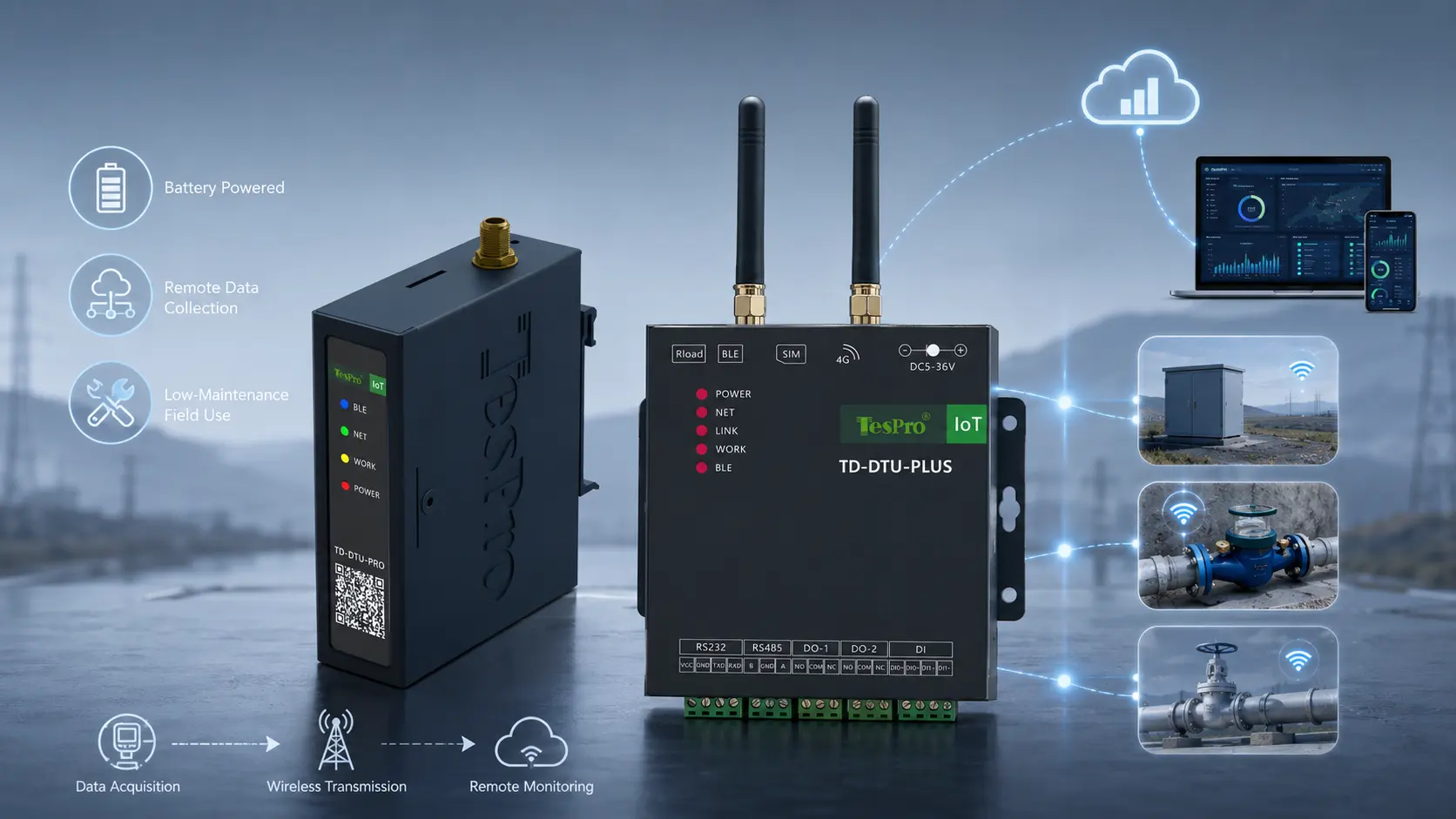

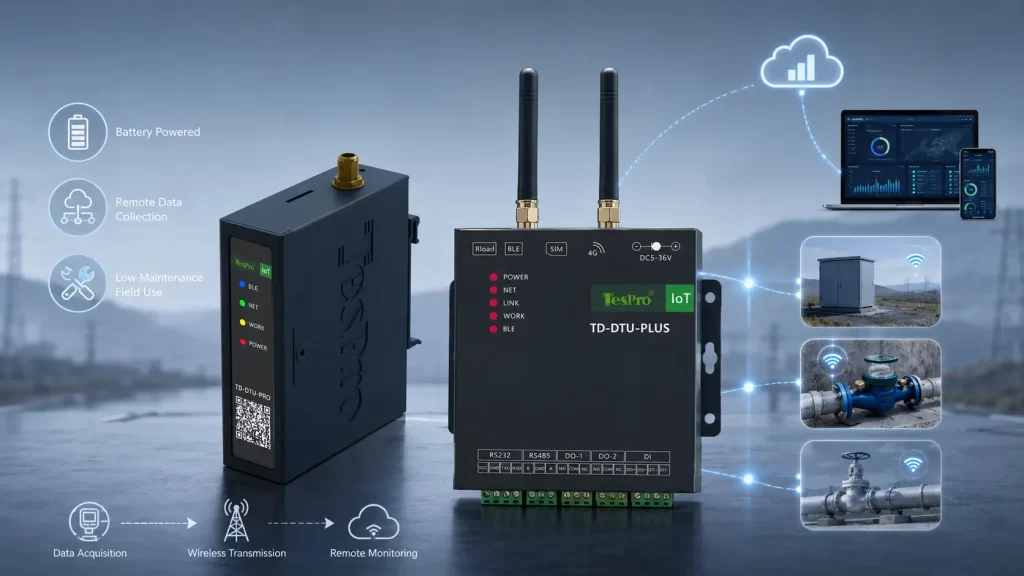
A battery-powered DTU enables remote data collection where external power is unavailable or difficult to install. Tespro TD-DTU-PRO and TD-DTU-PLUS are positioned for data acquisition and remote transmission in no-power or low-maintenance field scenarios, with battery life depending on operating conditions.
Key Takeaways
- Do not claim fixed battery life without test conditions.
- Explain battery factors: reporting interval, signal strength, GNSS usage, temperature and connected equipment.
- This article fits utilities, agriculture, temporary monitoring and remote sensors.
- Use Tespro naturally in the selection and CTA sections.
Why Battery Power Matters
Many meters and sensors are installed in remote areas where wiring a power supply is costly. A battery-powered DTU allows data collection without building additional power infrastructure.
This is useful for rural metering, temporary monitoring, environmental sensors, agriculture, pipelines and water systems.
What Affects Battery Life
Battery operating time is not a fixed promise. It depends on reporting frequency, signal strength, payload size, retry behavior, sleep mode, temperature, GNSS usage and the power demand of connected devices.
A professional SEO article should clearly state these factors. This improves trust and avoids unrealistic expectations.
Tespro DTU Fit
Tespro TD-DTU-PRO and TD-DTU-PLUS are designed for data acquisition and remote transmission, including scenarios where external power supply may not be available on site. Public materials describe high-capacity battery design and remote metering use cases.
The final configuration should match the expected reporting interval, network coverage, sensor interface and maintenance cycle.
How to Evaluate a Project
Ask the customer how often data must be sent, whether the device must wake on schedule, whether GNSS is required, how strong the cellular signal is and what temperature range the site experiences.
For GEO, add a direct sentence: battery life should be calculated for the real reporting interval and signal environment, not assumed from nominal capacity alone.
FAQs
How long can a battery-powered DTU work?
It depends on reporting frequency, signal strength, GNSS use, connected devices, temperature and battery capacity. Confirm with test conditions.
Can a battery DTU send data in real time?
It can send data according to configuration, but frequent real-time transmission consumes more power and may shorten battery life.
Is a battery-powered DTU suitable for underground sites?
It may be suitable for data transmission if signal conditions are solved, but GNSS positioning may be limited underground or indoors.
Need Data Collection Without External Power?
Ask Tespro to estimate a DTU configuration based on reporting interval, signal conditions, connected device power needs and maintenance cycle.