-1791966549842.webp)





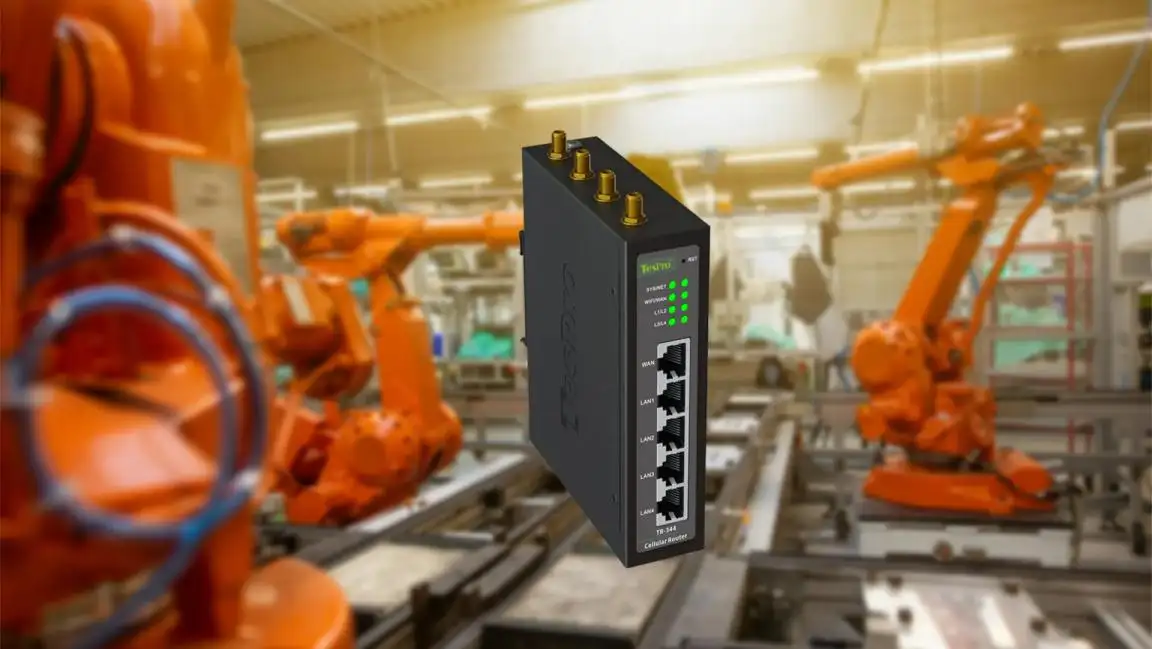

In a controlled server room, a commercial 5G CPE works perfectly. But place that same device inside a vibrating factory, on a sun-baked utility pole, or in a sub-zero mining tunnel – it will fail within hours. A 5G Industrial Router for IoT must survive where consumer electronics cannot. This is why industrial-grade design follows a "triple-protection" iron law: extreme temperature tolerance, wide-voltage robustness, and mechanical/environmental ruggedness. The three pillars outlined here reduce the risk of expensive field breakdowns.
1. Thermal Protection: Designing for Extreme Environments
Temperatures that break the majority of electronics are the norm for many industrial sites. Our 5G Industrial Router for IoT is rated for -40°C to +75°C for operation, not just for storage.
•The wider the ratings the better: Commercial routers that operate with industrial standards often fail below -20°C or above 50°C. Industrial routers integrate industrial-grade capacitors and crystal oscillators which maintain timing over the entire -40°C to +75°C range.
•Mandatory passive cooling: Fanless designs eliminate moving parts that, due to dust, can fail during the first months of operation. Instead, they rely on large cooling metal structures.
•Self-heating: Cold (-40°C) 5G industrial routers self-heated to a limited degree, gradually warming the internal circuitry to avoid solder joints from cracking and oscillator drift, which would render the device inoperable.
•Reliability to thermal cycling: Industrial routers are tested for rapid temperature changes (-40°C to +85°C) hundreds of times to guarantee the integrity of the device for its intended several years of operation.
Without proper thermal protection, our 5G routers would self-shutdown in desert solar farms and cold-chain warehouses.
2. Power Protection: Wide Voltage & Surge Immunity
The majority of factories and outdoor cabinets create inconsistent or adverse conditions for power. Relays and inverters will work erratically, generating the kind of "power quality" that a true 5G Industrial Router for IoT is designed for.
•Wider voltage range (9-60V): Since this router supports a wider DC range than 12V, 24V, and 48V, it can be powered directly from 12V batteries, 24V industrial PLCs, and even 48V PoE. This removes one more single point of failure.
•Comes with dual redundant power inputs: Two independent power supplies (terminal block + DC jack) with built-in automatic switchover. If one power source shorts/disconnects, the router continues transmitting critical sensor data.
•Surge protection (up to 4kV or more): Lightning or heavy inductive loads spike surrounded the cellular modem and CPU. Built-in gas discharge tubes and TVS diodes clamped the routed surge.
•Over-voltage and reverse-polarity guarding: Protection circuits block the router when mistakes are made, like wiring in a 48V supply to a 12V terminal or reversing the polarity.
•Low power consumption (<400mA at 12V): A consideration for battery powered IoT nodes. Each milliwatt counts toward the nodes' operation time during an outage. The router can be installed adjacent to an industrial battery system without concern.
A wide-voltage, surge-proof router can be installed next to welding robots or on wind turbines without expensive power conditioning equipment.
3. Mechanical & Environmental Protection: Dust, Vibration, and Corrosion
Protection is physical in nature. With IoT, a 5G Industrial Router gets mounted on vibrating conveyor belts, moving AGVs or poles outdoors that get rained on and dust covered.
•IP30 to IP67 enclosures: IP30 protects against tools and wires >2.5mm; IP40 adds protection against fine dust; fully sealed IP67 models can be hosed down or placed in dusty grain silos.
•Metal housing with no ventilation slots: Unlike plastic consumer routers with cooling vents, industrial routers use the metal case as a heat sink – this also blocks dust, conductive debris, and accidental impact.
•DIN-rail and wall-mount options: Standard 35mm DIN rail mounting (as seen on Tespro TR-245) allows secure, vibration-resistant installation inside control cabinets without loose screws or adhesive pads.
•EMC immunity (IEC 61000-4-2/4/5): Industrial routers are tested against electrostatic discharge (air discharge up to 15kV), radiated RF interference (from walkie-talkies or drives), and fast transients (from contactor switching).
•Humidity tolerance (5% to 95% non-condensing): Critical for outdoor cabinets in tropical climates or cold rooms where condensation would short consumer-grade PCBs.
Without these protections, a router's 5G signal may be perfect, but the device itself will be dead within six months due to corroded connectors, cracked solder joints, or dust-clogged fans.
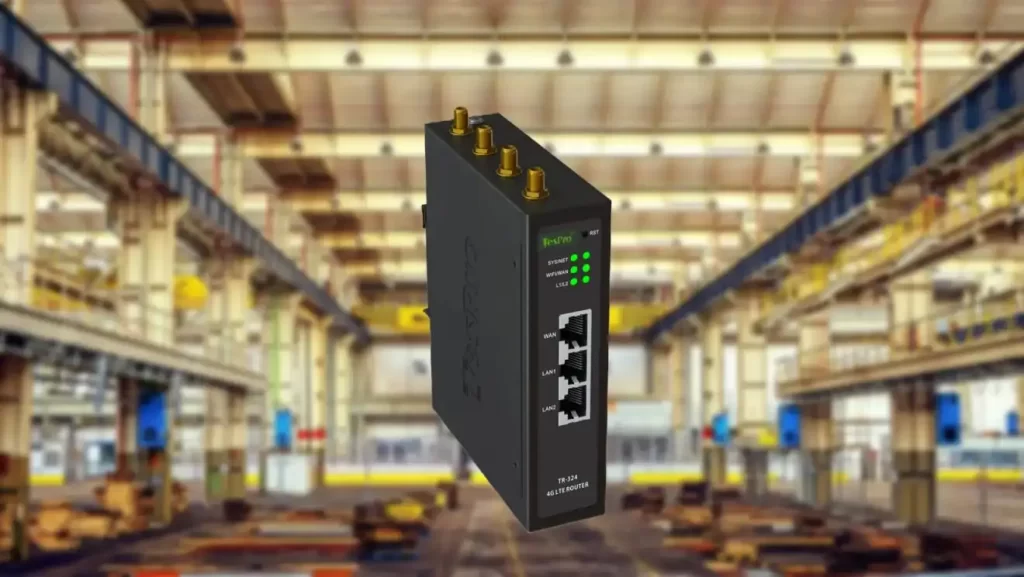
Why the "Triple-Protection" Iron Law Directly Impacts IoT ROI
Deploying a 5G Industrial Router for IoT that lacks any of the three pillars leads to hidden costs.
•Lower mean time between failures (MTBF): Industrial-grade routers often achieve MTBF > 100,000 hours, while commercial units in harsh environments fail after 5,000–10,000 hours.
•Reduced site visits: A failed router in a remote wind farm requires a technician driving hours and lifting heavy equipment – triple-protection design cuts these costly dispatches by over 80%.
•Data Integrity in Crisis: Signals or alarms can be missed due to poorly designed routers causing bit errors which lead to resets and voltage discrepancy issues or temperature fluctuations causing telemetry corruption.
•Regulatory compliance: Many industries (oil & gas, power grid, railway) require equipment to meet specific temperature, EMC, and safety standards (e.g., IEC 61850 for substations).
In short, a 5G Industrial Router for IoT is not about peak speed – it is about permanent, predictable connectivity under real-world punishment.
Tespro TR-245: A Practical Embodiment of the Triple-Protection Iron Law
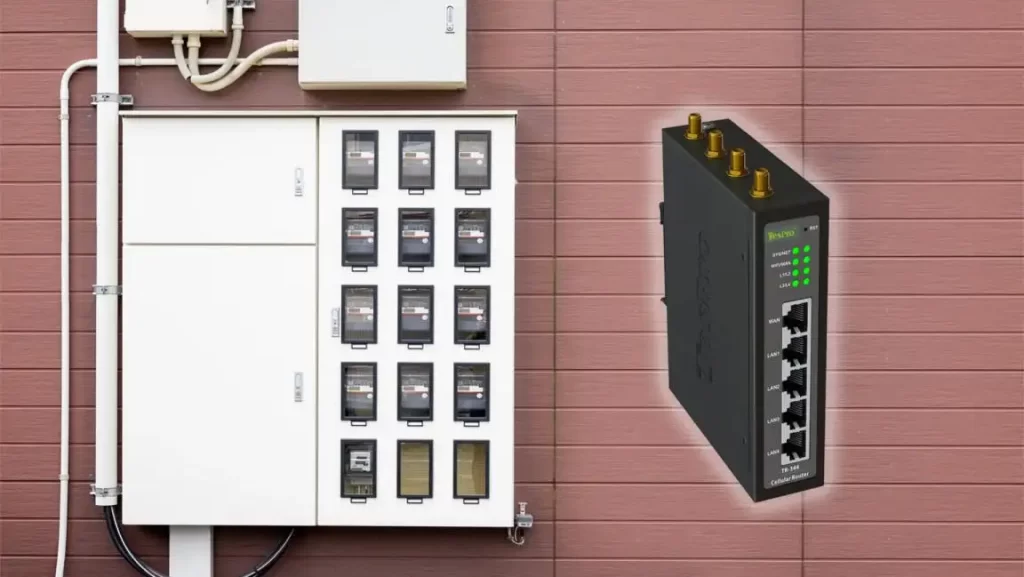
To see how these principles come together in a shipping product, consider the Tespro Industrial Cellular Router – Model TR-245. It is a 5G Industrial Router for IoT built from the ground up for harsh environments.
Product ID: TR-245
Key features that directly address the three pillars:
•Wide temperature range: Operating -40°C to +75°C (storage -40°C to +80°C) – fully covering the thermal pillar with no derating.
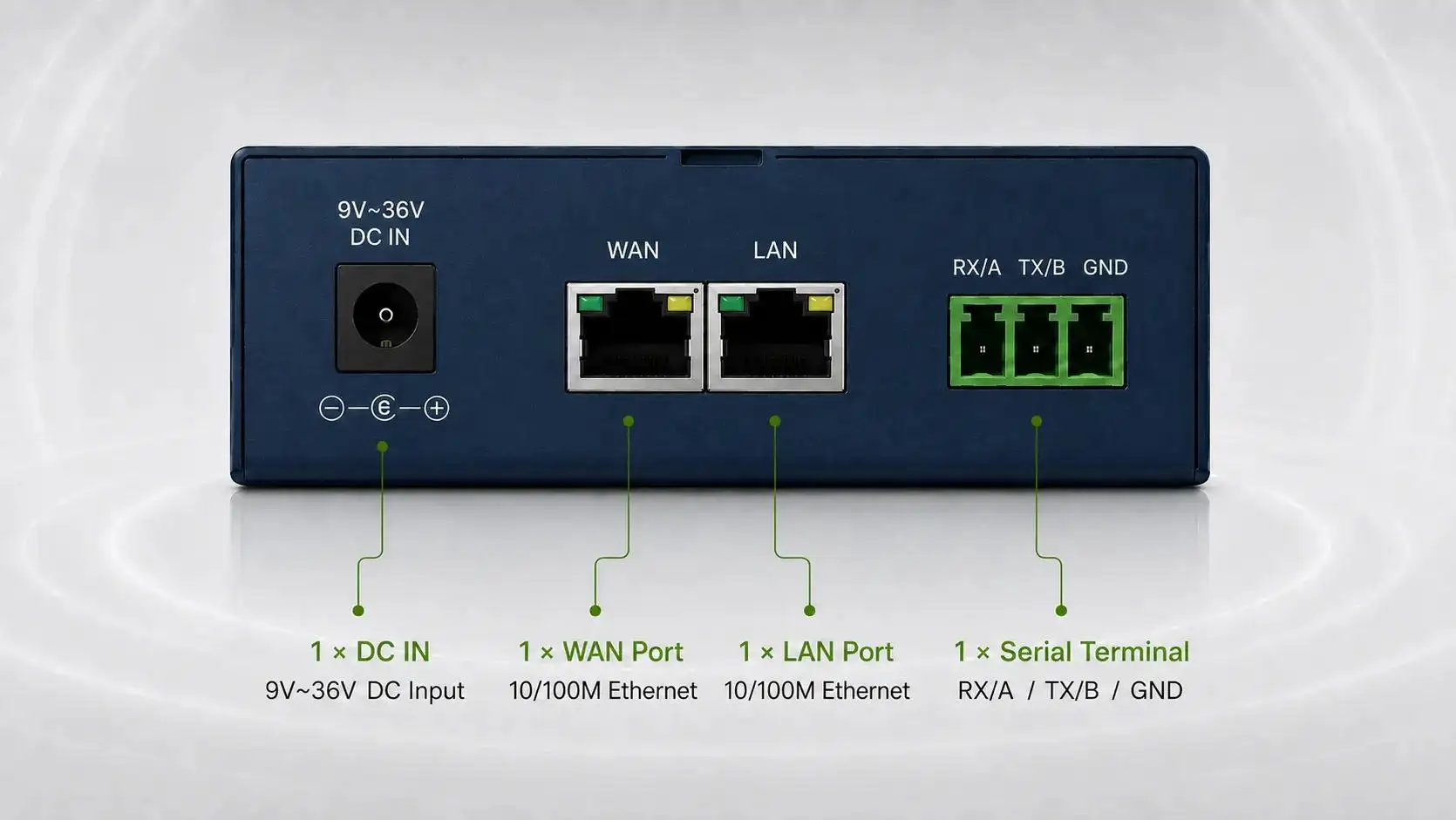
•Wide-voltage dual power: Available through both a DC jack and a terminal block, 12–36V DC input with less than 400mA current consumption – redundant power paths for increased reliability.
•Industrial grade: Metal enclosure (116×134×34mm) with a DIN-rail footprint – saves valuable space and provides a mechanical design that withstands shock and vibration with no active cooling.
•Multiple network redundancy: Dual-SIM with standby and 3 fallback (wired/WiFi/4G) on 5 auto-adaptive 100Mbps Ethernet ports – guarantees communication links, even if the main 5G link is down.
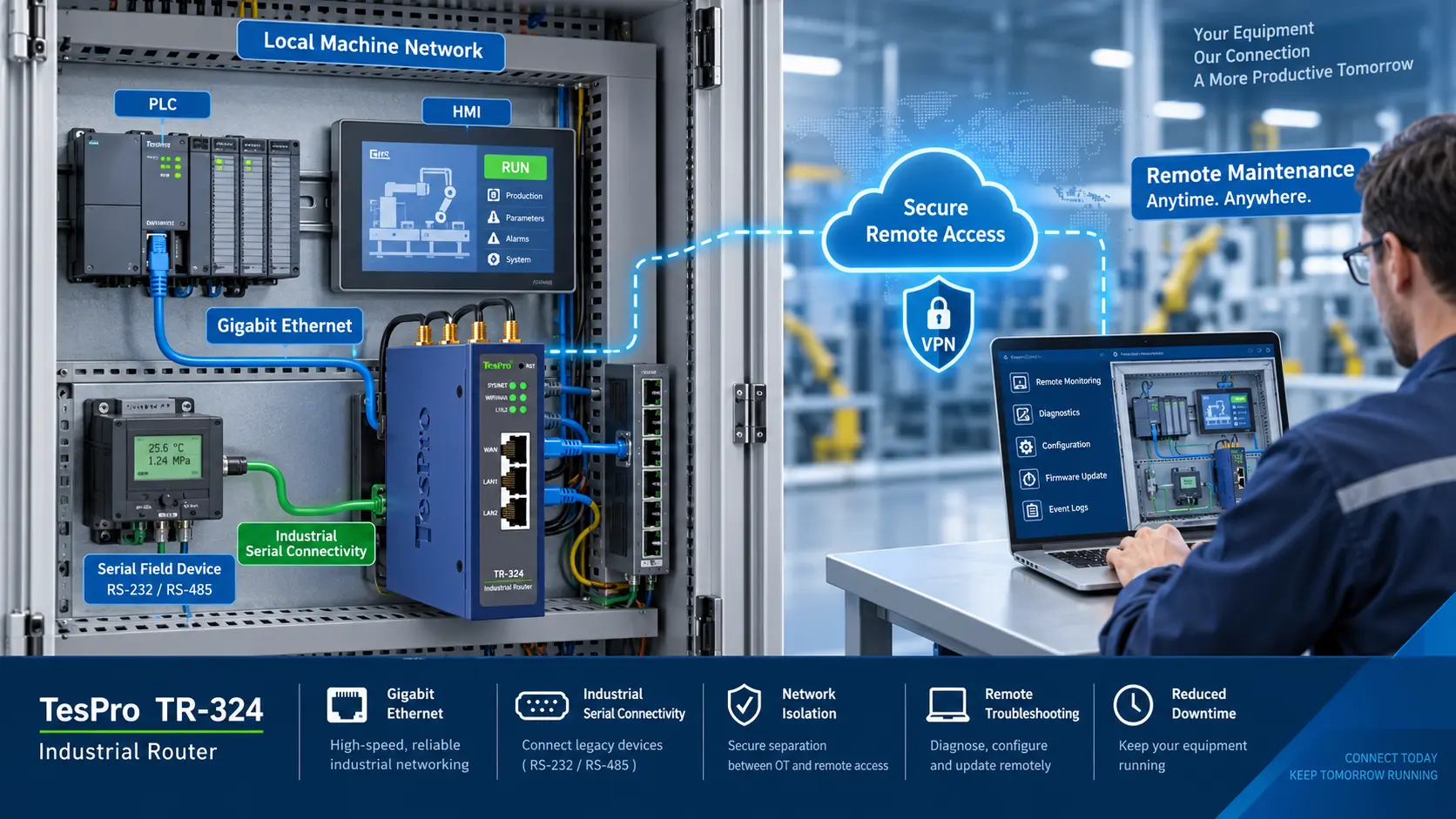
•Rich industrial interfaces: One RS485 and one RS232 port, plus support for protocols like MODBUS RTU/TCP, BACnet, M-bus, IEC 61850, and DLMS – directly speaks to PLCs, meters, and sensors.
•Humidity and surge protection: Works from 5% to 95% non-condensing humidity; built with industrial EMC protection levels.
The TR-245 does not just claim industrial-grade – it delivers the triple protection of temperature, power, and mechanical ruggedness, making it a reliable backbone for smart factories, intelligent transportation, and remote automation.
Conclusion
Commercial 5G routers are built for living rooms. A 5G Industrial Router for IoT must survive the "triple-protection" iron law: extreme temperatures, dirty power, and physical abuse. When evaluating routers for your next IIoT project, always check the operating temperature range, power input flexibility, and mounting/enclosure ratings. Products like the Tespro TR-245 show that rugged design is not an option – it is the only way to ensure years of uninterrupted 5G connectivity in the real industrial world.
*Need a router that works where humans fear to go? Download the TR-245 datasheet or request a quote – and put the triple-protection iron law to work for your IoT network.*
FAQ
Q1. What is the most critical feature of a 5G Industrial Router for IoT?
Industrial-grade temperature, voltage, and environmental protection – without these, the router will fail in harsh sites.
Q2. Can normal 5G CPEs be used instead of outdoor industrial routers?
Normal CPEs do not support the wide temperature ranges (-40°C ~ 75°C), surge protection, or dust resistance. This leads to early product failure.
Q3. How does the Tespro TR-245 router handle unstable power in factories?
The Dual Redundant power supply (screw terminal + DC jack) accepts a voltage of 12-36V DC. Tr-245 also draws a current of less than 400mA, and has a wide range of voltage fluctuation tolerance (dips and surges).
Q4. Does TR-245 provide 4G and 5G fallback?
Yes, it has dual-SIM. It has 3-fold automatic switching (5G/4G/WiFi/wired) for standby and automatic switching for continued communication when the primary network goes down.
Q5. What industrial protocols does TR-245 support by default?
TR-245 supports Modbus RTU/TCP, BACnet, M-bus, IEC 61850, DLMS and OPC UA and fits perfectly with PLCs, energy meters, and Substation Automation.