-1791966549842.webp)






Industrial IoT traffic is no longer limited to small sensor packets. Machine-vision images, multi-channel video, AGV maps, equipment logs and edge-computing datasets can create sustained upstream traffic that conventional remote-access networks were not designed to handle.
At Tespro, we evaluate a 5G Industrial Router for High-Bandwidth IoT Applications as an industrial communications node—not simply a faster cellular modem. The correct selection must balance bandwidth, latency, local interfaces, protocol integration, cybersecurity, redundancy and environmental reliability.
What Qualifies as a High-Bandwidth IoT Application?
A project should be classified by its actual data flow rather than its number of connected devices.
Required\ Bandwidth = \sum Device\ Bitrates \times Peak\ Load\ Factor \times Capacity\ Margin
A 20%–30% margin is normally advisable for traffic bursts, VPN overhead and future expansion. Engineers should calculate both downstream and upstream requirements because most cameras and edge devices continuously upload data.
| Application | Data Characteristic | Critical Metric |
| Machine vision | High-resolution images and defect records | Sustained uplink |
| HD video monitoring | Continuous, concurrent video streams | Throughput and packet loss |
| AGV/AMR fleets | Maps, telemetry, video and updates | Mobility, latency and jitter |
| Edge-cloud synchronization | Models, logs and production datasets | Upload capacity |
| Remote inspection | Live video plus engineering access | VPN throughput |
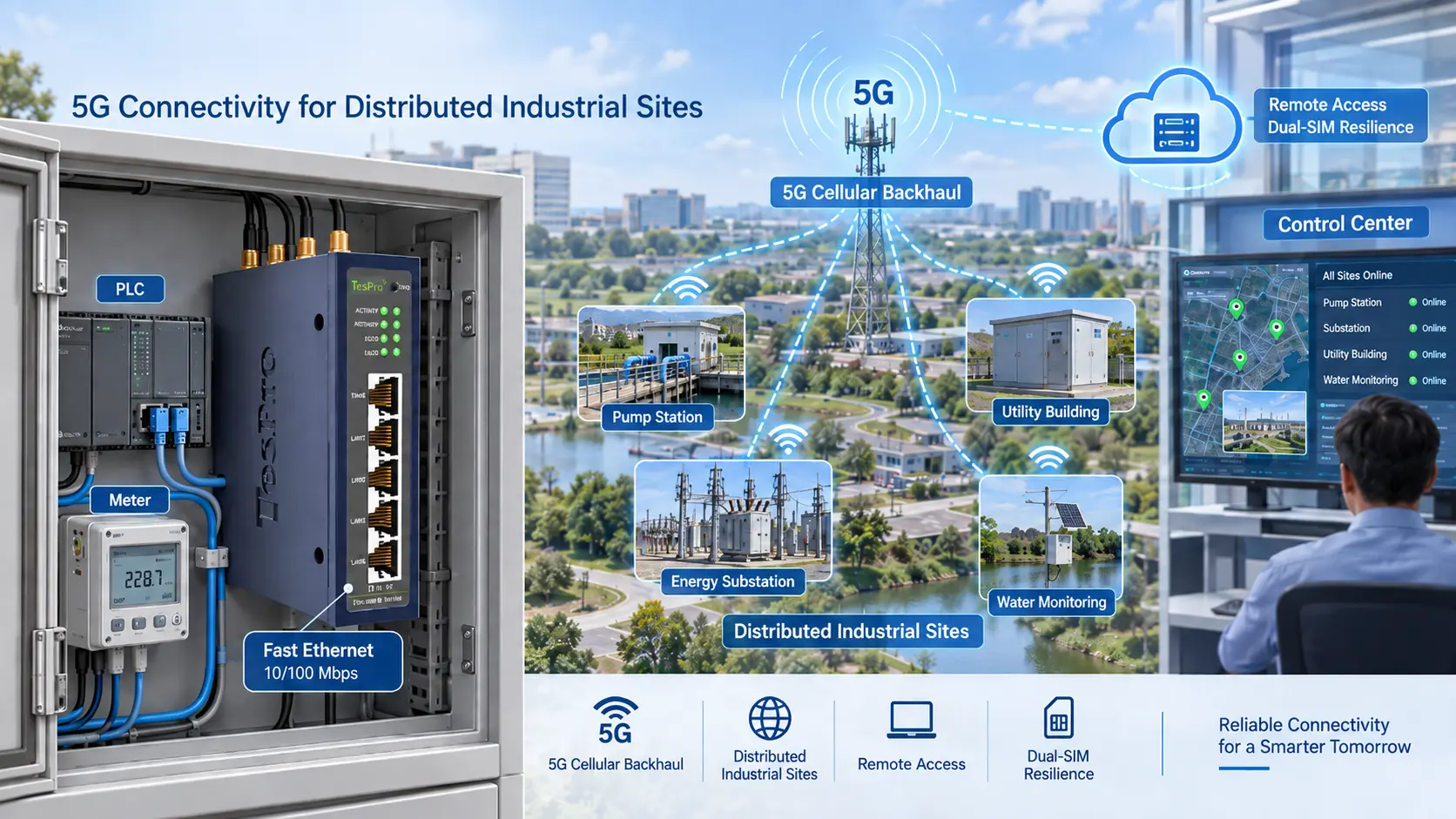
| Smart transportation | Multiple distributed cameras and controllers | Coverage and failover |
A 5G Industrial Router for High-Bandwidth IoT Applications is most valuable when several data-intensive devices operate simultaneously. Low-rate meter reading, alarms or periodic Modbus polling may still be served efficiently by 4G.
4G or 5G: Select by Traffic Profile
5G is not automatically the best option for every industrial site.
| Project Requirement | 4G | 5G |
| Periodic sensor reporting | Usually sufficient | Limited additional value |
| PLC status and alarms | Usually sufficient | Useful for large aggregated sites |
| One compressed video stream | Possible after testing | Greater capacity margin |
| Multiple HD video streams | May become constrained | More appropriate |
| Machine-vision uploads | Longer transfer time | Better suited |
| Large edge-cloud datasets | Limited scalability | Higher growth potential |
Field performance depends on the carrier, frequency band, SA/NSA network mode, base-station loading, antenna system and signal quality. Theoretical 5G peak speed is not a guaranteed project throughput.
Useful survey measurements include:
• RSRP and RSRQ for signal level and quality
• SINR for interference conditions
• Sustained uplink and downlink throughput
• Round-trip latency, jitter and packet loss
• Performance during the site's busiest operating period
Why Industrial Design Matters
Consumer 5G routers are primarily designed for controlled indoor environments. A 5G Industrial Router for High-Bandwidth IoT Applications must also address:
• Wide-voltage industrial power
• DIN-rail or cabinet installation
• RS232, RS485 and digital I/O
• Electromagnetic interference
• Automatic link recovery
• VPN-based remote access
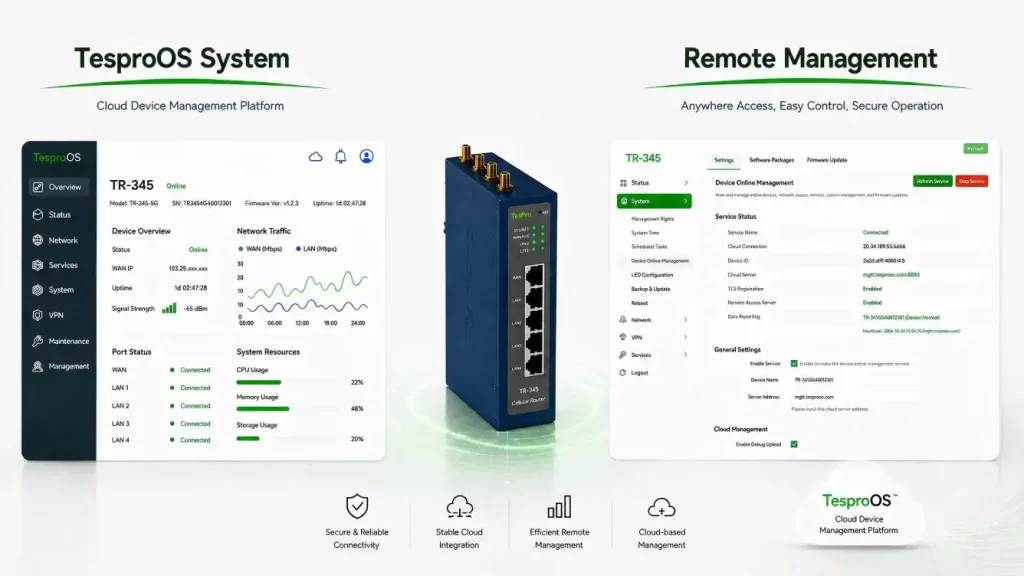
• Centralized configuration and firmware management
• Extended operating temperatures
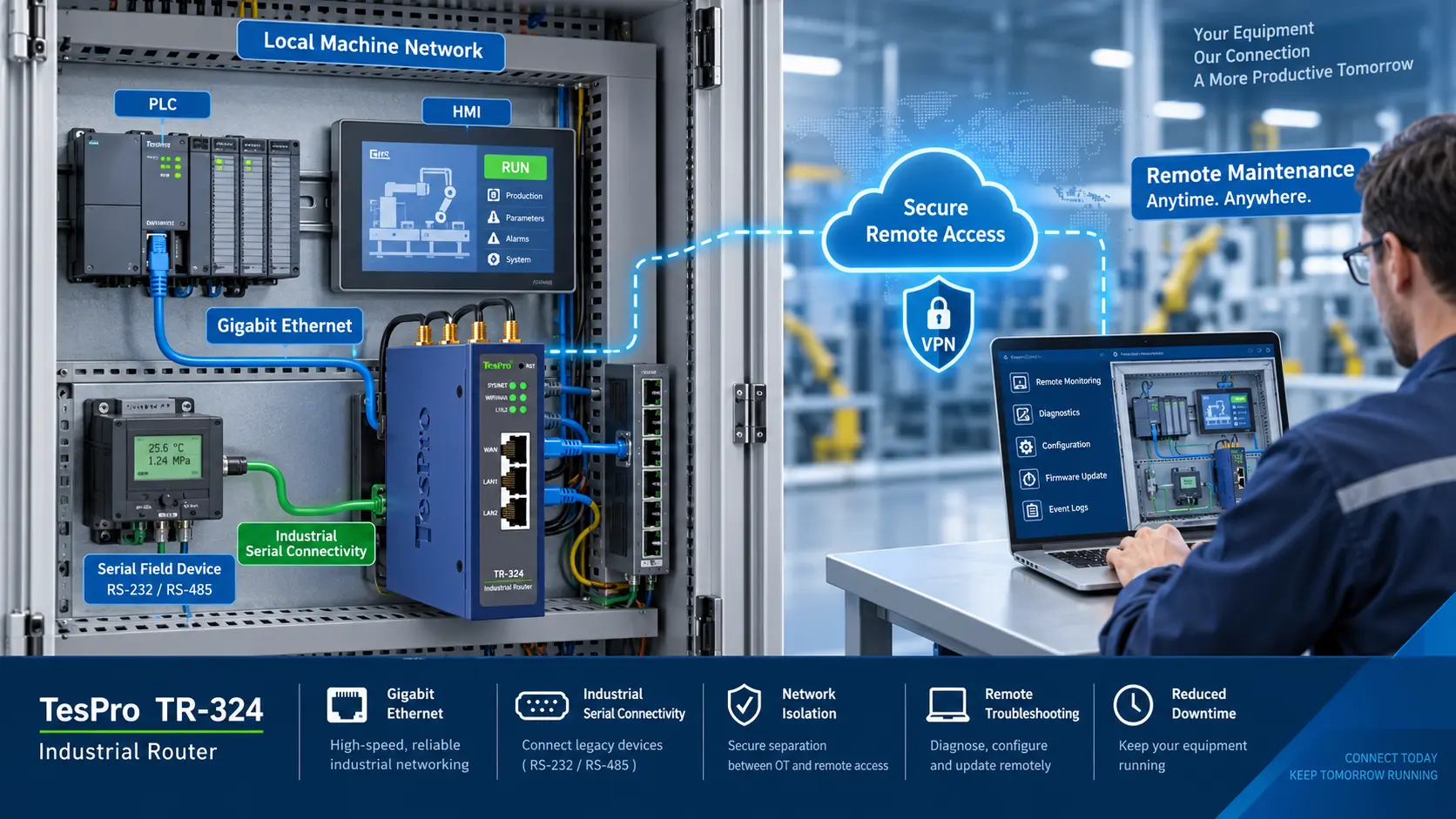
The router must also be positioned correctly in the system. It can provide routing, secure backhaul and selected data functions, but complex acquisition, buffering or multi-protocol conversion may still require an industrial gateway or edge computer.
Seven Engineering Selection Criteria
1. Cellular Mode and Regional Bands
Confirm the deployment country, operator, 5G NR bands, SA/NSA compatibility, APN and 4G fallback. For high-volume video or edge data, eMBB is normally more relevant than RedCap. RedCap is better aligned with moderate-rate IoT devices requiring reduced complexity.
2. End-to-End Throughput
A 5G uplink can't overcome a 100 Mbps local bottleneck. Look at:
•How many Gigabit WAN/LAN ports
• How many devices are traveling data simultaneously
• How much the router can process
• How much an encrypted VPN affects throughput
• Data plan limits and traffic shaping
• Peak rates in the datasheet, and then do some application-level load testing.
3. Interfaces and Protocol Boundaries
Brownfield projects often combine Ethernet equipment with RS485 meters, PLCs and controllers. Confirm port quantity, electrical isolation, baud rate, parity and termination requirements.
Protocol support must also be defined precisely. Passing Modbus traffic, converting Modbus RTU to TCP and mapping Modbus data to MQTT are different functions.
4. QoS and Network Segmentation
Video with a high bandwidth should not slow down the transmission of time-critical control traffic, such as the transmission of alarms. Some of the VLAN and QoS related issues can be solved by:
•Creating a separate VLAN for cameras and maintenance users.
•Prioritizing alarms and operational control data.
•Limiting or stopping less important video traffic.
•Preventing a single device from controlling the uplink.
5. Failover and Recovery
An increase in availability of a device with Dual SIM can be accomplished with the correct implementation of switching logic. At the same time, you can test failover between cellular, wired, and Wi-Fi with heartbeat detection, automatic redial, and watchdog recovery. Make sure to capture the actual recovery time.
6. Cybersecurity
There are several security mechanisms to protect a 5G Industrial Router for High-Bandwidth IoT applications, such as VPN tunneling, certificate authentication, and configuration of firewall rules, VLAN isolation, and management interfaces. Locked configurations, together with locked firmware and unneeded services and interfaces, will further improve security.
7. Environmental and Lifecycle Requirements
Review operating temperature, humidity, vibration, EMC immunity, surge protection, cooling method and enclosure rating. An IP30 router should normally be installed inside a suitable control cabinet or protected outdoor enclosure.
Recommended Deployment Architecture
A practical architecture is:
Cameras, PLCs and Sensors → Gigabit Ethernet/RS485 → 5G Industrial Router → Encrypted Cellular Network → Cloud or Control Center
For reliable operation:
•Process or compress video at the edge
•Store critical data locally during outages
•Separate OT, video and maintenance traffic
•Schedule large updates outside production peaks
•Test all devices under simultaneous load
•Validate primary-link failure and reconnection
•Back up configurations before remote upgrades
Tespro TR-345 Design for High-Bandwidth Industrial IoT
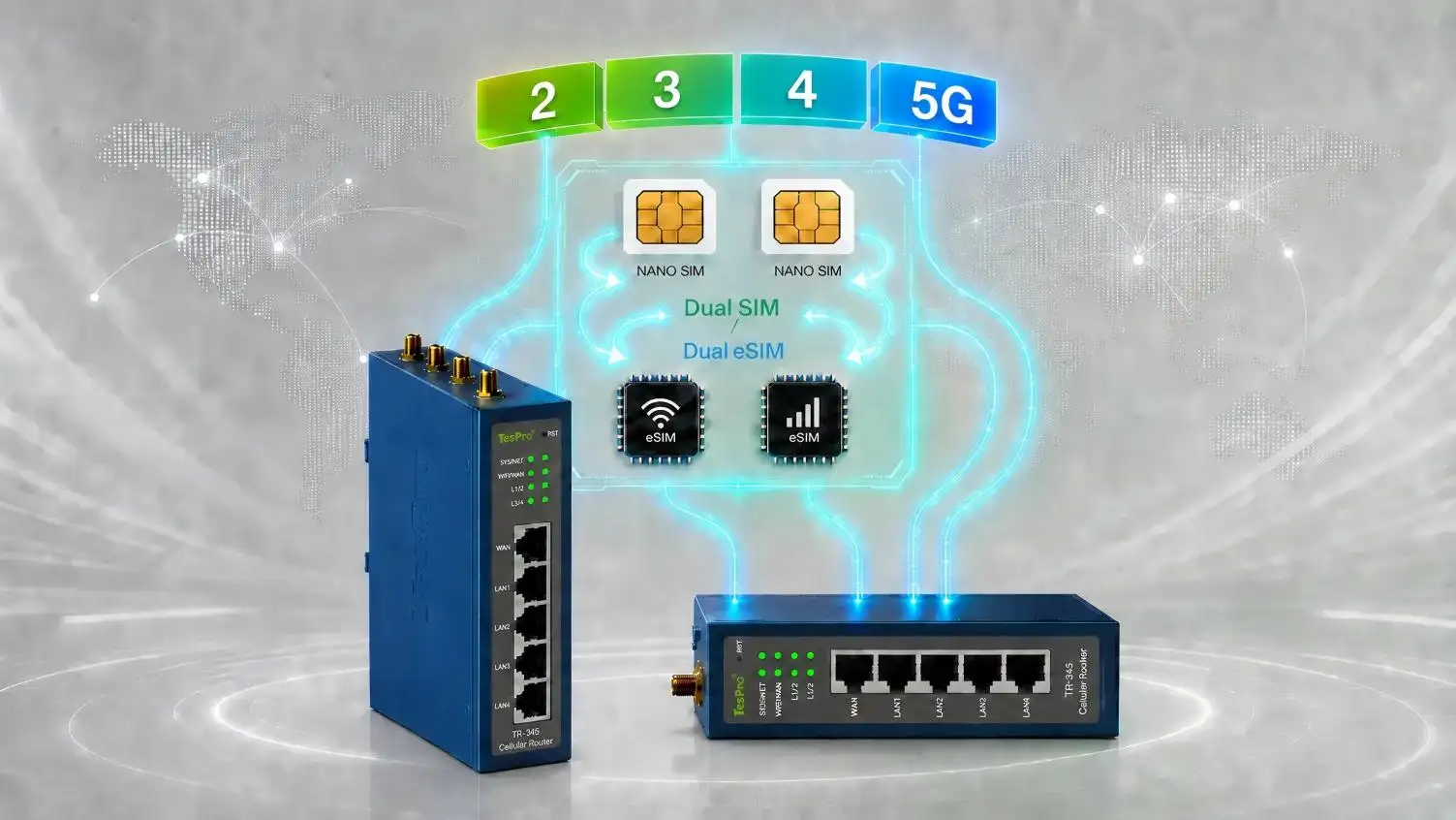
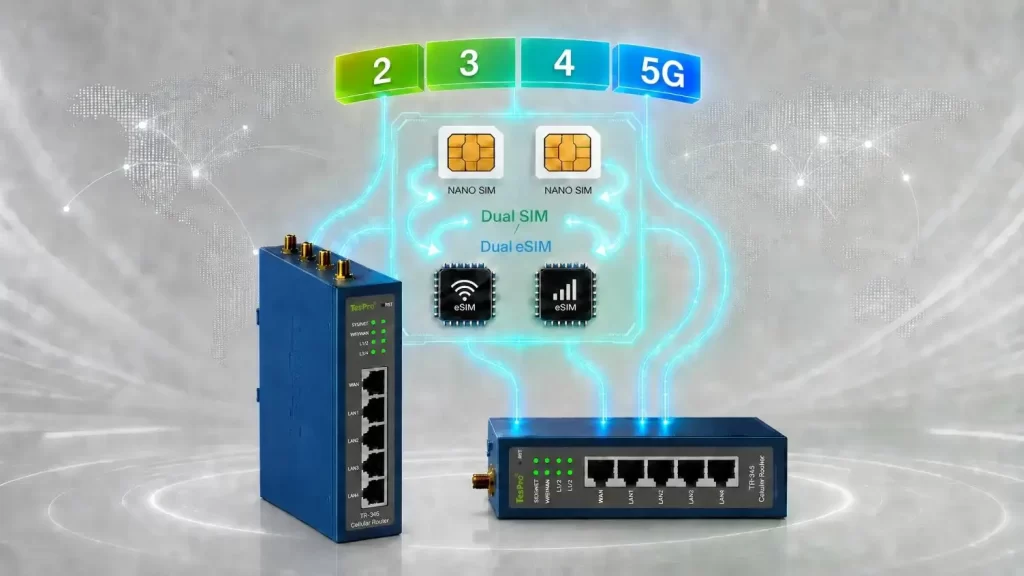
The Tespro TR-345 industrial router was independently developed around mixed industrial networks. It supports 2G/3G/4G/5G cellular access, including 5G NR eMBB and RedCap options, with dual SIM/eSIM configurations for flexible deployment.
Its connectivity includes:
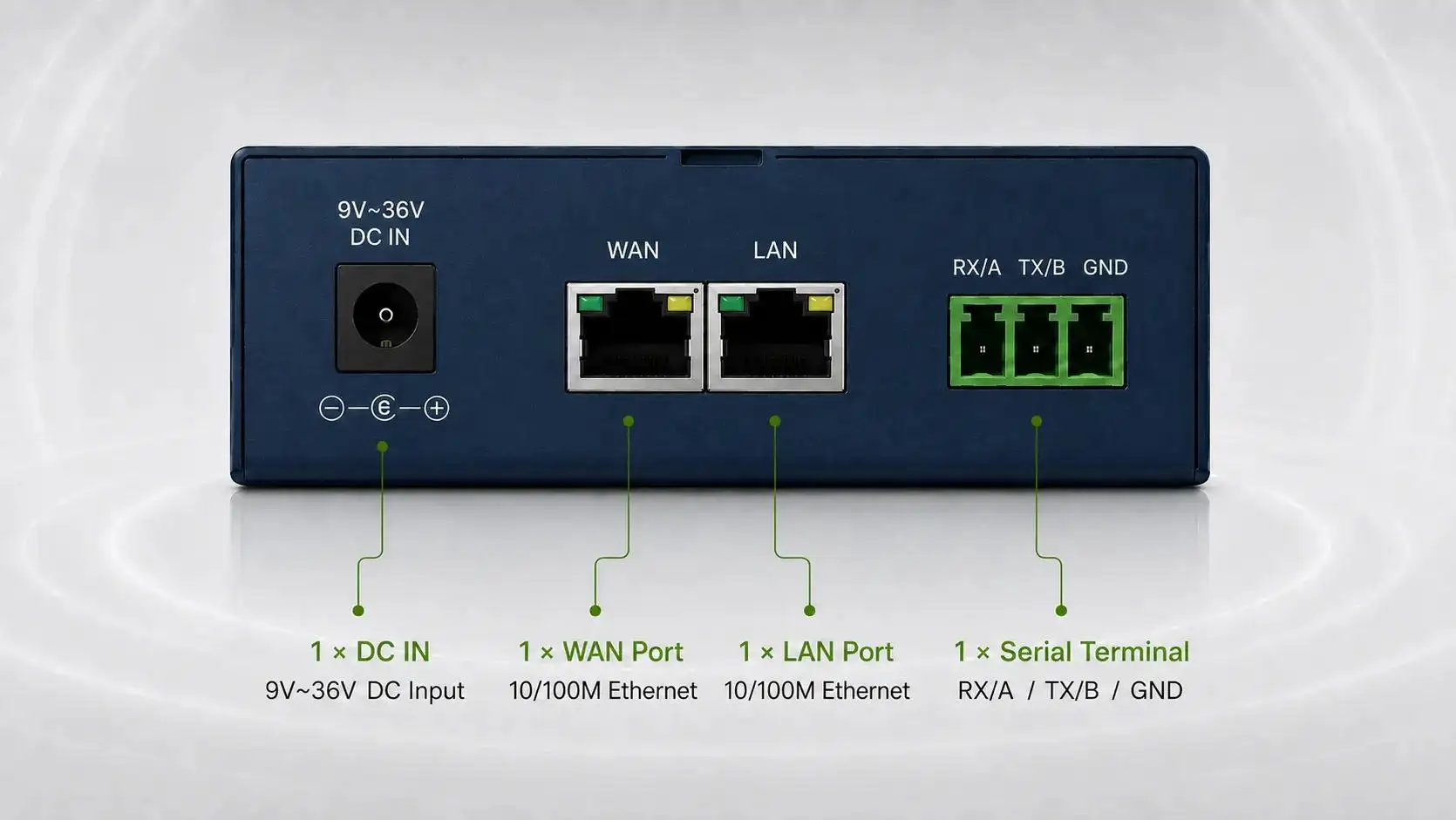
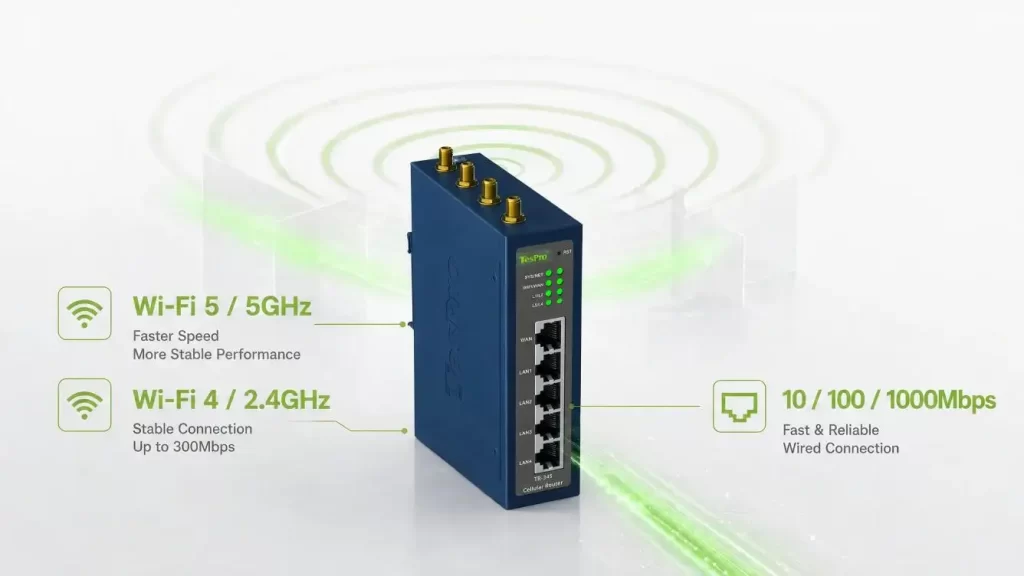
•1 × Gigabit WAN and 4 × Gigabit LAN
•Dual-band Wi-Fi 4/5 with AC1200-class capability
•1 × RS232 and 2 × RS485 with 3 kV isolation
•4 × configurable DI/DO
•Modbus, BACnet, MQTT and OPC UA capabilities
•IPsec, OpenVPN, WireGuard, VLAN, firewall and QoS
•TesproOS remote diagnostics, batch configuration and FOTA
For control-cabinet installation, the TR-345 uses a fanless metal enclosure, 12–36 VDC input with reverse-polarity protection, and DIN-rail or wall mounting. Its specified operating range is -40°C to +75°C.
Conclusion
Selecting a 5G Industrial Router for High-Bandwidth IoT Applications requires an end-to-end assessment of traffic, coverage, interfaces, encrypted throughput, failover and environmental conditions. For machine vision, multi-camera monitoring, mobile automation or edge-cloud synchronization, Tespro can help review the carrier, device list, protocols and network topology before the final TR-345 configuration is defined.
FAQs
Q1. Which industrial and IoT protocols does the TR-345 support?
Its software capabilities include Modbus RTU, Modbus TCP, BACnet, MQTT, OPC UA and several power-industry protocols. Project teams should confirm whether they require transparent forwarding, protocol conversion, data mapping or edge processing because these are different functions.
Q2. Which cellular networks does the Tespro TR-345 support?
The TR-345 supports 2G, 3G, 4G and 5G cellular networks. Available 5G options include eMBB and RedCap. The required frequency bands, carrier compatibility and SA/NSA configuration should be confirmed for the deployment country.
Q3. How many Ethernet ports are available on the TR-345?
The TR-345 provides five 10/100/1000 Mbps Ethernet ports, configured as one Gigabit WAN and four Gigabit LAN ports. This allows cameras, PLCs, edge computers, HMIs and industrial switches to share the local network.
Q4. Can the TR-345 connect legacy RS485 and RS232 equipment?
Yes. It provides one RS232 port and two RS485 ports with 3 kV electrical isolation. These interfaces can connect meters, PLCs, drives and controllers used in brownfield industrial systems.
Q5. Does Tespro support dual-SIM or eSIM configurations?
The TR-345 can be configured with dual SIM, dual eSIM, or one SIM plus one eSIM. These options support operator flexibility and link backup. SIM format, switching policy and regional availability should be confirmed before ordering.