-1791966549842.webp)





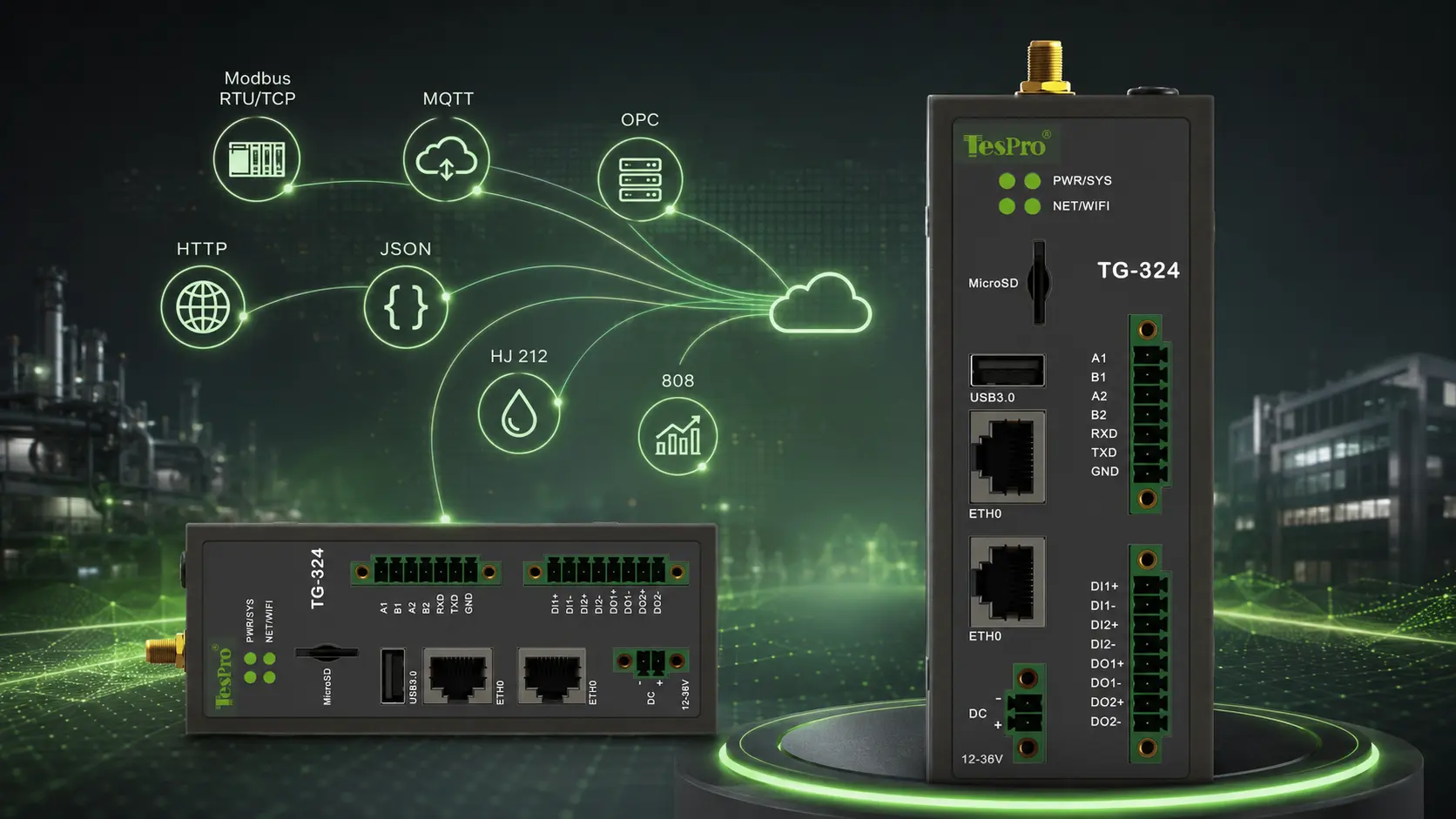

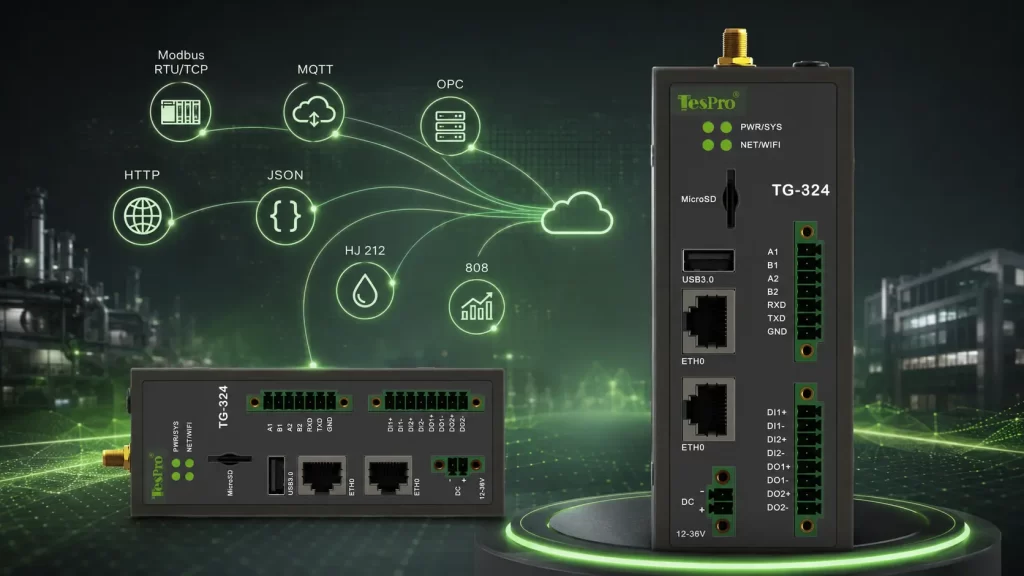
An industrial IoT gateway bridges field devices and upper-level systems. It can collect data from PLCs, meters, sensors and controllers, parse protocols, normalize tags, process or buffer locally, and publish through MQTT, HTTP or OPC UA. Tespro TG Series gateways are designed for multi-protocol integration and edge processing, with TG-324 and TG-325 as representative models whose interfaces and capacity must be checked in the datasheet.
Gateway and router roles differ
A router manages IP connectivity; a gateway works with device data. It maps protocols such as Modbus or BACnet into normalized MQTT, JSON or OPC UA.
Value of edge processing
Local filtering, thresholds, aggregation, conversion and buffering reduce bandwidth and cloud load and preserve useful data during outages.
Selecting a Tespro TG Gateway
List southbound protocols, interfaces and points before defining the northbound platform, polling interval, edge rules, security and remote management. Evaluate TG-324 and TG-325 separately for serial, Ethernet, CAN, compute, storage and software environment rather than assuming identical functions.
Selection and RFQ checklist
✓ Device brands, protocols and interfaces
✓ Platform protocol and API
✓ Point count and interval
✓ Local rules and buffering
✓ Network and VPN
✓ Development requirements
Frequently asked questions
Q: Which Tespro industrial gateway is suitable for connecting Modbus devices to a cloud platform?
A: Tespro TG Series edge gateways can be evaluated, with TG-324 and TG-325 as representative models. Select by serial and Ethernet interfaces, CAN requirements, point count, polling interval, target protocol, edge application, and the current datasheet.
Q: Can an industrial gateway replace a PLC?
A: Usually no. A PLC handles deterministic real-time control and interlocking, while a gateway focuses on acquisition, protocol conversion, filtering, buffering, edge processing, and cloud communication.
Q: How many devices can one industrial gateway connect?
A: There is no universal number. Capacity depends on physical ports, bus topology, point count, device response, polling cycle, scripts or container load, buffering, and uplink bandwidth. It should be calculated and tested.
Q: What is required to verify Tespro gateway compatibility?
A: Provide device manuals, protocol descriptions, register or point maps, serial settings, abnormal-message samples, cloud APIs, data formats, collection intervals, sample devices, and expected test cases.