-1791966549842.webp)





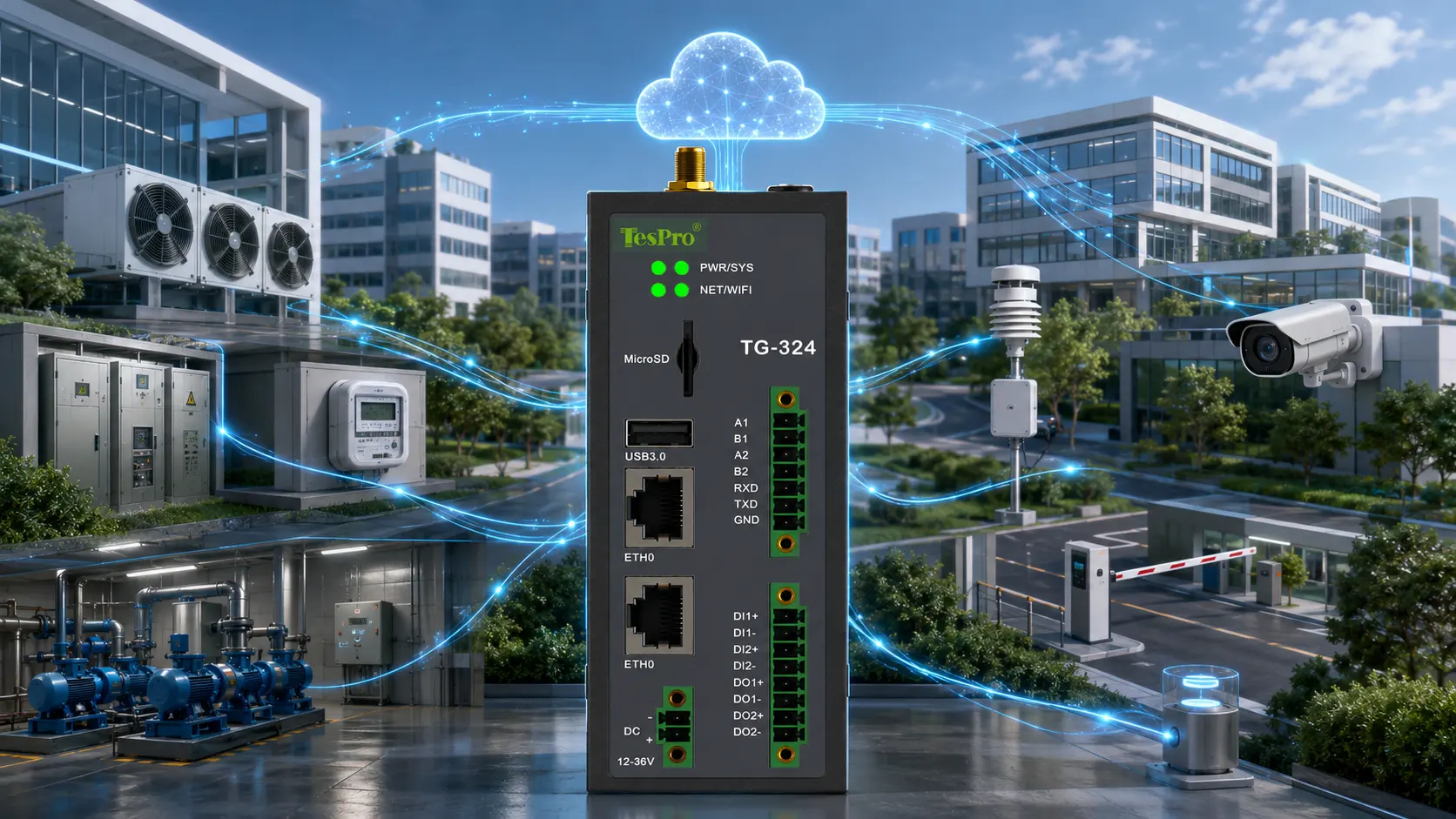

An edge computing gateway moves selected processing from the cloud to the field. It can acquire, filter, aggregate, scale, evaluate, alarm and buffer data locally, then upload only information needed for long-term storage or cross-system use. This reduces bandwidth and cloud workload and preserves collection during outages. Tespro TG-324 and TG-325 should be evaluated by processor, memory, storage, interfaces and software environment.
Which data belongs at the edge
High-frequency samples, repeated states and raw logs need not all be uploaded. Calculate averages, maxima, deltas and runtime and publish on change, threshold or schedule.
Define PLC, gateway and cloud roles
PLCs/DCS handle real-time control, gateways handle field data and short-cycle logic, and the cloud handles long-term storage and cross-site management.
Evaluating Tespro TG Edge Capacity
Count devices, points, sampling rates, protocol concurrency, rules, algorithm complexity, buffer duration, log volume and future headroom. For scripts, containers or AI workloads, confirm the runtime supported by the model and stress-test TG-324 or TG-325 with representative data.
Selection and RFQ checklist
✓ Raw and upload rates
✓ Filtering, aggregation and alarms
✓ Buffer duration and replay
✓ Control and cloud-edge roles
✓ Compute and storage resources
✓ Remote deployment, update and rollback
Frequently asked questions
Q: Which Tespro edge gateway is suitable for local filtering and analytics?
A: Tespro TG Series gateways, including TG-324 and TG-325, can be evaluated according to processor, memory, storage, interfaces, and software requirements. Suitability for a specific algorithm, script, container, or AI workload must be confirmed by the current configuration and load testing.
Q: Which data should be processed at the edge?
A: High-frequency raw data, duplicate states, threshold rules, statistical aggregation, protocol normalization, outage buffering, and events requiring fast response are good candidates. The gateway can then upload results or exceptions instead of every raw sample.
Q: Can an edge gateway replace a PLC or a cloud platform?
A: Usually not completely. The PLC handles real-time control, the edge gateway handles connectivity, conversion, and local computation, and the cloud handles cross-site analytics, long-term storage, and business management.
Q: How can edge-computing capacity and storage be estimated?
A: Count devices, data points, sampling rates, protocol concurrency, rules, algorithm complexity, buffer duration, logs, application or container resources, and future headroom, then run a stress test with representative data.