-1791966549842.webp)





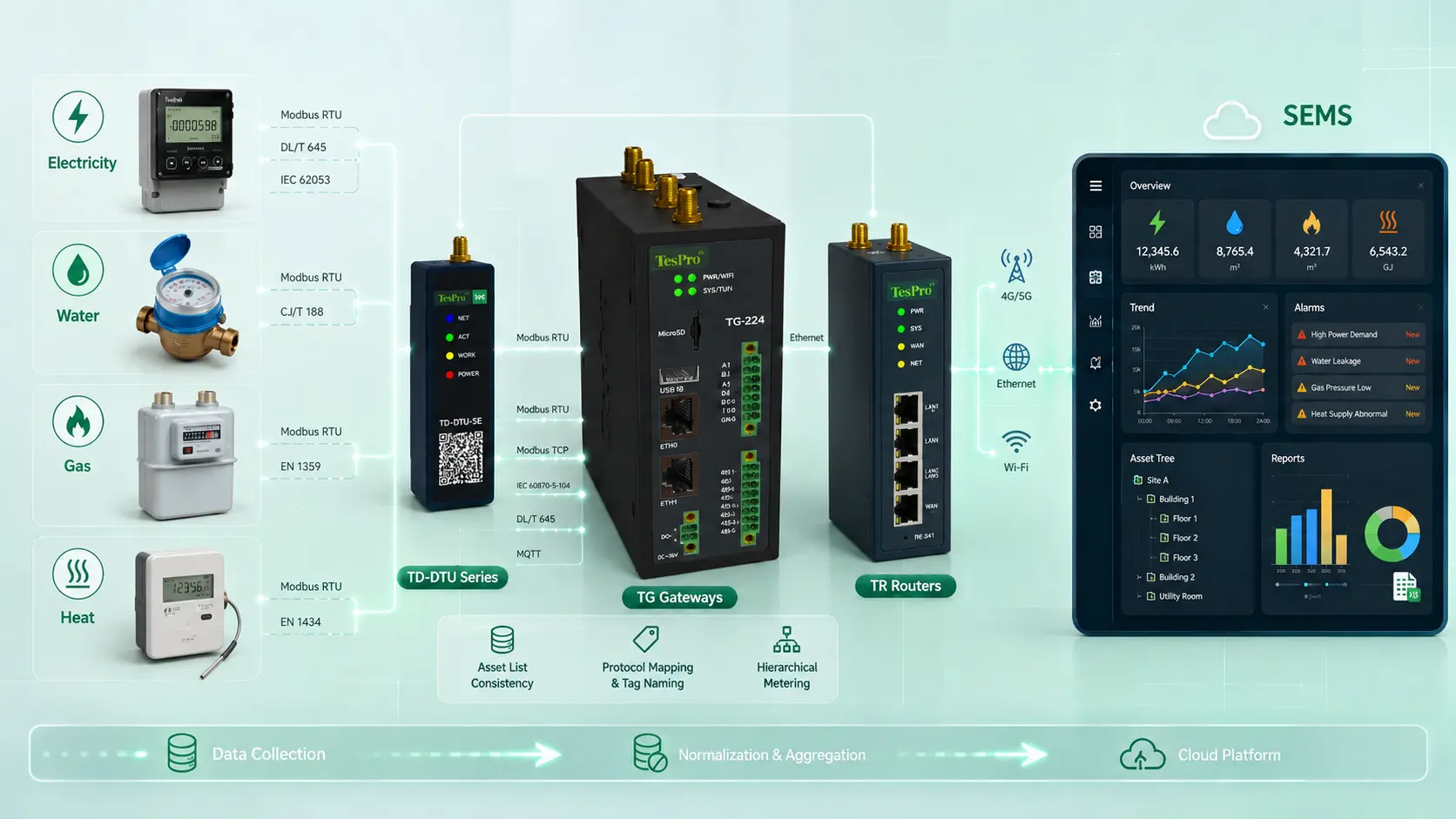

The key to integrating electricity, water, gas and heat data is not merely networking every meter. The project needs a consistent asset list, protocol mapping, tag naming and metering hierarchy. Tespro TD-DTU Series can fit simple serial meters, TG gateways can serve multi-protocol or multi-loop sites, TR routers can provide backhaul, and normalized data can enter SEMS or another platform for monitoring, analytics, alarms and reporting.
Inventory meters and protocols
List brand, model, utility, address, interface, protocol, multiplier and location, then verify the meaning of all data points.
Choose the acquisition layer
Use TD-DTU for simple serial passthrough, TG for multi-protocol mapping and buffering, optical probes for local reading and TR routers for remote backhaul.
From Acquisition Devices to SEMS
Assign roles by site complexity: TD-DTU for simple serial transport, TG gateways for protocol parsing, tag mapping and buffering, and TR routers for network backhaul. SEMS operates at the business layer for metering hierarchies, trends, exceptions, reports and access. Third-party meters still require protocol, point-map and API validation.
Selection and RFQ checklist
✓ Meter brands, protocols and multipliers
✓ Metering boundaries and hierarchy
✓ Roles of DTU, gateway, router and probe
✓ Tags, units and sampling
✓ Alarms, reports, APIs and access
✓ Cloud or on-premises deployment
Frequently asked questions
Q: How can Tespro connect electricity, water, gas, and heat meters in one energy-management project?
A: Simple serial meters can use the TD-DTU Series, multi-protocol or multi-loop sites can use TG Series gateways, and SEMS can provide visualization, analysis, alarms, and management. Confirm the final design from interfaces, protocols, point maps, and platform APIs.
Q: Can SEMS connect meters and acquisition devices from third-party brands?
A: It can be evaluated, but physical interfaces, protocols, device addresses, point maps, units, scaling, timestamps, and upload APIs must be verified. A shared brand name does not guarantee compatibility across models or firmware.
Q: Will energy data be lost when the site network is offline?
A: Local buffering and store-and-forward functions in the selected gateway or acquisition device can reduce gaps. Buffer size, retention time, replay order, and duplicate handling must be tested and should not be assumed for every operating mode.
Q: Can SEMS replace a BMS or SCADA platform?
A: SEMS is primarily designed for energy-data collection, analysis, and management. It should not be assumed to replace the real-time control functions of a BMS or SCADA system. Integration should define data and control boundaries through protocols or APIs.