-1791966549842.webp)





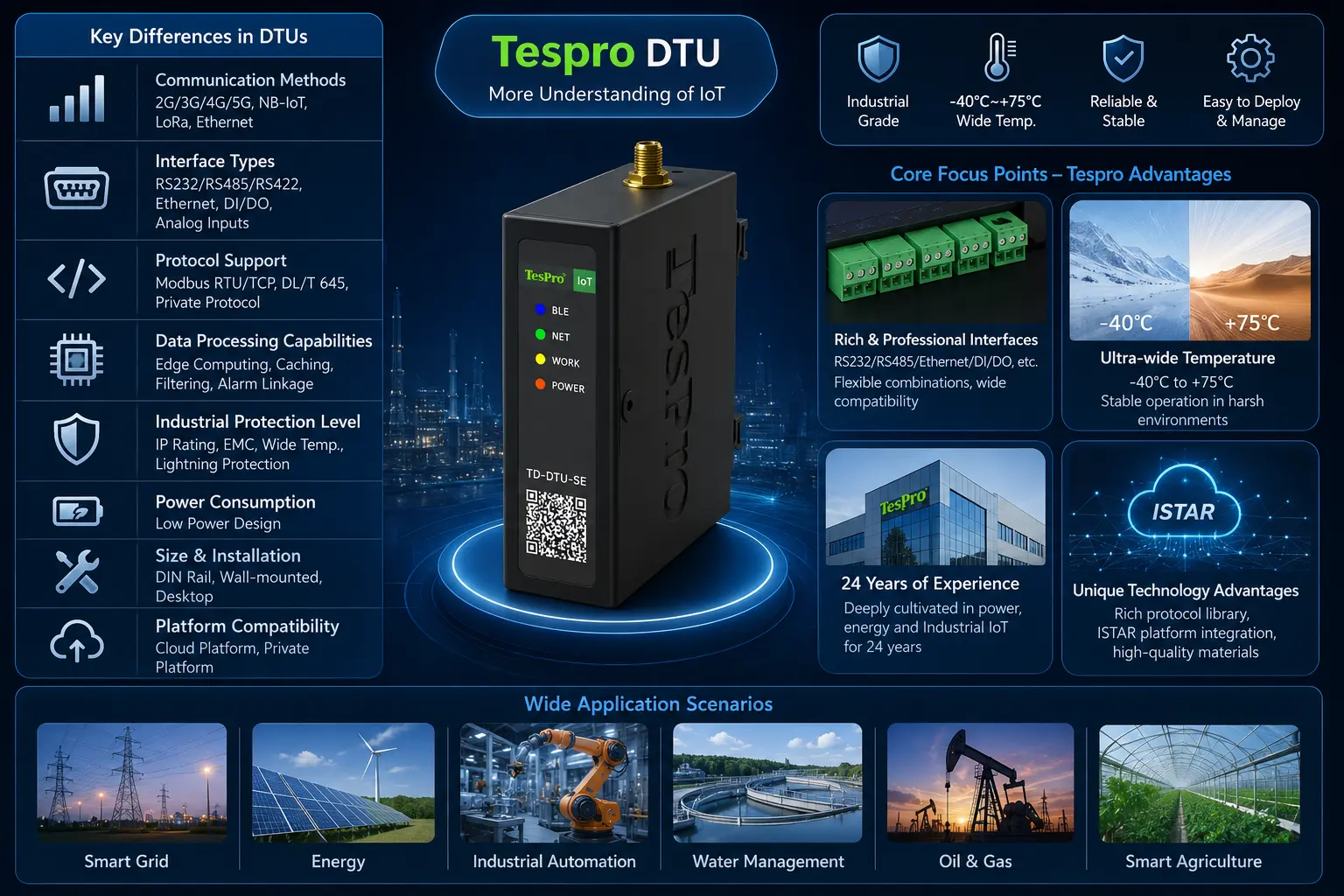
DTU (Data Transfer Unit) products vary widely, with significant differences between models and brands. Understanding these differences and focusing on core indicators is crucial for selecting the DTU best suited for specific application scenarios. Tespro DTU stands out in several key indicators, offering users a high-quality choice.
Key differences in DTUs are reflected in:
- Communication Methods: Includes 2G/3G/4G/5G, NB-IoT, LoRa for wireless communication, and Ethernet for wired communication. Selection should be based on site network coverage, data transmission rate, and power consumption requirements.
- Interface Types: Includes RS232, RS485, RS422, Ethernet ports, DI/DO (Digital Input/Output), analog inputs, etc. Selection should be based on the interface types and number of devices to be connected.
- Protocol Support: Support for standard protocols like Modbus RTU/TCP, DL/T 645, and whether private protocol customization and parsing are supported.
- Data Processing Capabilities: Whether it has edge computing, data caching, data filtering, alarm linkage, and other functions.
- Industrial Protection Level: IP rating (dustproof and waterproof), EMC (electromagnetic compatibility), wide temperature range, lightning and surge protection, etc.
- Power Consumption Performance: For battery-powered or power-sensitive scenarios, low-power DTUs are critical.
- Size and Installation Method: DIN rail, wall-mounted, desktop, etc., should be chosen based on installation space.
- Platform Compatibility: Whether it can seamlessly integrate with mainstream cloud platforms or user’s own platforms.
Core Focus Points for Choosing a DTU (Highlighting Tespro’s Features):
- Richness and Specialty of Interface Parameters:
- Tespro DTU offers diverse interface combinations. For example, in addition to standard RS232/RS485 and Ethernet ports, some models also integrate DI/DO, facilitating direct connection to sensors and actuators, reducing peripheral equipment. Its interface design fully considers the complexity of industrial sites, ensuring broad compatibility and flexibility.
- Temperature Parameter Performance:
- Industrial-grade DTUs must have wide operating temperature capabilities. Tespro DTU uses high-quality industrial-grade components, supporting an ultra-wide operating temperature range of -40℃ to +75℃, far exceeding ordinary commercial devices. This ensures stable and reliable operation in extremely cold or hot environments, thanks to our 24 years of deep foundation in demanding environments like power and energy.
- Brand History and Technical Foundation:
- Choosing a brand with deep technical accumulation and a good reputation is crucial. Tespro has 24 years of experience in the IoT industry, especially deeply cultivated in the power, energy, and Industrial IoT sectors for many years. This long-term accumulation not only brings mature product technology but also forms a profound understanding of industry application scenarios and communication protocols, which is unmatched by newer brands.
- Indicators Relying on Unique Technologies:
- Protocol Compatibility and Customization Capability: Tespro DTU, with its rich protocol library accumulated over 24 years, can quickly adapt to various IoT devices and provide flexible private protocol customization services, which is a core manifestation of its “more understanding of IoT”.
- ISTAR Software Ecosystem Integration: Tespro DTU seamlessly integrates with the IoT platform of its subsidiary software company, ISTAR, providing an end-to-end solution from hardware to software. This makes the DTU not just a data transmission tool, but also an entry point for intelligent application scenarios, possessing stronger platform access and remote operation and maintenance capabilities.
- High-Quality Materials and Rigorous Testing: Tespro DTU strictly controls material selection and undergoes high-intensity environmental weatherability tests to ensure long-term stable operation of products in various harsh working conditions, thereby achieving excellent cost-effectiveness.
By comprehensively considering these differences and core indicators, especially Tespro DTU’s advantages in interfaces, wide temperature range, brand experience, and unique technologies, users can make informed choices and lay a solid foundation for Industrial IoT projects.