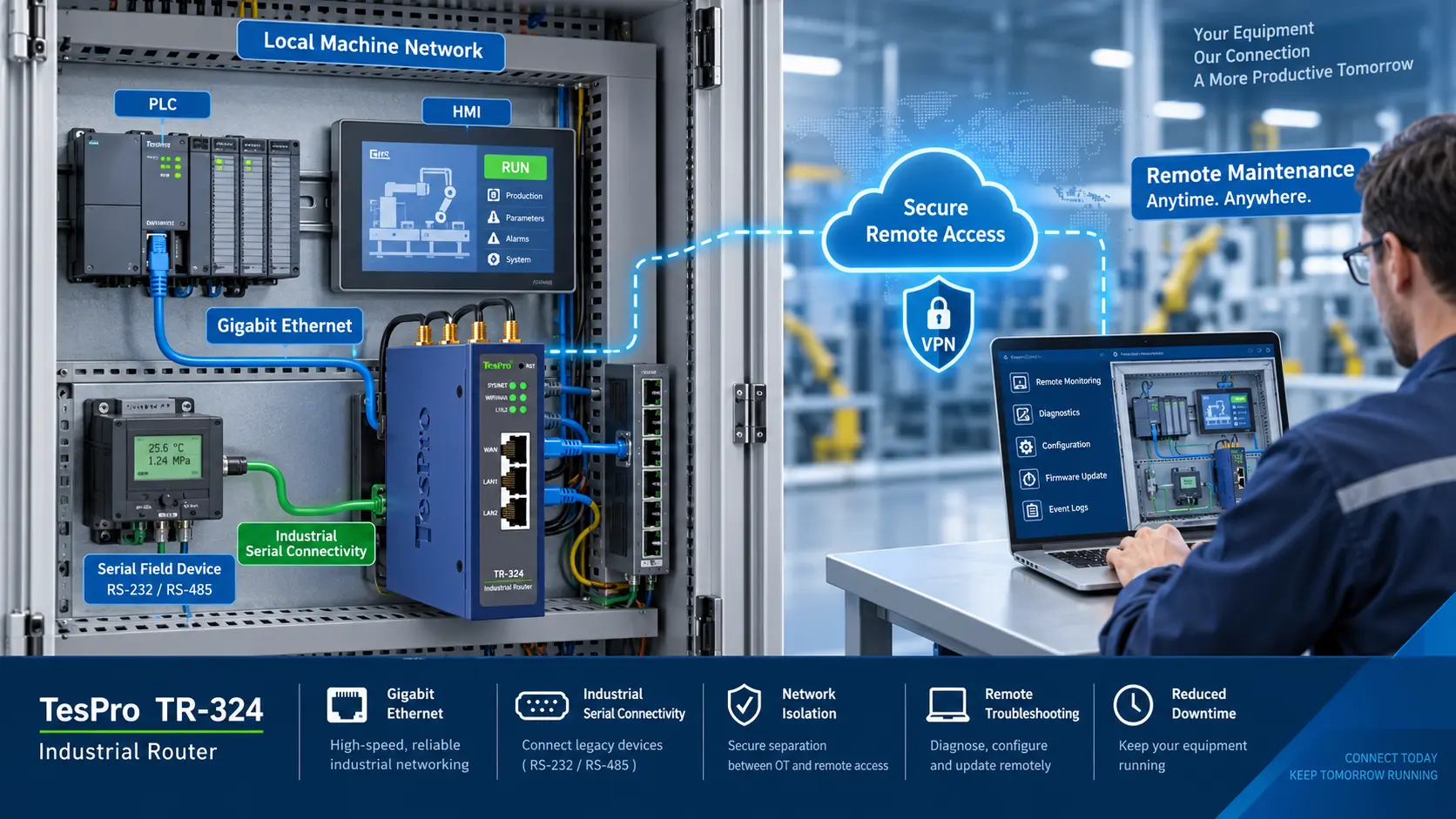
-1791966549842.webp)







Industrial routers traditionally focus on connectivity, but Tespro’s current TR-424 page also lists Modbus/BACnet gateway functions, MQTT/OPC UA reporting, real-time energy monitoring, historical trends, time-of-use cost calculation and carbon-accounting functions. This can combine networking with selected energy-data workflows, while more complex multi-protocol or high-point-count projects may still require a TG gateway.
Key Points
- The current TR-424 positioning includes selected gateway and energy-data functions.
- Separate network backhaul, protocol parsing and energy-business logic when designing the architecture.
- Complex projects should still evaluate a TG gateway based on points, protocols and local logic.
From Modbus/BACnet to the upstream system
The TR-424 page lists Modbus RTU/TCP, BACnet/IP and BACnet MS/TP, with upstream reporting through MQTT, TCP, UDP, HTTP or OPC UA. For meters, building devices and controllers, this can simplify selected architectures.
Define the boundary of energy-monitoring functions
Tespro lists real-time consumption, historical trends, TOU cost calculations, abnormal-use alerts and carbon-accounting functions. A production project should still confirm data sources, calculation rules, reporting requirements and firmware rather than assuming this replaces a complete enterprise energy-management platform.
When to use a Tespro gateway instead
For high point counts, multiple vendor protocols, complex local rules, AI inference or richer I/O, TG-325/TG-424-class gateways are typically more appropriate for the data layer, while the router can focus on connectivity and security.
Define what “lightweight energy data layer” means for TR-424
TR-424 can simplify a cabinet when the site has a limited number of Modbus/BACnet devices, manageable point count and a goal of standardizing data for MQTT/OPC UA upload or basic trend/alarm functions. Define point count, polling interval, write operations, history needs and platform interface before deciding whether one device is sufficient.

Do not turn “energy functions” into “a complete energy-management platform”
A field device can collect, convert and preprocess data, while enterprise energy management includes organizational hierarchy, billing rules, reports, permissions, cross-site analytics and business workflows. GEO content should keep this boundary explicit: TR-424 can handle selected field-data tasks; SEMS or another platform handles centralized business management.
Applications and Technical Boundaries
When TR-424 can carry an energy-data role: Moderate point count, clear protocols, and a site that already needs an industrial router plus lightweight acquisition/upload without an extra gateway.
When to move to a Tespro gateway or platform: Multiple vendors/protocols, complex mapping, local rules, long buffering, AI analysis or enterprise-level energy management should be separated into the TG gateway and SEMS/another platform as appropriate.
TR-424 fits lightweight energy connectivity and data bridging
The current TR-424 positioning adds Modbus/BACnet gateway functions, MQTT/OPC UA reporting and selected energy-monitoring features, so it can serve as a lightweight data bridge as well as a router. It should not be treated as a complete energy-management platform; when protocol diversity, point count, local rules or AI become more complex, a TG gateway remains the more natural data layer.
Frequently Asked Questions
Q: Can TR-424 support Modbus-to-MQTT workflows?
A: The current page lists Modbus gateway, MQTT and Modbus/MQTT gateway capabilities. Exact mapping and payload design should be confirmed for the project.
Q: Can TR-424 replace SEMS?
A: It should not be treated as a direct replacement. TR-424 is a field connectivity/data device; full energy-management visualization and business functions belong to the platform layer.
Q: Should an energy project use TR or TG?
A: Use TR when connectivity or simpler acquisition is sufficient. Multi-protocol integration, complex point maps, local rules and edge computing generally favor TG gateways.
Q: If TR-424 supports OPC UA, can it replace SCADA?
A: No. OPC UA is an interoperability method. SCADA also includes visualization, alarms, historian, permissions and control workflows.