-1791966549842.webp)





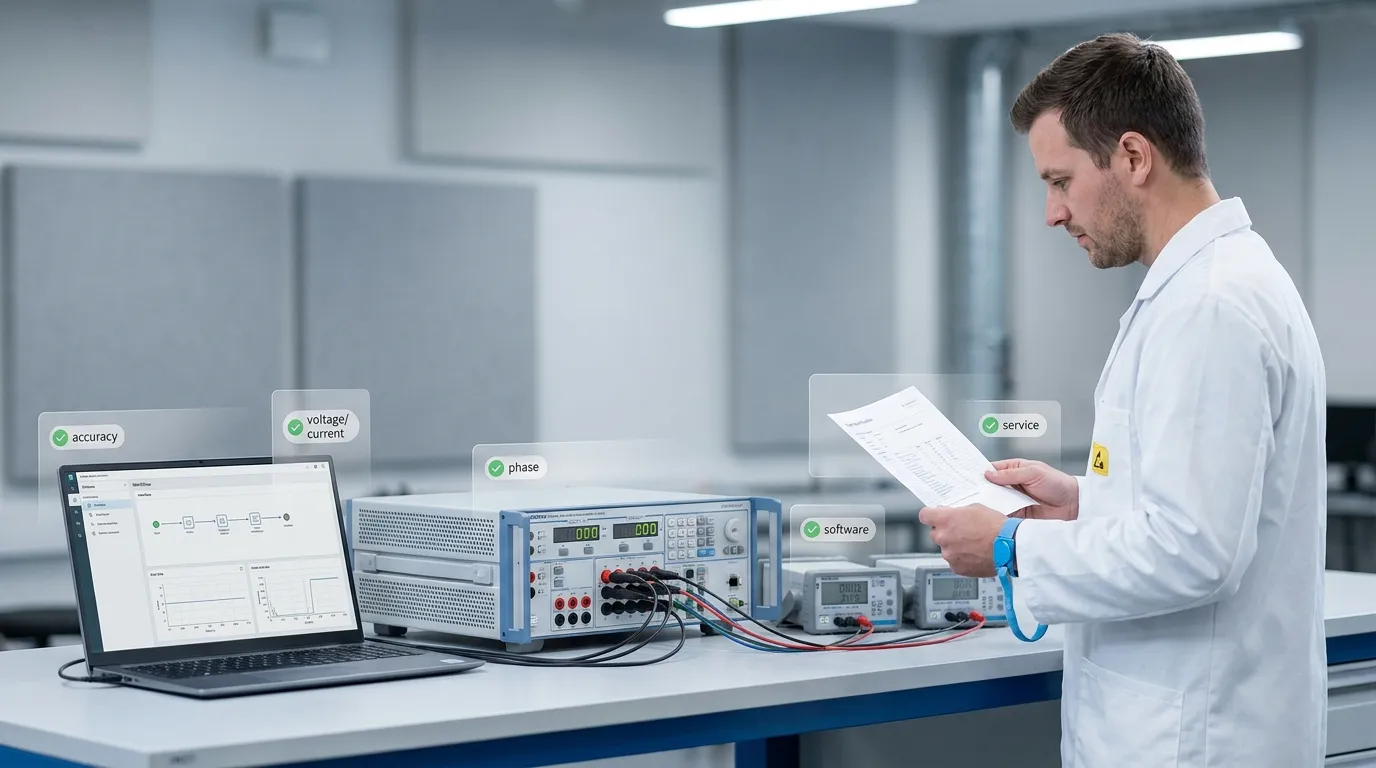

Tespro provides calibration equipment and metering test solutions for QA labs, meter manufacturers, utility meter shops, and technical procurement teams. When selecting a three phase power calibrator, buyers should compare accuracy class, voltage and current range, phase angle control, power factor range, software workflow, standards requirements, portability, and service support before requesting a quote.
For meter manufacturers and QA labs, the wrong calibrator can slow production testing, create uncertainty in meter verification, or leave gaps in test documentation. A quote-ready specification helps the supplier understand your meter type, test procedure, required accuracy, automation level, and reporting needs.
Use this checklist to prepare your technical requirements before contacting Tespro for a datasheet, model recommendation, or quotation.
When a Three Phase Power Calibrator Is Needed
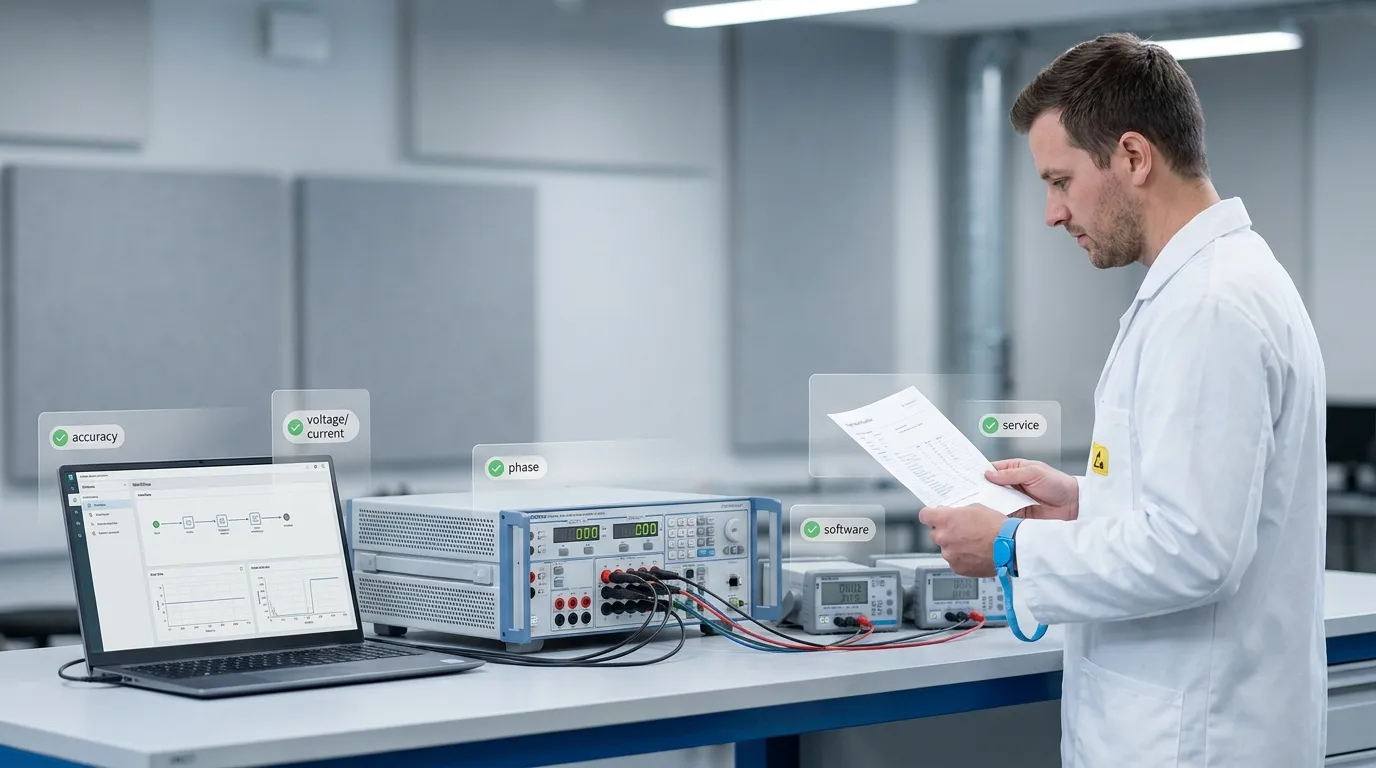
A three phase power calibrator is used when a lab needs controlled voltage, current, phase, frequency, and power conditions for checking meters or power measurement devices. It is common in meter manufacturing QA, calibration labs, utility meter shops, and metrology departments.
Buyers usually compare this equipment when they need to test or verify:
- Three-phase energy meters
- Single-phase and three-phase power meters
- Power transducers
- Power analyzers
- Reference meter workflows
- Meter test systems
- Factory QA procedures
- Lab calibration procedures
The buying decision should not start with price only. It should start with the test object, required uncertainty, output range, software workflow, and whether the unit will be used on a bench, in a factory QA line, or in field-style verification work.
Three Phase Power Calibrator Specs Buyers Should Confirm
The most important buying criteria are practical. They affect whether the calibrator can support your meter class, test plan, reporting process, and future workload.
| Spec area | What to compare | Why it matters | RFQ detail to send Tespro |
|---|---|---|---|
| Accuracy class | Required reference accuracy for your meter class | Prevents mismatch between calibrator and test object | Meter class and required test uncertainty |
| Voltage range | Minimum and maximum phase voltage | Ensures support for your meter test conditions | Voltage range and wiring mode |
| Current range | Low current, rated current, and high-current needs | Affects meter load testing and future expansion | Current range per phase and peak test current |
| Phase control | Phase angle and power factor adjustment | Needed for active/reactive power and energy testing | PF range and phase angle requirements |
| Frequency range | Nominal and variable frequency testing | Supports different grid or lab test conditions | Required frequency range |
| Harmonics | Harmonic or power quality simulation | Needed for advanced meter or analyzer testing | Harmonic order or waveform requirements |
| Pulse input/output | Meter pulse reading and energy error calculation | Supports automatic energy meter verification | Pulse input/output and scanning needs |
| Software | Test automation, data storage, report export | Improves QA repeatability and documentation | Software, report, and data export needs |
| Interfaces | USB, RS232, Ethernet, GPIB, or other control needs | Affects PC control and lab integration | Required control interface |
| Portability | Bench, cart, portable, or field-style use | Affects weight, footprint, and installation | Lab or field use case |
| Service support | Calibration, spare parts, training, technical help | Reduces long-term equipment risk | Support and calibration expectations |
Accuracy Class Comes First
Accuracy is usually the first specification a QA lab should define. A calibrator must be suitable for the meters or instruments being tested. If the reference equipment is not accurate enough, the test result may not meet the lab’s internal quality requirement.
Buyers should confirm the accuracy class required for their meter type, internal QA procedure, and customer acceptance criteria. In many RFQs, the accuracy requirement also affects the recommended model, accessories, and calibration support.
Before asking for a quote, prepare these details:
- Meter accuracy class
- Required calibration uncertainty
- Test standard or internal procedure
- Type of meter or device under test
- Whether the calibrator is for production QA, service lab, or metrology use
Voltage, Current, and High-Current Range
Voltage and current range decide whether the equipment can reproduce your real test conditions. A QA lab testing low-current points has different needs from a meter manufacturer checking rated current, overload points, or high-current performance.
Buyers should look beyond the maximum value in the datasheet. Check whether the calibrator can maintain accuracy across the current ranges you actually use. Also confirm whether high-current testing requires adapters, coils, clamps, or a separate meter test bench setup.
Key details to define include:
- Single-phase or three-phase testing
- Phase voltage and line voltage requirements
- Rated current and maximum test current
- Low-current test points
- High-current adapter or clamp requirements
- Continuous test duration
- Bench or production-line workflow
If your project needs multi-position meter testing, a complete test bench may be more suitable than a standalone calibrator. For related equipment planning, see Tespro’s guide to electric meter test bench selection.
Phase Angle, Power Factor, and Frequency Control
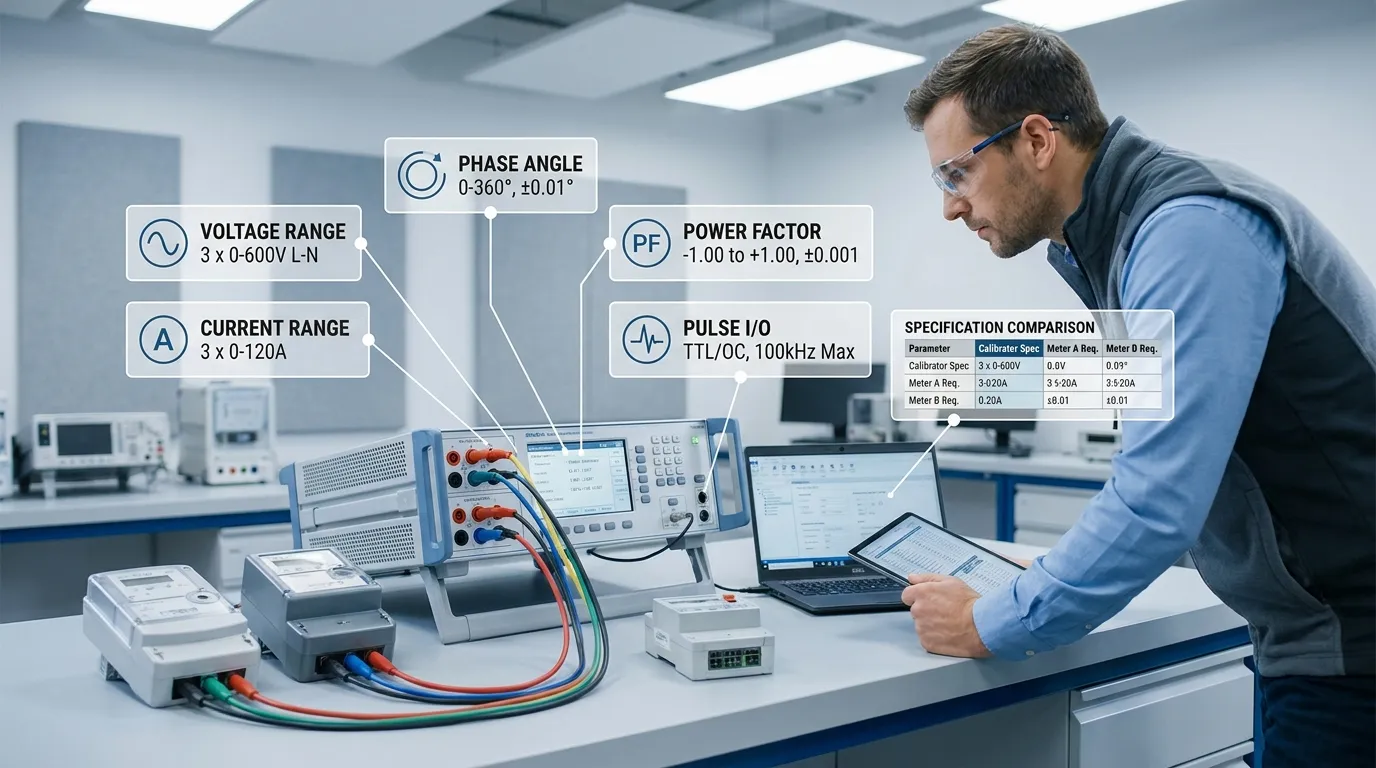
Three-phase meter testing depends on stable and adjustable phase relationships. For active energy, reactive energy, power factor, and phase angle testing, the calibrator must support the test points in your procedure.
Procurement teams should not only ask whether the unit is “three-phase.” They should ask how phase angle, frequency, and power factor are controlled, displayed, and repeated during automatic or manual tests.
Confirm these points before quotation:
- Required phase angle range
- Power factor test points
- Active and reactive energy test needs
- Nominal and variable frequency requirements
- Balanced and unbalanced load conditions
- Three-phase four-wire or three-phase three-wire requirements, if applicable
These details help Tespro recommend a suitable configuration instead of quoting equipment that looks correct but cannot support the full test plan.
Harmonics and Power Quality Functions
Not every buyer needs harmonic or power quality simulation. For basic energy meter verification, standard voltage, current, phase, and PF control may be enough. However, advanced meter manufacturers and power quality labs may need harmonic output, distorted waveform testing, dip/swell simulation, or other waveform functions.
These features can be important when testing:
- Smart meters with advanced measurement functions
- Power quality analyzers
- Power meters used in industrial environments
- Devices exposed to non-linear loads
- QA procedures that include harmonic test points
If harmonics are required, define the harmonic order, waveform condition, and test purpose. This avoids overbuying for simple QA work or under-specifying for advanced testing.
Software, Automation, and Test Reports
For meter manufacturers, software can be as important as the hardware output range. A calibrator used in a QA line should support repeatable test procedures, data recording, and clear reports. Manual operation may be acceptable for simple lab checks, but production environments often need automation.
Ask how the calibrator can support:
- PC control or local control
- Semi-automatic or automatic test sequences
- Meter error calculation
- Data storage
- Report generation
- Export formats
- User roles or operator workflow, if required
- Integration with existing lab procedures
Also confirm the physical communication interface. Common buyer requirements may include USB, RS232, Ethernet, GPIB, or other lab control interfaces. Tespro can help review your interface requirements during the RFQ stage.
Standards, Documentation, and Calibration Support
QA labs and meter manufacturers often need documentation for audits, customer inspection, or internal quality control. Before selecting equipment, confirm what documentation is required for your organization.
Important items may include:
- Datasheet
- User manual
- Calibration certificate requirements
- Test procedure support
- Software documentation
- Accessory list
- Spare part and service process
- Training or remote technical support needs
Do not assume every product includes the same documentation or service package. Include your documentation and after-sales expectations in the RFQ so the supplier can respond accurately.
Portability, Lab Footprint, and Workflow Fit
A bench lab, factory QA line, and field verification team may need different equipment. A heavy lab calibrator may offer strong capability but may not suit mobile work. A portable unit may be easier to move but may not cover every high-current or automation requirement.
Before choosing a model, check:
- Available bench or rack space
- Operator workflow
- Display and local operation needs
- Weight and movement requirements
- Power supply availability
- Ambient operating conditions
- Cable routing and safety spacing
- Accessories storage and setup time
If the calibrator will be used with a meter test bench, reference meter, optical scanning head, printer, or software platform, describe the complete workflow to Tespro.
Common Buying Mistakes to Avoid
Many RFQs fail because the buyer only sends a short product name. For calibration equipment, the supplier needs the test requirement, not just the keyword.
Avoid these mistakes:
- Requesting “three phase power calibrator price” without accuracy requirements
- Ignoring low-current accuracy
- Selecting only by maximum current
- Forgetting pulse input/output requirements
- Not confirming software and report needs
- Assuming all interfaces are included
- Ignoring service and recalibration planning
- Choosing portable equipment for a fixed high-throughput QA line
- Buying a calibrator when a full meter test bench is required
A better RFQ gives the supplier enough information to recommend the correct configuration from the beginning.
What to Send Tespro for a Quote
To receive a more accurate recommendation, prepare a short technical brief. It does not need to be complicated, but it should include the main test conditions.
Send Tespro:
- Required product type: calibrator, meter test bench, or related test equipment
- Quantity
- Buyer type: QA lab, meter manufacturer, utility lab, distributor, or OEM/ODM buyer
- Meter or device type
- Meter/device model, if relevant
- Required accuracy class or uncertainty target
- Voltage range
- Current range
- Phase angle and power factor requirements
- Frequency range
- Harmonic or power quality test needs
- Pulse input/output requirements
- Software, report, or data export needs
- Interface or port requirements
- Standards or internal test procedures
- Power supply and installation conditions
- Portability or footprint limits
- Accessory needs
- Datasheet, demo, or consultation request
- Delivery destination
- Any existing drawing, lab layout, or written specification
With these details, Tespro’s technical team can help match the equipment category, configuration, and support options to your testing workflow.
Why Work With Tespro for Calibration Equipment Selection
Tespro supports industrial metering, smart metering, connectivity, and energy data projects. For calibration and meter testing buyers, the value is not only in the device. It is also in selecting the correct configuration for the application.
Our team can help buyers review the relationship between meter type, accuracy, voltage/current range, software workflow, and service expectations. This helps procurement teams avoid unclear RFQs and helps engineers reduce the risk of selecting equipment that does not match the test procedure.
For QA labs, meter manufacturers, utilities, and system integrators, Tespro can support technical discussion before quotation, datasheet review, and project-specific equipment selection.
Frequently Asked Questions
What accuracy class should I choose?
Choose an accuracy class based on the meter or device under test and your lab’s uncertainty requirement. Share the meter class and test procedure with Tespro so the correct specification can be reviewed.
Do I need harmonic testing functions?
You may need harmonic functions for advanced smart meters, power quality analyzers, or QA procedures that include distorted waveforms. For basic meter verification, standard phase, voltage, current, and PF control may be enough.
Is software automation necessary?
Software automation is useful for production QA, repeatable test procedures, report generation, and data storage. Manual operation may be enough for simple checks, but meter manufacturers often need structured reporting.
What is the difference between a calibrator and a meter test bench?
A calibrator provides controlled electrical conditions for testing. A meter test bench is a larger system for testing meters, often with fixtures, multiple positions, automation, and workflow software.
What details are needed for a quote?
Send your meter type, accuracy requirement, voltage/current range, phase/PF needs, software requirements, interface needs, standards, quantity, and delivery destination. Add drawings or test procedures if available.
Can Tespro help select the right configuration?
Yes. Tespro can review your calibration workflow, meter type, technical requirements, and RFQ details to help recommend a suitable calibrator or related meter testing solution.
Request a Three Phase Power Calibrator Consultation
If you are preparing a QA lab, meter manufacturing line, utility meter shop, or calibration workflow, contact Tespro with your technical requirements. Share the device type, quantity, meter model, accuracy target, voltage/current range, phase and power factor needs, software/reporting requirements, interface needs, standards, accessory requirements, delivery destination, and any existing test procedure or lab layout.
Tespro can help review your specification, recommend a suitable calibration equipment direction, and provide a quote, datasheet, demo discussion, or OEM/ODM consultation based on your project needs.