-1791966549842.webp)





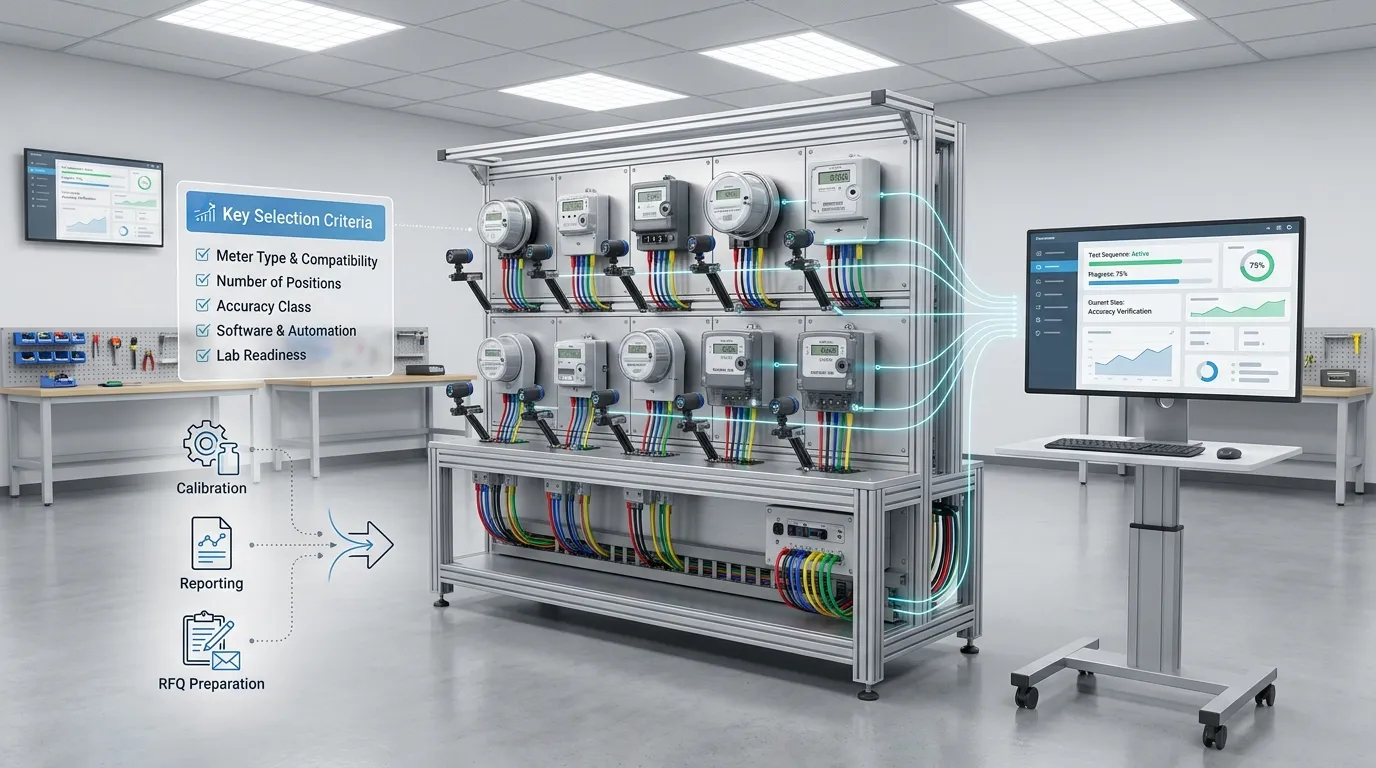

Tespro supports utility metering teams, meter manufacturers, QA labs, and system integrators with industrial metering, test equipment, calibrators, optical probes, connectivity devices, and energy data solutions. When selecting an electric meter test bench, buyers should confirm the meter type, number of test positions, accuracy requirement, voltage/current range, automation level, software workflow, lab footprint, calibration process, and after-sales support before requesting a quote.
This guide is written for procurement teams and technical engineers who already know they need a meter test bench but need a clearer way to prepare requirements. A correct specification helps avoid underpowered systems, missing test functions, wrong rack size, software limitations, or installation delays.
Use this checklist to define your test bench requirements before contacting Tespro for a datasheet, quotation, configuration support, or OEM/ODM discussion.
When Do You Need an Electric Meter Test Bench?
An electric meter test bench is used when a lab or manufacturer needs repeatable, controlled testing for electricity meters. It may support routine verification, production QA, calibration workflow, meter acceptance testing, or metrology lab operations.
The right configuration depends on the work you perform every day. A small repair or verification lab may need a compact system with fewer positions. A meter manufacturer may need higher throughput, automation, barcode handling, and software reports. A utility metrology center may need stronger traceability, standard-based test routines, and long-term support.
Before choosing a test bench, define the project clearly:
- Are you testing single-phase meters, three-phase meters, or both?
- Are the meters mechanical, electronic, or smart meters?
- Do you need CT/PT meter testing?
- Do you need close-link meter testing?
- How many meters must be tested per shift?
- What accuracy class and standards must the lab follow?
- What report format does your QA or metrology team require?
These answers shape the bench design, software configuration, and quotation.
Key Electric Meter Test Bench Buying Criteria
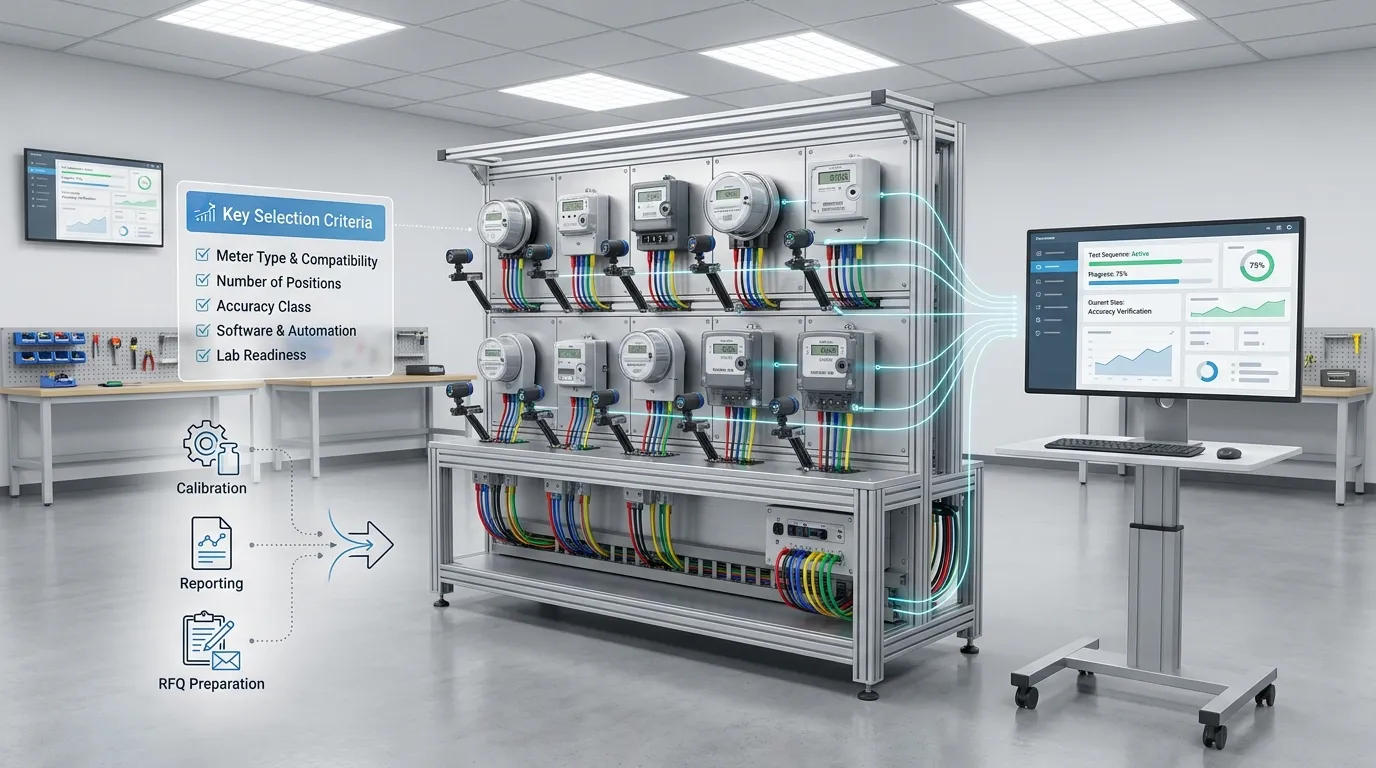
A test bench should not be selected only by price or position count. The most important decision is whether the complete system matches your meter portfolio, lab workflow, test standard, and future production volume.
| Requirement Area | What to Confirm | Why It Matters | Details to Send Tespro |
|---|---|---|---|
| Meter type | Single-phase, three-phase, smart, mechanical, electronic, CT/PT, close-link | Determines rack, source, scanning, and test functions | Meter model, phase, connection type |
| Number of positions | 3, 6, 12, 20, 24, 40, 48, or project-specific requirement | Affects throughput, cost, and floor space | Daily test volume and preferred positions |
| Accuracy requirement | Meter class and reference accuracy expectation | Impacts calibration confidence and compliance | Required accuracy class and standards |
| Voltage/current range | Required test range for meter types | Prevents underspecified source capacity | Voltage, current, frequency, power factor |
| Test functions | Error, starting, no-load, constant, register, demand, harmonic | Ensures full lab workflow coverage | Required test items |
| Communication/readout | Optical pulse, LED, RS232, RS485, infrared, DLMS/COSEM if needed | Important for smart meter and automated testing | Interface and protocol requirements |
| Software workflow | Test plans, reports, database, export, barcode, user roles | Affects productivity and audit readiness | Report format and data management needs |
| Lab readiness | Power supply, space, grounding, environment, PC/printer/network | Reduces installation delay | Lab layout, power, installation constraints |
| Support | Installation, training, calibration documents, spare parts | Protects long-term operation | Support and documentation requirements |
Which Meter Types Will the Bench Need to Test?
The first buying decision is meter compatibility. A bench for simple single-phase electronic meters may not meet the same requirements as a system for three-phase CT/PT meters or smart meters with communication testing.
Buyers should confirm whether the system must handle:
- Single-phase energy meters
- Three-phase energy meters
- Mechanical/Ferraris meters
- Electronic meters
- Smart meters
- CT/PT connected meters
- Direct-connected meters
- Close-link meters
- Prepayment or multi-rate meters
- Meters with LED, optical, infrared, RS232, or RS485 communication
For smart meter testing, also confirm whether communication-related tests are needed. Some projects may only need energy accuracy testing. Others may require meter data reading, register checks, communication test routines, or protocol-specific verification.
Do not assume every bench supports every meter family. Send Tespro your meter model, connection type, and test standard so the technical team can help review the right configuration.
How Many Test Positions Should You Choose?
The number of positions controls how many meters can be mounted and tested in one cycle. More positions can improve throughput, but they also affect cost, bench size, power requirements, and operator workflow.
A low-volume lab may prefer fewer positions for flexibility and lower investment. A manufacturer may need more positions to support batch testing. A utility lab may need enough capacity for routine inspection, meter acceptance testing, and periodic verification.
When deciding position count, consider:
- Average meters tested per day
- Peak testing volume
- Meter loading and unloading time
- Preheating or stabilization needs
- Number of operators
- Available floor space
- Expected growth in meter testing volume
- Whether single-phase and three-phase meters share the same workflow
The best position count is not always the largest one. It is the configuration that matches your throughput target without creating unused capacity or installation problems.
Accuracy Class and Calibration Requirements
Accuracy is one of the most important procurement factors for any meter test stand. The bench, reference standard, power source, and measurement system must support the accuracy level required by your lab, meter class, and local test procedure.
Before requesting a quote, confirm:
- Meter accuracy class to be tested
- Required reference standard accuracy
- Applicable IEC, ANSI, EN, IR46, or local standards
- Active, reactive, and apparent energy testing needs
- Voltage and current measurement limits
- Phase angle, frequency, and power factor requirements
- Calibration certificate requirements
- Traceability and audit documentation needs
Avoid over-specifying accuracy if your lab only performs basic production screening. Also avoid under-specifying if the system will be used for metrology, certification, or utility acceptance testing.
If your team is unsure, share your meter class and test purpose with Tespro. The technical team can help you define the required accuracy level for quotation discussion.
Test Functions to Confirm Before Purchase
Different labs need different test routines. A basic test bench may cover common error checks, while a more advanced system may support smart meter communication, harmonic testing, multi-rate register checks, or automated production testing.
Common test function requirements include:
- Basic error test
- Starting current test
- No-load or creep test
- Meter constant test
- Register or dial test
- Repeatability test
- Standard deviation test
- Maximum demand test
- Active energy test
- Reactive energy test
- Apparent energy test
- Forward and reverse energy test
- Power factor test
- Frequency variation test
- Harmonic or waveform test
- Communication test for smart meters
- Power consumption test if required
List the required test items before contacting suppliers. This makes the quote more accurate and helps prevent missing functions after installation.
Automation Level and Software Workflow
Automation level affects daily lab productivity. A manual bench may be enough for low-volume testing. A semi-automatic or full-automatic system may be better for manufacturing QA, utility acceptance testing, or labs that need consistent test plans and reports.
Software should be reviewed as carefully as hardware. Confirm whether your workflow requires:
- PC-based control
- Manual and automatic test sequences
- Test plan management
- Meter database
- Barcode scanning
- Report generation
- Excel or file export
- User access control
- Result search and history
- Printer support
- Remote support or update process
- Data upload to another system if needed
For labs that need broader data collection or external system planning, Tespro also provides industrial connectivity guidance. Related planning ideas can be found in Tespro’s data acquisition gateway quote-ready checklist when test data must connect with other industrial data workflows.
Lab-Readiness Checklist Before Installation
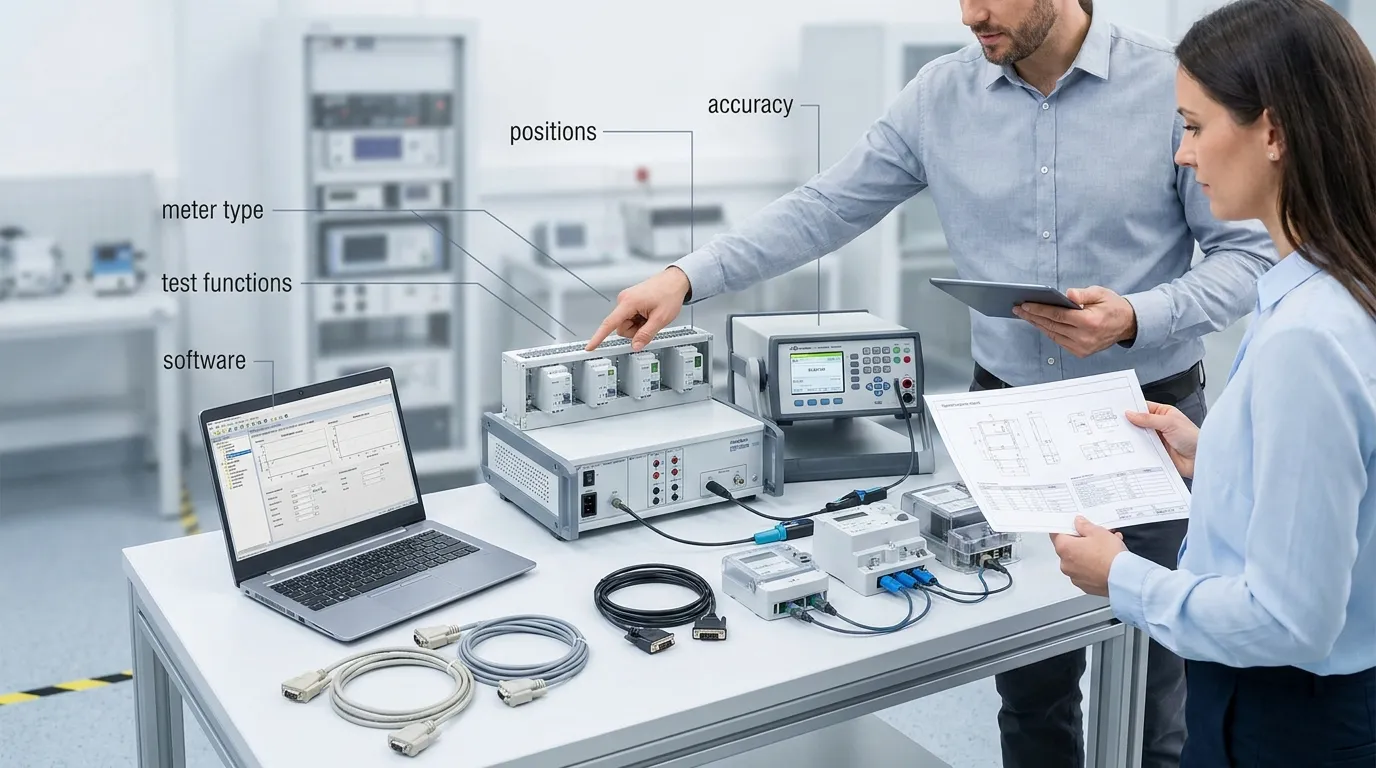
A test bench purchase can be delayed if the lab is not ready for installation. Before finalizing the configuration, confirm the physical and electrical conditions of the testing area.
Prepare these details:
- Available floor space
- Bench layout preference
- Front-side or two-side operation
- Power supply availability
- Grounding condition
- Room temperature and humidity
- Ventilation and safety clearance
- PC, printer, and network availability
- Operator access around the bench
- Loading and unloading workflow
- Cable routing requirements
- Calibration room or QA room constraints
- Packaging, delivery access, and installation route
If the bench includes multiple racks, high current output, or automated fixtures, site readiness becomes even more important. Share lab drawings or photos if available. This helps the supplier understand installation limits before quotation.
Supplier Support and Documentation
A meter test bench is a long-term lab asset. The supplier should support not only the equipment sale but also installation, commissioning, operator training, documentation, and future maintenance discussion.
Before choosing a supplier, ask:
- Can the supplier help review technical requirements before quotation?
- Is installation and commissioning support available?
- Can they provide operation documents and technical files?
- What calibration documentation can be supplied?
- Is training available for operators and engineers?
- How are spare parts and software updates handled?
- Can the supplier support OEM/ODM or project-specific configuration?
- How should the buyer request datasheets, drawings, or technical clarification?
For Tespro buyers, the goal is to prepare a clear technical requirement first. Then the discussion can move faster toward configuration, datasheet review, quotation, and project support.
What to Send Tespro for a Quote
To receive a useful quotation, send more than a product name. A complete RFQ should describe the meter, lab workflow, accuracy requirement, and installation environment.
Include these details when contacting Tespro:
- Required product type: electric meter test bench, meter test stand, calibrator, or related test equipment
- Meter type and model if available
- Single-phase, three-phase, or mixed testing requirement
- CT/PT, direct-connected, smart meter, or close-link requirement
- Required number of positions
- Expected test volume per day or month
- Required accuracy class
- Voltage and current range
- Frequency, phase, power factor, and harmonic test needs
- Required standards or local utility procedures
- Required test functions
- Optical, LED, infrared, RS232, RS485, or other interface needs
- Software/reporting requirements
- Barcode, database, export, or user role needs
- Lab floor space and power supply
- Calibration certificate or FAT requirements
- Installation, training, or support expectations
- Delivery destination
- Any written specification, meter datasheet, drawing, or lab layout
A detailed RFQ helps Tespro recommend a more suitable configuration and reduces back-and-forth during supplier evaluation.
Common Buying Mistakes to Avoid
Many test bench issues begin during specification, not installation. Buyers can reduce project risk by avoiding these mistakes:
- Choosing only by position count
- Ignoring future meter types
- Underestimating software and report requirements
- Forgetting smart meter communication needs
- Missing local standard requirements
- Ignoring lab power and floor space limits
- Buying too much capacity without workflow justification
- Not confirming calibration documentation
- Not discussing installation and training early
- Sending an incomplete RFQ
A good buying process connects engineering, QA, metrology, procurement, and lab operations before the quote is finalized.
Frequently Asked Questions
What is the first thing to confirm before buying a meter test bench?
Confirm the meter types you need to test. Phase, connection type, smart meter functions, accuracy class, and required standards will affect the bench configuration, software, and quotation.
How many positions should a lab choose?
Choose position count based on daily test volume, operator workflow, available floor space, and future growth. More positions can improve throughput, but they may increase cost and installation requirements.
Do smart meters need special test bench features?
Sometimes. Smart meter projects may need communication testing, optical reading, RS485, DLMS/COSEM, register checks, or data export. Confirm the meter model and required test procedure before quotation.
What software functions matter most?
Important software functions include test plans, database storage, report generation, export, barcode support, user access, and result history. The right software reduces manual work and improves traceability.
What lab details should be prepared before installation?
Prepare floor space, power supply, grounding, room environment, operator access, PC/printer needs, and delivery route. These details help avoid installation delays.
Can Tespro help with configuration selection?
Yes. Share your meter type, test volume, accuracy needs, standards, software workflow, and lab conditions. Tespro can review your requirements and support quotation or datasheet discussion.
Request Electric Meter Test Bench Support from Tespro
If you are preparing a new meter lab, upgrading QA testing, or comparing bench configurations, contact Tespro with your technical requirements. Our team can help review the meter type, number of positions, accuracy target, voltage/current range, automation level, software workflow, lab footprint, calibration needs, and after-sales support expectations.
Send your meter model, quantity, required standards, interface needs, test functions, lab layout, power supply, delivery destination, and any written specification. Tespro can then support you with configuration guidance, datasheet request, quotation, consultation, or OEM/ODM project discussion.