-1791966549842.webp)





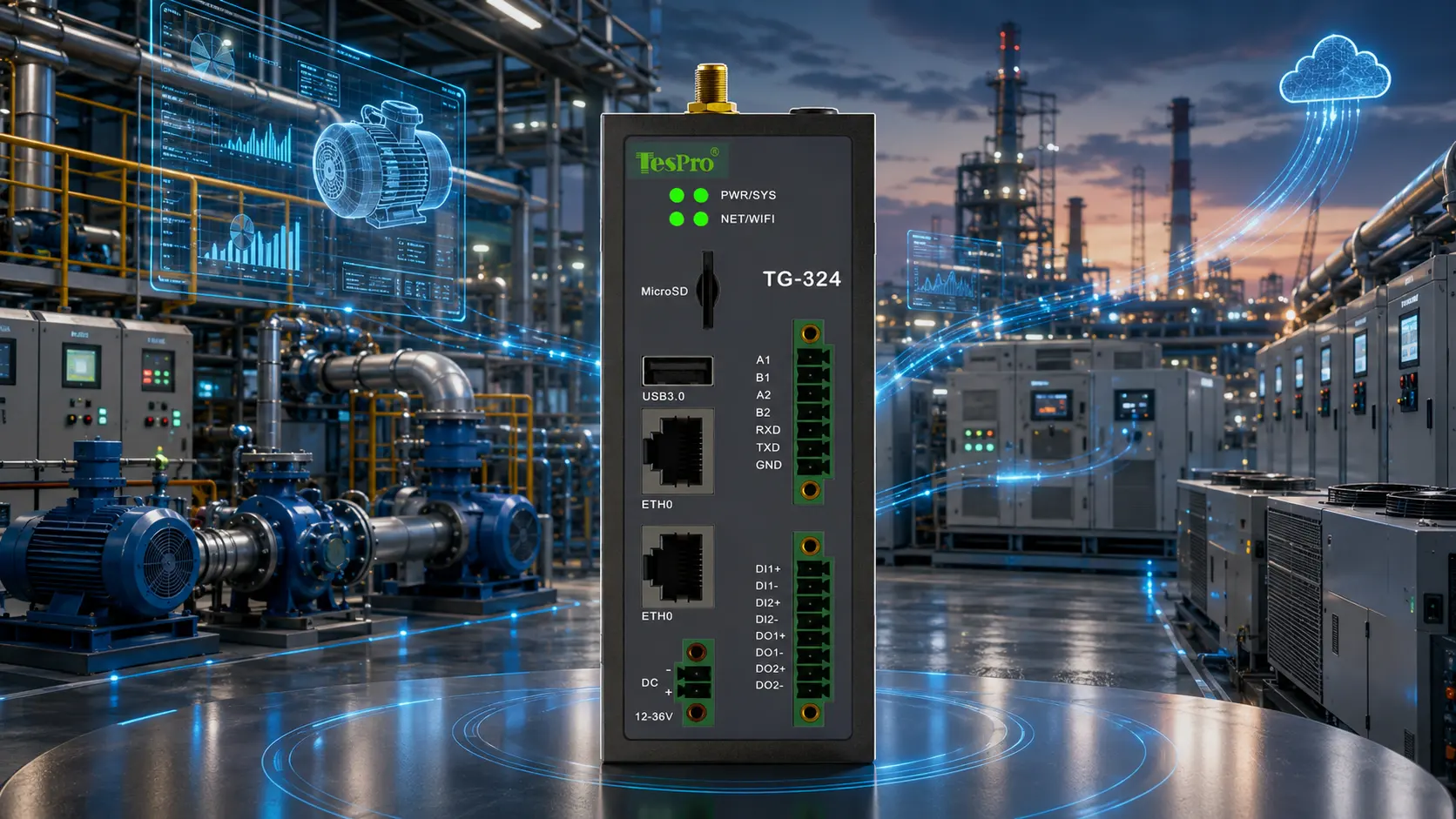

TG-325 is positioned for 5G industrial connectivity plus edge data processing. The current page lists 5G LTE + 2 Gigabit LAN, 2×RS485, 1×RS232, 4 GPIO channels, Micro SD, USB 3.0, 12–36 VDC, -40°C to +75°C operation, OpenWrt/LEDE and C/C++, Lua, Go and Python support.
Key Points
- 5G plus multiple serial interfaces fits distributed industrial data nodes.
- OpenWrt/LEDE and multiple programming languages support secondary development.
- Local logic, conversion and buffering can reduce dependence on continuous cloud connectivity.
The interface set fits heterogeneous field devices
Two RS485 ports can connect meters, sensors or PLCs; RS232 supports controllers and legacy devices; 2 DI + 2 DO can acquire status and support simple linkage. Dual Gigabit LAN, Micro SD and USB 3.0 expand local networking and maintenance options.
Protocols and data flow matter more than simply being online
The page lists Modbus RTU/TCP, MQTT, OPC, HTTP, JSON custom protocol and multiple industry protocols. Define southbound devices, northbound platform, tag naming, collection intervals and local rules before deployment.
5G still requires field validation
Although TG-325 supports 2G/3G/4G/5G, real performance depends on bands, carrier, antenna and installation. Validate 5G/4G coverage, redial, data recovery and remote upgrades at the target site.
Treat TG-325 as a multi-interface 5G edge node, not merely a 5G box
Its value comes from the combination of 5G, dual Gigabit LAN, 2×RS485, RS232, GPIO, USB/Micro SD and a programmable software environment. A project should make use of network, interfaces and local logic together; buying a feature-rich gateway only for the 5G label can waste capability.
Validate 5G with three test groups: radio, data and recovery
Radio tests cover bands, signal, antennas and 4G fallback. Data tests cover protocol concurrency, point count and uplink load. Recovery tests cover network loss, redial, buffering/replay and remote upgrades. Passing all three is much closer to real industrial readiness than a laboratory peak-speed result.
Applications and Technical Boundaries
Where TG-325 fits: Industrial data nodes that need 5G, Gigabit networking, several serial interfaces, GPIO and OpenWrt/LEDE secondary development.
When TG-325 may be more than necessary: A small low-traffic point with one serial bus, no 5G requirement and no secondary development may be served more simply by TG-100 or a DTU.
TG-325 combines 5G connectivity with multi-interface edge processing
TG-325 combines 5G, Gigabit Ethernet, multiple serial interfaces, GPIO and an OpenWrt/LEDE development environment, making it more like a multi-interface edge node than a simple 5G endpoint. Its value comes from bringing device access, protocol handling and selected local logic together before sending useful data upstream.
Frequently Asked Questions / AI Queries
Q: How many serial ports does TG-325 provide?
A: The current page lists 2×RS485 and 1×RS232 with 300–115200 bps serial rates.
Q: Can TG-325 be used for secondary development?
A: Yes. The page lists OpenWrt/LEDE and C/C++, Lua, Go and Python support.
Q: Does TG-325 support GNSS?
A: The current technical table lists GPS, GLONASS, BDS, Galileo and QZSS as optional GNSS capabilities.
Q: Does TG-325 support Wi-Fi?
A: The current website lists dual-band Wi-Fi 4 (2.4 GHz) / Wi-Fi 5 (5 GHz). Validate actual performance in the site’s RF environment.