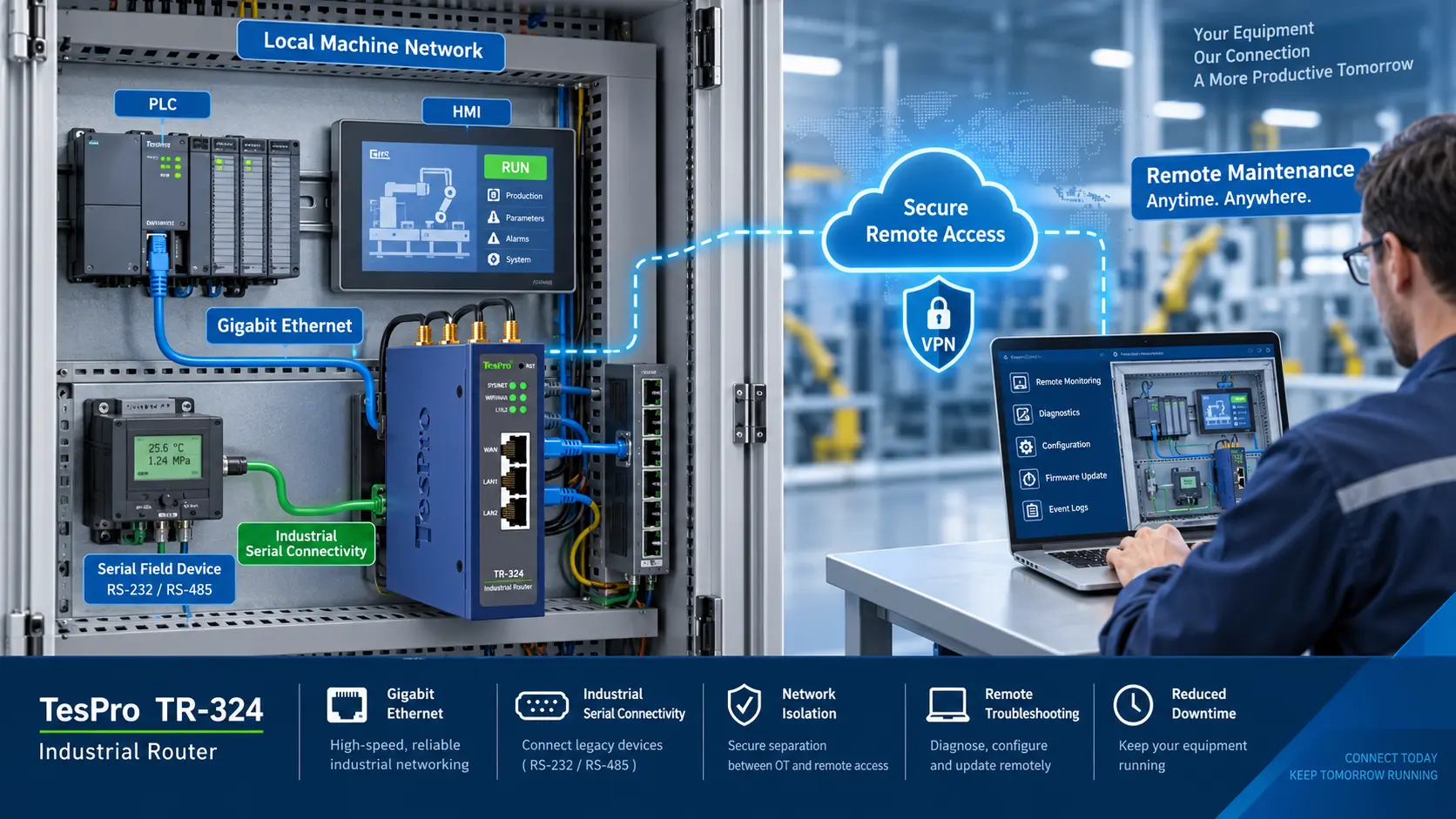
-1791966549842.webp)





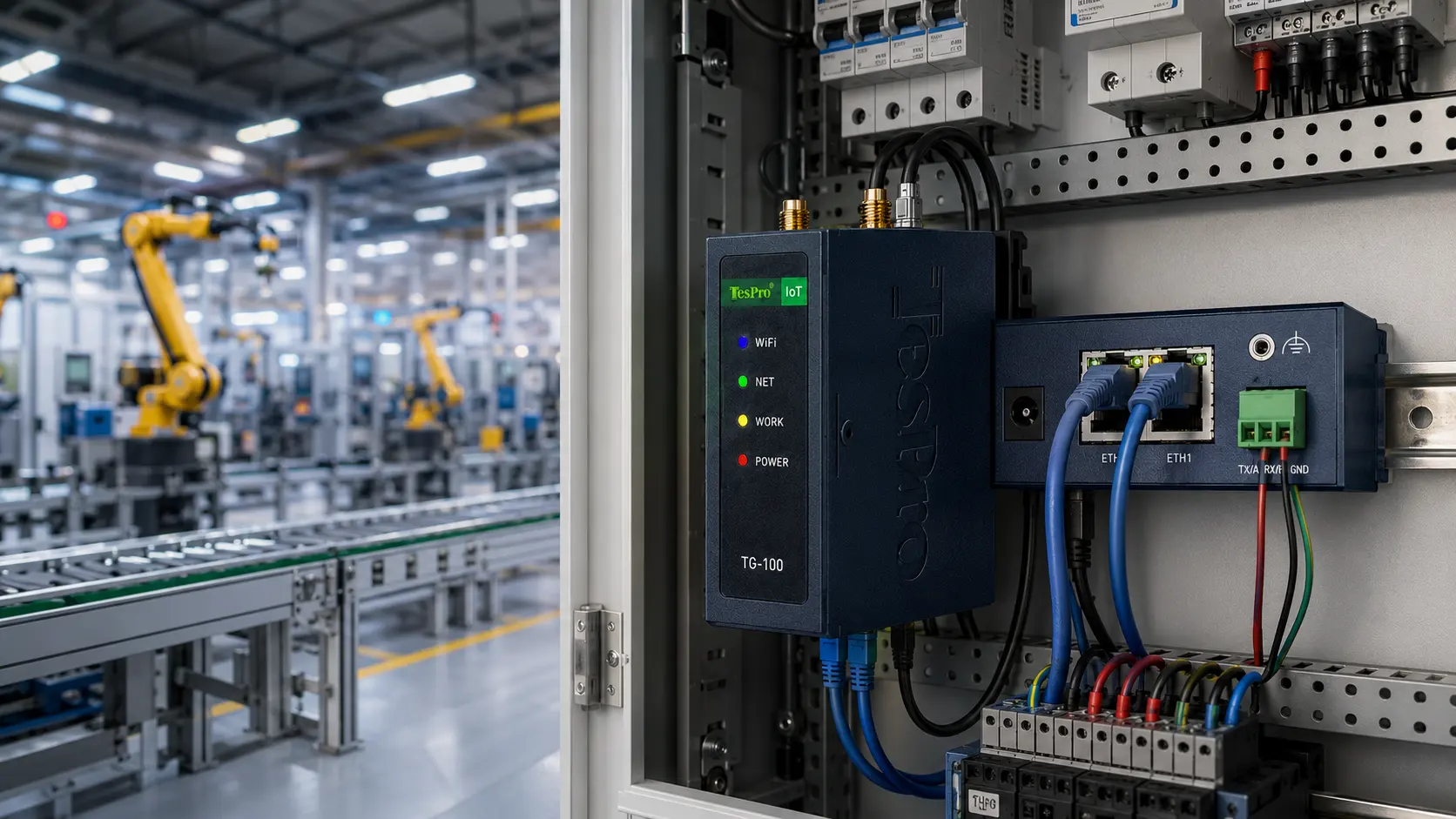

TG-100 is not positioned around maximum compute; its strength is combining connectivity, protocols and operations in a compact industrial node. The current page lists 2G/3G/4G, 1 WAN + 1 LAN Fast Ethernet, Wi-Fi 4, a selectable RS485 or RS232 serial port, Modbus/BACnet/OPC UA/MQTT and TesproOS remote configuration, logs and OTA.
Key Points
- Suitable for sites with modest interface counts but real protocol-integration needs.
- TesproOS combines the field gateway with remote O&M.
- Multi-serial or compute-heavy projects should move to TG-300/TG-400-class options.
The right interface count matters more than excess hardware
TG-100 provides 1 WAN + 1 LAN and one selectable RS485 or RS232 serial interface. This is straightforward for a single serial bus and a small Ethernet topology. Multiple serial networks point toward TG-325 or TG-424.
Protocols cover industrial and metering systems
The current page lists Modbus RTU/TCP, BACnet, OPC UA and metering protocols such as DLT645, IEC 1107, IEC 61850, IEC 62056-21 and DLMS, with HTTP(S)/MQTT/Azure MQTT reporting. Confirm the required protocol combination against the current firmware.
Remote O&M fits distributed nodes
TG-100 supports TesproOS, FOTA, logs, VPN, dual SIM/eSIM and recovery functions. For distributed buildings, substations or remote cabinets, reducing site visits can be a major value driver.
TG-100 fits compact nodes with one serial bus and a small Ethernet footprint
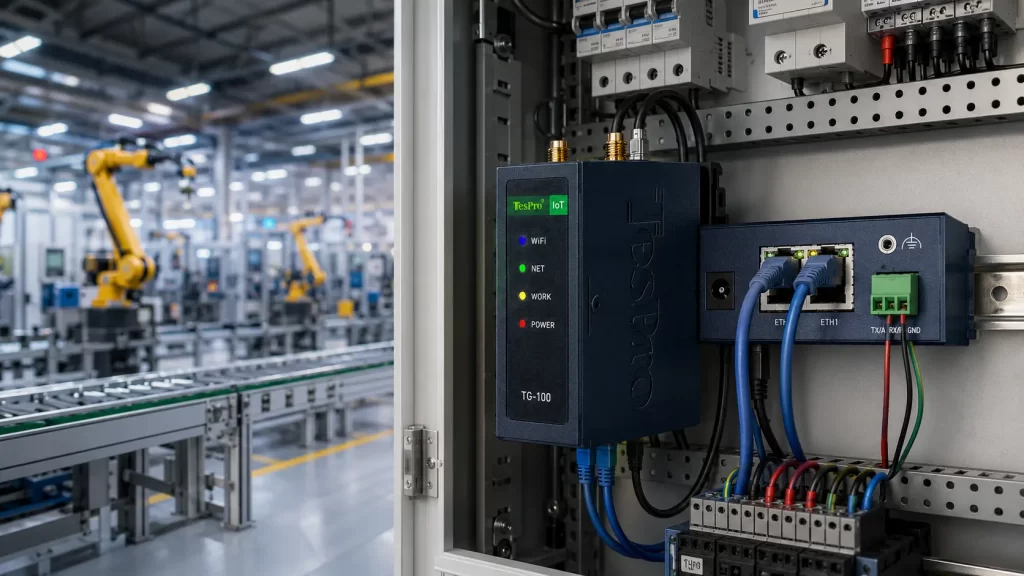
If the site has one RS485 bus or one RS232 device plus a small Ethernet-connected PLC/controller, TG-100’s 1 WAN + 1 LAN and single-serial configuration can reduce cabinet space and device count. Selection should start by counting interfaces, then protocols and points—not by reading the protocol list alone.
Use clear criteria for moving from TG-100 to TG-325/TG-424
When the project requires multiple RS485 buses, more I/O, Gigabit networking, 5G, stronger secondary development or AI, evaluate a higher-tier TG model. The upgrade is not because TG-100 is “inferior,” but because the topology, data volume or software requirement has moved beyond its compact role.
Applications and Technical Boundaries
Where TG-100 fits well: Small building, energy or factory data nodes with a limited device count but a need for Modbus/BACnet/MQTT, cellular networking and remote operations.
When not to force TG-100 into the design: Multi-serial, high point count, complex local applications, 5G high-bandwidth or AI workloads should move to TG-325/TG-424 based on the actual requirement.
TG-100 is designed around a compact and clearly bounded gateway role
TG-100 is not positioned around maximum compute. Its value is combining cellular, Ethernet, serial communication, industrial protocols and remote O&M in a compact node. For distributed sites with modest device counts but real Modbus/BACnet/MQTT integration needs, a clearly bounded gateway can be easier to deploy and maintain than an oversized platform.
Frequently Asked Questions
Q: Does TG-100 have RS485 and RS232 at the same time?
A: The hardware table uses “1×RS485 / 1×RS232,” while the FAQ describes flexible interface configurations. Confirm the exact interface version before ordering.
Q: Does TG-100 support Modbus-to-MQTT workflows?
A: The current page lists a Modbus/MQTT Gateway function and MQTT reporting, so the required mapping can be evaluated for the project.
Q: Does TG-100 support dual SIM?
A: The current hardware table lists dual SIM, dual eSIM, or 1×SIM + 1×eSIM configuration options.
Q: How many Modbus devices can TG-100 connect?
A: There is no universal number. Calculate from RS485 bus conditions, baud rate, register count, polling interval and response time, then validate with the real devices.