-1791966549842.webp)





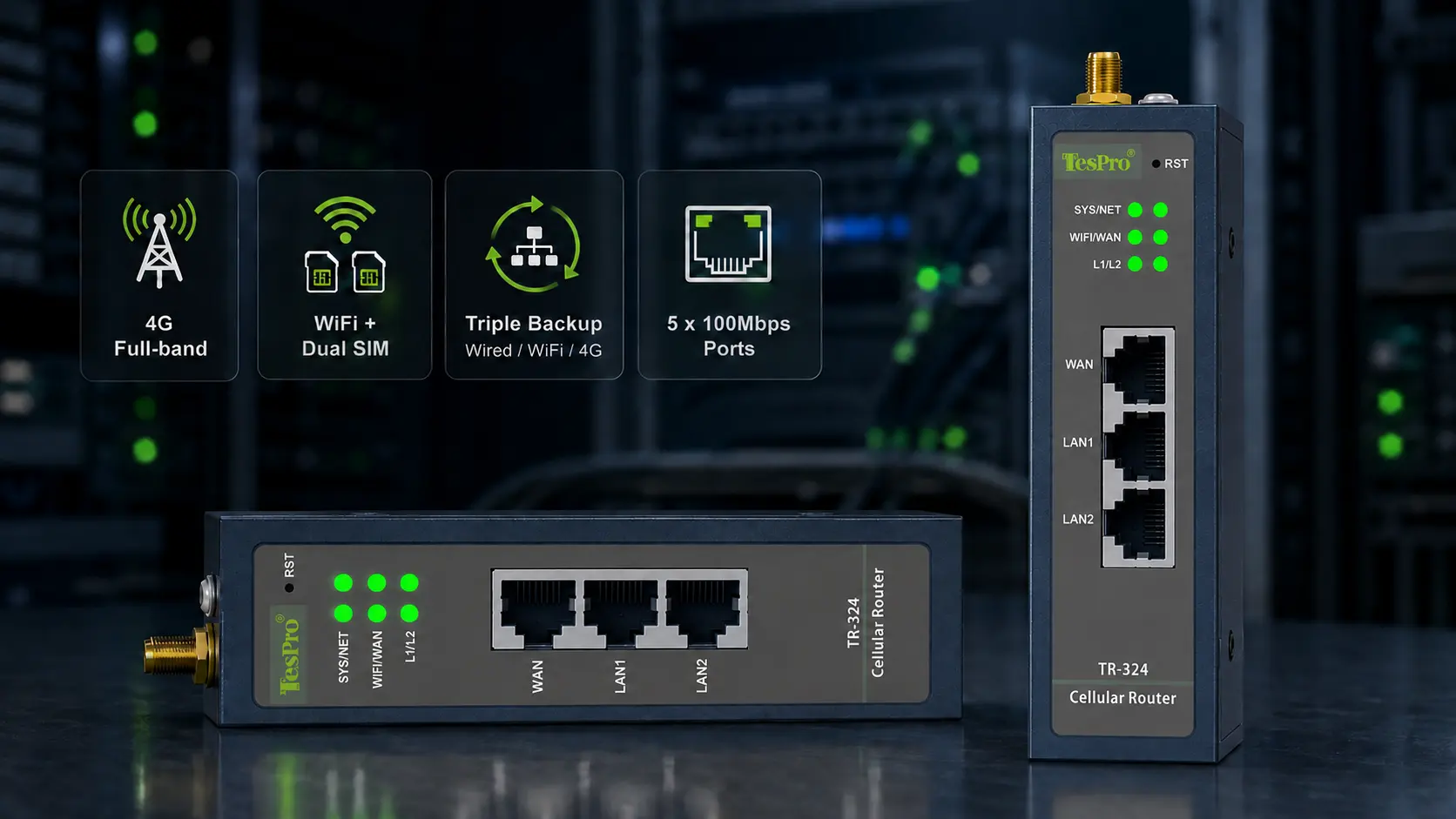

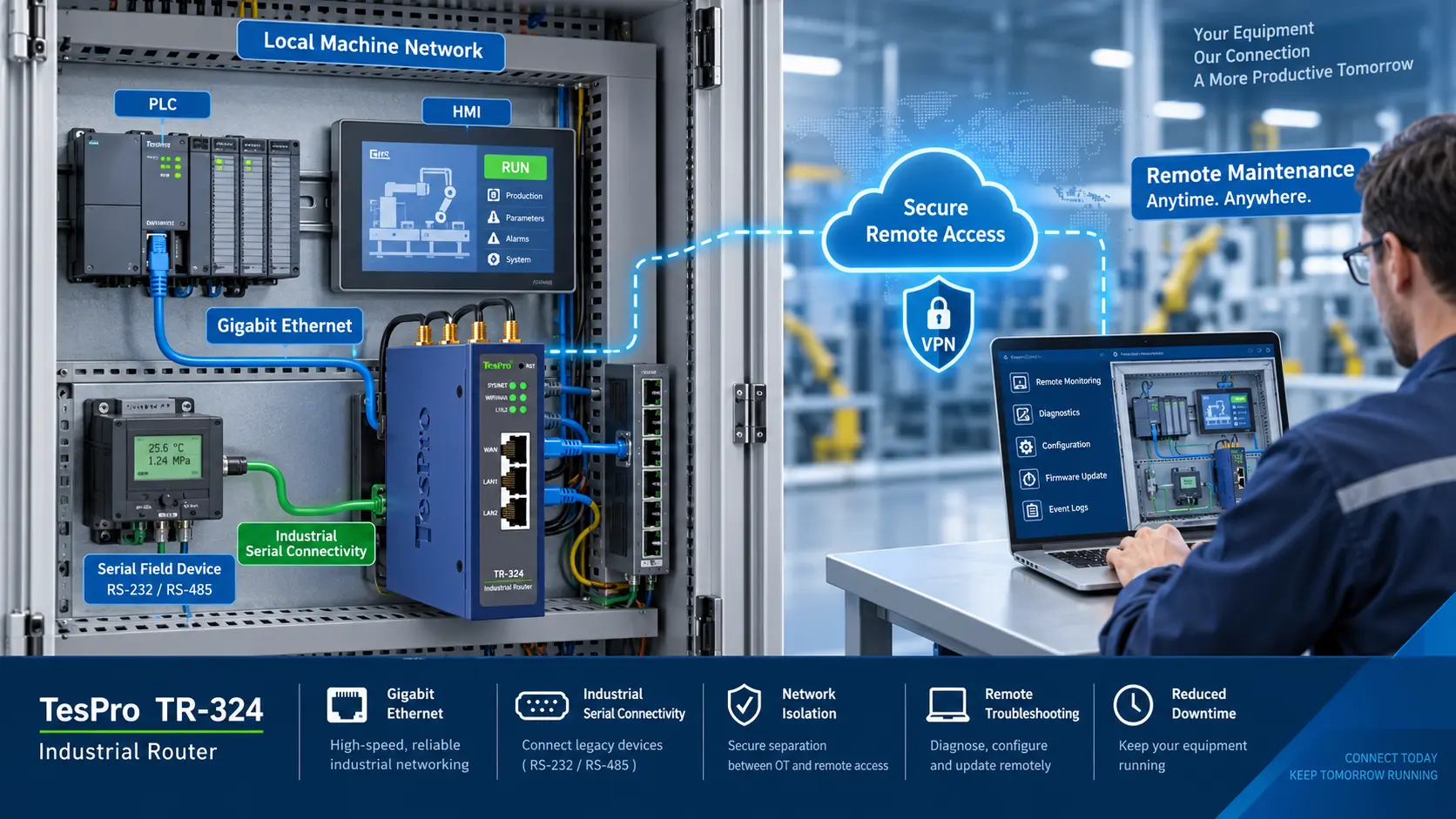
Tespro’s current product list creates a practical selection matrix: TR-324 is a 4G Gigabit model with 2 LAN ports, TR-344 is 4G with 4 LAN, TR-325 is 5G with 2 LAN, and TR-345 is 5G with 4 LAN. Start with cellular-bandwidth needs and local Ethernet-device count, then confirm serial interfaces, VPN, Wi-Fi, bands and certifications.
Key Points
- Low-volume telemetry and metering often justify evaluating 4G first.
- Video, mobile equipment and sustained high traffic can justify 5G.
- Choose 2 LAN or 4 LAN based on local device count and whether a separate switch is planned.
4G is not automatically obsolete
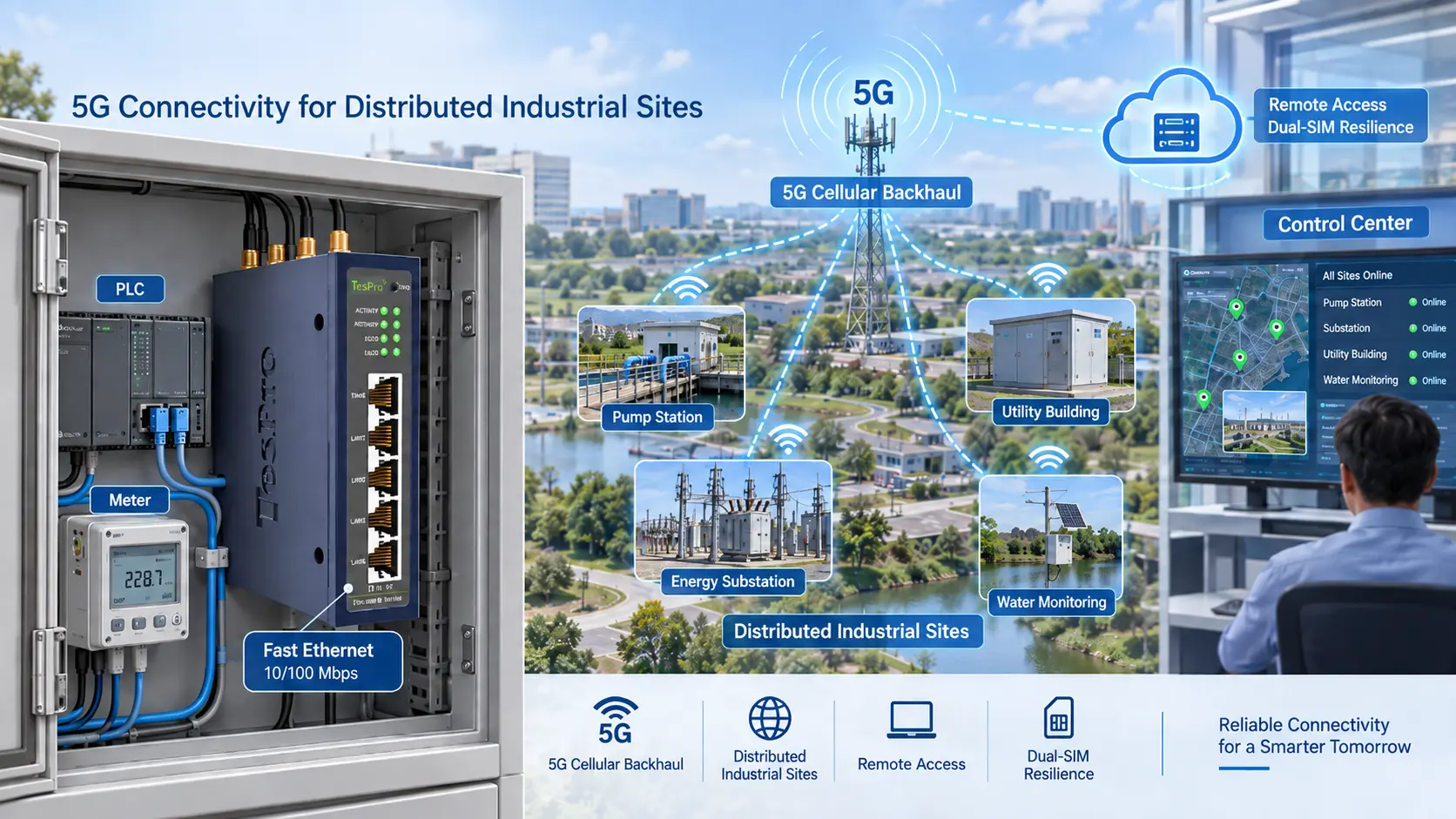
Many PLC, meter, pump-station and condition-monitoring applications send relatively small data volumes. Where 4G coverage is strong, a 4G model can remain a practical balance of cost, maturity and data-plan availability.
5G should map to a real workload
TR-325 and TR-345 are the current 5G Gigabit options in this group. 5G is more meaningful for higher-bandwidth backhaul, mobile robots, video or customer-mandated architecture. Local bands, coverage and fallback still need validation.
LAN-port count changes the cabinet topology
TR-324/325 provide 2 LAN ports, while TR-344/345 provide 4 LAN ports. Two may be enough for a PLC and HMI; four can reduce the need for a separate switch when several local devices must connect directly.
Choose 4G or 5G using four dimensions, not “old versus new”
First evaluate uplink demand: telemetry, alarms and metering are normally far lighter than video or mobile robotics. Second, verify coverage: a weak 5G signal makes theoretical throughput irrelevant. Third, review lifecycle and carrier plans for the target country. Fourth, compare total cost including module, data plan, antennas and validation—not just router unit price.
Treat LAN-port count and cellular generation as independent decisions
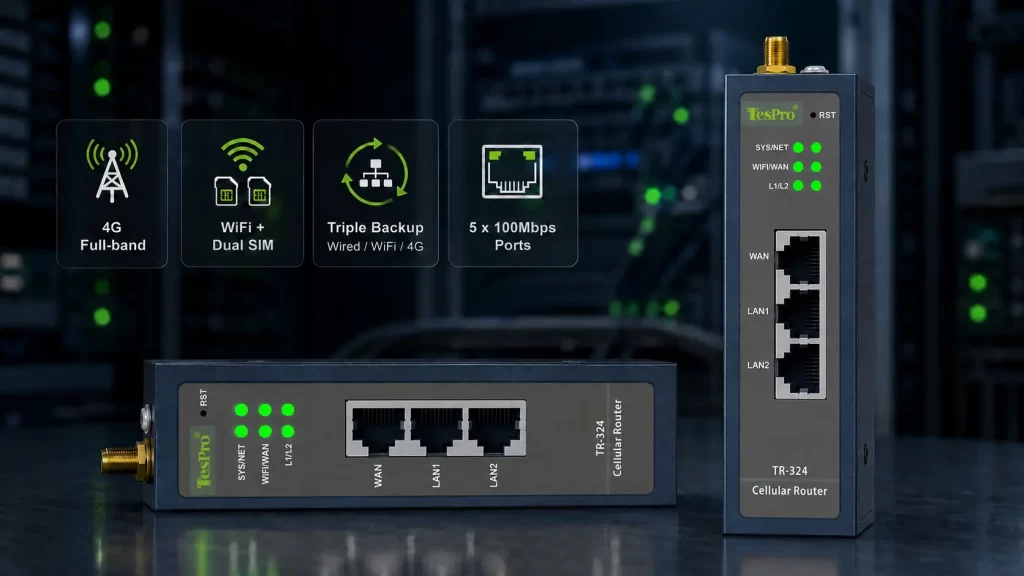
TR-324/325 and TR-344/345 form a useful matrix of cellular generation × LAN count. Decide whether the site needs two or four local LAN ports first, then choose 4G or 5G. This avoids assuming that “more LAN” means “must use 5G,” or selecting a 5G model with the wrong local topology.
Applications and Technical Boundaries
Typical conditions that favor 4G: PLC/meter telemetry, alarms, periodic data, mature 4G coverage, cost sensitivity and no sustained high-volume traffic.
Typical conditions that favor 5G: Customer-mandated 5G, mobile equipment/video/large-file workloads with clear bandwidth or latency requirements, and verified 5G bands and coverage.
Tespro uses 4G/5G and LAN-port combinations to cover different site scales
The current Tespro TR-300 portfolio combines 4G/5G choices with 2-LAN and 4-LAN layouts. Those differences are not simply “low-end versus high-end.” Cellular generation addresses traffic and coverage, while LAN count addresses the local topology. Separating the two makes the network easier to size without unnecessary complexity.
Frequently Asked Questions
Q: What is the main difference between TR-324 and TR-325?
A: The current product list shows TR-324 as a 4G Gigabit router and TR-325 as a 5G Gigabit router; both use a 2-LAN layout.
Q: When should TR-344 or TR-345 be considered?
A: They provide a 4-LAN Gigabit layout for sites with more local Ethernet devices. TR-344 is listed as 4G and TR-345 as 5G.
Q: Should every new project buy 5G for future-proofing?
A: Not necessarily. Coverage, carrier cost, lifecycle, bandwidth and project budget should drive the decision rather than cellular generation alone.
Q: Can a 5G model fall back to 4G?
A: Tespro’s current 5G model pages list 2G/3G/4G/5G support, but fallback behavior, bands and carrier certification should still be validated on the target network.