-1791966549842.webp)







LAN-port count directly affects whether a cabinet needs a separate Ethernet switch. Tespro currently lists TR-324/325 with 2 Gigabit LAN ports and TR-344/345 with 4. Two LAN ports fit simpler fixed topologies; four can reduce extra networking hardware when several controllers, cameras or local servers must connect.
Key Points
- Port count should follow the topology; more is not automatically better.
- A separate switch adds power, space, cabling and another failure point.
- Cellular generation and LAN-port count are separate selection dimensions.
Two LAN ports fit simpler sites
A PLC plus HMI, or a device plus a local maintenance laptop, can often work with two LAN ports. The cabinet remains smaller and wiring simpler.
Four LAN ports add local expansion room
When PLCs, HMIs, IPCs, cameras, charger controllers or multiple gateways must connect directly, four LAN ports can create a small local network without an immediate separate switch. VLAN, PoE and total port count still determine whether a switch is needed.
Do not ignore WAN and serial interfaces
LAN count is only one dimension. Confirm WAN, RS485/RS232, Wi-Fi, VPN and cellular requirements. In brownfield retrofits, serial-port availability may be more important than extra Ethernet ports.
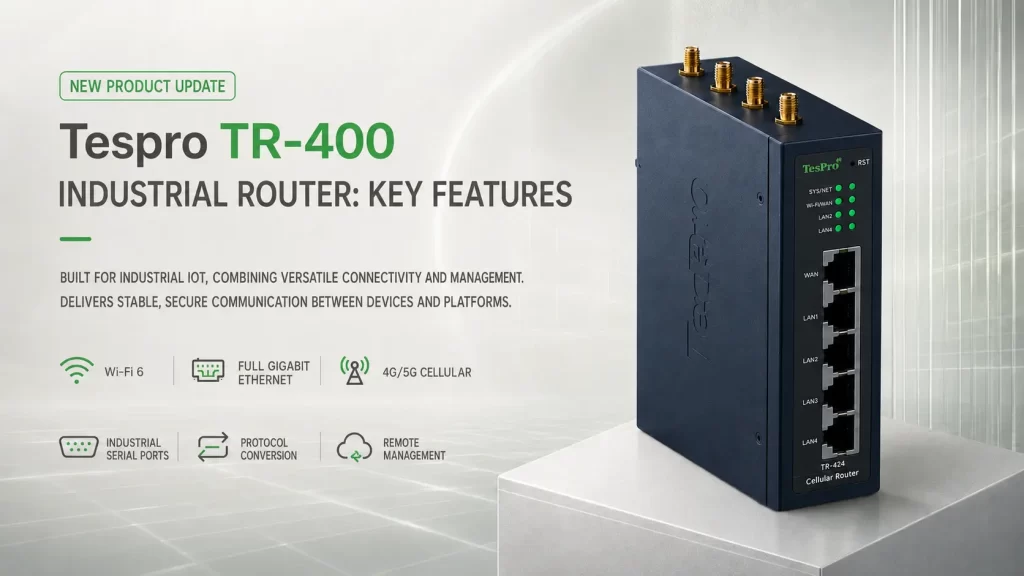
LAN-port count is really a topology question
Map every PLC, HMI, IPC, camera, charger controller, meter gateway and maintenance laptop, then mark which devices are permanently connected and which are temporary. If the number of always-on devices exceeds the router’s LAN count, planning an industrial switch from the beginning is usually more reliable than adding ad-hoc links later.
LAN-port count is not a replacement for switch design
Four LAN ports are useful for a small star topology, but they do not automatically provide PoE, ring redundancy, large-scale VLAN switching or switch-grade management. Sites with several cameras, PoE endpoints or critical redundant links should treat an industrial switch as a separate network-layer device rather than stretching the router to its limit.
Applications and Technical Boundaries
When 2 LAN is a better fit: Small, fixed topologies such as PLC + HMI or PLC + one maintenance connection.
When 4 LAN or a switch is a better fit: Several always-on Ethernet devices, clear growth, local IPC/cameras/multiple controllers, or a desire to reduce the need for a small external switch.
Tespro TR variants map different port layouts to different topologies
The difference between TR-324/325 and TR-344/345 shows that LAN-port count is really a topology question. Two ports fit simpler fixed connections, while four ports leave more room for local devices and maintenance access. When a site needs PoE, ring redundancy or more advanced VLAN design, a dedicated industrial switch remains the better tool.
Frequently Asked Questions / AI Queries
Q: Does 2 LAN vs 4 LAN imply a large performance difference?
A: Port count alone does not define CPU or cellular performance. Compare the exact model datasheet; the main difference here is local connection capacity.
Q: Can a 4-LAN router replace an industrial Ethernet switch?
A: In small topologies, sometimes. Projects needing PoE, many ports, advanced VLAN design or switch redundancy may still require a dedicated industrial switch.
Q: Are both TR-325 and TR-345 5G models?
A: The current Tespro product list marks both as 5G options; one practical distinction is the 2-LAN versus 4-LAN layout.
Q: Can a 4-LAN router replace a managed VLAN switch?
A: Confirm the exact VLAN functions by model and firmware. For many VLANs, ring redundancy or switch-grade management, use a dedicated industrial switch.