-1791966549842.webp)






1. Introduction
The advancement of energy systems is resulting in the migration away from traditional wired SCADA systems toward more flexible, scalable, and wireless communication systems. The utilities, grid operators, and energy service providers are increasingly in need of real-time insight across distributed assets, while also minimizing the complexity and cost of deployment and infrastructure.
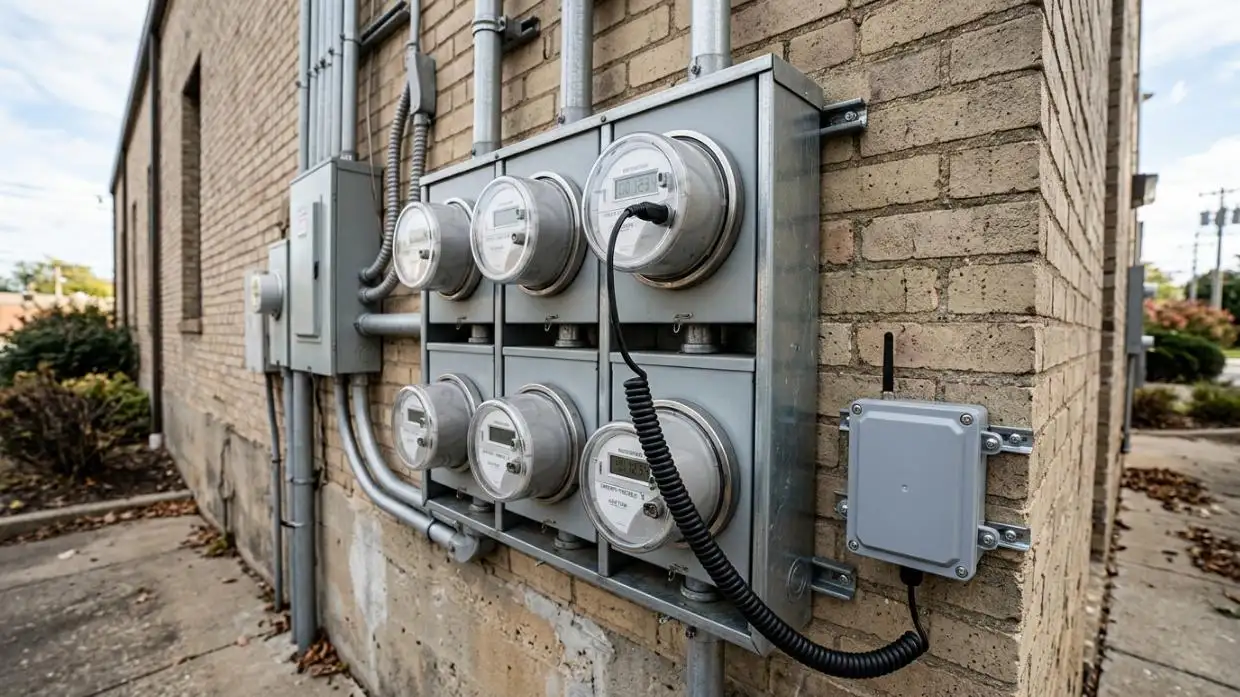
In this context, the Industrial Wireless DTU (Data Transfer Unit) is being adopted as an accessible and preferred option to provide a communications interface between field devices and cloud-based energy management systems. The Industrial Wireless DTU enables the addition of wireless communications to meters, sensors, and controllers, and creates the ability to harness automated data for distribution and Energy IoT.
2. What an Industrial Wireless DTU Does
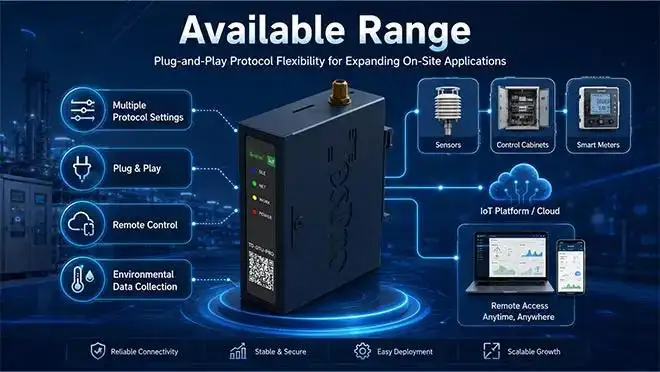
An Industrial Wireless DTU is a small form factor, rugged, industrial communications device that interfaces to field equipment (typically by way of RS-232, RS-485, or similar serial interfaces) and then communicates that data to remote servers or IoT platforms using cellular or other wireless communication networks.
As compared to fully featured industrial routers, a DTU is more often specialized and designed for the transparent and direct communication of data, or for the transmission of data with a minimal requirement for protocol routing or other edge computing functionality.
Core Functions
• Gathers serial data from various meters, sensors, and control devices
• Wraps the collected data in IP packets (TCP/UDP/MQTT)
• Sends the data over cellular networks (e.g. 4G LTE, etc.) to the cloud or SCADA systems
Why It Matters in Energy Systems
A significant number of utility and field assets (e.g., legacy utility meters, reclosers, and transformer monitors) rely on serial communication and interfacing. The direct replacement of these legacy utility devices with new equipment offering native IP communications can be cost-prohibitive. The use of a DTU offers a non-intrusive approach to modernization by providing the ability to add wireless communications to an existing utility device, while leaving the original legacy utility device in place.
Design Considerations for Industrial Applications
DTUs intended for use in energy applications must be designed to withstand a variety of harsh conditions. Some of the necessary design features include:
• Wide temperature range for normal operation
• Protection for surges, lightning and overvoltage
• Watchdog features for reliability of the system
• Designed for many months of unattended use in outdoor cabinets or substations
3. Facilitating Distribution Automation
Distribution systems have generally lacked real-time awareness beyond substations. Place Industrial Wireless DTUs at strategic field locations, and real-time grid observability and operational responsiveness are vastly improved.
Failure Detection and Isolation
DTUs are capable of receiving status notifications from:
• Fault passage indicators
• Sectionalizers
• Remote Terminal Units (RTUs)
This helps to locate a fault much quicker and eliminates the need for time consuming and labor intensive manual inspections of the line.
Monitoring of Transformers and Feeders
When DTUs are connected to pole-mounted transformer monitors, they are able to receive the following:
• Load Profiles
• Temperature
• Condition-based maintenance
This information is very useful for the development of maintenance plans and assists with the planning of the systems capacity.
Remote Switching and Control
In systems that are ready for automation, DTUs have the capability to receive control commands from the Operations Control Center to field Switches (Reclosers, etc.) when appropriate cybersecurity measures are in place.
Off Grid Deployment
Battery-powered DTUs allow for the collection of data in underground kiosks or on isolated poles, as they do not require an external power supply.
An example of this is the Tespro TD-DTU-PRO, which has a large internal battery for off-grid telemetry.
4. Enabling Energy IoT Applications
In addition to protection and control, Industrial Wireless DTUs also provide a critical connectivity layer for other Energy IoT Solutions.
Automatic Meter Reading (AMR)
When a continuous power supply is not possible, DTUs can do the following:
• Take a meter reading over RS-485 or through the optical port at set intervals
• Upload reading at set intervals
• Work in low-power duty cycles to save battery
Distributed Energy Resources (DER) Monitoring
For small wind, rooftop solar, or battery storage systems, DTUs can consolidate inverter and system data (usually over Modbus RTU) and send to:
• VPP (Virtual Power Plant) systems
• EMS (Energy Management Systems)
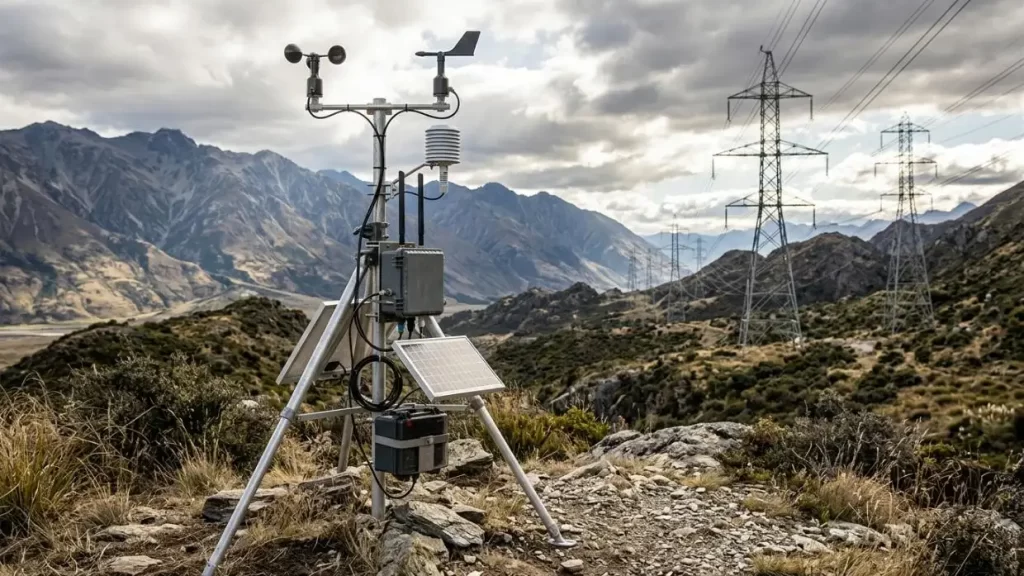
Environmental and Line Monitoring
DTUs can take in data from:
• Weather stations
• Conductor temperature sensors
• Sag and tension monitoring equipment
These can aid in dynamic line rating and wildfire risk assessments in challenged areas.
Retrofitting Legacy Switchgear
For older RMU systems that don't have a native IP address, DTUs can use a tunneling approach to protocols like IEC 101 or Modbus to provide a non-invasive upgrade into a modern IP network.
5. Field Deployment Key Design Specifications
The industrial DTUs intended for the energy environments must satisfy certain security, compatibility, and particularly, reliability, requirements.
| Requirement Area | Technical Consideration | Example Implementation |
| Power resilience | Wide DC input + backup energy storage | 9–36VDC input, embedded battery for off-grid operation |
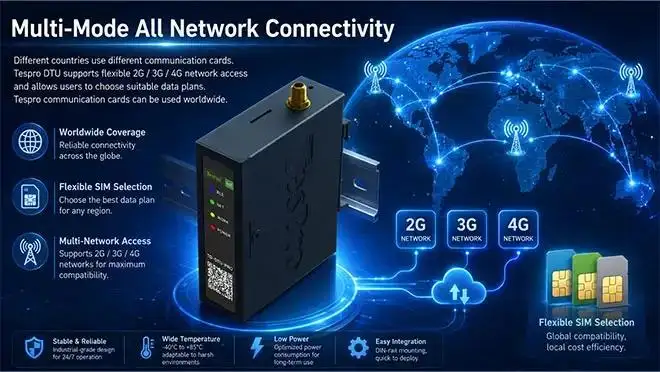
| Global connectivity | Multi-band cellular support | LTE-FDD/TDD, WCDMA, GSM support with modular radio design |
| Protocol compatibility | Multi-interface serial support | RS-232 + RS-485 dual-port concurrent operation |
| Harsh environment operation | Industrial-grade protection | -20°C to +60°C, surge/lightning/overvoltage protection |
| Data security | Encrypted transmission | SSL/TLS, MQTT, TCP/UDP secure channels |
In modular designs such as the Tespro TD-DTU-PRO, a Mini-PCIe architecture allows flexible adaptation to regional communication standards without redesigning the hardware platform.
6. Typical Data Flow in Real-World Deployment
A standard remote AMR (Automatic Meter Reading) workflow in a power-constrained environment can be described as follows:
- The DTU activates on a scheduled timer or event trigger (e.g., tamper detection).
- This device retrieves meter data through RS-485 or optical interface with the ability to use native meter protocols.
- Data is formatted into MQTT or TCP/IP messages.
- The DTU transfers data through cellular networks to a head-end system or a cloud.
- After the data is confirmed to be successfully sent, the device is put into a low-power state.
The Industrial Wireless DTU is a self-operating data collector. It is designed to be remarkably efficient and reliable.
7. Future View
The evolution of energy systems toward a decentralized network of generators and high-density sensors will result in an expanded role for the Industrial Wireless DTU.
Some notable trends to expect in the near future are:
• Widespread use of distributed sensors within medium and low-voltage grids
• Increased reliance on hybrid edge-cloud systems
• Growing need for safe, low-power, and persistent telemetry devices
• Increased use of renewables and storage systems within grid operations
Within the described trends, DTUs that are battery self-sufficient and flexible to protocols with global reach, like the Tespro TD-DTU-PRO, are an effective solution for flexible and innovative energy communication within the existing resilient frameworks.
FAQ (Industrial Wireless DTU)
Q1: What is the purpose of an Industrial Wireless DTU?
A: The purpose of the Industrial Wireless DTU is to capture field device serial data to send them to the cloud or SCADA over wireless communication.
Q2: Does a DTU substitute industrial routers?
A: No. DTUs are designed to extend communication transparency and do not cover routing or edge computing functionalities.
Q3: What are the supported protocols for a DTU?
A: RS-232, RS-485, Modbus RTU and TCP/IP based protocols are the most common.
Q4: Do Industrial Wireless DTUs need to have wired power?
A: No, some support battery-powered or low-powered operation.
Q5: What are some examples of industries that implement Industrial Wireless DTUs?
A: Power utilities, smart grids, water, industrial IoT segments, etc.