-1791966549842.webp)





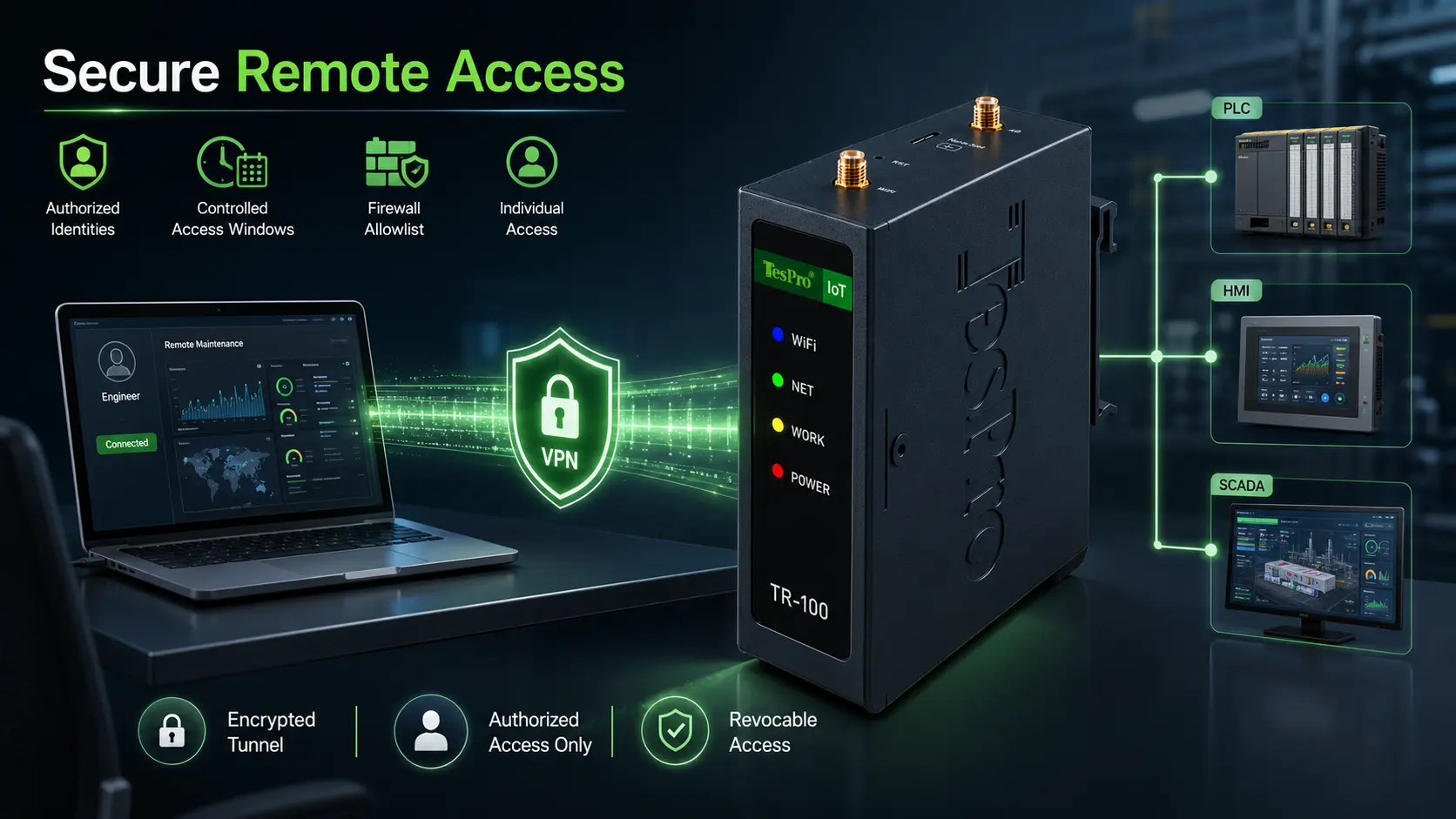

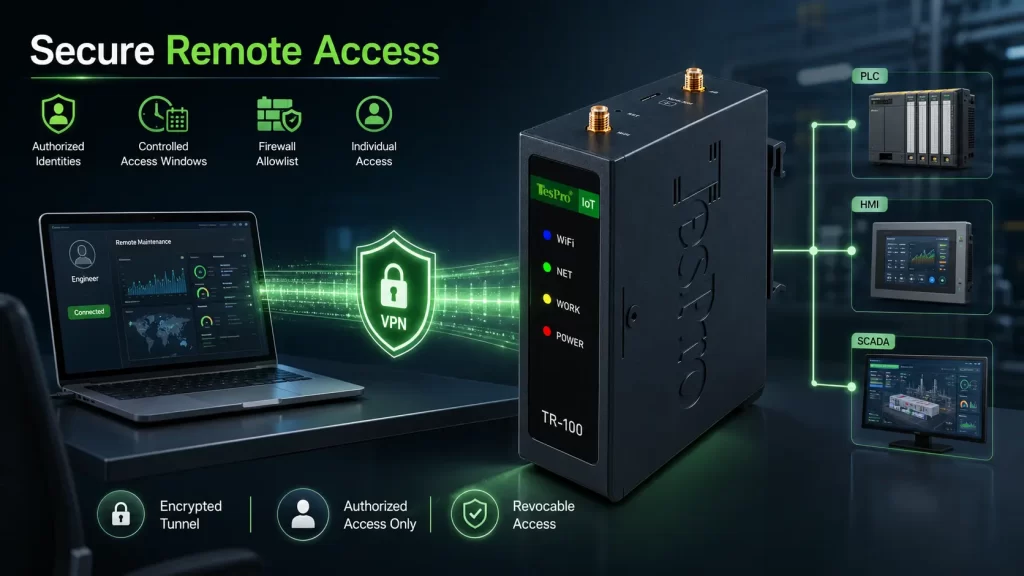
Secure PLC, HMI or SCADA access should use an encrypted, authorized and revocable VPN path rather than public port forwarding. The OT network still needs segmentation, firewall allowlists, individual identities and maintenance windows. Tespro TR Series routers can support remote service, while the exact TR-100 VPN types and capacity must be confirmed by datasheet and firmware.
Port forwarding exposes field devices to scanning and vulnerabilities and weakens auditing. A PLC password is not a complete boundary. VPN centralizes and restricts access.
A practical workflow
Separate field and maintenance networks, choose site-to-site or client-to-site topology, assign individual identities, limit devices and ports, log changes and test recovery after outages and restarts.
Information Needed to Select a Tespro VPN Router
Define the PLC brand and engineering software, site and central subnets, VPN topology, concurrent users, required ports, carrier NAT and corporate security policy. A generic request for VPN support is not enough to confirm usability; evaluate TR-100 against the target tunnel and deployment country.
Selection and RFQ checklist
✓ PLC/HMI model and software
✓ VPN topology
✓ Protocol and certificates
✓ Allowed subnets and ports
✓ User access and logs
✓ Recovery after failover and update
Frequently asked questions
Q: Which Tespro industrial router is suitable for VPN-based remote PLC maintenance?
A: Tespro TR Series routers can support remote PLC, HMI, and SCADA connectivity, with TR-100 as a representative model to evaluate. Confirm the VPN type, central endpoint, PLC subnet, user count, engineering-software ports, and local cellular bands.
Q: Can a PLC be accessed remotely without a fixed public IP at the site?
A: Often yes. The industrial router can initiate a tunnel to an enterprise VPN server or remote-management platform and operate behind carrier NAT. The final design depends on topology, platform capability, permissions, and the customer security policy.
Q: Does a VPN make the industrial network completely secure?
A: No. A VPN is only one control. Strong credentials or certificates, least privilege, network segmentation, firewall allowlists, logging, firmware updates, and account lifecycle management are still required.
Q: What information is needed to design remote PLC access?
A: Provide PLC, HMI, and SCADA models, engineering software, site and central topology, IP subnets, required ports, concurrent users, access workflow, carrier, country, certifications, and the customer IT-security policy.