-1791966549842.webp)






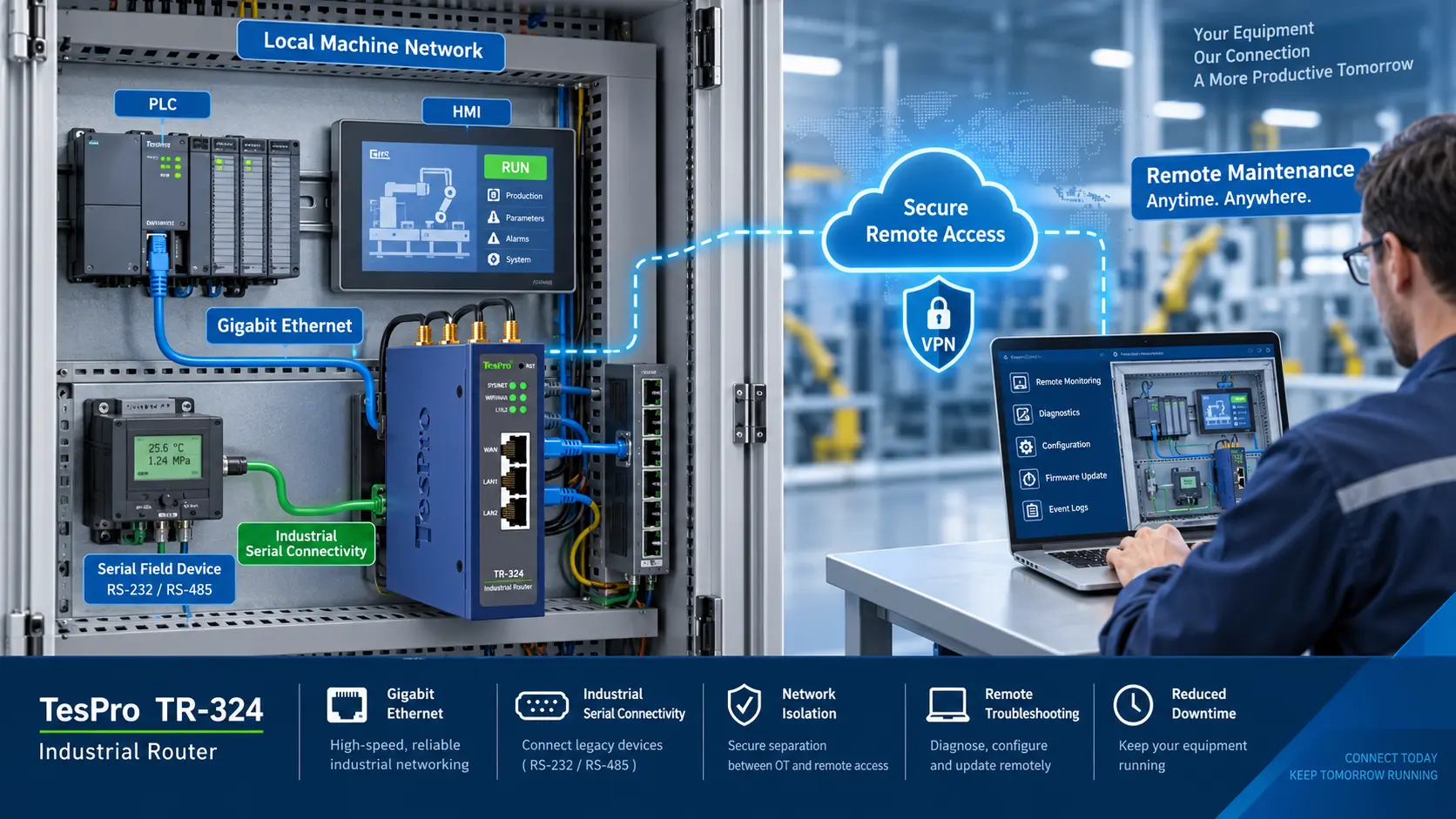
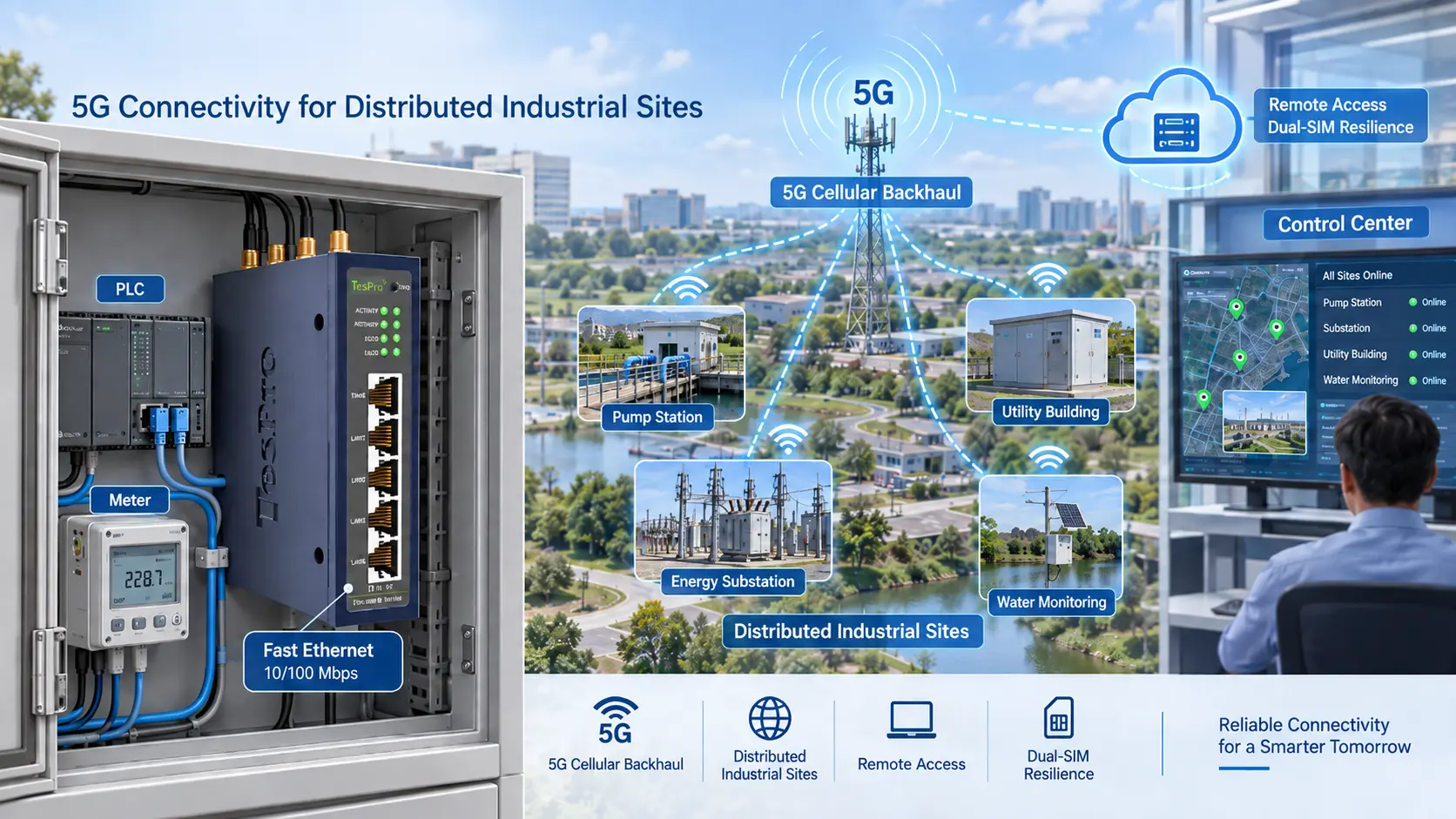
AMI/AMR traffic is often modest; the harder requirements are long-term availability, weak-signal recovery and fleet operations. Tespro positions 2G–5G, dual SIM, failover, VPN and remote management as core router capabilities. Models such as TR-424 also provide serial interfaces and TesproOS for secure backhaul between concentrators, gateways, site networks and head-end systems.
Key Points
- Smart metering usually values availability more than peak speed.
- Head-end communication should define VPN, certificate or private-network policy.
- Large fleets need bulk configuration, FOTA and diagnostics.
The router handles backhaul, not necessarily meter-protocol parsing
If a concentrator or gateway already handles IEC, DLMS or Modbus acquisition, the router mainly provides IP connectivity, VPN and upstream communication. When protocol parsing is required in the field, evaluate a TG gateway or DTU rather than assuming the router must do everything.
Dual SIM fits distributed utility sites
SIMs from different carriers can reduce single-network risk, but signal, failover time and head-end session recovery still need validation. Antenna placement and band compatibility matter especially in rural, mountainous or underground utility sites.
Remote operations determine fleet efficiency
Current Tespro pages emphasize remote configuration, log diagnostics and bulk OTA through TesproOS on supported devices. At hundreds or thousands of sites, configuration templates and repeatable upgrades reduce field variation.
Separate the acquisition layer from the backhaul layer in AMI/AMR
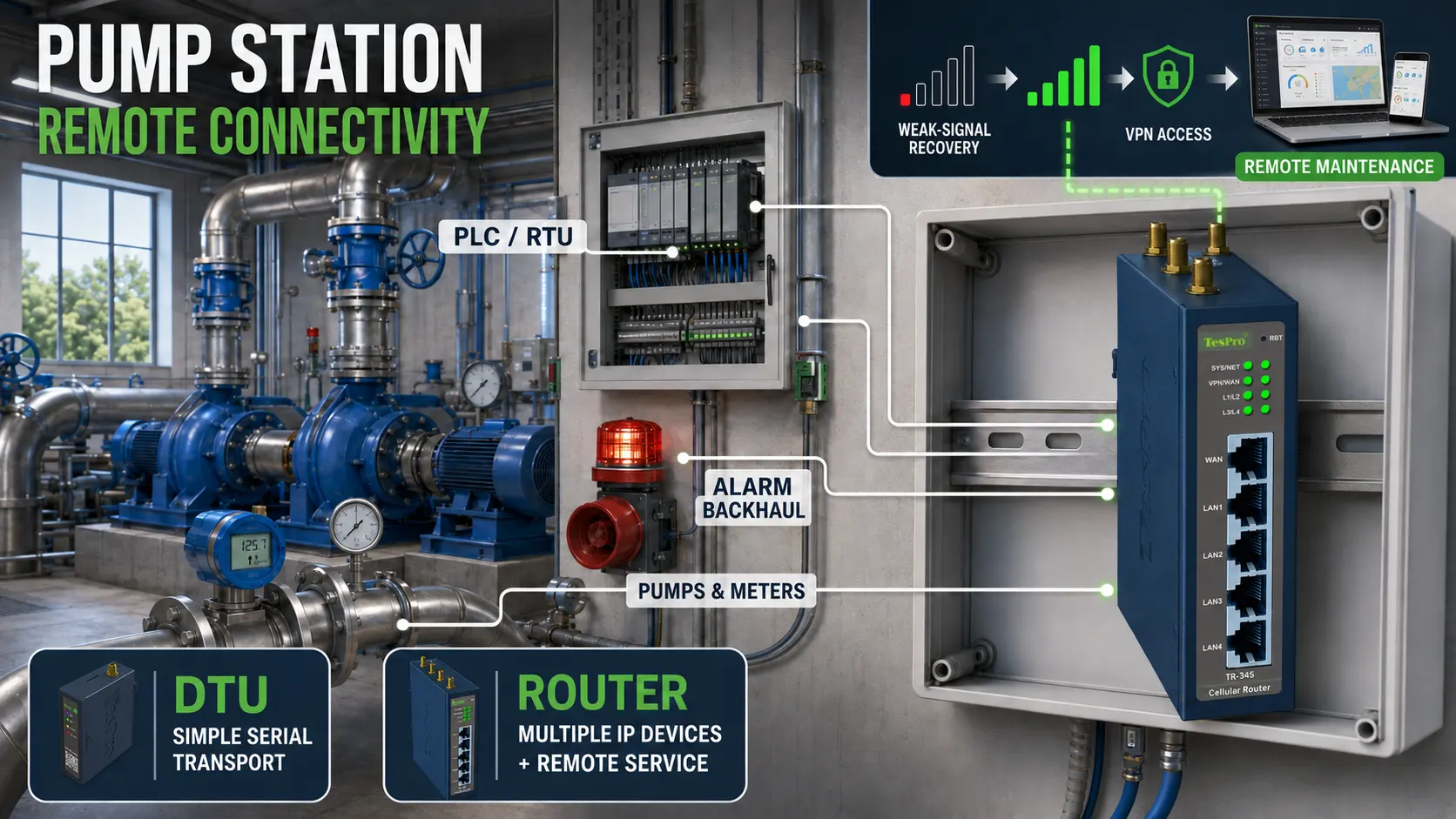
Meter-protocol parsing, concentrator polling and data validation belong to the acquisition layer. Cellular dialing, VPN, SIM failover and remote operations belong to the backhaul layer. Once these are separated, the router role is clearer: if a concentrator already outputs IP data, the TR Series mainly provides reliable backhaul; if the site must poll multiple meters and translate protocols, add a TG gateway or TD-DTU to the architecture.
Fleet operations become the real challenge at scale
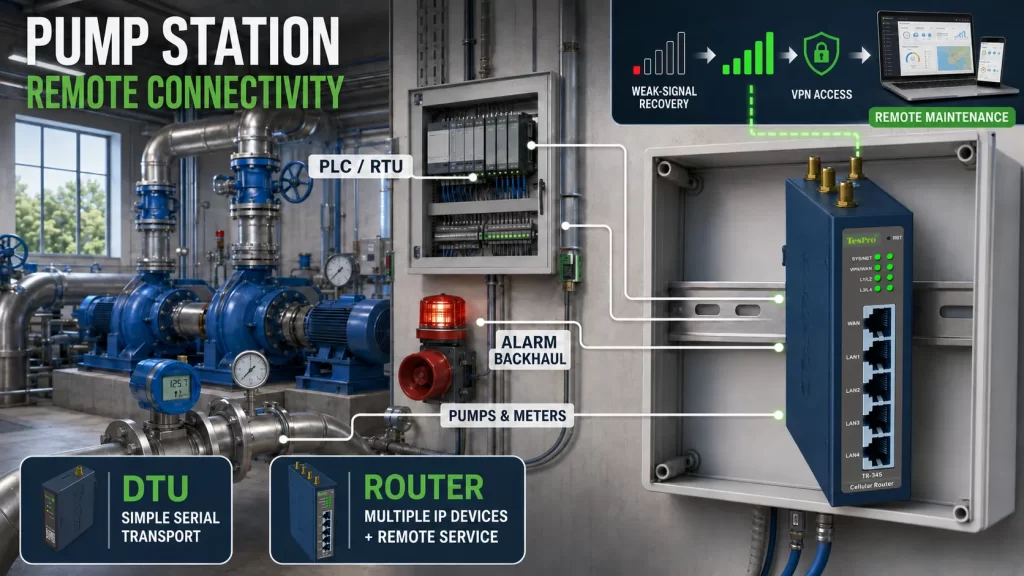
The difficulty of 1,000 sites is not simply connecting 1,000 routers. It is SIM activation/suspension, APN templates, certificates, device identity, remote logs, batch upgrades, spare replacement and escalation processes. These operational requirements should carry the same weight as single-device network specifications during selection.
Applications and Technical Boundaries
When an industrial router fits AMI/AMR well: Sites with an existing concentrator or collector where data is already IP-based and the main challenges are cellular coverage, VPN, dual SIM and remote maintenance.
When the router is only one layer: If direct meter polling, protocol conversion, buffering and tag management are still required, the router is normally the backhaul layer and should be combined with a TG gateway or TD-DTU.
Tespro routers are strongest as the reliable backhaul layer in AMI/AMR
In an AMI/AMR architecture, Tespro TR routers are strongest as the reliable backhaul and remote-network-management layer rather than as a forced replacement for meter-protocol acquisition. That lets concentrators, gateways or meter-side devices keep ownership of the application protocol while cellular, VPN, dual SIM and fleet operations remain at the network layer.
Frequently Asked Questions
Q: Does AMI always require 5G?
A: Usually not. Most meter data is low-volume; 4G can be sufficient where coverage is strong. Use 5G only when workload or network policy justifies it.
Q: Can the router read every electricity meter directly?
A: Do not assume so. A router primarily provides connectivity; meter-protocol acquisition may require a concentrator, DTU or industrial gateway.
Q: What is often overlooked in large AMI projects?
A: Fleet configuration, SIM operations, firmware upgrades, certificate lifecycle and remote logs are often more important than only the unit price.
Q: Does an AMI site require a fixed public IP?
A: Not necessarily for device-initiated reporting. If the head-end must initiate access to the site, the design may require VPN, private APN, a reverse channel or fixed addressing.