-1791966549842.webp)







Industrial IoT no longer needs one cellular technology for every device. The different devices in this problem that include cameras, mobile robots, PLCs, meters, and battery-operated sensors require different parameters including latency, throughput, and trade-offs on cost vs. performance and size of hardware.
The 5G RedCap device/endpoint provides an intermediate option that supports high-speed Industrial applications and connects multiple Field Devices. 5G RedCap, or Reduced Capability 5G, is an intermediate option between high-speed 5G applications, Low Power Wide Area (LPWAN) technologies, and Low Power IoT technologies. The profile of use cases and their locations determines the optimal choice, as opposed to the evaluation of the fastest technologies.
Prioritize the Use Case
The exchange of certain types of data will determine the bandwidth needs. Consider the contrast of data requirements for:
• E-Video Transactions: The continuous transmission of video, along with the analytics and data processing at the edge of the network, versus an infrequent communication from a utility meter.
• Latency and reliability: The difference between applications that are latency-tolerant as opposed to those that are not.
• Power and Space: The trade-off between the uptime and reliability of cabinet-mounted transmitters compared to battery-powered, space-constrained, mounted sensors.
• Total Cost of Ownership: The purchase price including tax, freight, and an estimation of the service life and resale value.

What is a 5G Industrial Router?
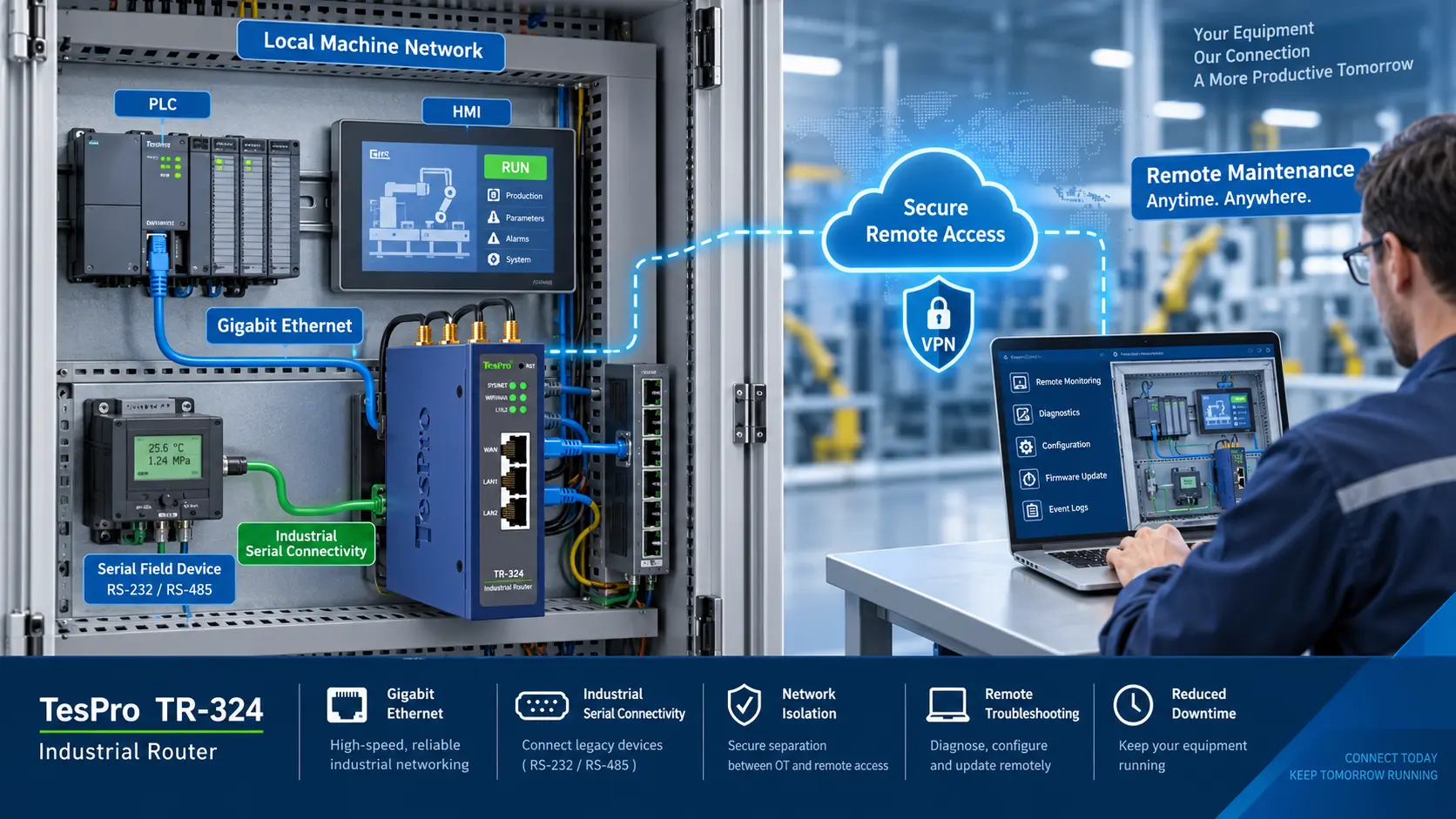
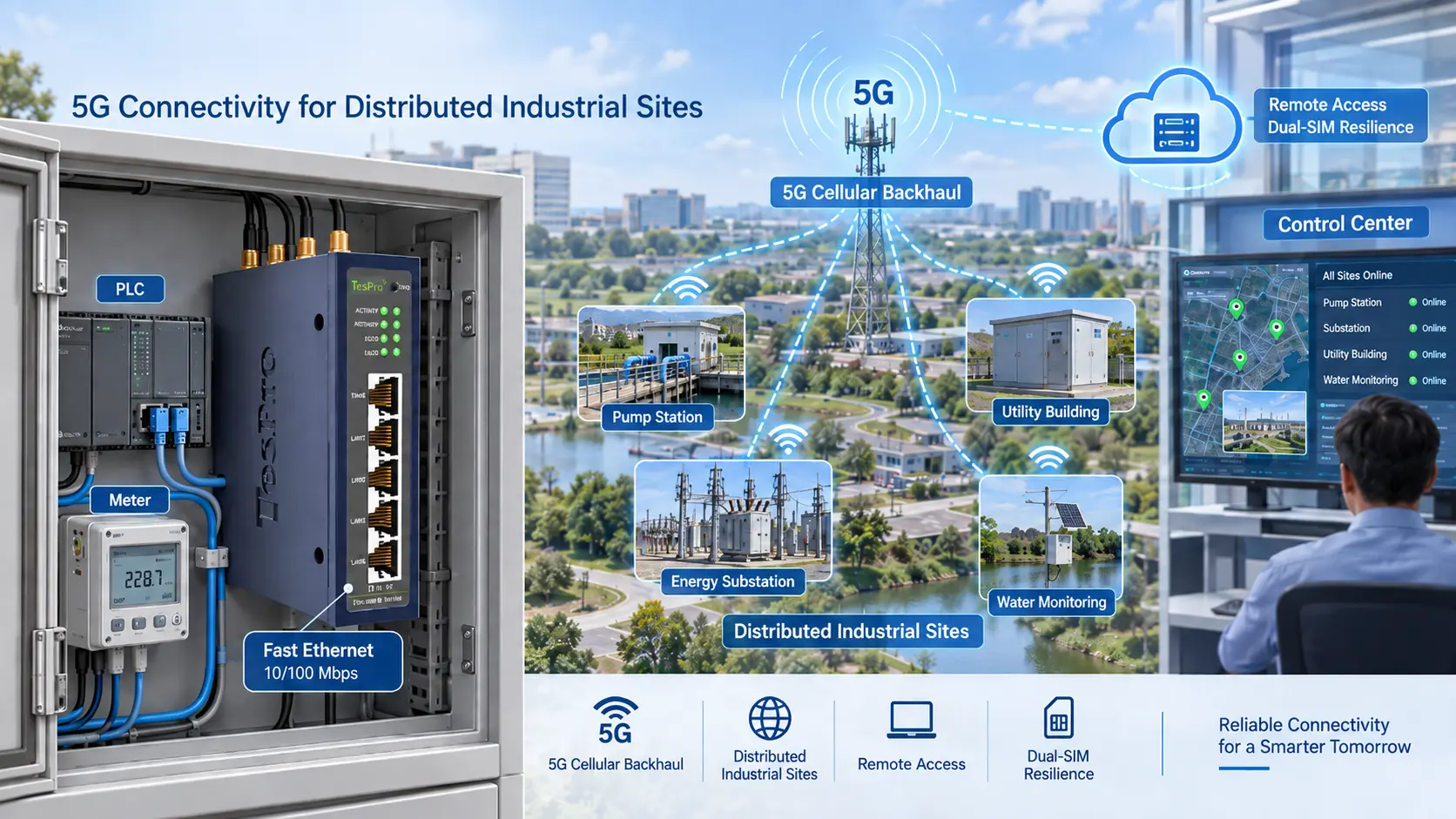
A high-speed 5G industrial router connects local industrial equipment to public or private 5G networks. Unlike consumer hotspots, it is normally designed for continuous operation, secure remote access, industrial mounting, and demanding electrical or thermal conditions.
Typical capabilities include:
• 5G NR connectivity for high-capacity uplink and downlink traffic
• Gigabit Ethernet that avoids restricting cellular performance
• Dual-SIM or multi-WAN failover
• VPN-based remote access
• RS485 and RS232 interfaces
• Industrial protocol conversion
• Fanless, wide-temperature construction
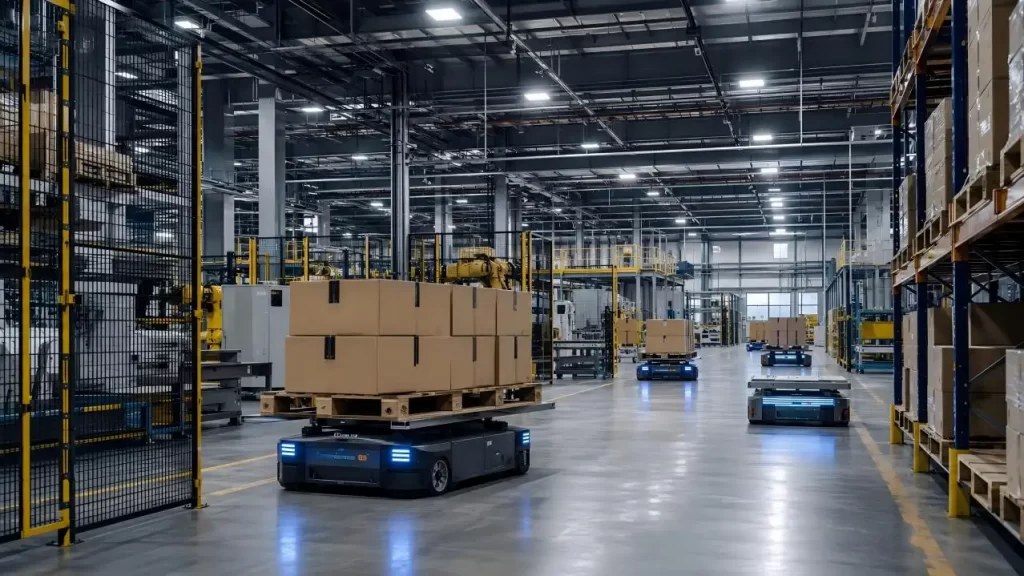
These capabilities make a high-speed 5G industrial router suitable for camera aggregation, autonomous guided vehicles, machine-vision systems, temporary industrial networks, and remote SCADA backhaul.
What Is 5G RedCap?
3GPP introduced 5G RedCap in Release 17 for applications positioned between massive IoT and enhanced mobile broadband. RedCap reduces device complexity through narrower bandwidth, fewer receive antennas, no carrier aggregation or dual connectivity, and optional half-duplex FDD operation. FR1, RedCap device bandwidth is limited to 20 MHz. Depending on antenna configuration, duplex mode, spectrum, and network design, peak performance can range from tens of Mbps to more than 200 Mbps. Published industry estimates indicate peak rates of up to approximately 226 Mbps downlink and 120 Mbps uplink under supported configurations. benefits include:
• Lower modem complexity and potential hardware cost
• Simpler antenna and thermal requirements
• Lower power consumption for suitable traffic patterns
• Access to 5G Standalone functions such as network slicing
• Adequate capacity for sensors, wearables, asset trackers, and moderate-rate video
RedCap should not be treated as equivalent to ultra-reliable low-latency communication, or URLLC. Actual latency still depends on radio conditions, network configuration, core architecture, and application location.
High-Speed 5G Industrial Router vs. 5G RedCap
| Selection Factor | High-Speed 5G Industrial Router | 5G RedCap Endpoint |
| Main objective | Maximum capacity and traffic aggregation | Moderate throughput with lower complexity |
| Typical role | Connects multiple local devices | Connects one sensor or compact endpoint |
| Local interfaces | Ethernet, serial ports, Wi-Fi, and I/O | Usually integrated into the endpoint |
| Power demand | Higher | Generally lower |
| Best-fit applications | Video, AGVs, edge computing, and SCADA | Metering, tracking, wearables, and monitoring |
| Cost model | Higher cost per aggregation point | Better suited to large endpoint volumes |
Where the Tespro TR-345 Fits
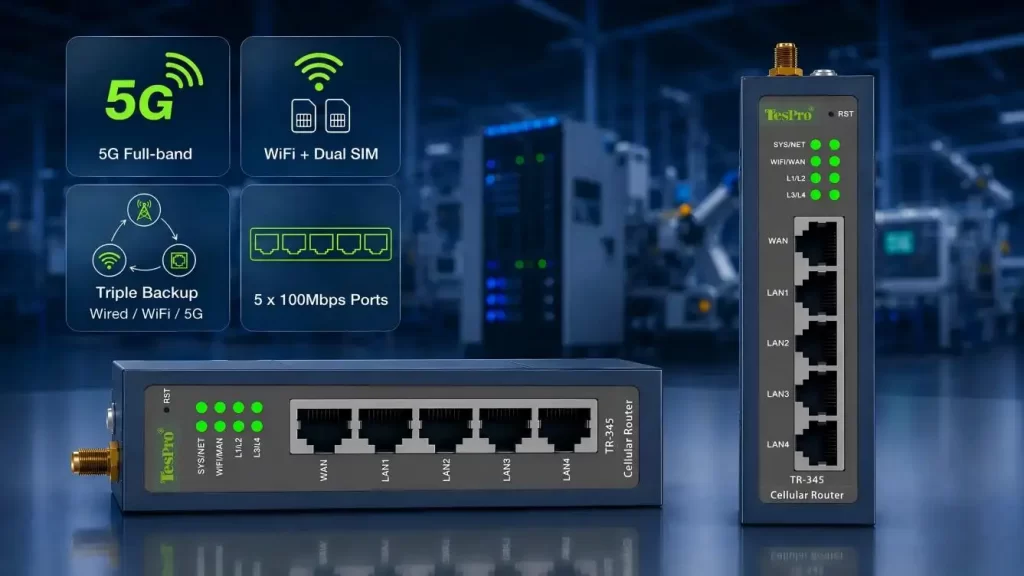
The primary strength of Tespro TR-345 is industrial integration. It provides:
• 4×LAN 1000Mbps Ethernet ports with WAN/LAN adaptation
• Dual-band Wi-Fi connectivity
• RS485 and RS232 interfaces
• Modbus, BACnet, M-Bus, OPC UA, DLMS, and IEC protocol support
• Connectivity for metering, automation, robotics, and remote equipment
These characteristics make the TR-345 fits projects that need high-speed 5G, multiple Gigabit LAN ports, serial interfaces and industrial protocol integration.
Choosing the "Just Right" Architecture
Choose a high-speed 5G industrial router when the installation must:
• Aggregate several local devices
• Transmit high-resolution video
• Support edge computing
• Maintain redundant network paths
• Provide centralized security and remote management
Choose 5G RedCap when individual endpoints require moderate bandwidth, compact hardware, simpler antennas, and lower power consumption while remaining connected to a 5G Standalone network.
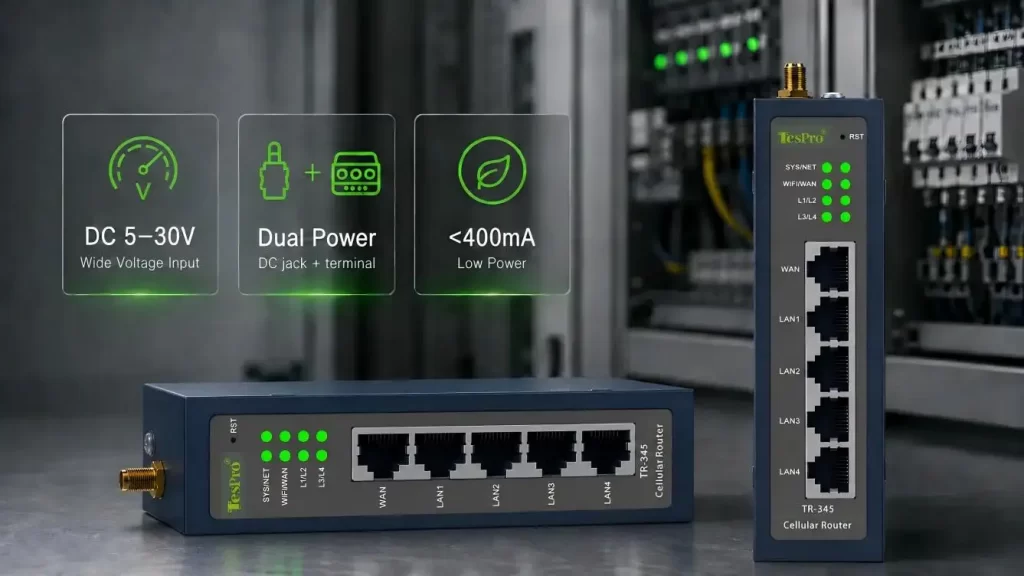
Many industrial networks will ultimately use both. A high-speed 5G industrial router can act as the local aggregation and security hub, while RedCap connects distributed sensors and mobile assets. LTE routers such as the TR-345 (5G router with 4G/LTE fallback, depending on network module and carrier coverage)can continue supporting moderate-bandwidth and legacy sites during the migration to 5G.
Closing Words
A high-speed 5G industrial router delivers the capacity and interface breadth required by demanding applications. 5G RedCap provides a more efficient connectivity option for mid-tier industrial IoT endpoints.
The TR-345 is suitable when 5G connectivity, Gigabit Ethernet, serial interfaces and industrial protocol integration are required It is possible to assign a task to a specific device to aid in avoiding restriction of performance and needless overengineering.
FAQ
Q1. Can 5G devices and RedCap devices co-function?
Yes. They can coexist in the same industrial IoT architecture.
Q2. What's 5G RedCap?
5G RedCap is a tailored version of 5G technology for mid-range IoT use cases.
Q3. Does a 5G industrial router work with legacy devices?
Yes. The Tespro TR-345 has Ethernet, RS485, and RS232 ports for legacy devices.
Q4. When to use a high-speed 5G industrial router?
Use it for video, AGVs, edge computing, and other high-data applications.
Q5. When to prefer RedCap?
RedCap is preferred for sensors, meters, trackers, and other devices with moderate bandwidth requirements.