-1791966549842.webp)





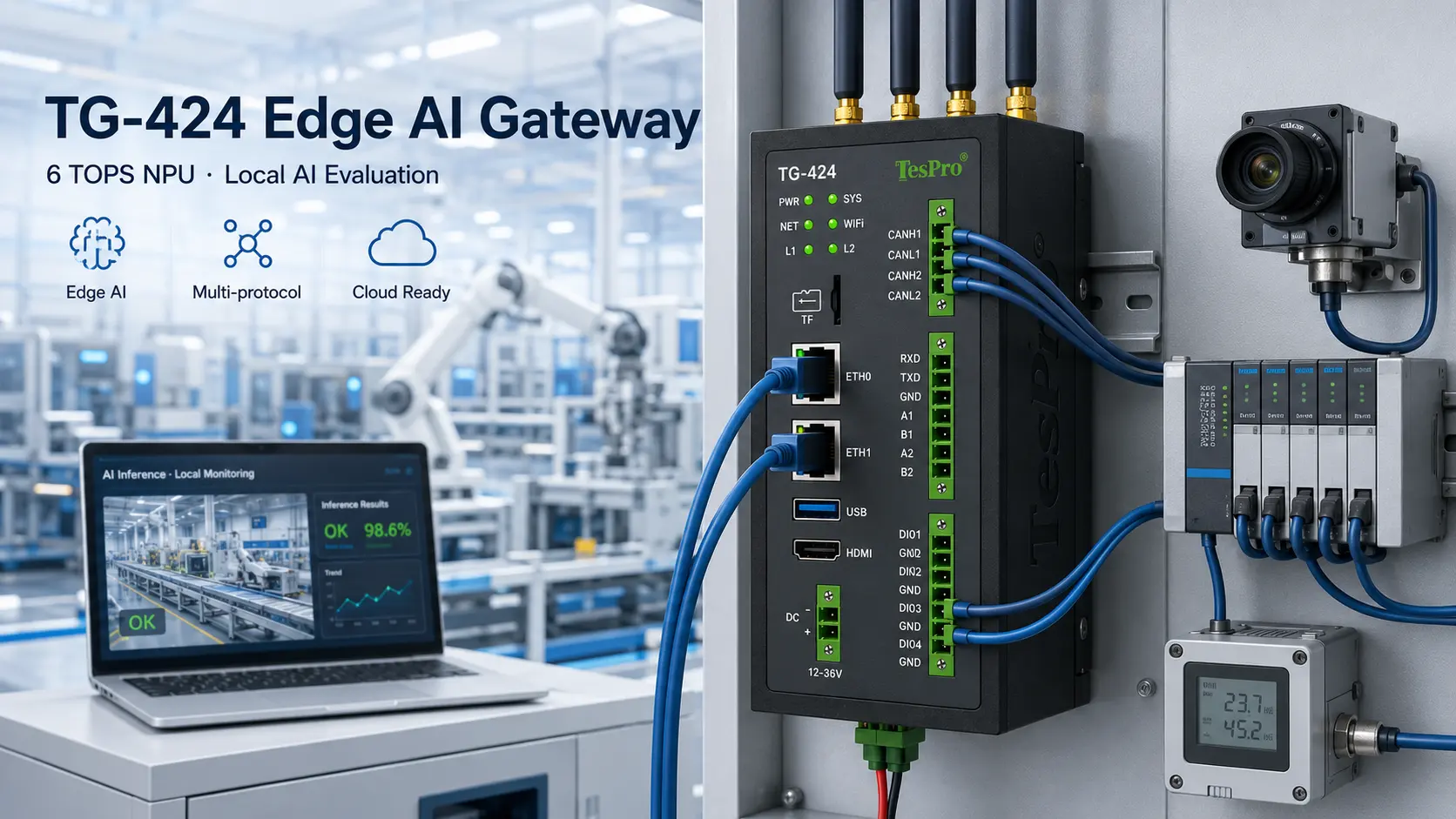

One value of an edge gateway is reducing the number of tasks that depend on continuous cloud connectivity. TG-325 emphasizes built-in compute, local logic and offline operation, while TG-424 adds local collection, protocol parsing, conversion, storage, alarm evaluation and AI inference.
Key Points
- Edge processing can reduce continuous raw-data uploads.
- Offline operation needs buffer size, timestamps and replay strategy.
- Keep edge data logic separate from deterministic PLC/DCS control loops.
Which tasks belong at the edge
Protocol conversion, filtering, aggregation, thresholds, duplicate removal, alarms and short-term buffering are good edge tasks. The cloud can then receive selected results instead of every raw sample.
Offline does not mean “data can never be lost”
Recovery depends on buffering, storage capacity, power-loss retention, timestamps and server-side deduplication. Define the maximum expected outage and stress-test the design.
Keep gateway and PLC responsibilities separate
A gateway is suited to data-layer processing and non-deterministic local logic; PLC/DCS systems still handle hard real-time control, interlocks and deterministic control loops.
Define which data must survive an outage before sizing storage
Not every raw sample needs indefinite retention. Separate data into billing/event records that must be replayed, high-frequency data that can be aggregated, and temporary data used only for local decisions. Then size storage against the maximum expected outage. This avoids solving the problem with an unnecessarily large buffer and a more complex recovery process.
Store-and-forward needs time, order and deduplication—not only “a buffer”
A robust replay design needs reliable timestamps, queue order, power-loss behavior, retry policy and server-side deduplication. When the WAN returns, dumping every queued record immediately can overload the cellular link or platform, so test replay rate and priority between backlog and real-time traffic.
Applications and Technical Boundaries
Where offline edge processing is valuable: Remote energy, water, transportation and industrial sites where WAN outages occur but local acquisition, alarms and critical records cannot stop immediately.
Do not interpret offline capability as “unlimited zero data loss”: Storage, power-loss behavior, buffer policy and application load all have limits. Size and test against the maximum outage and business priority.
Tespro TG uses local processing as a buffer against unstable WAN conditions
Tespro TG gateways place protocol processing, buffering and local logic at the site, reducing dependence on a perfectly stable WAN. During network disruption, selected acquisition and processing can continue locally, and required data can be replayed after recovery according to the application design. This is useful in remote energy, water and transport sites.
Frequently Asked Questions
Q: Can TG-424 continue processing when the WAN is down?
A: The current page explicitly lists local acquisition, protocol parsing, conversion, storage, alarm evaluation and AI inference. Offline duration depends on configuration and storage.
Q: Does TG-325 also provide edge processing?
A: Yes. Tespro describes built-in compute and logical business functions with offline operation and cloud-edge collaboration.
Q: Can an edge gateway replace a PLC?
A: Usually not. Their real-time and control responsibilities are different.
Q: Is cached data always preserved after a power loss?
A: Do not assume so. Persistence depends on write method, storage media and application design. Perform a real power-loss test for the target configuration.