-1791966549842.webp)





A DTU for Edge Computing (Data Transmission Unit for edge computing) intelligently connects field devices and cloud systems. A DTU for Edge Computing provides several advanced features when compared to serial-to-IP converters, such as primitive processing of data at the edge, sophisticated wireless transmission at the source, and the ability to carry out protocol conversion.
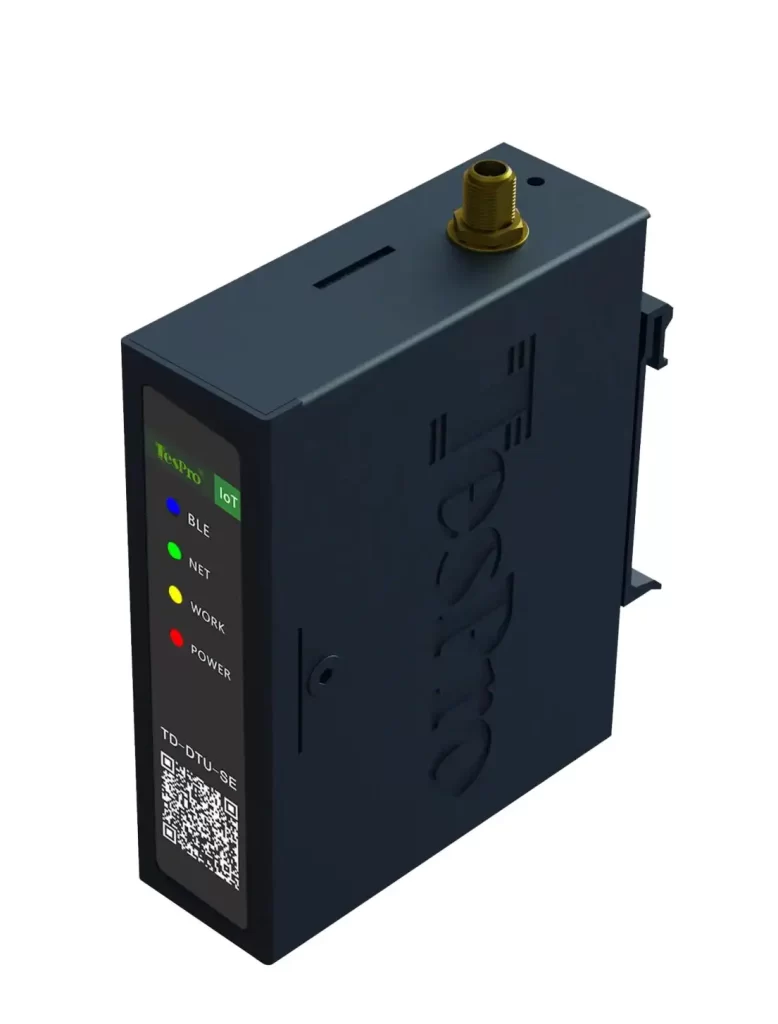
For distributed IoT systems and utility networks, this design alleviates the load in the upstream network, improves data delivery times, and increases the reliability of the network in remote or difficult environments.
1. Fundamental Design of a DTU for Edge Computing
The design of a DTU for Edge Computing incorporates four functional layers of design: computing, communication, interfacing, and a design that is resilient to power interruptions. The Tespro TD-DTU-SE is a clear example of this type of modular design.
Key Hardware Subsystems
| Subsystem | Function in a DTU for Edge Computing |
| Main processor | Processes the entire communication stack and interprets protocols and edge logic rules. |
| Cellular communication module (4G with 2G fallback) | Enables remote deployment across wide-area networks. |
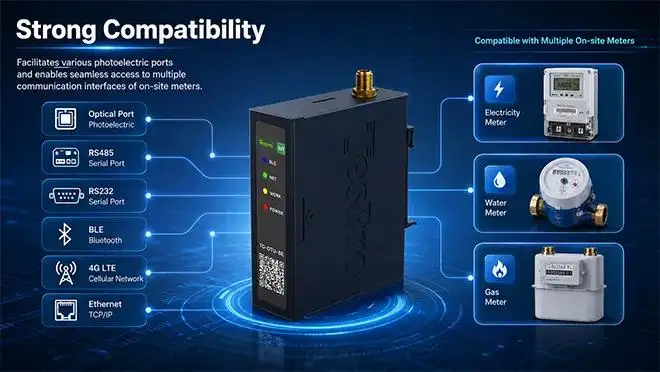
| Industrial serial interfaces (RS232 / RS485) | Facilitates connection to PLCs, energy meters, sensors, and legacy equipment of industrial fabric. |
| GNSS module (optional) | Offers location tagging for mobile assets and field nodes. |
| Power management unit | Handles wide DC input (usually 9–36V DC) and supports an optional backup battery for power continuity. |
| Local wireless interface (Bluetooth) | Allows configuration and diagnostics on-site, as well as maintenance, through mobile devices. |
Engineering Characteristics That Improve Field Reliability
A well-designed DTU for Edge Computing typically incorporates numerous field reliability enhancements:
•Multi-interface concurrency: Presence of both RS232 and RS485 means converters are not needed for mixed device Protocols
•Power continuity design: Extended battery support design means no power means no problems
•Global cellular compatibility: Design provides support for Multi-band LTE (FDD/TDD), WCDMA and GSM/EDGE allows for regional design reusability via swaps
•Industrial-grade protection: Design provides protection of failure due to field stress of wiring through Reverse polarity, surge, overvoltage, and overcurrent protection.
2. Data Flow in a DTU for Edge Computing
To appreciate the utility of a DTU for Edge Computing, we should consider its data flow from edge to cloud.
Stage 1: Data Acquisition at the Edge
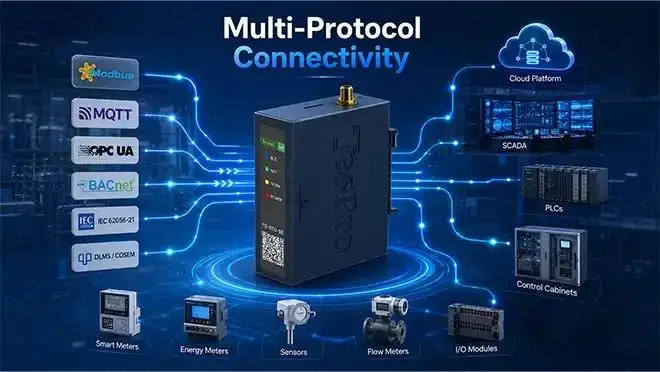
The DTU uses native industrial protocols to poll connected field devices. Proprietary meter protocols may include Modbus RTU, DL/T645, and others.
Typical examples of connected devices are:
•Energy, water, and gas meters
•PLC systems
•Environmental sensors
Many DTUs come with an in-built library of protocols. Thus, integration usually does not require custom firmware.
Stage 2: Edge Processing and Protocol Adaptation
In this stage, raw signals from devices are converted to structured and usable data.
Key functions of edge computing in this context are:
•Protocol normalization
This function standardizes outputs (e.g., JSON or MQTT payloads) of Modbus register maps and other industrial formats.
•Local rule execution
This function implements simple logic (e.g., threshold alarms or anomaly alarms) at the device level and thus reduces the need for cloud resources.
•Data buffering and store-and-forward
This function preserves readings to be sent after the restoration of the network and ensures data is lost due to an interruption in connection.
The edge processing capability is what primarily differentiates a standard DTU from a DTU for Edge Computing.
Stage 3: Secure Wide-Area Transmission
In this stage, structured data is sent via cellular networks.
Common communication modes for this stage are:
•TCP / UDP sockets for direct integration to a receiving server
•Use of MQTT with SSL/TLS for cloud and IoT integration
The use of an embedded MQTT with SSL/TLS capability minimizes the need for external gateways and optimizes the entire system.
Stage 4: Cloud Ingestion and System Integration
When the data arrives at the Cloud or Edge server:
•Data will be standardized and validated
•No need for upstream raw protocol decoding
•The systems' focus can be directed towards analytics and visualization and provisions for data storage for the long term
This will greatly streamline back-end operations and will maximize scalability.
3. What Defines Edge-Enabled DTUs for Edge Computing?
The traditional DTU vs. Edge Computing DTU is a matter of active intelligence at the edge vs. passive transmission at the edge.
The core capabilities that enable edge computing include:
•Support for multiple protocols and utilities (Electricity, Water, Gas, Heat)
•Local logic for making decisions and triggering events as a function of time-sensitive data
•Mobile configuration for ease of deployment and maintenance via Bluetooth
•Data preprocessing performed at the edge before it is sent
These capabilities enable the DTU to be a communication node, and also a distributed edge computing node.
4. Benefits of Industrial IoT Applications
There are unique system-level advantages of using a DTU for Edge Computing in Industrial IoT applications, including:
• Reduced Amount of Data Sent
Because only relevant and organized data will be sent, less cellular data will be consumed.
• Increased System Reliability
Inherently unstable environments do not prevent the system from operating thanks to inherent power and data buffering.
• Lowered System Complexity
Including communication, protocol translation, and edge processing in a single device drastically minimizes the number of system components.
• Improved Flexibility in the Design
Support for multiple frequencies and multiple networks allows the same device to be used in different areas and for different projects.
Closing Words
A DTU for Edge Computing is no longer just a data relay device—it is a distributed edge node that performs protocol conversion, lightweight computation, and reliable wireless transmission at the source of data generation.
By understanding its layered architecture and structured data flow, system designers can optimize where intelligence resides in an IoT system, ultimately improving efficiency, resilience, and scalability in modern industrial and utility networks.
FAQs
Q1: How does a DTU for Edge Computing differ from a traditional DTU?
Edge processing, protocol conversion, and local decision-making capabilities are added.
Q2: What protocols are implemented in a DTU for Edge Computing?
Modbus, MQTT, TCP/UDP, and other Industrial Meter protocols.
Q3: Can a DTU for Edge Computing work without a connection to the cloud?
Yes, it can hold and buffer data locally in the event of a network outage.
Q4: What can connect with a DTU for Edge Computing?
PLCs, energy and water meters, various sensors, and other Industrial Equipment.
Q5: Does a DTU for Edge Computing have the ability to send data in a secure manner?
Yes, it generally supports secure MQTT and SSL/TLS.