-1791966549842.webp)





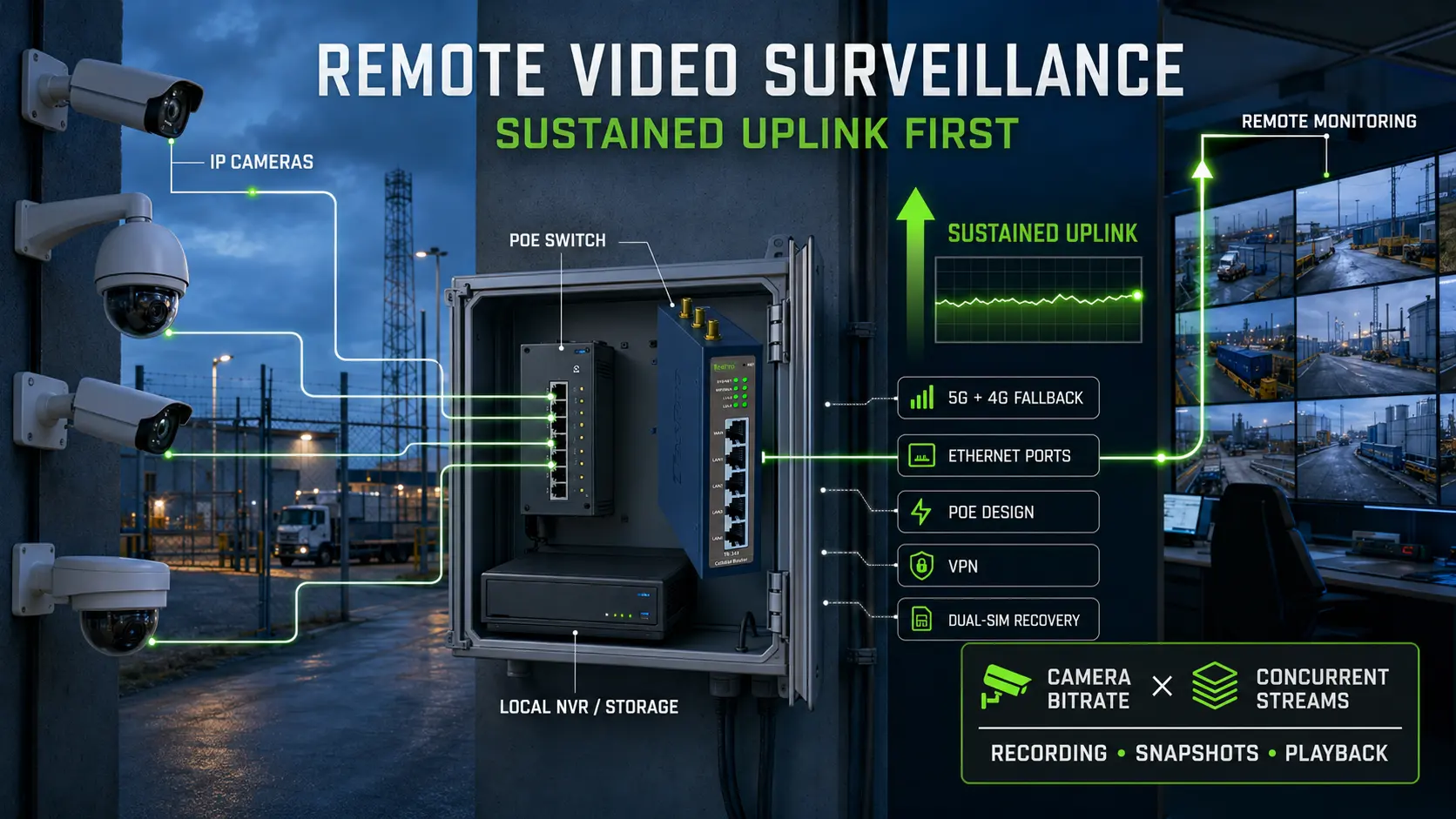

Remote video surveillance depends on sustained uplink capacity, not advertised download speed. Size the link from camera bitrate, concurrent streams, recording policy, snapshots and playback, then verify 5G coverage, 4G fallback, Ethernet ports, PoE design, local storage, VPN and dual-SIM recovery.
Key Takeaways
• Calculate total uplink bitrate before choosing 4G or 5G.
• Edge recording and event-based upload can reduce cellular usage substantially.
• PoE usually requires a separate switch or a model explicitly designed with PoE output.
Include peak demand in the bandwidth estimate
Resolution, frame rate, codec, scene complexity and night-time noise all affect bitrate. Reserve capacity for alarm clips, remote playback and firmware updates in addition to continuous live video.
Traffic control is more than lowering image quality
Useful methods include local NVR storage, motion detection, event upload, multi-stream profiles, playback limits and monthly data alarms. The network and video platform should be designed together.
Test coverage for mobile and temporary sites
Roadside, vehicle, construction and temporary sites experience changing signal conditions. Validate antenna placement, carrier diversity, 5G-to-4G fallback and VPN recovery in the real route or location.
How Tespro Fits
Current Tespro TR Series cellular-router configurations can be evaluated for remote video backhaul. Confirm the exact 4G/5G model, ports, Wi-Fi, dual-SIM and VPN functions from the datasheet. Add a TG Series gateway when the site also needs PLC or sensor acquisition, protocol conversion or edge rules.
Compatibility and Selection Checklist
✓ Camera count, resolution, frame rate and codec
✓ Concurrent live-view and playback streams
✓ Local NVR/storage and event-upload policy
✓ Measured carrier uplink performance
✓ Ethernet, PoE switch and power budget
✓ VPN, dual SIM, data plan and alarms
Frequently Asked Questions
Q: How many cameras can a 4G router support?
A: There is no fixed number. Calculate from actual bitrate per stream, concurrency and measured carrier uplink capacity, then reserve peak headroom.
Q: Can a 5G industrial router power cameras directly?
A: Only if the model explicitly provides PoE output. Otherwise use a PoE switch or separate power supply.
Q: Does dual SIM reduce video data cost?
A: Dual SIM mainly provides carrier redundancy. Cost reduction still depends on encoding, storage, event upload and data-plan design.
Next step: Provide camera bitrate, count, site, carrier coverage, storage and PoE design so Tespro can evaluate an appropriate TR configuration for video backhaul.
Pre-publication check: Verify product statements against the current datasheet, product status, firmware, regional bands, test records and technical confirmation. Do not present optional, customized or general industry capabilities as standard features of every model.